
How to Buy Podcast Ads: A 2026 Playbook
You’ve probably been handed the same brief a lot of marketing directors get: “Test podcast ads this quarter, but make sure we can measure them.”
That sounds simple until core questions start. Which shows matter? Should you buy host-read ads or use programmatic? How much budget is enough to learn something useful? What do you ask for in a media kit? And if your sales cycle is long, how do you prove the channel influenced pipeline instead of just generating vague awareness?
That’s where most podcast buying advice falls apart. It stays high level. It tells you podcasts are growing, then stops before the operational work begins.
Podcast advertising is no longer an experimental side channel. It’s a scaled media category with buying options that range from direct host endorsements to automated audience targeting. In 2024, global podcast ad revenue reached $4.02 billion, with the U.S. accounting for $2.57 billion, and projections point to $5.03 billion by 2027 at a 7.76% CAGR, according to Amazon Ads' podcast advertising guide. If you’re still treating podcasts like a niche test, you’re reading the market too late.
If you need the strategic case first, why brands should advertise on podcasts is a useful primer. What follows is the practical playbook for how to buy podcast ads with the rigor of a real media channel.
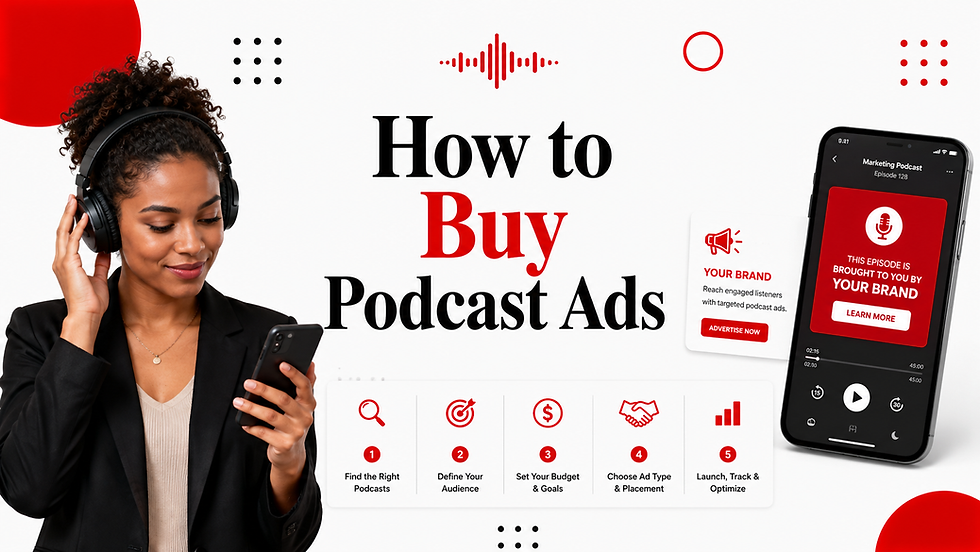
Table of Contents
Host-Read vs Programmatic Ads Choosing Your Inventory - What each format is actually good at - Podcast Ad Format Comparison - The hybrid approach most teams end up using
Planning Your Campaign and Setting a Realistic Budget - Start with the business outcome not the show list - Sample Podcast Ad Campaign Budget Template ($25k) - How to keep a test campaign honest
Executing the Buy A Guide to Negotiation and Outreach - What to ask for before you discuss price - A practical outreach framework - Podcast Ad Buying Checklist
Crafting Ad Creative That Actually Converts - What weak podcast creative sounds like - Script examples you can adapt
Measuring Performance and Optimizing for ROI - What to measure by campaign goal - How to handle B2B attribution without fooling yourself
Frequently Asked Questions About Podcast Ads - What’s a realistic budget to start with? - How long does it take to see results? - Should I buy direct or work through an agency? - What’s the hardest part of podcast measurement? - Are downloads the same as listeners? - What usually hurts performance most?
Why Podcast Advertising Is a Priority in 2026
A B2B marketing director usually comes to us after the same pattern. Paid social is getting more expensive, search is capturing demand rather than creating it, and leadership wants a channel that can build familiarity before a sales rep reaches out. Podcast advertising earns attention in that gap because it can do two jobs in the same campaign. It can make the brand more credible and still give you something measurable to optimize against.
That matters because podcast buying is no longer a side experiment. The channel has enough inventory, enough repeat advertisers, and enough pricing consistency to support disciplined media planning. If you need the business case, this breakdown of why brands should advertise on podcasts gives useful context. The practical point is simpler. Buyers can now test podcasts with the same level of planning they apply to paid search, paid social, or sponsorships.
For B2B teams, the advantage is attention quality. A strong placement reaches someone who chose the show, listens for a sustained stretch, and has an existing level of trust with the host. That creates a better setting for complex offers such as demos, gated reports, category education, or consideration-stage messaging. Podcasts rarely win by producing the cheapest click. They win by making the first touch feel credible enough that the second touch performs better.
I have seen this show up in client programs where branded search lift, direct traffic, and demo conversion rate improved after podcast campaigns launched, even when the podcast line item did not look like the last-click winner in the dashboard. That is the trade-off. Podcast ads often influence demand before they capture it. Teams that expect immediate paid-social style attribution usually underinvest or judge the test too early.
The best podcast campaigns start with audience fit. If the listeners already resemble your buyer, the ad sounds like a recommendation inside a trusted environment, not another interruption.
The channel also exposes bad planning fast. If the show is poorly matched, the host read is generic, or the landing page asks for too much too soon, performance drops quickly and there is nowhere to hide behind cheap CPMs. That is a good thing for serious buyers. It forces cleaner strategy, sharper offers, and better measurement discipline.
That is why this guide is built as an operating manual, not a theory piece. The sections that follow include a budget planning template, script examples by format, and a buying checklist you can use with your team before money goes out the door.
Host-Read vs Programmatic Ads Choosing Your Inventory
The first real decision in how to buy podcast ads is inventory. Most mistakes happen here. Teams either overpay for host-read placements that aren’t audience-aligned, or they overuse programmatic inventory and wonder why the campaign feels forgettable.
The right answer depends on the job the campaign needs to do.

If you want a deeper view into why founder-led and personality-led reads work, this breakdown of host-read podcast ad effectiveness is worth reading alongside your media planning.
What each format is actually good at
Host-read ads are strongest when trust matters. The host interprets your brand in their own voice, often with a personal setup that makes the recommendation feel natural inside the episode. For B2B, that can work especially well on niche business, operations, marketing, fintech, or vertical-industry shows where audience fit is tighter than raw audience size.
Programmatic ads are stronger when you need scale, consistency, and audience targeting across a broader pool of inventory. You control the creative more tightly, buying is faster, and it’s easier to spread budget across multiple shows without negotiating with each publisher one by one.
There’s a trade-off. Host-read tends to feel more trusted. Programmatic tends to be easier to scale and optimize operationally.
Practical rule: If your message requires borrowed trust, start with host-read. If your message is already clear and proven, programmatic can extend it efficiently.
Podcast Ad Format Comparison
Attribute | Host-Read Ads | Programmatic Ads |
|---|---|---|
Authenticity | High. The host delivers the ad in their own voice and can contextualize the offer | Lower. The ad is usually standardized and inserted automatically |
Creative control | Shared with the host. Great reads often improve through collaboration | High. Brand controls final script and audio asset |
Scale | Slower to build because outreach and approvals take time | Faster to launch across many shows and audiences |
Targeting | Best when the show itself is the targeting layer | Best when you want broader audience or inventory-based targeting |
Operational effort | Higher. Each buy often needs direct negotiation and trafficking checks | Lower once setup is complete |
Best use case | Trust-building, founder stories, nuanced offers, category education | Reach, retargeting, consistent creative testing, broader market coverage |
The hybrid approach most teams end up using
The market is already moving toward blended plans. According to AudioGo’s podcast advertising overview, programmatic podcast ad spend grew 45% year over year to $2.1B in 2025, while agencies increasingly build hybrid bundles that combine direct host-read placements with programmatic distribution. That same source notes these bundles can create 30% cost savings via DSPs and 2x the reach through omnichannel campaigns.
That lines up with how experienced buyers structure real campaigns. Use host-read inventory where the host’s credibility carries the message. Use programmatic to widen frequency, support retargeting logic, or keep the campaign live while direct placements roll in on different publishing schedules.
A simple perspective is this:
Choose host-read when your offer needs explanation, credibility, or category trust.
Choose programmatic when you already know the message works and need more coverage.
Choose both when you want trust at the top and efficient repetition underneath.
What doesn’t work is treating the formats as interchangeable. They aren’t. One borrows trust. The other buys distribution.
Planning Your Campaign and Setting a Realistic Budget
Budget problems in podcasting usually start before finance gets involved. They start when the campaign brief is vague. “Let’s test podcast ads” isn’t a plan. It’s an expense waiting to drift.
Start by deciding what the campaign needs to accomplish. If the goal is demand generation, build for measurable actions. If the goal is awareness in a narrow buying committee, build for message retention and qualified traffic quality. The shows, creative, landing page, and reporting setup should all follow that decision.

Start with the business outcome not the show list
A strong plan usually answers five questions before any insertion order is signed:
What counts as success Don’t use generic language like “brand lift” unless your team has agreed on what signals will stand in for it. For B2B, that may be qualified landing page visits, demo requests, or named-account engagement.
Who the listener needs to be Build a listener persona the same way you’d build a paid social audience brief. Job title, company stage, pain point, buying urgency, and content habits matter more than broad demographics.
Which shows match the buying context A show can be popular and still be wrong for you. Relevance beats general prestige. A narrower show with the right audience often creates cleaner downstream behavior than a large show with weak alignment.
What offer belongs in audio Podcast listeners respond better to one clear action than to a menu of options. Pick one page, one CTA, and one message angle.
How reporting will work before launch Set up vanity URLs, UTMs, CRM fields, and post-conversion questions before the first ad runs. Retroactive attribution is where teams lose confidence in the channel.
If your team also coordinates social distribution around the same campaign window, these expert social media campaign management tips are useful for aligning creative, timing, and reporting across channels.
Sample Podcast Ad Campaign Budget Template ($25k)
Line Item | Est. Cost | Notes |
|---|---|---|
Direct host-read placements | TBD | Reserve for a small number of high-fit shows rather than spreading thin |
Programmatic test budget | TBD | Use for broader reach, message repetition, or audience extension |
Creative production | TBD | Includes script development, ad asset recording, and versioning |
Landing page and tracking setup | TBD | Vanity URL, UTM structure, CRM tagging, and form alignment |
Measurement and reporting | TBD | Weekly pacing review and post-campaign readout |
Contingency | TBD | Hold back budget for swaps, makegoods, or scaling what works |
The point of the template isn’t the exact split. It’s discipline. Every campaign needs a line item for creative and measurement, not just media.
How to keep a test campaign honest
A test should answer a narrow question. Can a trust-led host-read open quality traffic from the right audience? Can a standardized message scale across multiple shows? Can a niche category podcast produce leads at acceptable quality?
Don’t judge podcast ads by week one noise. Judge them by whether the campaign was built to generate interpretable data.
One practical option for teams that don’t want to handle outreach, trafficking, and reporting internally is using an agency partner that buys across direct and network inventory. Podmuse is one example. It plans and buys podcast campaigns across host-read, sponsorship, and programmatic inventory through relationships with publishers and ad networks.
Executing the Buy A Guide to Negotiation and Outreach
The buying process gets easier once you stop treating podcasts like a black box. At this stage, your job is straightforward: identify the right contact, verify the audience fit, secure the right ad unit, and protect the campaign with clear terms.

The fastest way to broaden your starting universe is to review curated podcast ad networks in the U.S. and worldwide, then narrow by category fit and buying model.
What to ask for before you discuss price
Direct buys can outperform automated placements when the show and read are right. According to Adopter Media’s podcast advertising guide, direct buys negotiated with podcast creators can deliver 2-3x higher engagement than programmatic spots. The same guide recommends asking for a 60-90 second host-read, an 80% impression guarantee, and targeting a 15-25% discount when you bundle inventory across multiple shows.
Those details matter because they change the quality of the buy, not just the cost.
Ask for these items before you negotiate rate:
Audience and content fit: Who listens, and why do they trust this host?
Ad placement details: Is the unit pre-roll, mid-roll, or post-roll? Is it baked-in or dynamically inserted?
Delivery expectations: What impression guarantee is included, and how are makegoods handled?
Creative rules: Can the host personalize the read, and who approves final language?
Category adjacency: Are there competitive advertisers in the same episode run?
A practical outreach framework
Good outreach is short and specific. Don’t send a broad sponsorship inquiry. Send a campaign brief.
A strong first message usually includes:
Your company and offer
Why that show is a fit
The format you want
Your desired flight window
What you need from the media kit
For example:
We’re planning a campaign for a B2B software brand targeting operations leaders. We’re interested in host-read mid-roll placements because the host’s perspective matters for this offer. Please send your latest media kit, placement options, flight availability, and any impression guarantee terms.
That gets better responses than “What are your rates?”
A useful walkthrough on the buying workflow is below.
Podcast Ad Buying Checklist
Use this before signing any insertion order:
Confirm the audience match: The show should line up with your actual buyer, not just your aspirational brand image.
Verify inventory type: Host-read, announcer-read, and programmatic each behave differently in market.
Lock the ad position: Mid-roll is often preferred when you want the strongest attention environment.
Request delivery protections: Impression guarantees and makegood terms should be explicit.
Review the creative process: Decide who writes first draft, who edits, and who signs off.
Set attribution inputs: Vanity URL, promo code if relevant, UTM naming, and CRM tracking must be ready before launch.
Get reporting cadence in writing: You need to know when delivery and performance data will arrive.
Check cancellation and rescheduling terms: Podcasts move. Release calendars slip. Protect the timeline.
The operational difference between a smooth campaign and a messy one is rarely the ad itself. It’s usually the paperwork and prep.
Crafting Ad Creative That Actually Converts
A B2B marketing director buys strong shows, locks clean placements, and still sees weak response. In my experience, the problem is often the script. Podcast ads fail when the copy sounds like website messaging pushed into an audio slot.
Listeners are cooking, driving, or clearing inboxes. They will not hold three product claims, a category definition, and a soft CTA in working memory. Good podcast creative respects that constraint.
The first job of the ad is simple: make the listener recognize their problem fast.

What weak podcast creative sounds like
Weak creative usually breaks in three places. It takes too long to get to the point. It lists features instead of naming the pain. It ends with a CTA nobody will remember an hour later.
Bad example for a host-read:
“Our platform is a synergistic tool for teams seeking workflow visibility, analytics, and enterprise-grade collaboration. Visit our website to learn more.”
A host cannot do much with that. It gives them no story, no opinion, and no language they would use in a normal conversation.
A stronger host-read starts with a situation the audience already knows:
“If your team is still chasing updates across email, Slack, and spreadsheets, you already know how much time disappears before real work starts. That’s why this tool stood out to me. It gives teams one place to see what’s moving, what’s stuck, and who owns the next step.”
That works because it creates recognition first. Then it introduces the product.
Script examples you can adapt
The format should match the inventory. Host-read ads can carry more nuance because the audience trusts the voice. Programmatic ads need tighter structure because the voice actor has no built-in relationship with the listener.
For host-read ads
Use this structure:
Hook: Name the problem in plain language
Personal frame: Give the host a natural entry point
Value: Explain the main benefit without jargon
Proof cue: Add a concrete use case if available
CTA: Give one memorable action
Example:
“A lot of software promises efficiency. B2B operations teams usually need fewer handoff problems, fewer status meetings, and a clearer view of who owns what. If you manage pipeline or operations, this platform helps keep work visible without turning every update into another meeting. Go to [brand URL] and see the workflow for yourself.”
For programmatic ads
Keep it shorter and more direct. One problem. One outcome. One CTA.
Example:
“Work gets lost between tools. [Brand] helps teams keep projects, approvals, and next steps in one place. Visit [brand URL] to see how it works.”
In most campaigns I review, brands try to fit too much into 30 or 60 seconds. Cutting one claim usually improves recall more than adding another benefit improves persuasion.
A useful rule is this: say less about the company and more about the moment when the product becomes useful.
If your team needs help producing multiple script variants quickly, especially for testing message angles across formats, tools focused on automated ad production can speed up rough drafts. They still need human editing, especially for host-read scripts, but they can shorten the first-pass process.
What internal brand teams usually need is not more copy. They need a working asset set: one host-read script, one programmatic cutdown, two alternate hooks, and a CTA line that can survive a single listen.
Use this final checkpoint before approving creative:
Can the listener identify the problem in the first sentence?
Does the script sound like spoken language, not site copy?
Is there one core benefit instead of a stack of features?
Can the host make it sound natural in their own voice?
Can the CTA be repeated from memory after one listen?
If the answer to any of those is no, revise the script before the campaign goes live.
Measuring Performance and Optimizing for ROI
This is the part that decides whether podcasting becomes a repeatable channel or a one-quarter experiment.
The good news is that podcast ads do have performance benchmarks. According to Triton Digital’s guide to buying podcast ads, podcast ads deliver a 4.9x long-term ROAS, ahead of the broader media average. The same source reports that 95% of weekly U.S. listeners take an action after hearing an ad, with a 0.24% impression-to-visit rate and a 6.2% conversion-to-purchase rate. Those numbers are useful because they prove the channel can drive measurable response, not just awareness.
What to measure by campaign goal
If your campaign is aimed at brand awareness, focus on clean delivery and downstream quality signals:
Reach and impressions
Show-level traffic patterns
Direct and branded search movement
Time on page and engaged sessions from podcast landing pages
Post-campaign survey feedback if you have it
If the campaign is built for direct response, the core metrics shift:
Landing page visits from vanity URLs and UTMs
Form fills or demo requests
Promo code usage where relevant
Lead quality by show and creative variant
Cost per qualified lead or opportunity
The mistake is using one measurement framework for every campaign. Awareness buys and conversion buys need different scorecards.
Attribution for podcasts gets clearer when you stop asking for perfect certainty and start building multiple signals that point in the same direction.
How to handle B2B attribution without fooling yourself
B2B teams struggle more here because audio often influences a buyer before they’re ready to convert on the same device, in the same session, or under the same channel label.
That’s why you need a layered approach.
Use:
Vanity URLs for human memory
UTM-tagged landing pages for traffic analysis
CRM source fields for lead capture
Self-reported attribution questions on forms
Show-level comparisons across creative and audience segments
If someone visits directly later, gets retargeted elsewhere, and converts through branded search, the podcast may still have done the first meaningful work. Your reporting should be able to acknowledge that influence without claiming every conversion.
For optimization, make changes in a sequence, not all at once:
Fix weak audience-show fit.
Tighten the CTA.
Improve landing page continuity.
Shift budget toward placements that produce higher-quality traffic.
Refresh creative only after the first four are examined.
That order matters. Buyers often blame the script when the actual problem is the show.
Frequently Asked Questions About Podcast Ads
What’s a realistic budget to start with?
Use a budget that’s large enough to generate signal, not just activity. A tiny spend spread across too many shows won’t tell you much. A focused test with a clear audience, a small number of placements, and working attribution usually teaches more than a broad but shallow launch.
How long does it take to see results?
You’ll usually see traffic signals first. Revenue or pipeline impact can take longer, especially in B2B. Expect different timelines for awareness campaigns and demand generation campaigns. If the sales cycle is long, evaluate early indicators before judging final outcome.
Should I buy direct or work through an agency?
Direct buying makes sense when you want a specific show and have the time to manage outreach, negotiation, trafficking, and reporting. An agency makes more sense when you need broader access, tighter operations, or a mix of direct and programmatic inventory.
What’s the hardest part of podcast measurement?
Attribution. A 2025 IAB finding summarized by Acast reports that 62% of marketers cite attribution as their top barrier to podcast ad investment. That challenge is sharper in B2B because buying journeys are long and often involve multiple touchpoints before conversion.
Are downloads the same as listeners?
No. They’re related, but they aren’t identical. Treat download counts as one signal, not the entire story. What matters more is whether the buy reaches the right audience and creates meaningful business response.
What usually hurts performance most?
Poor audience fit, weak creative, and sloppy tracking. If those three are wrong, even a premium show won’t save the campaign.
If you’re evaluating how to buy podcast ads for a B2B or consumer campaign and want a practical media plan, Podmuse can help map the right mix of host-read, sponsorship, and programmatic inventory, along with the tracking setup needed to measure results clearly.


Comments