
B2B brand storytelling podcast guide: 3x ROI

Updated: Apr 23
Most B2B brands are producing content that blends into the background. Blog posts go unread, webinars attract low attendance, and social media posts scroll past decision-makers without a second glance. Podcasts offer something genuinely different: a direct, uninterrupted channel to the people who matter most to your business. This guide walks you through why podcasts work for B2B brand storytelling, the frameworks that make episodes compelling, the tools you need, and how to measure results that actually move the needle for your organization.
Table of Contents
Key Takeaways
Point | Details |
Story-driven podcasts boost B2B engagement | Strategic storytelling via podcasts creates deeper emotional connection and business opportunity than traditional B2B content. |
ABT and similar frameworks drive results | Using proven podcast story frameworks ensures messaging stays focused, compelling, and measurable. |
ROI goes beyond downloads | Measure podcast success through lead generation, pipeline influence, and conversion—not audience size alone. |
Right tools and guests matter most | Professional setup and choosing strategic guests significantly increase your potential for business impact. |
Why podcasts are the new frontier for B2B brand storytelling
With the value of standing out established, here’s why podcasts specifically make sense for your brand storytelling strategy.
Podcasts reach the audiences that other formats miss. Decision-makers, senior buyers, and niche industry leaders are listening during commutes, workouts, and travel. They are not always reading your blog or attending your webinars. Podcasts put your brand voice directly in their ears, often for 30 to 60 minutes at a time, which is a level of sustained attention that almost no other content format can match.
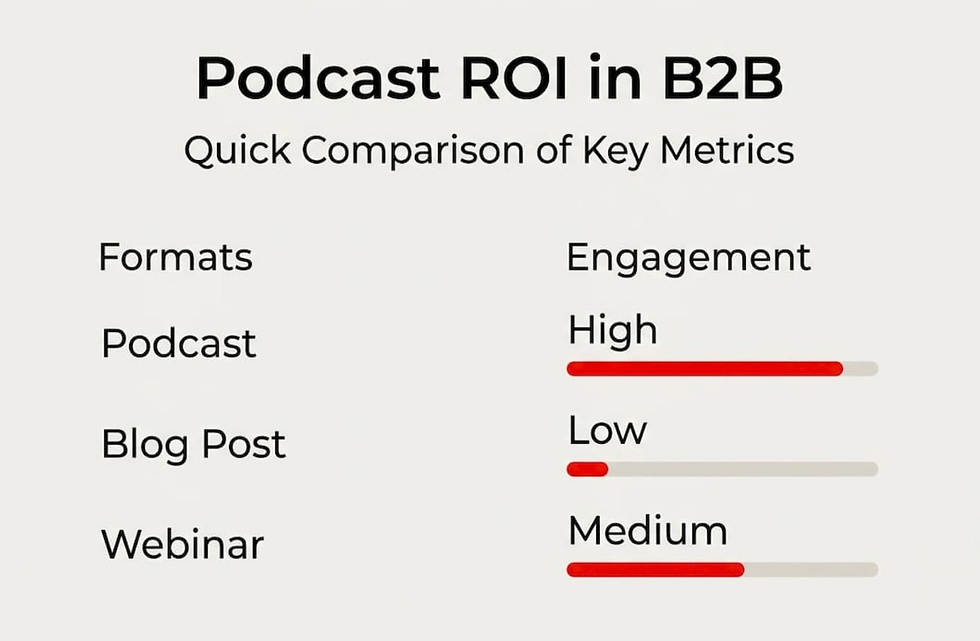
The engagement numbers tell a compelling story. Podcast listeners typically complete 80% or more of an episode, compared to the average blog post read time of under two minutes. That listen-through rate means your message lands more fully and more consistently. When you look at the marketing podcast impact that top-performing B2B shows generate, the pattern is clear: depth of engagement translates into pipeline movement.
Here is how podcasts compare to other common B2B content formats:
Format | Avg. engagement rate | Sales cycle influence | Decision-maker reach |
Blog post | Low (under 2 min read) | Indirect | Moderate |
Webinar | Medium (40-60% drop-off) | Moderate | High |
Podcast | High (80%+ listen-through) | Direct and measurable | Very high |
Social post | Very low (seconds) | Minimal | Variable |
Beyond engagement, podcasts drive podcast business results that show up in your pipeline. Strategic guest selection is one of the most underused levers in B2B podcasting. When you invite a target account’s CMO or a key industry partner onto your show, you create a relationship before a sales conversation ever begins. That dynamic shifts the entire dynamic of outreach.
Key advantages of B2B podcast storytelling include:
Access to niche audiences who self-select based on topic relevance
High listen-through rates that reinforce brand messaging across full episodes
Guest-to-client conversion opportunities built into the production process
Thought leadership positioning that builds trust over multiple episodes
Podcasts also shorten sales cycles by 20-30% for B2B companies that use them strategically. Prospects who have listened to your show arrive at sales conversations already familiar with your perspective, your values, and your expertise. That familiarity reduces friction and accelerates decisions. Exploring social media podcast strategies alongside your show can amplify this effect further by extending your reach across platforms.
Key frameworks for crafting your brand story
Now that you understand podcasts’ impact, it’s time to build your own strategic narrative.
Before you record a single episode, you need clarity on two things: your purpose and your audience. What does your brand stand for, and who specifically are you trying to reach? Answering these questions shapes every creative decision that follows, from episode topics to guest selection to the tone of your host.

The ABT Framework (And, But, Therefore) is a proven methodology for brand storytelling that works especially well in podcast episodes. The structure is simple: establish context (And), introduce tension or challenge (But), and resolve it with your brand’s perspective or solution (Therefore). This three-part arc keeps listeners engaged and makes your episodes feel purposeful rather than meandering.
Here’s how ABT compares to other common storytelling structures:
Framework | Structure | Best for | Podcast fit |
ABT | Context, tension, resolution | Narrative-driven episodes | Excellent |
Hero’s Journey | Challenge, transformation, return | Long-form brand stories | Good |
Problem-Solution | Problem, solution, outcome | Product-focused content | Moderate |
STAR | Situation, task, action, result | Case study episodes | Good |
Forrester’s 5-step storytelling framework covers purpose, audience, narrative, visuals, and delivery, and it maps well to podcast planning. Use it to align your internal team before going public with your show.
Here is a numbered guide to structuring a story-driven episode:
Define the episode’s single core idea before writing anything else
Open with a relatable problem your target audience faces
Apply the ABT arc to build narrative tension and resolution
Bring in a guest or case study to ground the story in real experience
Close with a clear takeaway that listeners can act on immediately
You can find additional podcast storytelling techniques that help B2B brands shape episodes with intention and strategic clarity.
Pro Tip: Rehearse your episode narrative with one or two internal stakeholders before recording. If they can’t summarize the core message in one sentence, the story needs more focus.
Essential tools and preparation steps for podcast success
With your story framework ready, let’s ensure you’re equipped for flawless podcast execution.
Audio quality is not optional in B2B podcasting. Decision-makers who encounter poor audio often associate it with low production standards across the board. The good news is that you don’t need a professional studio to produce a polished show. You do need the right gear and a clear production workflow.
Here is a breakdown of production levels to help you choose the right setup:
Level | Microphone | Software | Hosting | Best for |
Basic | USB dynamic mic (e.g., Blue Yeti) | Audacity (free) | Buzzsprout | Early-stage shows |
Professional | XLR condenser mic + interface | Adobe Audition | Libsyn or Transistor | Established B2B brands |
Outsourced | Agency-managed | Full production suite | Managed distribution | Scaling brands |
Brands that invest in production quality see the difference in audience retention and credibility. In fact, 90% of branded podcast listeners report satisfaction, with an average ROI of 3:1 for B2B shows that follow structured production processes. You can explore podcast launch case studies to see how other brands have approached this investment.
Beyond equipment, preparation matters just as much. Common oversights that derail B2B podcast launches include:
Skipping guest pre-interviews, which leads to unfocused conversations
Failing to align episode topics with current sales or marketing priorities
Ignoring distribution planning until after recording is complete
Underestimating editing time, which delays publishing schedules
Neglecting show notes and transcripts, which reduce SEO value
Guest sourcing deserves its own attention. Build a pipeline of guests the same way your sales team builds a pipeline of prospects. Identify who you want on the show three to four months out, and align each guest with a specific business objective, whether that’s entering a new market, building a partnership, or converting a target account.
Pro Tip: Invest in a quality microphone before anything else. Listeners forgive imperfect editing, but poor audio quality is the single fastest way to lose a B2B audience permanently.
Measuring podcast ROI: Beyond downloads
Equipped and prepared, your focus now shifts to proving and improving podcast impact.
Downloads are easy to track and easy to misread. In B2B podcasting, a show with 500 highly targeted listeners who are all potential buyers outperforms a show with 50,000 casual listeners every time. Your C-suite wants to see revenue impact, not vanity metrics.
The numbers support a business-outcome focus. Guest-to-client conversion rates reach up to 48% for B2B shows with strategic guest selection, and 22% of closed-won deals include a podcast touchpoint in the buyer’s journey. Those are pipeline numbers worth reporting.
“The most successful B2B podcasts are not measured by how many people listened. They are measured by how many deals moved forward because of what those people heard.”
Here is how to set up, track, and analyze business-focused podcast metrics:
Define your business objective first (pipeline, brand awareness, partner development)
Set up UTM tracking on all episode-related links and landing pages
Track listen-through rates per episode to identify your strongest content
Monitor guest-to-opportunity conversion by tagging podcast guests in your CRM
Apply multi-touch attribution to connect podcast touchpoints to closed deals
Report pipeline influence quarterly alongside download data for C-suite alignment
To measure beyond downloads, focus on pipeline influence, lead conversion rates, listen-through rates, and multi-touch attribution. These metrics connect your podcast directly to revenue conversations. You can also track lead generation through podcasting by comparing inbound inquiry rates before and after your show launches.
For podcast-enabled sales teams, share episode links as part of outreach sequences and track which prospects engage with them. That data tells you which topics resonate with buyers and which guests drive the most interest.
Perspective: Why ‘small’ podcasts can deliver big B2B results
Conventional wisdom says you need a large audience to justify a podcast investment. That assumption is wrong for most B2B brands, and the data backs it up.
A B2B podcast with 10 strategic guests who are all target accounts or key industry partners can generate more measurable business value than a consumer show with tens of thousands of passive listeners. The math is straightforward: one guest-to-client conversion from a mid-market account often covers the cost of an entire podcast season.
We’ve seen this pattern repeatedly. Brands that start focused, with a specific niche, a defined guest profile, and a clear business objective, consistently outperform brands that chase broad appeal from day one. Broad appeal is a consumer podcast goal. B2B podcast success is about depth of relationship, not width of reach.
The targeted guest strategies that drive the best results treat every episode as a business development opportunity. Your guest is not just a content contributor. They are a potential client, partner, or referral source who now has a positive, high-value experience with your brand. That shifts the starting point of every future conversation.
For brand managers, the reframe is simple: start focused, not broad. Build the show your ideal buyers want to listen to, not the show you think will get the most downloads.
Level up your brand storytelling podcast
If you’re ready to implement a high-impact B2B podcast strategy, here’s how you can accelerate the journey.
Podmuse works with B2B brands at every stage of the podcast lifecycle, from initial strategy and story framework development to full production, distribution, and ROI reporting. Whether you’re launching your first show or scaling an existing one, the team brings the same end-to-end approach that has delivered results for brands like Intel and PayPal.
Explore how shows like The Marketing Cloudcast and the Purposeful Productivity Podcast have been built for strategic impact. When you’re ready to move from planning to execution, Podmuse’s agency solutions offer the production expertise, guest booking support, and measurement frameworks your brand needs to turn podcasting into a genuine business driver.
Frequently Asked Questions
What is a B2B brand storytelling podcast?
A B2B brand storytelling podcast is a show designed to communicate your company’s expertise, values, and perspective through conversations and narratives that resonate with a professional audience.
How can a podcast deliver 3x ROI for B2B brands?
Podcasts can generate 3x ROI by combining multiple outcomes, including brand awareness, lead generation, content repurposing, and sales enablement, all from a single content channel.
What types of stories work best in B2B podcasts?
The most effective stories focus on real customer challenges, industry insights, case studies, founder journeys, and expert conversations that provide practical value to listeners.
Who should host a B2B podcast?
Typically, founders, executives, or subject matter experts make the best hosts because they bring credibility, industry knowledge, and a strong personal connection to the audience.
How does a podcast support the sales funnel?
A podcast supports the funnel by building awareness at the top, nurturing trust in the middle, and reinforcing credibility during decision-making stages, often influencing high-value deals.
How can podcast content be repurposed?
Each episode can be turned into multiple assets, including short-form videos, social media posts, blog articles, newsletters, and sales materials, maximizing the value of every recording.
How long does it take to see ROI from a podcast?
While early engagement can happen within weeks, meaningful ROI typically develops over a few months as audience growth, content library, and distribution efforts compound.
What metrics should B2B brands track?
Brands should track listener growth, engagement, lead generation, pipeline influence, content performance, and overall contribution to revenue.
Do B2B podcasts need large audiences to be successful?
No, B2B podcasts can deliver strong ROI with smaller, highly targeted audiences, especially when listeners are decision-makers or high-value prospects.
What are common mistakes in B2B podcast storytelling?
Common mistakes include focusing too much on promotion instead of value, lacking a clear narrative, inconsistent publishing, and not aligning content with business objectives.


Comments