
B2B Podcast Strategy: The 2026 Demand Gen Guide
- Laura Slope

- May 7
- 14 min read
The number that should change how you think about a b2b podcast is this: 83% of senior executives listened to a podcast in the past week, and in 2026 the worldwide podcast audience is projected to reach 619.2 million listeners according to Content Allies' B2B podcast statistics. That’s not a fringe media habit. It’s a direct line into the routines of people who approve budgets, evaluate vendors, and shape buying committees.
Many teams still treat podcasting like a side content project. That’s the wrong frame. In B2B, a podcast works best when it’s built as a channel for account access, market education, and pipeline influence. It can support category positioning, create warm reasons to talk to target accounts, and give sales and demand gen teams reusable content that feels more credible than another gated PDF.
The challenge isn’t whether the medium matters. It does. The core question is whether your company will build a show that sounds generic and reports vanity metrics, or a show that earns attention from the exact people you want in your pipeline. If you want the broader strategic context, this look at how podcasts power B2B content marketing strategy is a useful companion.
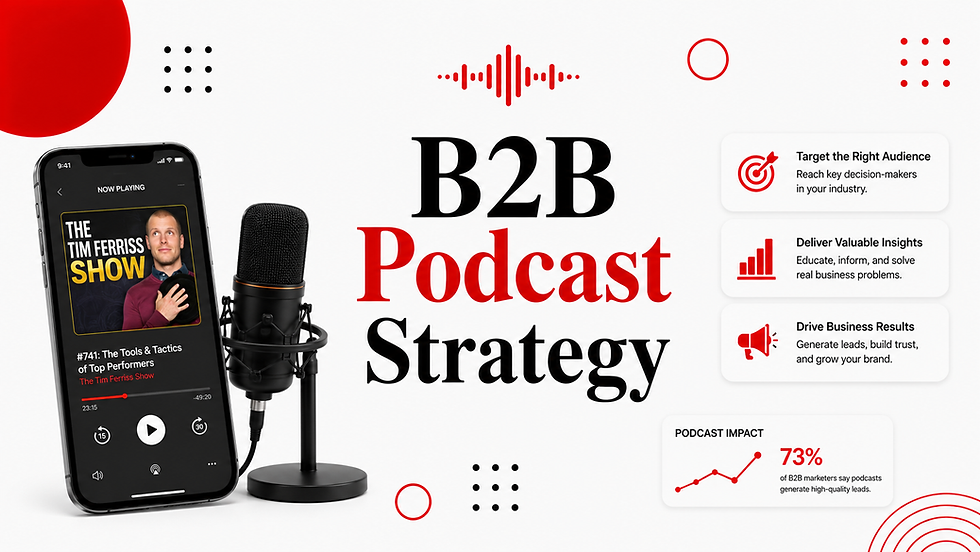
Table of Contents
The Strategic Value of Your B2B Podcast - Your show is a digital boardroom - What podcasts do better than most B2B channels
Designing Your B2B Podcast for Business Impact - Start with the minimum viable audience - Choose a show concept that your market will remember - B2B Podcast Formats and Their Strategic Goals
B2B Podcast Production and Distribution Workflow - The production stack that actually matters - A workable episode workflow - Distribution is part of production
Growing and Monetizing Your B2B Podcast - Audience growth that fits B2B buying reality - How a B2B podcast creates revenue
Measuring True ROI for Your B2B Podcast - Downloads are context, not proof - The metrics that matter to revenue teams - A simple measurement model for B2B teams
Introduction Why B2B Podcasting Is Non-Negotiable in 2026
Podcast listening is already part of executive behavior. Your buyers are not waiting to be taught the format.
For B2B teams, the opportunity is less about reach and more about access to sustained attention. A buyer might ignore a display ad in two seconds and skim a LinkedIn post in ten. The same buyer will spend 25 minutes with a sharp host and a credible guest while driving to the airport or clearing email between meetings. That difference matters because B2B deals rarely move on one touch. They move on repeated exposure to clear thinking.
A good b2b podcast gives your market proof of how your company thinks. It sounds like a VP of Operations pressing a guest on rollout risk, or a CMO asking how a team got sales to use a new message in live calls. Those moments do more than fill a content calendar. They signal judgment. They give target accounts a reason to trust your point of view before they ever speak to sales.
The timing matters too.
Brands that start with a focused premise can still build a show people associate with a specific problem, buying committee, or category debate. Brands that wait often publish a generic interview series, promote it lightly, and wonder why it never affects pipeline. The gap is usually not production quality. It is strategic intent. Teams that treat podcasting as part of demand generation tend to get more from it than teams that treat it as a side project for brand awareness alone. This breakdown of how podcasts support a stronger B2B content marketing strategy is useful because it connects the format to broader marketing execution, not just audience growth.
A weak B2B podcast sounds like a repurposed webinar. A strong one sounds like the conversation your market wishes it could sit in on.
That distinction is where value starts. Strong shows are built to influence pipeline, deepen account engagement, and earn brand authority that sales teams can use. The companies getting results do not judge success by downloads alone. They use the show to open doors with target accounts, create better follow-up for outbound, and stay present across a long buying cycle.
The Strategic Value of Your B2B Podcast
A b2b podcast earns its place in the budget when you stop comparing it to a blog and start comparing it to a room full of your ideal buyers.

Your show is a digital boardroom
The most useful mental model is this. Your show is a digital boardroom.
You invite customers, partners, analysts, operators, and internal experts into structured conversations about the problems your market cares about. Your ideal buyer gets to listen in on those conversations whenever they want. Over time, your brand becomes associated with clarity, access, and seriousness.
That’s very different from demand gen that depends on interruption. The listener chooses to spend time with you. In B2B, that voluntary attention matters because trust usually builds through repeated exposure to good judgment, not one brilliant campaign.
This also explains why many branded shows fail. They mistake distribution for strategy. They publish interviews, but the guest list is random, the topics are broad, and the conversation never sharpens a point of view. The result is respectable production with very little commercial value.
What podcasts do better than most B2B channels
A good b2b podcast does three things unusually well.
Builds authority through voice: Written thought leadership can sound polished. Audio lets buyers hear how your team thinks in real time. That difference is bigger than most brands realize.
Creates warm access to accounts: An interview invitation is often a better opening than a cold outbound message. It gives your team a legitimate reason to start a relationship with someone important.
Produces reusable sales and marketing assets: One conversation can feed LinkedIn clips, sales follow-up, newsletters, internal enablement, and event content.
The trade-off is that podcasting is slow to fake and hard to outsource badly. You can’t hide weak positioning behind editing. If the host asks shallow questions or the brand has no clear view of the market, listeners notice.
Practical rule: If an episode could be published by five competitors without changing anything except the logo, the strategy is too generic.
There’s another strategic advantage that often gets missed. Podcasting helps unify teams. Marketing gets a content engine. Sales gets relationship openings. Executives get a platform for market perspective. Customer success gets material that reinforces customer education. When the show is planned well, it becomes one of the few channels that multiple functions can use.
That’s why the best programs don’t chase “thought leadership” as an abstract goal. They use the show to own a conversation that matters to a narrow, valuable audience.
Designing Your B2B Podcast for Business Impact
Before you buy microphones or book guests, decide what kind of business asset you’re building. Most podcast problems start in strategy, not production.
Start with the minimum viable audience
Don’t define your audience as “CMOs,” “IT leaders,” or “SaaS founders.” That’s still too broad. A strong b2b podcast starts with a minimum viable audience, which means the smallest group of people worth building the show for.
That audience should map tightly to your ideal customer profile. Think in terms of role, company context, buying pressure, and current priorities. A VP of Marketing at a mature SaaS company has different concerns than a marketing leader at an early-stage services firm. If you try to serve both, your show will blur.
Use these questions to tighten the audience:
Who do we want in future pipeline? Be specific about job function and level.
What problems do they actively talk about with peers? Not what you sell. What they need help thinking through.
What would make them come back next week? Utility beats broad inspiration in B2B.
A narrow audience makes topic selection easier. It also improves guest targeting, messaging, and distribution because the team knows exactly who each episode should help.
Choose a show concept that your market will remember
The best concept is not “interviewing leaders in our space.” That’s a format, not a concept.
A concept needs tension and shape. Maybe your show examines failed implementations and what teams learned. Maybe it decodes how buyers make large purchasing decisions. Maybe it focuses on one function inside a niche vertical. Buyers remember shows that help them think, not shows that merely publish.
A few concept tests work well in practice:
Can someone explain the show in one sentence?
Would the same guest say different things on this show than on every other one?
Does the show naturally connect to our commercial strengths without turning into a pitch?
If the answer to those questions is no, refine the concept before launch.
A focused show with a modest audience is usually more valuable than a broad show with scattered listeners.
B2B Podcast Formats and Their Strategic Goals
Format matters because it determines workload, host demands, and what the show can realistically accomplish.
Format | Best For | Resource Level | Primary Goal |
|---|---|---|---|
Expert interview | Guest relationships, market credibility, account access | Moderate | Lead generation and authority |
Solo commentary | Strong point of view, fast publishing cadence, executive voice | Low to moderate | Brand positioning |
Narrative or documentary | Category education, complex stories, flagship brand content | High | Brand awareness and differentiation |
Panel discussion | Community building, multi-perspective analysis, event tie-ins | Moderate to high | Partner development and audience engagement |
A few trade-offs are worth stating plainly.
Expert interview is the most common format because it’s flexible and commercially useful. It works especially well when the guest list aligns with target accounts, partners, or customers. The risk is sameness. Weak hosts turn interviews into polite Q&A with no edge.
Solo commentary can work surprisingly well for founders or subject-matter experts with a strong point of view. It gives you speed and control. The downside is that a vague thinker becomes very exposed very quickly.
Narrative or documentary has real branding power, but it demands strong editorial instincts, extra production time, and a willingness to script. Most B2B teams underestimate the lift.
Panel discussion is useful when your market values comparison and debate. It can also tie neatly to events, communities, or customer roundtables. The risk is clutter. Too many voices and not enough moderation can flatten the episode.
When teams ask which format is “best,” the better question is which format fits the operating reality of the business. A show you can produce consistently beats an ambitious format you abandon after a handful of episodes.
B2B Podcast Production and Distribution Workflow
Podcast production doesn’t need to be complicated. It does need to be consistent. In B2B, professionalism matters because poor audio, awkward pacing, and sloppy publishing signal the same thing buyers fear from vendors: operational looseness.

The production stack that actually matters
You do not need a studio packed with gear. You do need dependable tools.
According to Casted’s guidance on equipment for B2B podcasts, technical setups with dynamic microphones and integrated platforms like Riverside.fm can reduce background noise by up to 50% and cut post-production time by 60-70% via AI workflows. This is essential for achieving the 67% average audience retention rate seen in high-performing B2B shows. That’s the practical reason experienced teams favor dynamic mics and stable remote recording platforms. Better sound preserves attention. Faster editing protects cadence.
A sensible stack often looks like this:
Dynamic microphone: Audio-Technica ATR2100x or Shure MV7 are common picks because they handle untreated rooms better than sensitive condenser mics.
Remote recording platform: Riverside.fm is widely used because it records separate local tracks and simplifies guest sessions.
Headphones: Closed-back headphones make it easier to catch echo or level problems before the recording ends.
Editing workflow: Descript or similar transcript-based editors help non-audio teams move faster.
AI support tools: If your team is evaluating automation for editing, clipping, transcription, or repurposing, this roundup of top AI podcasting tools is a practical starting point.
If you want hands-on support rather than building every step internally, a service option like Podmuse’s podcast distribution strategy support can sit alongside tools such as Riverside and Descript. The main point is operational clarity. Someone needs to own the workflow.
A workable episode workflow
The easiest way to lose momentum is to reinvent the process each week. Use a repeatable system.
Brief the episode Start with the business reason for the conversation. Why this guest, why this topic, and what should the listener understand by the end?
Prepare a real run of show Don’t script every sentence. Do structure the arc. Strong hosts know where they want to open, where to probe, and which rabbit holes to avoid.
Record for clarity, not perfection Ask shorter questions. Stop guests who drift. Reframe when needed. A clean recording always beats “we’ll fix it in post.”
Edit for pace Remove throat-clearing, repeated phrases, and long setup that delays value. B2B listeners are patient when the material is strong, not when it’s padded.
Package the episode Title, show notes, transcript, clips, episode art, and links should be part of the same production checklist.
Bad production usually isn’t about equipment. It’s about weak preparation and no editorial discipline.
Distribution is part of production
Publishing the RSS feed is the minimum. Distribution starts earlier.
Your show should be available on Apple Podcasts, Spotify, and YouTube. For many B2B brands, YouTube matters because buyers search there for topics, people, and conference-style discussions. Video also gives the team stronger assets for LinkedIn and email.
A useful distribution checklist includes:
Platform publishing: Apple Podcasts, Spotify, YouTube
Owned channels: Newsletter, website, sales follow-up, customer email
Social assets: Short clips, quote graphics, and topic-led posts
Internal use: Sales enablement, recruiter outreach, executive sharing
Teams that treat distribution as a separate afterthought usually publish episodes that no one beyond existing followers sees. Teams that build distribution into the production workflow create more value from the same recording session.
Growing and Monetizing Your B2B Podcast
Growth and monetization work best when they’re connected. If audience strategy is disconnected from commercial strategy, the show may get attention but still struggle to justify investment.

Audience growth that fits B2B buying reality
A b2b podcast rarely grows the same way a consumer show does. You usually don’t need mass reach. You need the right listeners and repeated exposure in the places they already pay attention.
The fastest early growth usually comes from four channels.
Guest amplification: Give guests short clips, quote cards, and suggested copy they’ll want to share.
LinkedIn distribution: Native video clips and text posts built around one insight often outperform generic “new episode” announcements.
Email reuse: Feature a sharp takeaway in your newsletter, then let the full episode carry the detail.
Sales-led sharing: Reps can send a relevant episode to prospects when it helps a conversation.
One underused tactic is audio extraction from video assets. If you’ve recorded webinars, virtual panels, or executive conversations and want to test whether they can become audio-first content, a simple utility like the vitelnk tool for video to MP3 can help teams create rough audio working files for review before they invest in a full repackaging workflow.
Growth also improves when the show has a recognizable editorial style. Buyers come back for consistency. They want to know what kind of perspective they’ll get, how deep the discussion will go, and whether the host will ask the questions they care about.
How a B2B podcast creates revenue
The direct path is sponsorship, host-read ads, or broader ad inventory. That can matter, especially as brands mature their media strategy. But for most B2B companies, the bigger opportunity is indirect monetization.
That means the podcast helps create revenue by improving access, trust, and conversion conditions around deals already relevant to the business. A few common paths look like this:
Guest-to-pipeline motion: The guest conversation opens a relationship that later develops commercially.
Sales acceleration: Prospects listen before or during active evaluation and enter calls with more context and confidence.
ABM support: Episodes are shared intentionally with named accounts because the topic aligns with their priorities.
Authority lift: The show makes the brand easier to trust in crowded markets where multiple vendors look similar on paper.
A dedicated monetization plan matters. If you need a reference point for the business models available, this guide on how to monetize a podcast breaks out the main routes.
Later in the funnel, video can deepen that value because teams can reuse it across channels and internal workflows.
What doesn’t work is bolting revenue expectations onto a show with no buyer alignment. If the guest roster is vanity-driven, the topics don’t map to real business problems, and the team has no follow-up process, monetization will feel random. Commercial outcomes come from design, not hope.
Measuring True ROI for Your B2B Podcast
A B2B podcast can influence revenue long before it produces obvious attribution in a dashboard. That is why weak measurement leads good shows to get undervalued. If the reporting stops at downloads, leadership sees a media line item. If the reporting shows account engagement, sales usage, and pipeline touchpoints, the show starts to earn a place in the demand generation budget.

Downloads are context, not proof
Downloads help answer one narrow question: did anyone consume the episode? Revenue teams need a different answer. They need to know whether the show reached the right accounts, created useful sales conversations, or improved deal progression.
Analysts at Be Omniscient’s B2B podcasting statistics found that strong B2B shows are judged by pipeline impact, guest conversion, and influence on enterprise deals, not by raw audience volume alone. That aligns with what mature teams see in practice. A niche show with 300 listeners from the right accounts can outperform a broad show with 3,000 anonymous listeners.
The reporting question should be simple. Which buying committees engaged, and what changed after they engaged?
The metrics that matter to revenue teams
Useful podcast measurement sits across three systems: podcast analytics, CRM, and sales feedback. If one of those is missing, the ROI story usually collapses into guesswork.
Track metrics such as these:
Firmographic fit: Which companies, industries, and seniority levels are listening?
Guest progression: Which guests turned into meetings, introductions, or open opportunities?
Listener behavior: Where do high-value listeners drop off, and which episodes hold attention?
Topic influence: Which episode themes show up later in sales calls, email replies, or content requests?
Pipeline association: Which opportunities had a podcast touchpoint during research, evaluation, or consensus building?
That last point matters more than many teams expect. B2B buying is rarely linear. A podcast often works as mid-funnel proof. It gives a champion language to explain your category, gives stakeholders confidence in your team’s expertise, and gives sales a relevant asset to send without sounding promotional.
Content Allies makes that operational gap clear in its discussion of B2B podcasting trends, pointing to the need for B2B-specific analytics such as company-level listener data, role and seniority visibility, drop-off reporting, and CRM integration. Generic media reporting does not go far enough for a team trying to defend spend in pipeline reviews.
A simple measurement model for B2B teams
Use a three-layer model and keep it disciplined.
Measurement layer | What to track | Why it matters |
|---|---|---|
Audience quality | Firmographic fit, repeat listeners, high-value accounts | Confirms the show is reaching the market you actually sell to |
Relationship outcomes | Guest follow-ups, introductions, second meetings | Shows whether the show creates access and trust with the right people |
Revenue influence | Opportunities with podcast touchpoints, deal acceleration, closed-won notes | Connects podcast activity to pipeline and revenue |
A simple example shows how this works. A guest from a target account joins the show. The account is tagged in CRM, the AE logs the episode in the opportunity record, and marketing notes that two stakeholders from the same company watched clips from that conversation. Six months later, the deal closes. The podcast should not get full credit for the win, but it should get documented credit for pipeline influence and account engagement.
That level of measurement is usually enough to make budget conversations easier.
A few operating habits make the model stick:
Create a podcast source field in CRM: Give sales, partnerships, and customer success a clear way to log influence.
Use self-reported attribution: Add the show as an option on forms and ask about it on discovery calls.
Tag guest types: Separate prospects, customers, partners, recruits, and strategic targets.
Review performance by topic: Revenue impact usually clusters around a few repeat themes, not across every episode equally.
Include podcast touches in deal reviews: Influence becomes visible to leadership.
The trade-off is straightforward. Clean measurement takes more coordination between marketing and sales, and it will never look as tidy as last-click attribution. But it reflects how B2B buying takes place. That makes it more credible, not less.
Teams that report podcast ROI well do one thing consistently. They treat the show as part of the demand engine, then measure it by account penetration, relationship progress, and pipeline movement. That is how a B2B podcast earns long-term support.
Conclusion Your B2B Podcast Playbook Starts Here
A strong b2b podcast is not a side project for the marketing team to keep busy. It is a business asset built on four disciplines.
First, intentional strategy. Define the audience tightly, choose a concept with a real point of view, and match the format to the outcome you need. Second, professional production. Buyers don’t expect a broadcast studio, but they do expect clarity, structure, and consistency. Third, strategic promotion. Distribution has to be designed into the show, not added after publish day. Fourth, business-focused measurement. If the dashboard can’t connect to relationships, accounts, and pipeline, it won’t survive budget scrutiny.
Those four pieces reinforce each other. A focused strategy improves guest quality. Better guests improve content and reach. Better distribution improves account penetration. Better measurement shows which topics and conversations are worth repeating. That’s how the show compounds.
The teams that get the most from podcasting treat it like a long-term operating system for trust. They don’t publish random episodes and hope the market notices. They use the show to create better conversations with the people they want to work with, then they build internal processes around those conversations.
That’s the playbook. Not more content for the sake of content. Better access, better signal, better follow-through, and clearer proof that the channel contributes to revenue.
If you want help building that kind of podcast system, Podmuse works with brands on strategy, production, distribution, audience growth, and podcast advertising so the show can function as a measurable part of demand generation rather than another isolated content stream.


Comments