
Founder Led Podcast Strategy for 2026

Your founder keeps getting the same nudge in planning meetings. Start a show. Clip it for LinkedIn. Put it on YouTube. Meanwhile, the brand already posts occasional interviews, nobody owns the calendar, and nobody can explain what the show should change for buyers. That's the normal starting point, and it's also where most founder shows stall. A founder led podcast isn't a microphone purchase or a content side project. It's a decision about who carries the company's expertise in public, in what format, and how you'll know the effort moved anyone closer to a conversation.
Table of Contents
Choose Audio Video or Both - When Each Row Is the Wrong Choice
Trust the Founder Earns With Buyers - The Audience Is Already Listening
Episodes Built Around Buyer Problems - Two Episodes, Same System
Show Patterns for B2B and Consumer Brands - How Each Pattern Plays Out
Production Promotion and the Founder Voice - Controls That Keep Delivery Human
Why a Founder Led Podcast Matters Now
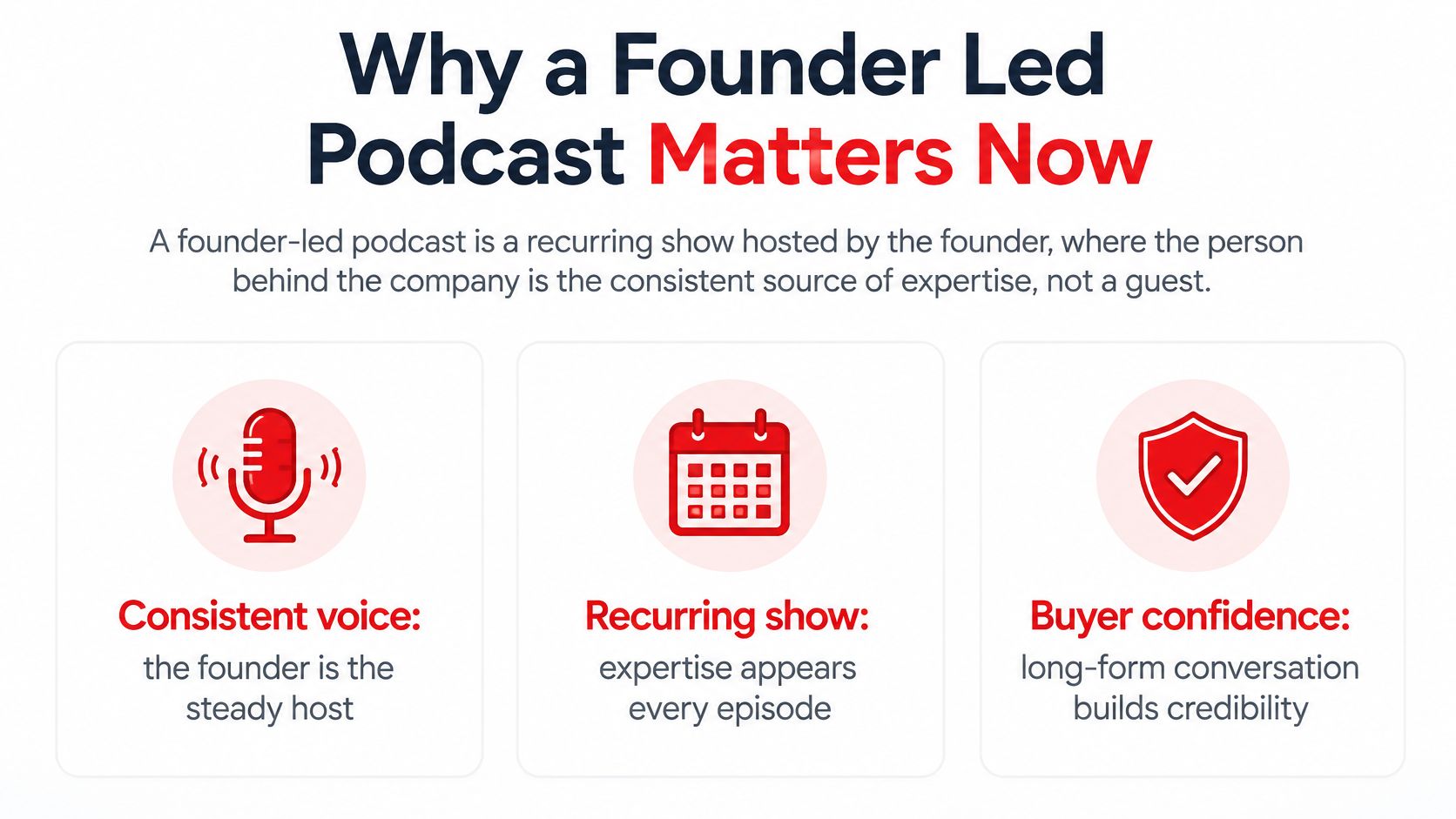
A founder-led podcast is a recurring show hosted by the founder, where the person behind the company is the consistent source of expertise, not a guest who appears once. Say a software founder hosts every episode and works through pricing, rollout, and buying decisions with peers. Over a season, prospects don't just hear claims. They hear how that person reasons.
That consistency now meets a large audience. Edison Research's 2025 U.S. podcast consumer report shows 73% of Americans aged 12 and older, approximately 210 million people, had consumed a podcast in audio or video form, while 55% were monthly podcast consumers and 40% listened weekly. Since 2015, total weekly time spent with podcasts among Americans aged 13 and older increased 355%, reaching 773 million hours per week.
Video explains much of that scale. 51% of Americans aged 12 and older had ever watched a video podcast, 37% had watched one within the past month, and 26% had watched one within the past week. Among weekly podcast consumers, 88% agreed that hearing advertising is a fair exchange for free content, so a commercial purpose doesn't automatically repel listeners.
Measure | Figure |
|---|---|
Americans 12+ who consumed a podcast in audio or video | 73% (about 210 million) |
Monthly podcast consumers | 55% |
Weekly podcast consumers | 40% |
Weekly time with podcasts since 2015 | Up 355% to 773 million hours |
Ever watched a video podcast | 51% |
Watched a video podcast in the past month | 37% |
Watched a video podcast in the past week | 26% |
Weekly consumers who call ads a fair exchange | 88% |
One conversation can now live as audio, a YouTube episode, short clips, and social posts. That's why the format choice matters before anyone books a studio.
Choose Audio Video or Both
Start with the decision table, not the gear list. Your primary objective should pick the format.
Format | Best objective | Primary home | What it protects | Skip it when |
|---|---|---|---|---|
Audio-first | Thought leadership and customer trust on the go | Spotify, Apple Podcasts, RSS | Intimate voice and a lighter setup | Growth depends on YouTube search or the topic needs to be seen |
Video-first | Demand generation, recruiting, searchable expertise | YouTube | Face, thumbnails, and clip-ready arguments | The audience mostly listens during commutes or the topic has low visual value |
Dual-format | Trust plus discovery across apps and social | YouTube plus podcast apps, with LinkedIn and short-form clips | One interview reused as several entry points | The team cannot sustain guest booking, lighting, and edit cadence |
When Each Row Is the Wrong Choice
Audio-first protects intimacy. A founder can record a tight conversation without a set, and listeners can follow during a commute, a run, or school pickup. It's the wrong choice when buyers search for the problem by name and expect to find a person explaining it on video. You'll have good episodes that new buyers never discover.
Video-first treats the show as a searchable video interview franchise. The founder's face, the episode title, and the thumbnail all answer a question someone typed. Barrett Media's report on the 2025 Infinite Dial survey notes 51% of people have watched a podcast in video form, YouTube is the primary podcast platform for 33% of respondents versus 26% for Spotify and 14% for Apple Podcasts, and 28% of Gen Z podcast discoverers find shows primarily through YouTube search. That's a discovery argument, not a production vanity argument.
Dual-format is the default when trust and discovery both matter. You record once, publish the full episode to YouTube and podcast apps, then cut clips for LinkedIn and short-form video. Don't pretend that filming an audio episode equals a video system. A video-native episode plans the clip moments in advance, states the buyer problem in the title, and keeps the founder conversational even inside a polished frame.
Practical rule: If nobody can name the search, clip, or listening moment the format serves, you don't have a format yet. You have recording equipment.
Video is wasteful in clear cases. Skip full video when your audience listens while driving, when the subject is abstract and nothing gains from being seen, or when lighting and editing will delay every release. In those cases, strong audio plus a written summary beats a beautiful episode that ships late.
I'd lock one primary objective before anyone debates cameras. Thought leadership, demand generation, recruiting, and customer trust point to different homes and different titles. Once you split episodes across channels, you'll also need a clean way to measure attribution across marketing channels so YouTube views, podcast listens, and site visits don't get credited as if they were separate campaigns.
Trust the Founder Earns With Buyers
The image below shows the mechanic at its simplest, two people in a real conversation rather than a founder reading brand copy.
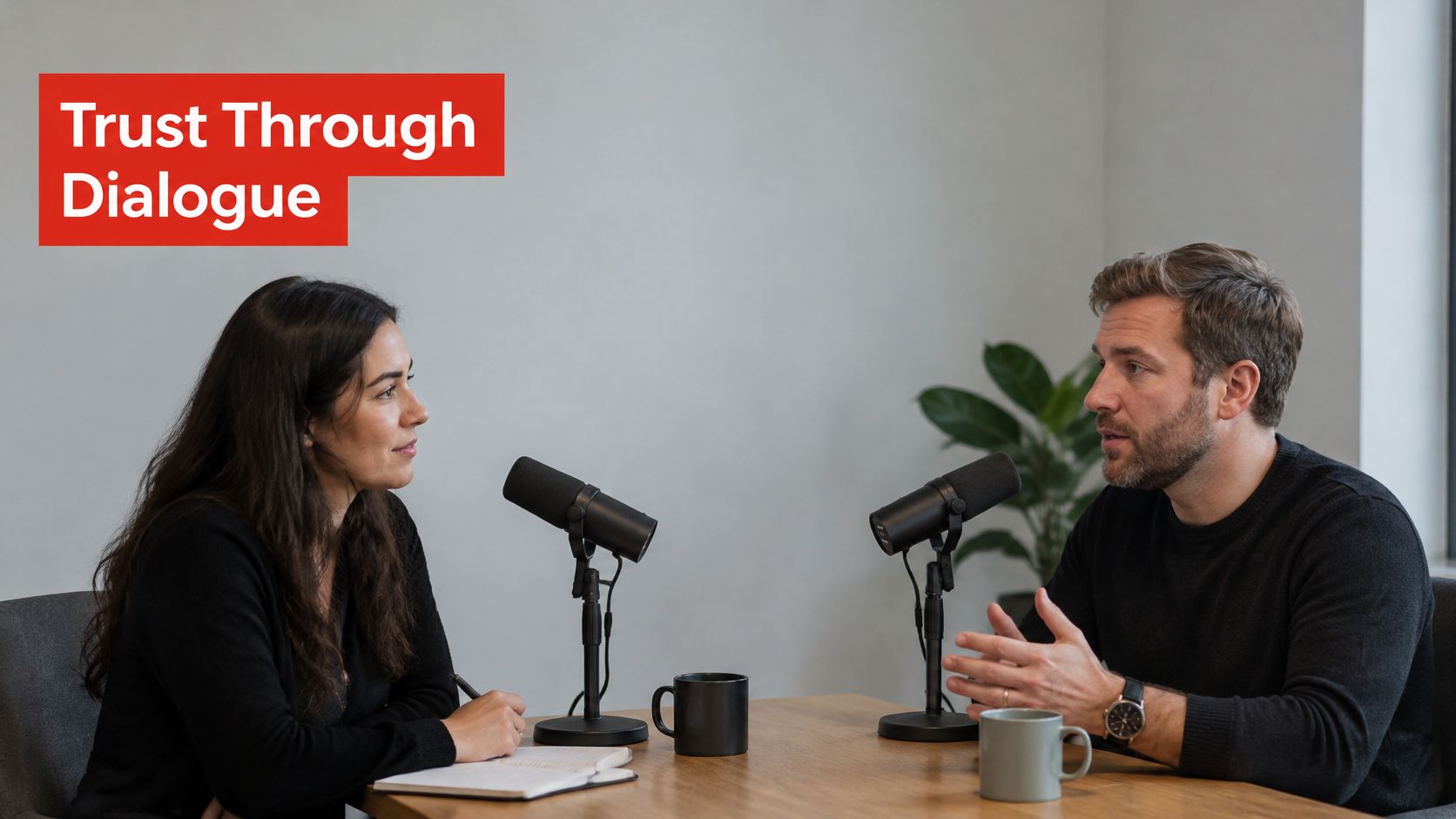
A founder led podcast works as a trust-transfer channel. The same person shows up episode after episode, and long-form talk lets a prospect judge reasoning, priorities, and honesty instead of a slogan on a landing page. Deloitte's podcast advertising research reports 75% of podcast listeners trust the hosts they follow, and nearly 40% say podcast advertising influences them more than advertising in other media, rising to approximately 50% among Gen Z and millennials.
That trust only transfers when the founder acts like a domain expert. In B2B, the episode should tackle a high-cost decision and name the trade-off, the assumption, and the limit of the advice. In consumer and DTC categories, the same work happens through the story behind the product and the person who made the call. Buyers learn who stands behind the brand when a formula changes, a price rises, or a collection gets cut.
The Audience Is Already Listening
You aren't asking senior buyers to adopt a new habit. Radio Ink's report on Signal Hill Insights research found that in 2024, 83% of senior executives in the United States listened to podcasts weekly. A B2B founder show can reach decision makers inside a medium they already use, provided the conversation respects their time.
Watch how much of that trust comes from listening well, not talking more, in the conversation below.
Host trust is a mechanism, not a guarantee. Overly scripted promotion and unsupported claims weaken it fast. Customer lessons, stated limitations, and honest follow-up questions strengthen it, which is why the habits behind active listening for stronger customer relationships matter in the interview chair as much as in a sales call.
People trust a recurring human source more than a rotating brand voice.
Trust gives you permission to be heard. Episode design decides whether you keep it.
Episodes Built Around Buyer Problems
A topic brainstorm produces episodes your team wants to publish. A buyer-problem system produces episodes your market wants to finish. Build it in this order.
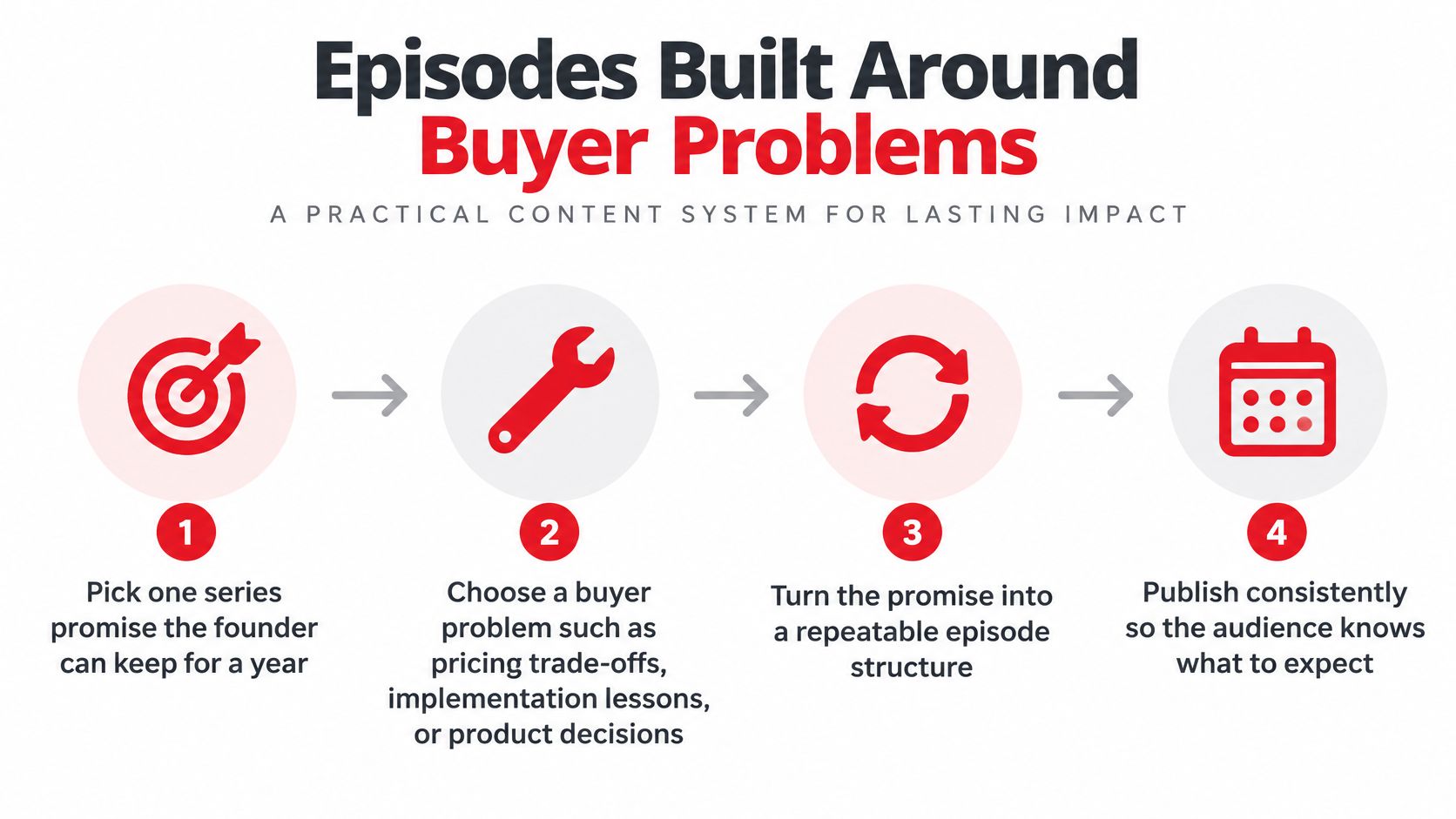
Pick one series promise: Choose ground the founder can hold for a year, such as pricing trade-offs, implementation lessons, or how product decisions get made. If the promise changes monthly, returning listeners have nothing to return for.
Map each episode to a buying stage: Awareness episodes name a costly mistake. Consideration episodes compare real options. Decision episodes help a buyer choose, delay, or walk away with eyes open.
Title the buyer's question: Write the title as the problem in the buyer's language, not your campaign name. Search, thumbnails, and podcast apps all need that plain wording to match intent. Our guide to podcast topic ideas that start from audience problems is a useful place to pressure-test a list before you record.
Use a stable structure: Open by setting the stakes in a few sentences. Let the founder reason through one concrete example. Bring in a guest or customer lesson only when it adds evidence, then close with a single next step.
Keep a trade-off question bank: Stock questions that force limits into the open, such as what this approach costs, when it fails, and who shouldn't use it. Those answers stop an episode from collapsing into a pitch.
Plan repurposing at the outline: Mark two or three segments that can become a clip or a short written note without changing the argument. If you hunt for clips after recording, you'll pick loud moments instead of useful ones.
Two Episodes, Same System
Say a B2B founder records an episode on a six-figure software choice. The useful version compares build, buy, and delay, then states what each path breaks. A consumer founder explaining why a product formulation changed does the same work at kitchen-table scale. Both episodes earn attention because the decision, not the brand, carries the story.
Choose a cadence the founder can host. A clever calendar that slips every month teaches the audience not to come back, and it teaches your own team that the show is optional.
Show Patterns for B2B and Consumer Brands
Think of the show as standing office hours, not a launch commercial. The founder keeps a regular appointment, brings the right people into the room, and answers the questions buyers already ask in sales calls and community threads.
Pattern | Right guest | Wrong guest | Audio-only enough |
|---|---|---|---|
B2B executive show | Peer operator facing the same costly decision | Vendor with a product pitch to sell | Usually yes |
Customer-story series | Buyer who lived the before and after | Customer chosen only for logo value | Yes for audio, but clips need video |
Consumer founder-story show | Team member who made the product call | Influencer with no role in the decision | Only when the product doesn't need to be seen |
Community or merchant series | Active customer or seller in the scene | Guest who never used the product | Usually yes |
How Each Pattern Plays Out
In a B2B executive show, the founder hosts a peer through one expensive decision per episode, such as build versus buy or a rollout that failed in month two. The listener is often a peer who could become a pipeline contact. The episode bores the room when both speakers trade general leadership advice and never touch a budget, a deadline, or a consequence.
A customer-story series keeps the founder as interviewer while a buyer explains the before and after in their own words. It suits proof-heavy categories like payments, software, and financial services. Pick a customer only for logo value and you'll get polite praise with no usable detail. Our roundup of brands with podcasts and the formats they use shows how varied these structures can look once a brand commits.
A consumer founder-story show follows one product or collection decision at a time. It fits ecommerce and beauty when buyers want the person behind the brand, not another influencer segment. A community or merchant series brings customers or sellers into the conversation, so the brand hosts a scene it already has instead of performing a monologue. Interview, thought-leadership, and narrative shapes can all work if the founder remains the recurring voice.
Pick the pattern that matches conversations your team already has. If sales calls are full of peer war stories, start there. If your community already talks without you, host that room.
Production Promotion and the Founder Voice
Start with the shortest thing you'll publish, the founder's own promotional read. Spotify's Nielsen-commissioned study on podcast ad voices found host-read ads produced a significant increase in emotional connection compared with voice-talent ads, 53% of listeners preferred ads read by the podcast host, and 30 to 60 seconds was the most effective length for host-read advertisements.
Inside that 30 to 60 second window, say one thing well. State one audience problem, one concrete value, and one low-friction next step. Disclose clearly when the segment is commercial. Multiple product messages in one read don't sound thorough. They sound like a brochure.
Controls That Keep Delivery Human
Consistent microphone technique: Same distance, same gain, same quiet room every session, so listeners aren't adjusting volume between episodes.
Clean but honest edits: Remove stumbles and dead air, keep pauses and reactions that show the founder is thinking.
Loudness normalization: Match episodes to a steady level so the show sounds professional in a car and on earbuds.
Simple video framing: Use a clean branded frame and an eye-line that feels like conversation, not a news desk.
Publish in a fixed order. Send the full episode to its primary home first, then the same cut or audio version to the other apps, then the two or three clips you marked at outline stage. Each clip should carry the buyer question from the episode title, not a teaser that hides the point.
Promotion should fit the show's stage. Ask guests to cross-post with a clip that features their best answer, not your logo. Swap promos with a show whose audience shares your buyer. I'd hold paid support until a few episodes prove the format holds attention, because paid reach poured into a weak episode only documents the weakness faster.
Polish should make the founder easier to trust, not harder to recognize. If editing sands off every conversational cue, you've spent money removing the asset you built the show around.
What to Measure Besides Downloads
Downloads tell you a file was delivered. They don't tell you a buyer listened, believed you, or took a step. Read the signals in layers.
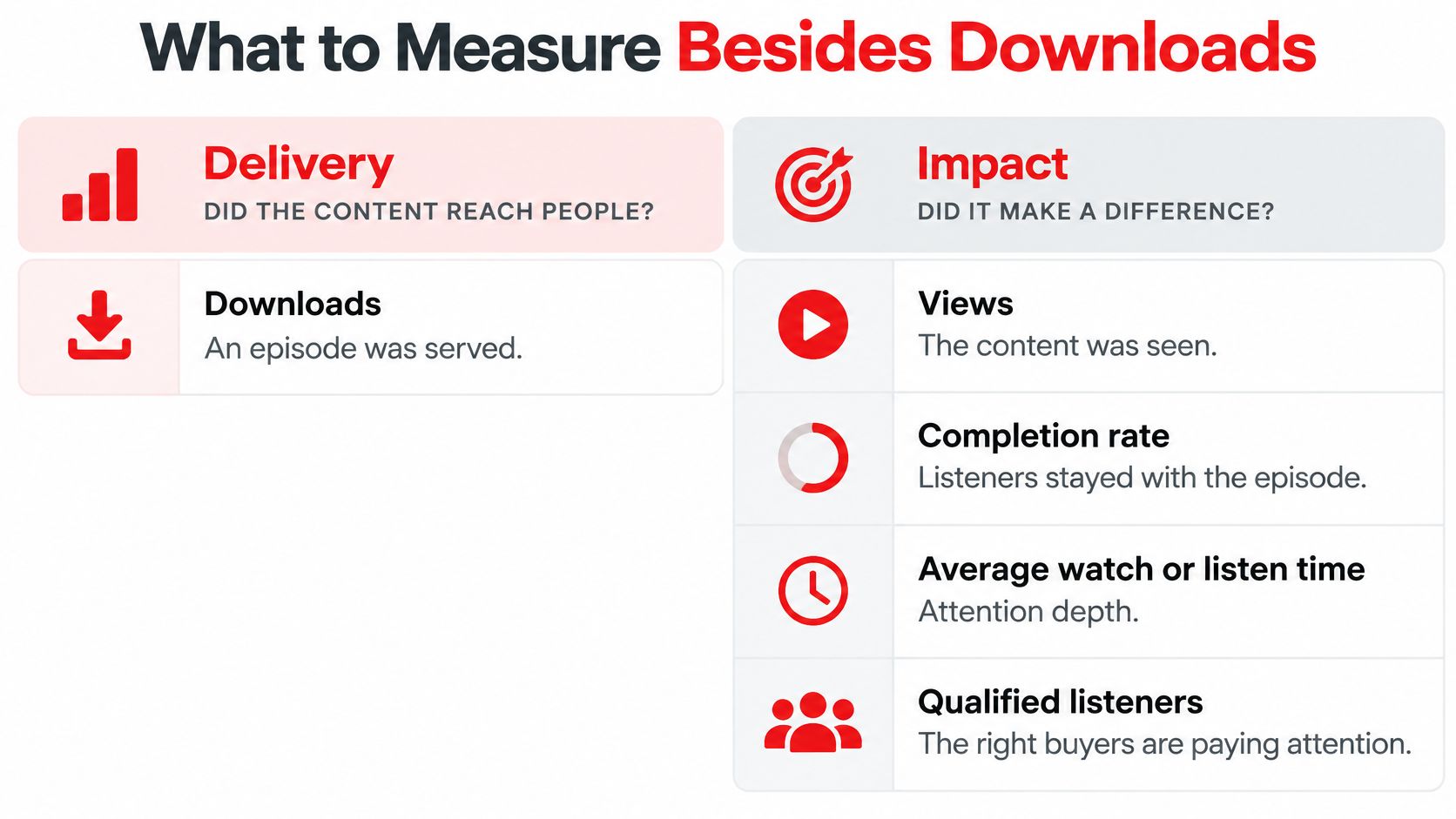
Signal | What it proves | Common misread |
|---|---|---|
Downloads or views | The episode was delivered | Treating reach as pipeline |
Completion or watch time | People stayed with the argument | Assuming a long runtime means a better episode |
Branded search and direct traffic | The founder or show name is being looked up | Crediting every brand search to the latest episode |
Assisted conversions and influenced opportunities | Exposure showed up before a commercial step | Requiring every listener to convert on the first episode |
Give each episode its own landing page or campaign parameter. Then compare exposed and non-exposed audiences on branded search, site engagement, demo completion, and pipeline creation. Our breakdown of podcast data analytics and the metrics worth tracking goes deeper on setting that up without drowning in dashboards.
Read the numbers together. A show with modest downloads, high completion, and assisted opportunities appearing in the CRM is doing commercial work. A show with large downloads and no downstream behavior has distribution without a buyer. If your team needs a broader measurement frame, explore 100Signals' demand generation resources alongside your podcast reporting so the show is judged like other demand programs.
Set a rhythm and keep it. Check attention monthly, read pipeline quarterly. That pace stops you from killing a trust-building show after three episodes, and it also stops you from funding one that never starts a conversation.
Pitfalls That Distort Founder Show Results
Most founder shows don't fail loudly. They drift, one small distortion at a time, until the numbers look fine and the buyers are gone.
Format drift: Filming an audio episode and calling it a video system, so titles and thumbnails never answer a search. Fix it by planning clip moments and titles around the buyer problem before recording.
Spokesperson drift: Letting the founder read polished promotion until unsupported claims erode trust. Fix it by requiring one trade-off and one limit in every episode.
Vanity guests: Booking a famous name who never faced the decision your audience is making. Fix it by screening guests on the problem they've lived, not their follower count.
Promise drift: Changing the series promise every month, which teaches listeners the show has no point of view. Fix it by holding one promise for a full season.
Download tunnel vision: Judging the quarter on downloads alone, or crediting every brand search to the latest episode. Fix it by reading completion and assisted conversions beside reach.
Audience mismatch: Forcing video on commute listeners, or running audio-only when the topic depends on seeing the product. Fix it by matching format to the listening moment.
The damage looks different by brand type. A B2B show that drifts into a pitch loses peers who came for a decision they share. A consumer story show that hides the trade-off loses credibility with buyers who came to meet the person behind the product.
Every fix returns to the same anchor. Name the buyer problem the episode was built around, then check whether the format, guest, and metric still serve it.
Decide Who Runs the Show
The last decision isn't creative. It's operational, and I recommend a simple test. Keep the show in-house when the founder already has a reliable editor, a quiet recording setup, and one named person who will publish every episode on the promised cadence. If any of those three is missing, the show will slip the first time the founder's calendar fills.
Hand off the workflow when the founder's job should be hosting and your marketing team wasn't hired to be a studio. Our podcast production covers concept development, recording, editing, publishing, and distribution, so the host can focus on hosting and content. We can typically launch a podcast within a month, depending on scope, including planning, setup, recording, editing, and distribution.
A handoff shouldn't remove the founder's judgment. The founder still owns the point of view, the episode questions, the trade-offs worth naming, and the single next step at the close. Everything else, from guest coordination to clip delivery, is production work that can sit with a partner.
As the NYC production partner behind this guide, we help founders define concept, format, episode structure, and strategy, then produce audio or video so brands build thought leadership without running the workflow. A free consultation is the cleanest way to test fit. Our contact form asks you to choose one of three paths, advertise a product or service, create podcast content or grow a podcast, or book podcast and YouTube interviews, so the first conversation starts with your actual goal.
Do one thing this week. Write the series promise in one sentence, pick audio, video, or both using the table above, and decide who owns everything except the founder's voice. That single page will tell you whether you're launching a show or just talking about one.
If you want a founder led podcast that functions as a searchable, measurable channel rather than another production burden, Podmuse can take your show from concept and format through recording, editing, publishing, and distribution while your founder focuses on hosting. Visit us to book a free consultation and choose the path that fits, whether that's creating or growing podcast content, advertising a product or service, or booking podcast and YouTube interviews.


Comments