
CEO Podcast Strategy: A Step-by-Step Plan for 2026

83% of surveyed senior and mid-level executives had listened to a podcast during the previous week, compared with 66% of all respondents, according to Sounds Profitable's summary of Signal Hill Insights' 2024 research. That makes podcasting relevant to executive communications, but it doesn't make launching a CEO show the right decision.
A useful CEO podcast strategy starts with buyers, not microphones. Plan the conversation as source material for executive video, clips, written insights, and sales conversations, then report what those assets influenced without pretending every subsequent deal came from the show.
Table of Contents
Where a CEO Podcast Earns Its Place - When the commitment makes sense - When to hold off
Set One Business Outcome and the Six-Stage Model - Six-stage CEO podcast operating model - Keep the comparison readable
Choose Shows and Guests That Reach Your Buyers - Five-criteria scoring for shows and guests - Make the invitation honest
How to Run a CEO Episode From Brief to Publish - Prepare the people and the recording - Finish the assets before release
Pick the Right Format for Each Idea - Which format does which job - Match the asset to the argument
Distribute Each Episode Beyond the Feed - Build a coordinated release - Add paid and community distribution selectively
Measure Influence Without Overstating Attribution - Measurement tiers and the claim each supports - Test contribution rather than claiming certainty
Confirm Your Pilot Plan Before Booking Episode One - Name owners and decision rules
Where a CEO Podcast Earns Its Place
Podcasting has an established audience: 55% of Americans aged 12 and older had listened in the previous month, while 37% had watched a video podcast in the previous month, according to Edison Research's 2025 Podcast Consumer study. The practical implication isn't that every executive needs a show. It's that an audio-only plan ignores an important way people consume podcast content.
Your CEO's time is the scarce input. Use it where explaining a difficult decision, challenging an industry assumption, or questioning a knowledgeable guest will help buyers evaluate the company.
When the commitment makes sense
Your sales cycle requires trust before contact. A substantive conversation can expose the CEO's reasoning before a buyer agrees to a meeting.
Your buyers already consume relevant shows. Confirm this through customer interviews and sales conversations, rather than assuming general podcast popularity proves audience fit.
Your team can sustain publication. Commit preparation, editing, approvals, and distribution capacity, not just a recurring recording slot.
A founder with a distinctive explanation of an expensive customer problem has useful material. A founder who wants visibility but won't take a position doesn't yet have a show concept.
When to hold off
Don't launch without a named buyer segment, someone responsible for preparing the CEO, and a plan for extracting useful clips. Without those inputs, the team will struggle to distinguish a business asset from an expensive publishing habit.
For an internal business case, Statlyst can help you find citable podcast figures. Check the underlying audience definitions before using any figure to justify investment, because broad listening habits aren't evidence that your particular buyers will listen.
The go-or-no-go test is straightforward: can you name the buyer, the desired outcome, and the person who will prepare the CEO? If any answer is vague, fix it before booking guests.
Set One Business Outcome and the Six-Stage Model
Choose one primary business outcome before choosing a name or designing artwork. Executive reach, qualified pipeline, and purchase require different editorial decisions and different evidence of success.
For executive reach, prioritize relevant exposure and recognition. For pipeline, choose problems that buying groups are actively trying to resolve. For purchase, make the offer and response path explicit.
Downloads provide publishing context, but they don't tell you whether the right accounts listened. Record the baseline for the business metric you intend to change.
Six-stage CEO podcast operating model
Stage | Decision to make | Output to hand off |
|---|---|---|
1. Business outcome | Executive reach, qualified pipeline or purchase | One named outcome with a baseline number |
2. Audience and show | Which buyers the show must reach | Ideal-customer profile and format fit |
3. Guest and topic | Which people and problems overlap that profile | Ranked target-account list |
4. CEO preparation | What the CEO must prove and say | Short briefing, five priority questions, approved proof points |
5. Recording | Who supplies expertise and who sets the point of view | Conversational interview with a clear angle |
6. Repurposing and measurement | Which assets come out and how results are tracked | Clips, written insights, unique URLs and seven-, 30-, and 90-day windows |
Use the response timing reported in Radio Online's coverage of podcast advertising benchmarks to inform the final stage: more than 80% of measured lead and purchase conversions occurred within seven days, so separate early response from the longer 30- and 90-day review windows. Those are advertising-campaign observations, not a promise that an executive interview will generate immediate pipeline.
The handoffs matter as much as the decisions. The producer needs an editorial brief, the editor needs asset requirements, and marketing operations needs campaign definitions before publication.
Keep the comparison readable
Don't change creative and targeting simultaneously. If a new topic reaches a new audience through a new channel, you won't know which change explains the result.
Operating rule: Change one meaningful variable per cohort, and record the change before results arrive.
Close the planning meeting with a sentence the team can evaluate: We will improve [business outcome] among [buyer segment], compared with [recorded baseline]. If the team can't complete it, production is premature.
Choose Shows and Guests That Reach Your Buyers
A large general-business audience isn't automatically more valuable than a small audience concentrated in your buying market. For a technical CEO, a specialist show can offer a better setting for useful detail than a broad leadership interview.
Start with a ranked target-account list. Identify executives who own relevant problems, then assess whether their expertise will produce a conversation your buyers need.
The Sotros Infotech B2B podcast playbook describes a target-account approach built around relevant executive guests and personalized follow-up. Treat that as a practical workflow, not a guaranteed revenue formula.
Five-criteria scoring for shows and guests
Use the following proposed scorecard, rating each criterion from 1 to 5. Agree on an invitation threshold before reviewing names, and reject candidates below it rather than making exceptions for fame.
Criterion | What it measures | Score of 5 means |
|---|---|---|
Audience overlap | Share of listeners or guests inside the ideal-customer profile | Most listeners match the profile |
Buyer seniority | Seniority of listeners or guests who make or shape buying decisions | Listeners or guests are VP or C-suite buyers |
Geographic relevance | Fit with your sales territories | Audience sits in your active regions |
Purchase influence | Whether listeners make or influence purchases | Listeners regularly buy or shape buying decisions |
Rights to reuse | Ability to secure clip and newsletter rights | Clip and newsletter rights are confirmed in writing |
For guest appearances, ask the publisher how it understands its audience. Job titles, relevant audience-survey results, and examples of listener questions are more useful than a large headline download count alone.
For a CEO-hosted show, don't confuse a guest's employer with their editorial value. A prestigious company name won't rescue a conversation about a problem the guest doesn't own.
Make the invitation honest
Invite guests to explain a real decision, constraint, or unresolved challenge. Don't disguise a discovery call as an editorial interview, and don't make commercial follow-up a condition of participation.
Develop the angle using these questions to ask on a podcast, then tailor the questions to the guest's responsibilities. After publication, a personal recap should explain which insight matters to colleagues in the buying group, rather than asking the guest to share a link.
How to Run a CEO Episode From Brief to Publish
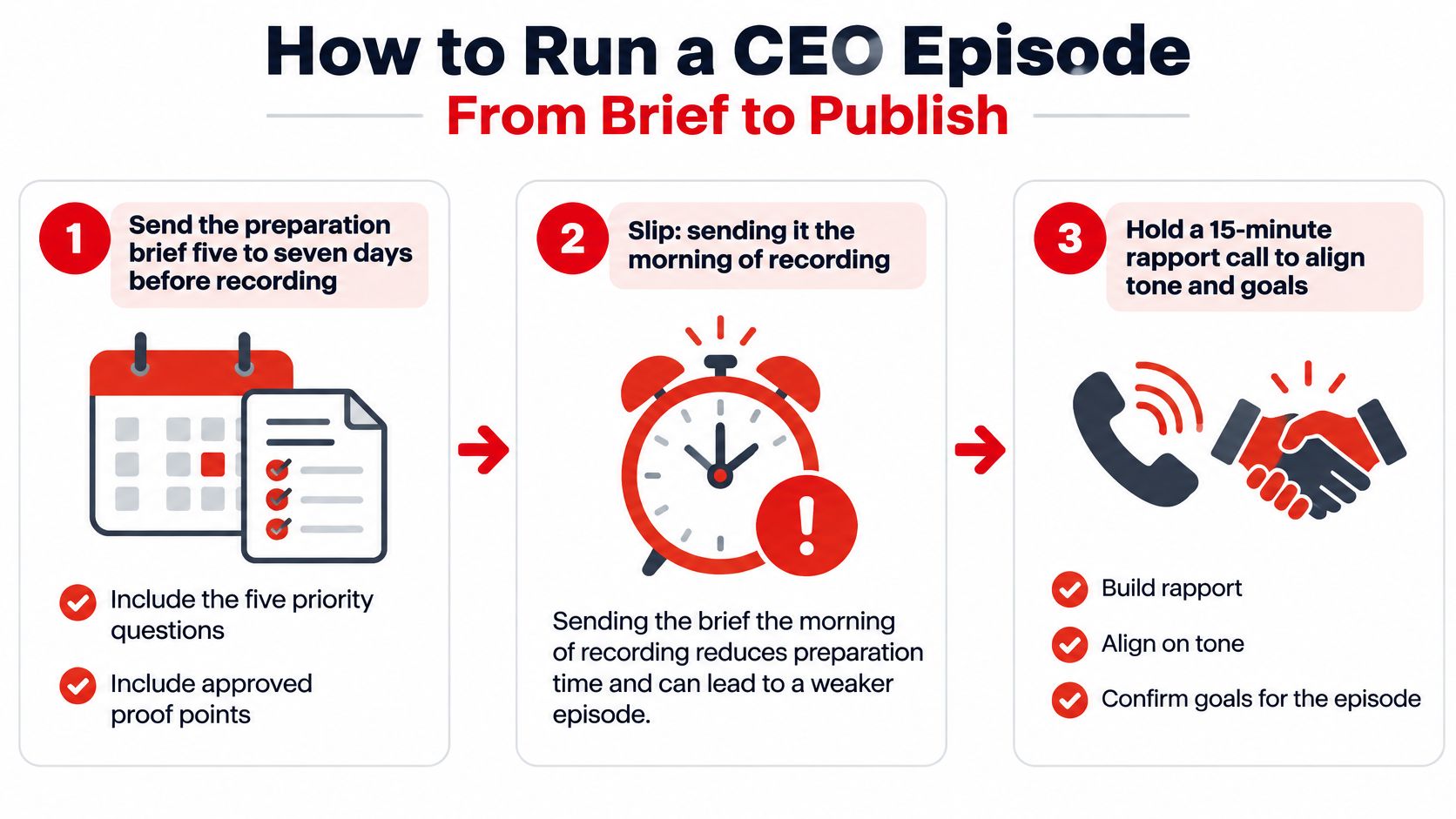
The producer's job is to remove avoidable friction without scripting away the conversation. Give the CEO enough structure to arrive informed, while leaving room for disagreement, follow-up questions, and unexpected expertise.
Use this workflow as the production checklist.
Prepare the people and the recording
Send the preparation brief ahead of recording. Include the audience, central question, approved proof points, pronunciation notes, and subjects that require care. The usual slip is sending it on recording morning, when nobody has time to identify a weak premise.
Hold a short rapport call. Confirm the guest's current challenge, sensitive topics, and preferred level of technical detail. Skipping this conversation leaves the host discovering basic context during the opening.
Record clean source material. Use a quiet, furnished room, a dedicated microphone, headphones, and separate local tracks where possible. The common mistake is accepting laptop audio without checking fan noise, echo, clipping, or backup recording.
Close with a useful question. Ask what challenge the guest is working through now, and log the answer for appropriate follow-up. Don't turn a candid answer into an unsolicited sales pitch.
Finish the assets before release
Edit for clarity, then inspect the sound. Remove repetition and distracting interruptions without erasing the speaker's meaning, and check noise reduction through headphones. Budget for editorial review, audio cleanup, captions, and export checks rather than treating editing as a quick trim.
Build a complete episode package. Select standalone clips, write a recap, and prepare an episode-specific destination with a relevant next action. The usual slip is choosing dramatic excerpts that lose the qualification that made the original answer accurate.
Publish only after the tracking check. Confirm the campaign ID, destination links, captions, guest approval status, and personalized publication email. Creating the CRM campaign afterward leaves the team reconstructing activity that should have been logged automatically.
If production ownership is unclear, Carlos Alba Media's resource on finding the right podcast production team can help frame the resourcing conversation. Decide who owns editorial judgment, technical delivery, approvals, and asset handoff before comparing production options.
A healthy release is boring operationally. The guest receives a useful recap, the scheduled assets are ready, and the CRM campaign exists before anyone clicks through.
Pick the Right Format for Each Idea
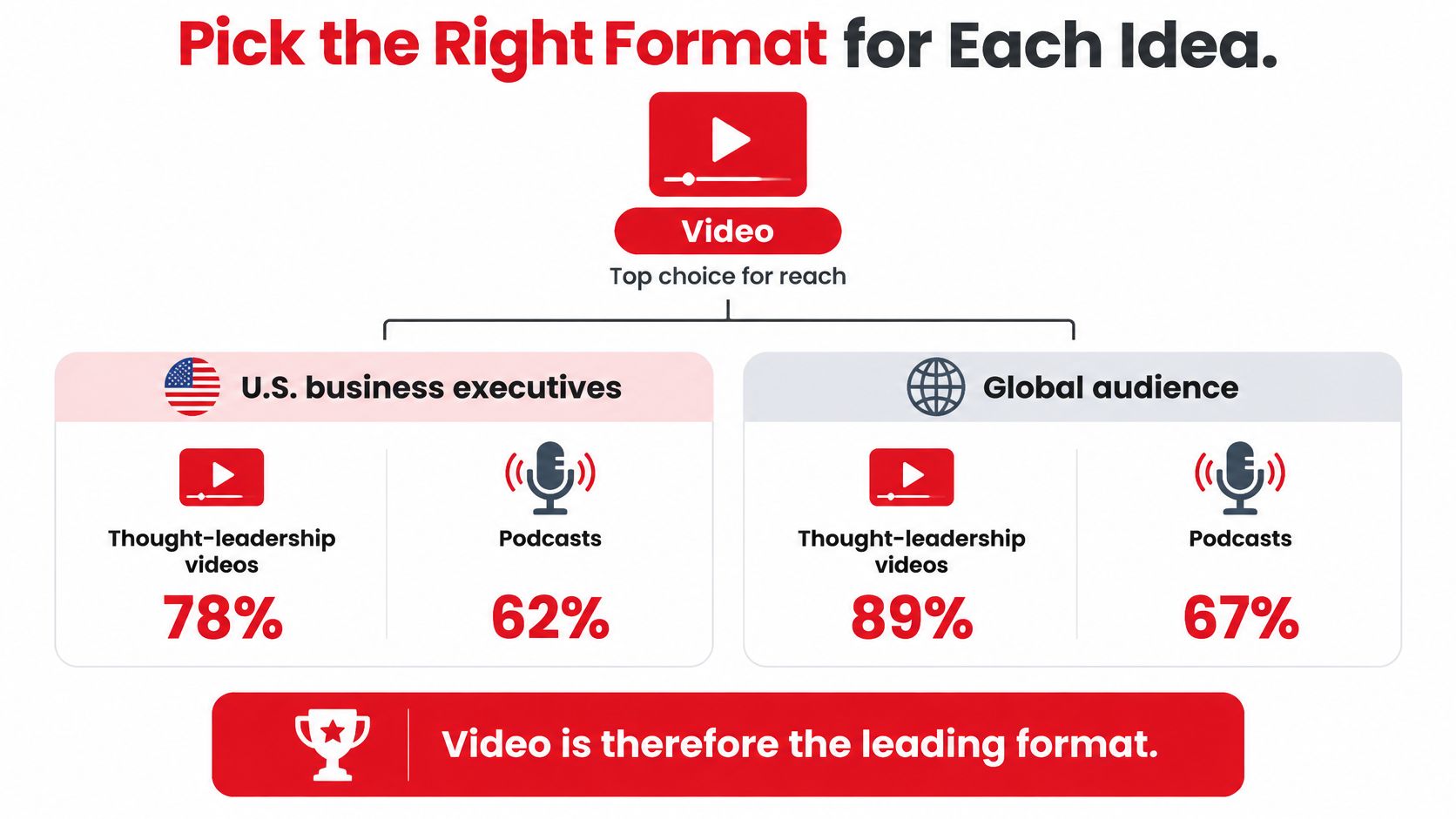
78% of U.S. business executives regularly watch thought-leadership videos, compared with 62% who listen to podcasts, according to the executive-content findings discussed by Luminetics. That supports planning video deliberately, although it doesn't establish which format your own buyers prefer.
Which format does which job
Format | Best use | Funnel role | Main metric |
|---|---|---|---|
Full audio episode | Depth on one problem with a guest's reasoning | Credibility and recall | Completion rate and listener profile |
Full video episode | Executive presence and discovery | Trust before a sales call | Engaged-view rate |
Short clip | One claim a buyer could act on, for social feeds | Reach to decision-makers | Qualified views and shares |
Written summary | Search and internal sharing | Sales enablement | Organic visits and forwards to buying groups |
Paid sponsorship slot | Reach into a target show | Response to a direct offer | Site visits on a unique URL |
Use this hierarchy as an editorial starting point, not a rule that every idea needs every format.
Match the asset to the argument
The full conversation preserves reasoning, objections, and context. Full video also lets prospects assess how the CEO explains a difficult issue, while clips introduce a specific claim to people who haven't committed to the episode.
Written summaries serve a different need. A buying-group member should be able to scan the argument, identify its relevance, and forward it without asking colleagues to watch an entire interview.
Say a B2B infrastructure CEO explains a pricing change. Keep the complete argument in the long-form recording, then create separate clips about pricing logic, migration risk, and the customer implications, plus a recap account executives can use.
Don't manufacture a customer result if the conversation contains no approved evidence. A clear explanation of the trade-off is more credible than an unsupported success claim.
Decision rule: Keep an idea long-form when removing the reasoning would distort it. Cut a clip when the claim and its necessary qualification can stand alone.
The podcast is the raw material, not the whole product.
Distribute Each Episode Beyond the Feed
A release plan works when every asset has a destination, an owner, and a clear use for the intended buyer. Set platform requirements and editorial context before editing begins, so clips are prepared for their channels rather than exported without a plan.
Build a coordinated release
Publish the full conversation. Use consistent titles and accessible descriptions, and include a relevant destination in the show notes.
Schedule clips around distinct ideas. Open with the claim or problem, not a generic announcement that the episode is live.
Equip the account team. Provide a concise recap, context for outreach, and the asset that addresses an account's active concern.
Use owned channels. Include the episode in the newsletter and organize sales-enablement files by buyer problem, not publication date.
A video podcast repurposing workflow can help make these handoffs repeatable. Keep captions, source files, approved copy, and destination links together so sales teams can find and share the current version.
Add paid and community distribution selectively
Paid sponsorship needs its own offer and tracking plan. 76% of weekly podcast consumers aged 13 and older had taken some action after hearing a podcast advertisement, according to Edison Research's podcast findings. That broad response measure is not an expected lead-conversion rate.
Brand response is a separate outcome: 61% of branded-podcast listeners said an episode made them somewhat or much more favorable toward the sponsoring brand, according to Signal Hill Insights' branded-podcast survey reported by Podnews. Track favorability separately from commercial response.
In relevant community discussions, answer the question at hand and share a clip only when it adds useful context. Disclose any affiliation and follow each community's rules; do not insert promotional links into unrelated threads or buy fabricated recommendations. For background on the separate category of Reddit citation services, distinguish paid citation services from organic participation in communities.
Prioritize buyer relevance over reach alone. A clip that helps an account team address an objection can remain useful after its social reach slows.
Measure Influence Without Overstating Attribution
Establish a pre-appearance baseline before release. Record branded-search activity, direct traffic, target-account engagement, and the relevant pipeline measure using consistent definitions.
Then distinguish what you observed from what you inferred. An episode-specific visit is observable; the claim that the episode caused a purchase requires stronger evidence.
The CEO Interviews resource on executive podcast growth discusses thought leadership's relevance to vendor evaluation. That relationship supports measuring influence, but it doesn't establish that an individual podcast appearance caused a deal.
Measurement tiers and the claim each supports
Use these reporting windows as an operating convention, not as evidence that every buyer moves on the same timetable.
Tier | Example metrics | When to read | Claim it supports |
|---|---|---|---|
Reach | Qualified listeners and video views inside target accounts | Days 1–7 | Exposure only |
Engagement | Completion rate, engaged-view rate, clip shares | Days 7–30 | Interest in the CEO's point of view |
Account influence | Target-account engagement, guest referrals, CRM self-reports | Days 30–90 | Contribution, labeled as self-reported |
Revenue | Opportunities and pipeline influenced, against the pre-set baseline | Day 90 and each quarter | Influenced, not sourced, unless a unique URL or code traces it |
Even a unique URL traces a response path, not the complete explanation for a purchase. Someone may hear the CEO, ask a colleague, attend a demonstration, and return through a sales email.
Use the framework in this B2B podcast attribution guide to keep campaign tracking and commercial reporting connected. Store the campaign ID, contact or account association, interaction date, and self-reported influence in the CRM.
Test contribution rather than claiming certainty
Where feasible, compare exposed target accounts with similar accounts that weren't exposed. Match on factors such as account size, sales stage, territory, and existing engagement, then document the differences you couldn't control.
Don't treat voluntary listeners as a randomized audience. They may already be more interested in your company, which can make exposed accounts look stronger even without a podcast effect.
Ask prospects how they encountered the company and what helped them evaluate it. Preserve their answer rather than forcing every response into a podcast category, and label self-reported influence clearly.
A strong appearance can improve trust, recruiting conversations, partner access, or sales-call quality without producing an attributable lead. Conversely, a last-touch conversion doesn't justify assigning the entire opportunity to the final link clicked.
Report what you can trace, label what you infer, and never credit every deal to the show.
Confirm Your Pilot Plan Before Booking Episode One
Lock the pilot before the guest invitations go out. Otherwise, an accepted invitation can turn an unresolved strategy into a production deadline.
Create a shared pilot document with the business outcome, buyer segment, ranked target accounts, baseline, invitation threshold, and continuation criteria. The continuation decision should reflect your primary objective, not whichever metric happens to look best.
Name owners and decision rules
Editorial ownership: Name the person accountable for the CEO's preparation, topic quality, and approved proof points.
Production ownership: Assign recording, editing, captions, asset delivery, and publication checks.
Measurement ownership: Give marketing operations responsibility for CRM logging, reporting definitions, and the review meeting.
Choose a bounded run your team can finish and evaluate. Put the review date on the calendar before recording starts, and decide what would justify continuing, changing the format, or stopping.
Keep existing strengths in-house. If your team already records reliably, outsourcing editing and distribution may solve the actual capacity problem without replacing a working setup.
At Podmuse, we help define the concept, format, episode structure, and content strategy so the show aligns with the brand and its goals. That planning should settle what the CEO needs to contribute and what the production team can handle.
This week, put the outcome sentence, baseline, and initial target accounts into a shared document. Assign its owners and schedule the preparation brief before anyone books the first recording.
Podmuse covers concept development, recording, editing, publishing, and distribution, so your CEO can focus on hosting and content. Visit Podmuse to discuss a pilot built around buyer-relevant conversations, reusable video assets, and clearly defined business outcomes.
Comments