
Consulting Firm Podcast Production: A Step-by-Step Guide

Buying better microphones won't fix a consulting podcast that nobody has time to approve. The popular advice, choose a niche, book interesting guests, and publish consistently, skips the operating problem: partners have client commitments, marketing needs usable assets, and someone must decide which claims can leave the firm.
Consulting firm podcast production is an operating system for partner time and approvals, not just a recording service. Build the calendar, decision rights, and sales handoffs before investing in studio polish. A technically excellent episode that sits in an approver's inbox produces nothing.
Table of Contents
Map the Production Workflow Before You Record - Put the handoffs on the calendar - Resolve the decisions that block booking
Decide Build or Buy for Your First Ten Episodes - Buy coordination, not just editing
Pick a Format Your Partners Can Sustain - Compare the full partner commitment - Turn sales questions into a season
Book Guests and Choose a Recording Setup - Book for a question worth answering - Select the setup by its main risk - Protect the recording block
Edit, Caption and Publish Each Episode - Use a release checklist - Package for search and distribution
Promote, Repurpose and Buy Placements - Match the channel to the job - Repurpose in editorial order
Measure Pipeline Influence, Not Just Downloads - Audit delivery before interpreting demand - Build an evidence plan sales can use
Map the Production Workflow Before You Record
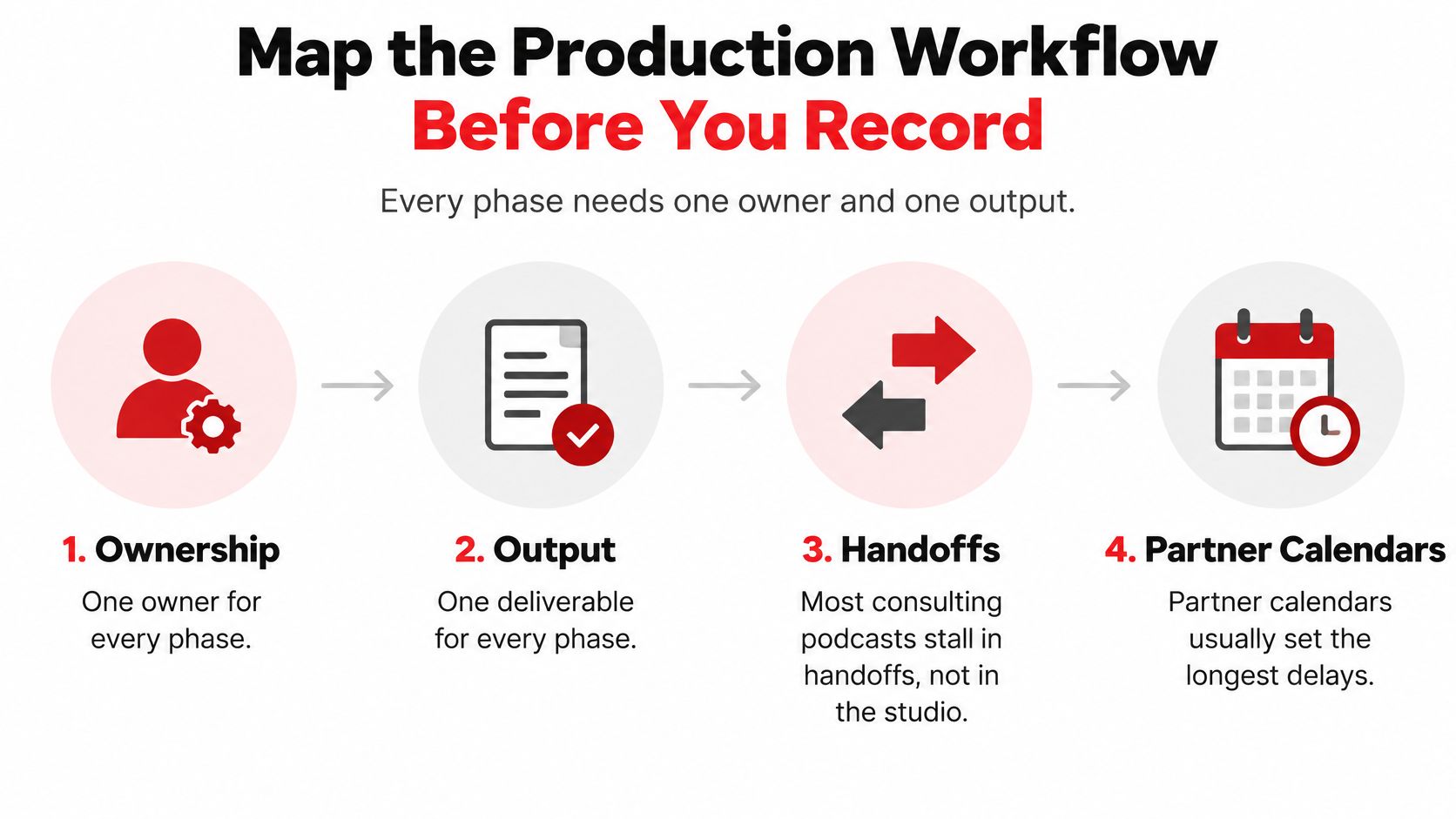
Most consulting podcasts stall in handoffs, not in the studio. An editor waits for a claim check, the account team hasn't cleared a client reference, or the partner assumes marketing can approve the final cut.
Give every phase one owner and one output. Contributors can be numerous; accountability shouldn't be shared.
Put the handoffs on the calendar
Use this illustrative launch schedule as a planning scenario, not an industry turnaround benchmark. Replace the allowances with commitments from the people doing the work.
Production phases, owners and typical lead times for a sample launch
Phase | Owner | Output | Typical lead time |
|---|---|---|---|
Strategy and show brief | Partner sponsor and marketing lead | One-page show brief | Allow 2 to 3 weeks |
Format and content planning | Producer and subject-matter lead | Episode list with titles and runtimes | Allow 2 weeks |
Guest sourcing and booking | Producer and firm account team | Confirmed guests with approved bios | Allow 3 to 6 weeks |
Recording | Producer and engineer | Raw local audio and video files | Reserved session plus file verification |
Post-production | Editor | Master files, transcript, captions and show notes | Allow 3 to 5 business days |
Publishing and distribution | Producer | Live episode on hosting and platforms | Allow 1 to 2 days |
Promotion and repurposing | Marketing lead | Clips, posts and placements | Ongoing from publish date |
Measurement review | Analytics owner | Monthly KPI readout against the brief | Monthly |
For this scenario, assume a 48-hour approval turnaround. If the partner instead needs a week for each review, add that review week to every post-recording phase requiring their approval. Don't bury approval time inside the editor's deadline.
Booking can overlap with content planning once the show's proposition is settled. Put actual dates against the first episode, working backward from publication, and reserve the sponsor's review slot before confirming the recording.
Resolve the decisions that block booking
Business goal: Choose a practice-level outcome, such as supporting transformation opportunities, or a named partner's authority. If lead quality is the priority, Grou's guidance on how to improve the quality of B2B leads offers useful context for defining the desired inquiry.
Buyer roles: Write procurement directors evaluating implementation risk, not executives. Specify the decision they're trying to make.
Approval authority: Name who clears technical claims, client names, and guest bios. Give the producer a substitute approver and an escalation route.
Finish with a one-page show brief containing goal, audience, format, cadence, approver, and success metric. Attach the calendar and owner list. A creative concept isn't a production plan until someone accepts each handoff.
Decide Build or Buy for Your First Ten Episodes
Budget line | What drives the cost | Build in-house | Hire a partner |
|---|---|---|---|
Equipment and room | Microphones, interface, room treatment and remote kit | One-time purchase and staff training | Often included or billed as a studio day |
Editing and captions | Recorded material, edit complexity and correction passes | Producer and editor time | Per-episode fee or monthly retainer |
Guest booking | Shortlist size and rescheduling | Partner network time | Account management fee |
Hosting and distribution | Storage, feeds and analytics | Software subscription | Usually bundled |
Promotion | Paid placements and clips | Separate media budget | Often quoted separately |
Measurement | Log access and CRM work | Analytics staff time | Scoped in the brief |
Equipment is the most visible purchase, but partner time and repeated approvals can consume more resources. A cheaper editor doesn't help when marketing spends its week chasing decisions.
Use a shared budget session to expose those internal costs.

Buy coordination, not just editing
Build in-house when a producer is already available, an editor is assigned, and partner scheduling isn't the bottleneck. Otherwise, buy production coordination for the opening run. As a hypothetical staffing test, reserve about ten producer hours a week and see whether that allocation survives booking, preparation, revisions, and publishing.
Zemith's guide to the best free podcast tools for 2026 can help assess a starter software stack. Free software still needs an owner.
For a vendor comparison, request relevant B2B samples, a named editor, documented turnaround, hosting-log access, episode identifiers, raw-file ownership, and a revision cap. Separate guest booking and promotion from basic editing in the quote.
Our B2B podcast production agency guide gives context for that scope. At Podmuse, we help define the concept, format, episode structure, and content strategy, then handle recording, editing, publishing, and distribution; recording can happen through our studio network, remotely, or at a client's office or event.
I'd commission a fixed-budget pilot before a season commitment. For example, contract an initial six-episode pilot within a proposed ten-episode relationship, then review cost per published episode, available completion signals, and pipeline influence. A free consultation is a practical way to test scope and working fit before setting that budget.
Pick a Format Your Partners Can Sustain
Choose the format around partner availability and buyer attention, not the most impressive production treatment. A reliable speaker answering a difficult buying question can be more useful than a beautifully filmed panel with no clear conclusion.
Edison Research figures summarized by National Public Media show that 47% of U.S. monthly podcast consumers earn at least $75,000 annually, while 18% own a business. That supports considering the channel, but it doesn't prove your intended buyers will listen. Topic selection still has to earn their attention.
Compare the full partner commitment
The cadence options below are starting choices, not performance benchmarks. Partner time includes preparation, recording, and substantive review, not merely the minutes spent speaking.
Format | Best for | Partner time per episode | Realistic cadence | Guest or client dependency |
|---|---|---|---|---|
Expert interview | Sharing views with clients and prospects | Brief review, conversation and factual sign-off | Every two weeks | High |
Solo expert monologue | Research-led takeaways from one partner | Outline development, delivery and claim review | Weekly | None |
Roundtable panel | Showing depth across several partners | Shared preparation and coordinated attendance | Monthly | Medium |
Client story series | Proof of outcomes | Account preparation, interview and client clearance | Monthly | High, client approval required |
Narrative or scripted | Long-term brand storytelling | Script development, fact-checking and pickups | Monthly or quarterly | Low |
A solo monologue removes guest scheduling, but it transfers editorial responsibility to the partner. Someone must turn their expertise into a coherent argument rather than a spoken slide deck.
An interview gives the host another perspective to question. It also creates dependencies around availability and factual review. Client stories need explicit clearance for outcomes and identifying details; don't assume the relationship owner can authorize publication.
Scripted production can reduce calendar coordination, yet it increases writing and editing work. Choose it when the story benefits from careful construction, not because it looks easier to schedule.
Choose the format by total partner effort per published episode, not recording time alone.
Turn sales questions into a season
Collect buyer questions: Ask the practice team which questions repeatedly arise during sales conversations.
Write episode propositions: Turn each question into a specific title and assign a credible speaker.
Group related topics: Build a season that develops a useful argument rather than a miscellaneous guest list.
Test the cadence: Check it against client delivery periods, travel, and partner leave.
Name episode owners: Give each recording someone responsible for readiness, not just hosting.
A hypothetical partner with only 45 minutes available each month cannot support a weekly interview show. Marketing can prepare the materials, but it can't manufacture their attention.
Choose the format the firm can sustain through a full business cycle, including its busiest periods. A modest schedule kept reliably is a better operating choice than a launch cadence that requires constant exceptions.
Book Guests and Choose a Recording Setup
Guest booking starts with relevance, not celebrity. Build the shortlist from client relationships, partner networks, and shows your buyers already follow. The account team should flag relationship sensitivities before outreach, not after someone accepts.
Book for a question worth answering
Build the shortlist: Record each guest's expertise, buyer relevance, relationship owner, and potential conflicts.
Send a specific pitch: Lead with the episode question, expected runtime, and recording format. Explain why their perspective matters.
Hold an editorial pre-call: Confirm the argument, useful examples, prohibited topics, and any review expectations.
Send a prep sheet: Include the core questions, pronunciation notes, a quiet-room request, headphones, and a wired connection where practical.
Complete the tech check: Test the actual device, microphone, browser permissions, framing, and recording location before the session.
The pre-call shouldn't become a rehearsal of polished answers. Use it to find disagreement, evidence, and examples the host can examine. Tell guests whether review is limited to factual corrections or includes broader editorial approval.
A hypothetical invitation might ask a procurement leader to explain when a transformation supplier's implementation plan becomes credible. That's a stronger proposition than inviting them to discuss leadership and innovation.
Select the setup by its main risk
Setup | Best use | Main advantage | Main risk | Production control |
|---|---|---|---|---|
Professional studio | High-stakes interviews and video-led shows | Controlled sound, lighting and engineering | Travel and booking friction | Confirm accessibility, camera coverage and delivery arrangements |
Remote local recording | Geographically dispersed speakers | Separate source files without travel | Guest equipment and incomplete uploads | Test local capture and verify uploads before closing |
On-location recording | Client offices and events | Convenient access to speakers | Noise, interruptions and setup time | Inspect the room and reserve setup access |
Cloud-only call capture | Low-stakes internal material or backup | Simple access | Compression and connection failures | Keep an independent backup when possible |
For a publishable remote show, require local source files from each speaker. A meeting recording captures what survives the connection; local capture gives the editor a stronger source to work with. Our guide to podcast remote recording explains the practical setup decisions.
A studio isn't automatically the right answer. If travel makes the partner cancel, the controlled room has solved the wrong problem. Conversely, a high-stakes guest shouldn't spend their session troubleshooting a laptop microphone.
For on-location work, walk the room with headphones. Listen for ventilation, corridor traffic, refrigeration, and reflective surfaces; a boardroom that looks prestigious can sound poor. Keep microphones close to speakers and record isolated tracks.
Protect the recording block
Book setup, the conversation, pickups, and file verification as separate activities within the calendar hold. Don't tell a guest they can leave immediately after the final answer if their recording still needs to upload.
For a hypothetical recording plan, reserve 45 to 60 minutes of conversation to target a 30-minute finished episode. That's an editorial allowance, not a guaranteed yield: a focused guest may need little cutting, while an unsupported argument may be unusable regardless of duration.
Edit, Caption and Publish Each Episode
Post-production should produce a usable knowledge asset, not merely cleaner audio. The editor needs an episode brief, pronunciation notes, source material, and a clear distinction between removable repetition and qualifications that must remain.
The Signal Hill branded-podcast report announcement reports that 61% of branded-podcast listeners became more favorable toward the sponsoring brand. Protect that opportunity by making the episode understandable, accessible, and faithful to the speaker's argument.
Use a release checklist
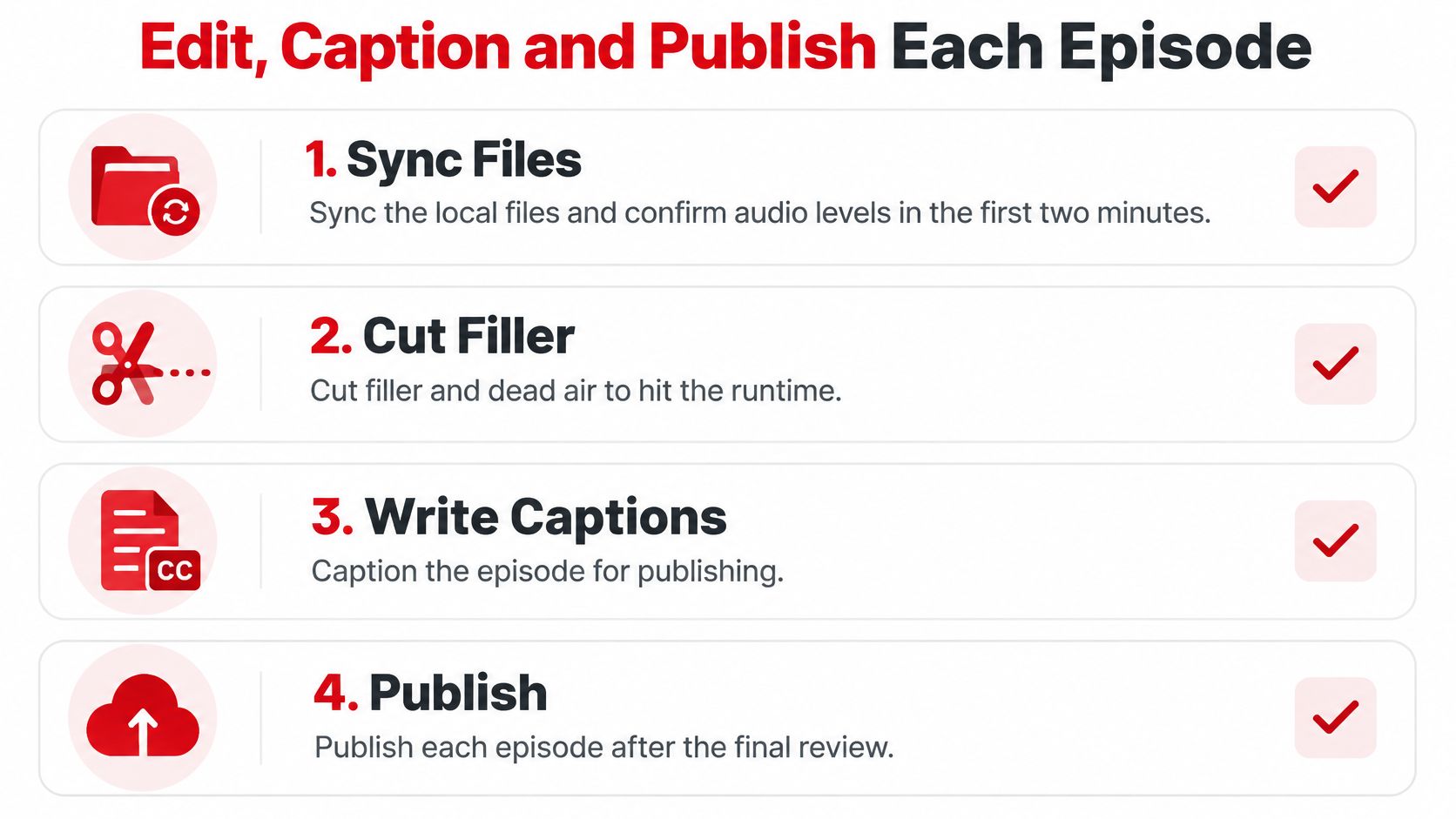
Verify the files: Sync local tracks, check the opening, and confirm nothing is missing before detailed editing.
Make the editorial cut: Remove filler and dead air without changing the argument.
Balance the sound: Reduce distracting noise and match host and guest levels.
Correct the transcript: Manually check names, acronyms, product terms, and technical language.
Add navigation: Write speaker labels, chapters, and a descriptive title using buyer vocabulary.
Prepare accessible versions: Produce accurate video captions and localized summaries where relevant.
Request consolidated approval: Send time-coded questions and identify claims needing evidence.
Release the episode: Publish source-linked show notes and a single listener next step.
Use the checklist as a handoff document, with completion recorded against each deliverable.
For a hypothetical 30-minute interview, initially reserve four to eight working hours for the complete post-production package, then replace that allowance with tracked production time. Keep working hours separate from elapsed approval time.
Transcript correction is easy to cut because the audio already sounds finished. That's a mistake when a miscaptioned technical term can reverse the meaning of an answer.
Package for search and distribution
Publish audio through an RSS-compliant host and submit the feed to major directories. Give the video version a consistent episode title and chapter structure, while preserving each platform's separate analytics.
Build a searchable episode page with the transcript, summary, guest bio, and source links. If you use ClipNova to make long AI videos from approved material, treat the output as a draft requiring editorial review, not a substitute for the recorded expert's evidence.
Editorial safeguard: Approve the meaning of the excerpt, not just the accuracy of its words.
A clip can reproduce a sentence perfectly while dropping the caveat that makes it defensible. Require review of any excerpt that will circulate without the full answer, especially claims involving client outcomes, forecasts, or professional advice.
Promote, Repurpose and Buy Placements
Choose promotion by what you need to buy: credibility, reach, audience exchange, expert access, or discovery. Those are different jobs, and they need different buying models and success signals.
Keep the promotion plan beside the episode calendar so assets don't wait until launch day.

Match the channel to the job
Host-read sponsorships on niche shows buy an introduction through a familiar voice. Negotiate the episode, placement, talking points, and reporting terms. Track reported delivery and tagged landing-page visits, but don't pretend you can observe every listener's action after the read.
Programmatic audio buys access to targeted listener segments through impression-based inventory. It can expand reach without negotiating every show individually. Check frequency, placement quality, and available playback reporting; the creative must explain the relevance without relying on the host's endorsement.
The central trade-off is borrowed credibility versus scalable delivery. Host reads can offer a stronger contextual introduction but require individual coordination. Programmatic campaigns offer broader buying flexibility, though a generic consultancy ad can waste that access.
Promo swaps exchange airtime with a peer show. There's no media payment, but production and coordination still cost staff time. Agree comparable value based on audience relevance, placement, and delivered exposure, then use a dedicated destination to observe response.
Guest appearances put a partner's expertise inside another show's conversation. Unpaid editorial invitations cost preparation and availability rather than inventory fees. Track referral visits and inbound mentions, and keep paid appearances clearly distinguished from editorial bookings.
Paid social clips extend discovery beyond existing podcast listeners. Judge them by whether viewers progress to the episode or a relevant destination, not by cheap views alone.
The buying environment is substantial: IAB and PwC report approximately $2.9 billion in U.S. podcast advertising revenue in 2025. That doesn't establish a fair price for your campaign. Compare audience fit and delivery terms before accepting inexpensive inventory.
Repurpose in editorial order
Create the complete episode first so every derivative has an approved reference. Then select a substantial video excerpt, shorter clips that retain the question's context, a written insight post, and a LinkedIn carousel organized around the argument.
Use video examples to discuss presentation choices before approving your own campaign assets.
Disclose sponsorships in show notes and relevant promotional materials. Give guests approved copy and assets they can share without rewriting the firm's position.
Budget discipline: Test a defined audience and message, not every available channel.
For example, pair an owned email campaign with a fixed-budget paid placement and a six-week review window. Define the decision in advance: continue, change the creative, change the audience, or stop.
Measure Pipeline Influence, Not Just Downloads
A raw file request isn't evidence that a prospect listened. The IAB Tech Lab podcast measurement guidance requires sufficient delivered content for at least one minute of playback and describes deduplication commonly using IP address and user agent within a 24-hour window. Even a valid download establishes delivery, not attention or purchase intent.
Audit delivery before interpreting demand
Use the IAB workflow as the basis for a documented measurement process:
Filter traffic: Remove bots, malformed requests, and non-content activity.
Apply the content threshold: Check that delivered bytes represent sufficient playable content.
Aggregate unique listeners: Apply the documented deduplication method.
Generate consistent metrics: Preserve episode, audience, and relevant ad-delivery definitions.
Review repeatedly: Reconcile discrepancies and audit changes in collection or reporting.
Before launch, secure hosting-log access, episode identifiers, campaign dates, and ad markers where applicable. An attractive dashboard doesn't replace a measurement dictionary.
Metric | What it shows | Data source | Limit |
|---|---|---|---|
Valid downloads | Audio delivered and deduplicated | Hosting logs under IAB filtering | Not proof the episode was heard |
Completion and repeat listening | Available attention and return signals | Platform analytics | Definitions differ across platforms; use your own baseline |
Target-account reach | Evidence of exposure among relevant accounts | Consented first-party activity and CRM matching | Hosting data alone doesn't reliably identify decision-makers; privacy review required |
Qualified site sessions from episode links | Intent after exposure | Tagged links and web analytics | Attribution is partial |
Sales feedback on mentions | Qualitative influence in deals | CRM notes and call summaries | Anecdotal evidence, not causal proof |
Exposed versus matched non-exposed accounts | Differences consistent with possible influence | CRM comparison or controlled holdout | Matching alone doesn't establish causation |
Build an evidence plan sales can use
Establish an internal baseline from the opening episodes rather than chasing a universal completion target. For example, review the first four to six releases using comparable observation windows, separating format changes and paid promotion from ordinary episode performance.
Our guide to B2B podcast attribution provides a framework for connecting exposure signals with commercial activity. Keep account identification grounded in consented first-party evidence, not assumptions drawn from network traffic.
The sales handoff should contain the episode's buyer problem, relevant account segments, approved excerpts, and a suggested follow-up resource. Don't hand sales a list of supposed listeners that the measurement system cannot identify.
Tag episode destinations, capture voluntary self-reported discovery, and give sales a consistent CRM field for podcast mentions. Compare exposed accounts with similar non-exposed accounts while acknowledging that existing interest may explain both listening and buying.
Write the attribution rules before the results arrive. Claim influence when a prospect cites an episode or a documented touchpoint appears in an opportunity journey. Reserve causal claims for a defensible experiment, and don't label the full value of an associated opportunity as podcast-generated revenue.
Podmuse offers end-to-end audio and video podcast production, from concept and content strategy through recording, editing, publishing, and distribution. Visit Podmuse for a free consultation to define a sustainable format, production scope, and promotion plan around your partners' availability and your firm's business goals.
Comments