
Multilingual Podcast Production: A Step-by-Step Guide

The most common advice about multilingual podcasting is to translate the English show and dub every episode. That's an expensive way to discover whether a market wants the program at all. Multilingual podcast production works better when each language is treated as its own product, with a localization level, release gate, and performance measures chosen for that market.
That doesn't mean every language needs a different show. It means the team should make deliberate choices about what to adapt, what to keep consistent, and what evidence would justify investing more. Start with market fit, build every version from production-ready source files, and publish only when that language's version passes its own quality checks.
Table of Contents
Choose Languages and Localization Depth - Match the localization level to the evidence
Record Once and Prepare Stems for Every Language - Prepare the source package during production
Casting Voice Talent Without Losing Speaker Identity - Keep the cast coherent - Set consent terms before using synthetic voices
Translate, Dub and Gate Each Language Version - Run the same pipeline for every language - Hold every language to a release gate
Distribute Language Feeds and Measure Results by Market - Use metrics to choose the next production move
Budget, Timeline and Tooling - Set the sequence before spending on a dub
Decide Whether to Build In-House or Hire a Partner - Keep the decision tied to accountability
Choose Languages and Localization Depth
Choose markets before pricing translation. A 2026 history-podcast language dataset found shows in more than 20 languages, with English accounting for 40.2% of shows, Spanish 17.6%, and Portuguese 9.4%. Read that as supply, not demand: it tells you how crowded a language is for one category, not whether your buyers will press play.
Demand still matters, and consumer surveys often find weekly podcast listening far above the global average in some non-English markets. Treat those signals as a reason to look, not proof that a B2B or branded show will reach qualified listeners there. Shortlist a few markets by weighing listening evidence, the density of competing shows in your topic, the language your buyers already use at work, and the value of reaching that audience.
Each shortlisted language gets its own product decision: the adaptation level, the release gate, and the metric that would justify spending more.
Match the localization level to the evidence
You don't have to choose between English-only and full dubbing. Run adaptation as a ladder, from cheap discovery assets to a complete re-voiced episode.
Level | What You Produce | Effort | Best When |
|---|---|---|---|
Translated metadata | Titles, descriptions, and show notes in the target language | Low, about a day per episode | Testing demand in a new market |
Transcripts and captions | Time-coded subtitle files and searchable text | Low to medium | Video podcasts and clip distribution |
Native-language intro | Translated cold open and host intro placed over the English episode | Medium | Shows with a stable host and a recurring format |
Full dubbing | Complete episode re-voiced from an adapted script | High, weeks per batch | Proven demand and a priority market |
A B2B software show, for example, could test a Spanish-language market with translated titles and show notes before funding dubbed episodes. The team can track whether the discovery assets reach relevant listeners and whether those listeners stay with the English audio. If the topic depends on language-specific explanation, or the audience will not listen in English, metadata may hit a hard ceiling. That is evidence for the next rung, not a reason to start at the most expensive one.
Decision rule: Move a market up one localization level only when its completion rate or lead quality is comparable to the English feed.
Record Once and Prepare Stems for Every Language
A multilingual release starts with the recording session, not the dubbing studio. If the source package has separate dialogue, clean transcripts, and clearly marked edits, a localization team can work from the material without rebuilding the episode. If all the voices and music are baked into one audio file, even a small change can turn into a complicated edit.
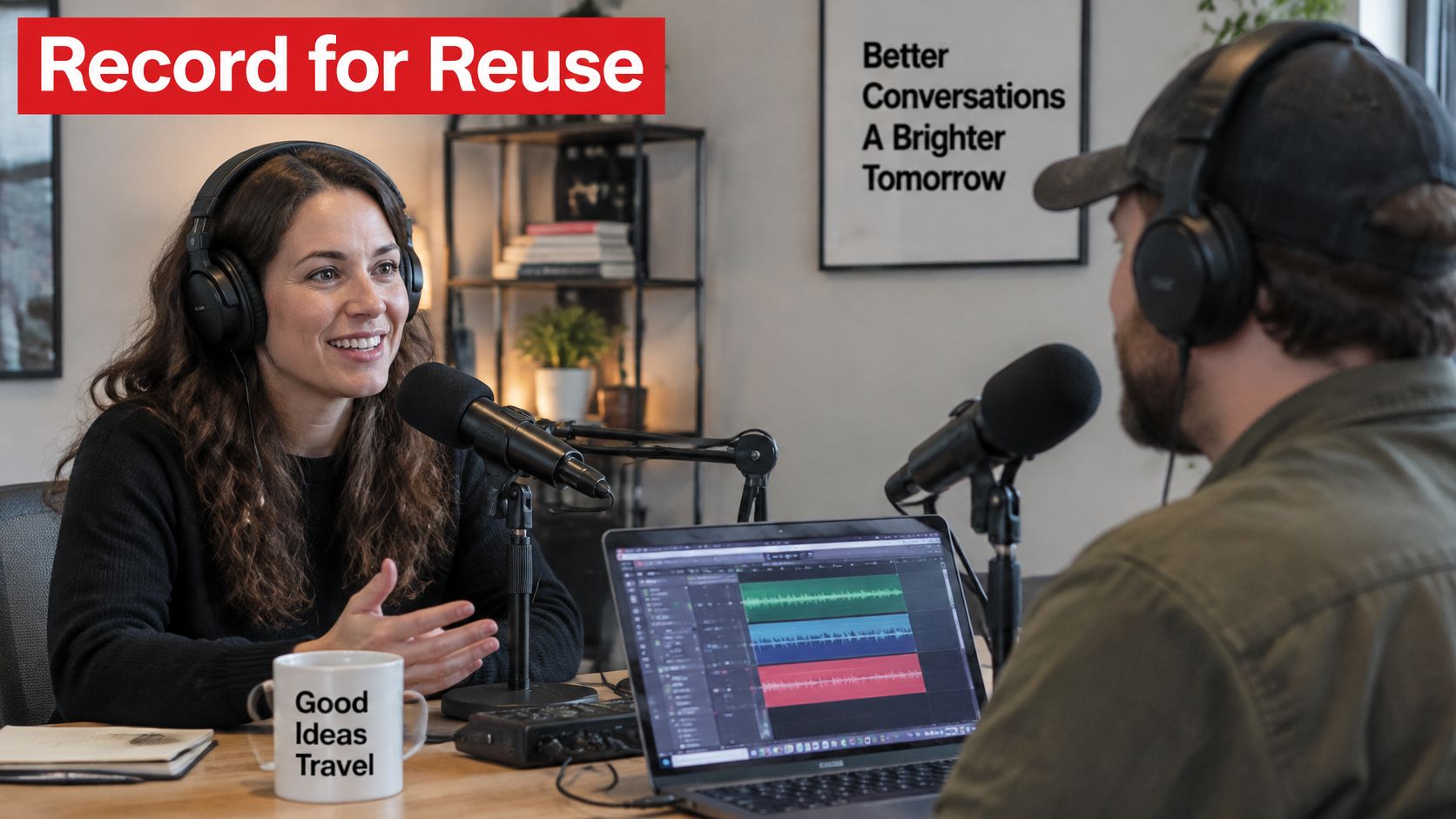
Prepare the source package during production
Record each speaker on a separate track. Separate tracks let an editor replace or rebalance one voice without disturbing the others. A single mixed track can make it difficult to duck an English speaker beneath a dubbed voice or fix one guest's audio independently.
Capture room tone in every recording space. Record a clean stretch of silence after the conversation, without moving microphones or furniture. Editors can use it to fill gaps and smooth dialogue edits without introducing abrupt changes in background sound.
Log timecodes and edit points. Mark the beginning and end of each kept segment in the session notes, and identify cuts, pickups, and speaker changes. Translators and voice talent can then match their work to the source instead of guessing where a line belongs.
Export a lossless master. Keep the uncompressed or losslessly encoded master as the reference for all language versions. A compressed listening file is useful for review, but it shouldn't be the source for editing or detailed transcript work.
Create a speaker-labeled transcript from the master. Label who's speaking and preserve the timecodes. The labels matter in interviews, where a translation can otherwise blur a host's question and a guest's answer.
Keep music and effects separate. Export music beds, stingers, and sound effects as their own stems. Then the target-language mix can retain the show's identity while replacing or adjusting only the speech.
Build a terminology file before the session closes. Record names, product terms, recurring phrases, and preferred pronunciations while the hosts and producers can still confirm them. A glossary created after dubbing starts can lead to inconsistent choices across scripts and episodes.
Skipping stems can produce avoidable rework. For example, if an intro's music and speech are mixed together, the team may have to rebuild the opening to make room for a Spanish voiceover. A separate music stem makes that adjustment much simpler.
For a practical companion on editing sessions and dialogue, see this guide to audio editing for podcasts. Before handing an episode to localization, check that the source package contains separate speaker tracks, room tone, edit notes, a lossless master, a time-coded transcript, music and effects stems, and a glossary.
Casting Voice Talent Without Losing Speaker Identity
Listeners need to recognize who's speaking and what kind of person they're hearing. A voice that matches the host's language but not their manner can make a familiar show feel like an advertisement. Casting should preserve the original speaker's role and character, not imitate an accent or chase a superficial voice match.
Audition candidates on the same passage from the English episode, ideally one that includes a proper name and a technical term. That makes it easier to compare pronunciation, pacing, and how each person handles the same material. Listen for the host's register, too. A consultant who speaks with calm authority shouldn't suddenly sound like an energetic announcer in German.
Keep the cast coherent
Choose a consistent voice for each speaker and keep that voice across episodes. In a multi-speaker interview, audition the host and guest voices together, not just in isolation. If both voices have similar pitch, rhythm, and delivery, listeners may struggle to follow who said what, even if the script is accurate.
Give the voice talent more than a script. Include the terminology glossary, pronunciation guidance, a short profile of each speaker's style, and examples of the desired energy. Explain where the host tends to pause, how the guest expresses uncertainty, and whether the show favors conversational warmth or a more formal presentation. A guide to turning scripts into natural AI speech can help teams understand the production options, but a natural-sounding synthetic voice still needs direction and review.
Consider a founder interview in which the English-speaking guest says a product “may reduce” a particular risk. If the translated answer turns that cautious statement into a guarantee, the issue is not merely vocal style. A reviewer needs to compare the translated line with the original meaning, and separate source tracks can help clarify which speaker made the claim.
Set consent terms before using synthetic voices
If you use a cloned voice, get written consent that states the permitted scope, languages, and term of use. Decide how listeners will be told that the audio is synthetic, and make that disclosure consistent with your publishing approach. Don't treat permission to clone a voice as blanket approval for every future episode or use.
Human voice talent is the safer choice for emotional episodes, sensitive subjects, and high-stakes branded content. Synthetic voices can be useful for testing or for predictable formats, but they still require human review for speaker identity, emotional nuance, and meaning. For an episode where a guest's credibility or a careful qualifier carries real weight, the cost of a flat or misleading delivery can outweigh the production savings.
Translate, Dub and Gate Each Language Version
A word-accurate dub can still fail the market. The translated line has to carry the same intent as the source and land inside the same timing window without sounding squeezed, a constraint known as isochrony. Research on English-to-Italian dubbing found that explicitly optimizing prosodic alignment improves timing alignment and subjective quality, so sentence length, pauses, and emphasis deserve the same attention as word choice (English-to-Italian dubbing study). Treat each language as a separate product with its own release decision, because a clean pass in Spanish proves nothing about the German version.
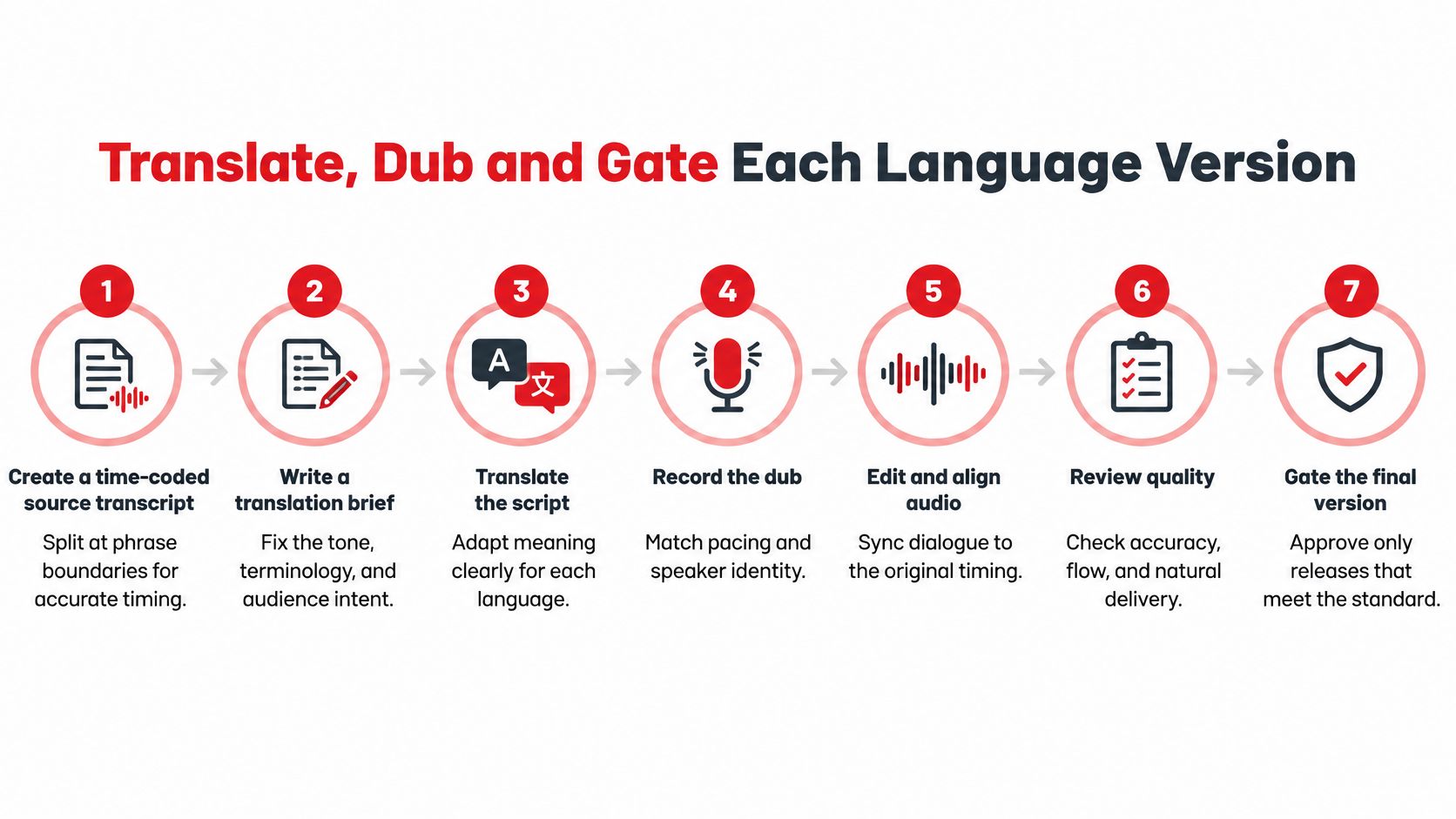
Run the same pipeline for every language
Create a time-coded source transcript. Split it at phrase boundaries and preserve segment timecodes. Sentence-level blocks that run long can hide the pauses and cut points the voice talent needs.
Write a translation brief. Specify terminology, names, emphasis, tone, and speaking intent. Attach a pronunciation dictionary and examples of the speaker's style so the translator and voice talent share the same reference.
Translate, then adapt the script for timing. Preserve meaning while shortening or restructuring lines that will not fit the source window. Literal translation breaks the timing, and compressing every line makes the delivery sound rushed.
Record or generate the target voice. Match the source's pacing and pauses while letting the voice sound natural in the target language. Chasing a perfect visual match at the cost of intelligibility is a bad trade, particularly for audio-only releases.
Complete a native-speaker linguistic review. Check the target script and rendered audio for accuracy, pronunciation, idioms, and meaning. An expression can be correctly translated and still feel out of place in a local business context.
Review the mix. Compare dialogue levels, room tone, and music balance with the source. Inspect every segment for omissions, unnatural pauses, clipping, and inconsistent speaker identity.
Re-transcribe the rendered audio and measure word error rate. Compare the new transcript with the approved target script to catch dropped or misheard words. WER works as an intelligibility check. It cannot judge delivery, emotion, or whether the voice stays consistent across episodes.
Use a native-speaker panel to score naturalness, meaning preservation, voice consistency, and prosodic fit. The prosody-transfer study evaluated 1,200 parallel utterances and found a statistically significant 6.2% MUSHRA improvement for phrase-level prosody modeling over utterance-level transfer, which is why phrase-level control shows up in perceived quality. Text-based scores alone will not catch a dub that flattens emotion or rushes a line, so pair them with structured listening review. Automated dubbing tools keep improving, and the Autodub tool overview gives a sense of how the category is packaged for buyers. Even with a strong tool in the chain, the output still needs the acceptance tests above, because automated delivery still drifts on emphasis, pacing, and speaker identity over long episodes.
Hold every language to a release gate
Gate | Pass Standard | Sign-off |
|---|---|---|
Semantic accuracy | Zero critical semantic errors | Native-language reviewer |
Terminology | Names and brand terms approved in the glossary | Brand owner |
Audio integrity | No clipping and no missing segments | Audio editor |
Voice consistency | Same voice and accent as earlier episodes | Producer |
Loudness | Measured against the target distribution specification | Audio editor |
Intelligibility | Word error rate on re-transcribed audio checked against the approved script | QA lead |
A language version fails on a single critical semantic error, even when the mix sounds polished. For video, add visual timing and lip-sync checks; for audio-only feeds, spend that review time on intelligibility and pacing. The payoff of gating each language separately is speed where it counts: a version that passes ships on schedule, while a version that fails gets reworked or delayed without holding the other markets hostage.
Distribute Language Feeds and Measure Results by Market
A translated episode is hard to discover if the title, description, or show notes still speak only to the English audience. Publish each language as its own feed where the platform supports it, with language-specific metadata and cover art. Translate show notes, chapters, and transcripts, then confirm that the feed's language tag matches the audio.
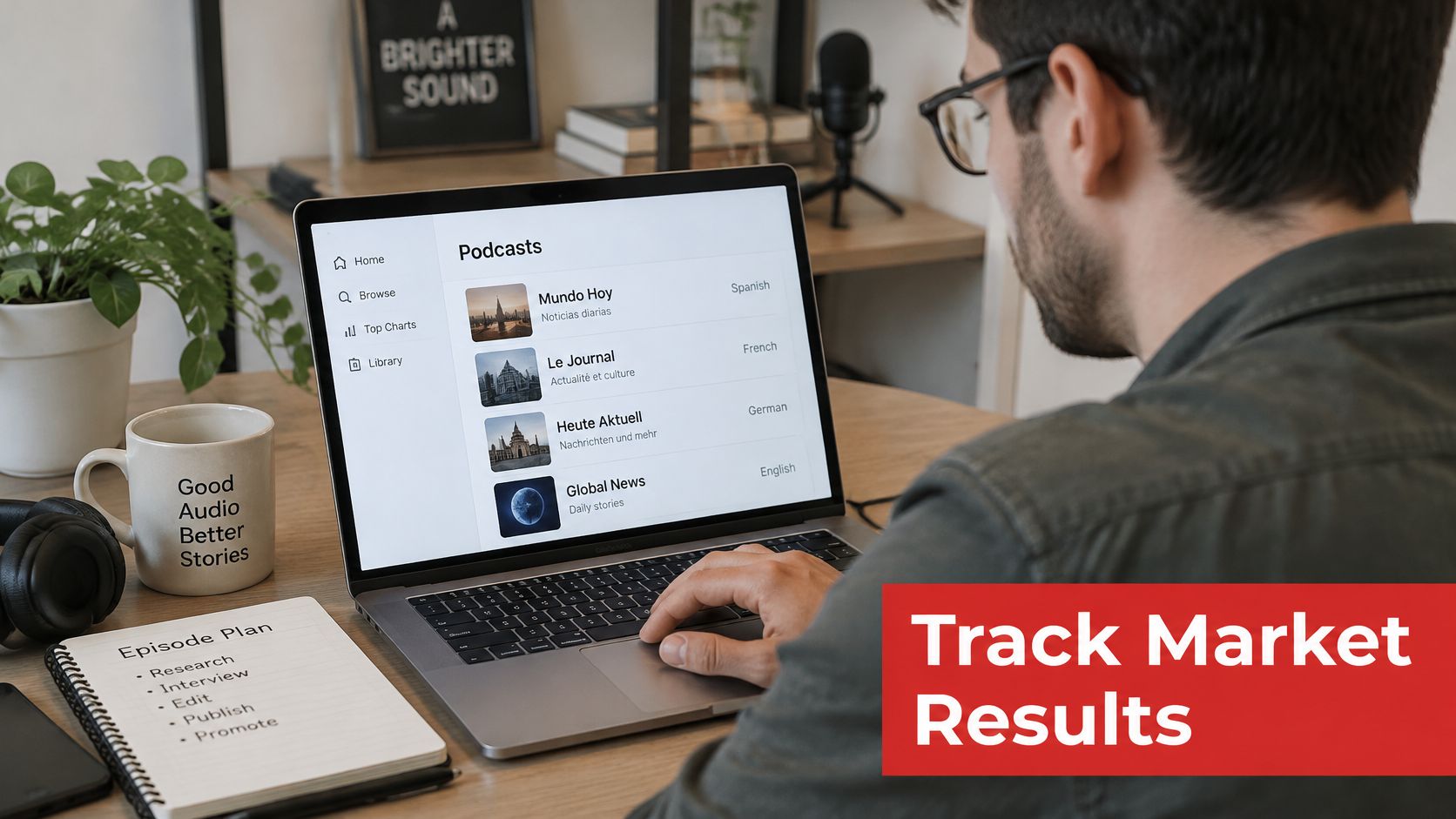
Treat metadata as part of localization, not a final administrative task. A translated title may need local phrasing to communicate the episode's promise, while retaining the brand name or a technical term that the target audience already recognizes. A word-for-word title can be accurate and still sound unnatural in search results.
Use metrics to choose the next production move
Metric | Where to Read It | Decision It Informs |
|---|---|---|
Completion rate by language feed | Hosting platform analytics for each feed | Whether the episode holds listeners |
Follows or subscribers per feed | Platform dashboards | Whether the market is growing |
Lead or signup quality by language | CRM with a language field | Whether the market deserves more budget |
Cost per listener in paid media | Ad platform reports | Whether to fund paid promotion in that language |
Transcript and caption views | Player or hosting statistics | Whether level-one assets are working |
Compare feeds using the same measures, not total downloads. A large download count can reflect paid promotion or broad curiosity without showing that listeners stayed, followed, or became qualified leads. If a Portuguese feed attracts listeners but has weak completion, test a tighter opening before commissioning more dubbing. If transcript views rise but audio engagement remains limited, improve the path from the translated asset to the episode.
Review each market's metrics monthly during its initial three months, then quarterly. That rhythm gives the team time to identify a fix without treating every short-term fluctuation as a reason to change the whole production plan.
Use the show's distribution guide to coordinate publishing across platforms, feeds, and supporting assets: how to distribute a podcast.
For a video podcast, the same language plan should cover the full package, not just dialogue. Consider how localized captions, clips, and metadata will work across the channels where viewers find the show.
Budget, Timeline and Tooling
A single per-episode price hides the work that grows as a show adds languages. Budget by cost driver so you can compare a metadata test with a full dub and see which production choices multiply across the whole workflow.
Cost driver | What it multiplies |
|---|---|
Language count | Every production stage in each language |
Episodes per month | Translation, voice, and QA hours |
Voice talent | Talent fees per language per episode |
QA hours | Native review, ASR runs, and listener panel |
Paid promotion | Cost per listener in each market |
Five kinds of tools support the workflow. A multitrack recording setup preserves separate speaker tracks and sound stems. A transcription tool should produce speaker-labeled transcripts and be able to re-transcribe the rendered audio for WER checks. A translation workspace keeps the brief, glossary, and pronunciation dictionary together. A loudness meter lets the audio editor check the release against the selected distribution specification. Finally, use a shared review space where native reviewers can comment on specific script segments and audio timecodes.
Set the sequence before spending on a dub
Choose markets and localization levels before committing to voice and dubbing costs. Metadata work may take about a day per episode; full dubbing is better planned in batches that can take weeks. Those are different production commitments, so start with a smaller pilot and scale only after its language version clears the release gate.
Calculate the recurring workload by episode volume and language count, then reserve separate time for native review and mix QA. Paid promotion also needs its own line in the plan because a market can show organic interest without being a sound place to buy additional reach.
For the team comparing production scope and spend, this overview of podcast production services pricing can help frame the discussion. Keep the budget decision tied to the work required in each language, rather than treating translation as a single line item.
Decide Whether to Build In-House or Hire a Partner
Build in-house when volume is modest and one producer can hold the whole chain: freelance translator, native reviewer, voice talent, audio handoffs, approvals. That keeps creative control close, but the producer absorbs terminology drift, missed timecodes, consent terms, and reshoots when a line reads cleanly in English and lands wrong in the market.
A partner earns the fee when several language versions move at once and each one still needs its own release gate. Outsourcing shifts coordination while accountability stays with you. Before production starts, name who approves each gate, who owns the glossary and pronunciation dictionary, and who can stop a release when pacing, loudness, or speaker identity slips.
Keep the decision tied to accountability
Use identical acceptance criteria either way. Ask who performs native review, whether the listener panel is in-house or subcontracted, and who signs off semantic accuracy, terminology, audio integrity, voice consistency, loudness, and intelligibility. Require reporting by language feed, since aggregate downloads can hide one market that is underperforming.
If the partner runs a distributed bench rather than one studio team, Filta's guide to remote podcast teams is useful for thinking through roles and handoffs. For multilingual work, add one stricter test: every language has a named owner from script adaptation through final approval, with authority to send a version back before it reaches Spotify, YouTube, or social cuts.
Podmuse covers concept development, recording, editing, publishing, and distribution, and its agency services list localization, monitoring and alerts, audience growth, interview booking, podcast marketing, and creative support. That scope suits teams that want one accountable production lane while hosts stay on hosting and content.
Decide by failure mode. If your risk is losing voice or control, keep casting and approvals inside. If your risk is missed gates across languages, hire the partner and put the gate criteria, reporting cadence, and release-stop owner in writing.
Podmuse supports podcast production from concept through editing, publishing, and distribution, and its services include localization and audience reporting. If you're planning multilingual podcast production, visit Podmuse to discuss a market-specific release gate and the workflow needed to launch each language with control.
Comments