
Real Estate Podcast Marketing Playbook for 2026

Your brokerage's planning deck keeps mentioning podcasts, but nobody owns the budget. Or you've already sponsored a show, the host sounded convincing, and the sales team still can't tell whether the campaign influenced any appointments.
Both situations call for the same decision: what local job should the podcast do? Real estate podcast marketing works best when you choose a format for a specific objective, then measure whether people remember your brand and move toward a qualified conversation. Downloads alone won't answer that question, and neither will the first week's form fills.
Table of Contents
Why Housing Brands Are Buying Podcast Inventory - Buy relevance rather than a housing label
Choose the Podcast Path and Produce Episodes That Last - Make the production decision before recording - Build a repeatable publishing workflow
Buy Host-Read Ads as a Conversion System - Qualify the inventory before approving the read - Negotiate delivery, not just a mention
Read Lift Before You Read Cost per Lead - Use norms without turning them into promises - Separate attribution from causation
Stop the Mistakes That Burn the Next Flight - Fix the operating failure at its source - Keep the improvement order simple
Brief One Market Before You Scale - Assign the work your team can maintain
Why Housing Brands Are Buying Podcast Inventory
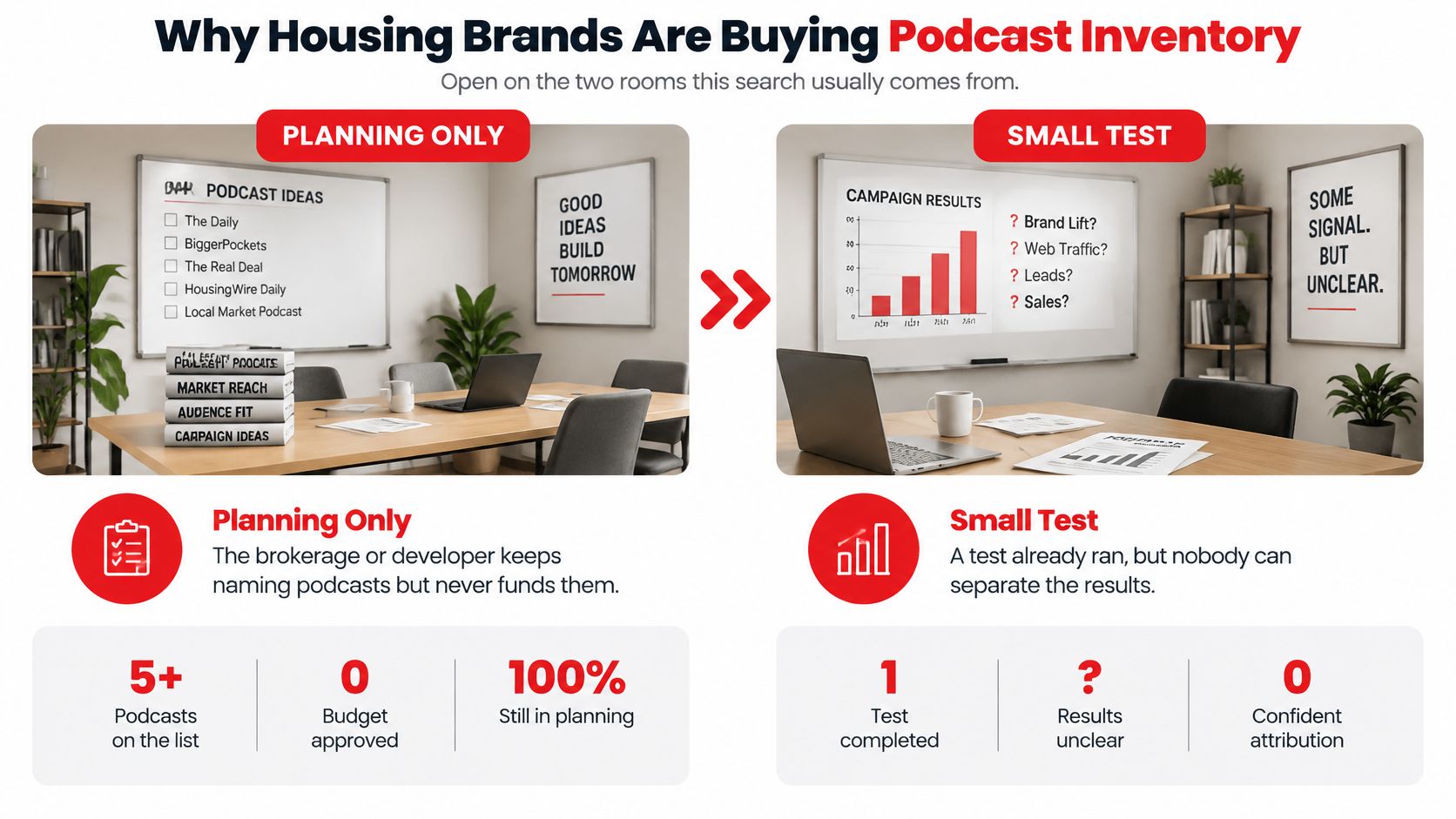
Say a developer wants attention for a new community while its brokerage partner wants seller appointments across the surrounding market. Both suggest podcasts. They're discussing the same medium, but they aren't buying the same outcome.
The developer might need buyers to understand the project's location and practical trade-offs. The brokerage needs homeowners to remember a useful reason to request a valuation. Buying an undifferentiated sponsorship won't resolve that mismatch.
The scale justifies a serious planning conversation. U.S. podcast advertising revenue reached approximately $2.862 billion in 2025, up 17.6% year over year, while Edison Research data cited in Wildcast's real estate advertising analysis indicates that 56% of weekly podcast consumers own their homes. Advertisers are buying host-read endorsements, sponsorships, and programmatic placements, not just experimenting with an unfamiliar format.
That homeowner audience has exposure to housing decisions, but exposure isn't a lead list.
Homeownership signals exposure to housing decisions, not immediate intent to buy or sell.
These are the common starting positions before a team makes an actionable commitment.
Buy relevance rather than a housing label
A local culture or business show can offer community credibility even if it rarely discusses property. A national investing program may suit a developer's investment thesis while wasting money for an agent who only serves a narrow listing area.
Match the audience to the decision:
Community credibility: Local shows can introduce the people, services, and practical knowledge behind a brokerage or development.
Thought leadership: Business and investing programs can give an executive room to explain a market position, development approach, or investment discipline.
Specialist demand: Targeted inventory can support mortgage, property-management, commercial real estate, or home-services campaigns when listener interests align.
For the hypothetical developer, a neighborhood-focused series might explain access, ownership responsibilities, and the project's development story. For the brokerage, a locally relevant host could introduce a seller-preparation service. Neither needs to begin with a conventional interview show.
The operating commitment matters more than the launch announcement. Assign someone to placement selection, message testing, delivery checks, and attribution. Budget for repeated exposure and creative revision rather than assuming a single brand mention will produce recognizable demand.
Before anyone books a studio or an advertising flight, choose the path whose controls and evaluation window fit the business objective.
Choose the Podcast Path and Produce Episodes That Last
Five real estate podcast paths and when to fund each
These are recommended planning windows, not measured promises of performance. Use them to agree on when the team will review progress before committing resources.
Path | Best when | What you control | Primary KPI | Fair read after |
|---|---|---|---|---|
Branded show | Local authority, recruiting, or a neighborhood archive | Format, guests, and the back catalog | Branded search and appointment or recruit quality | Plan for 90 days or more |
Host-read sponsorship | A remembered offer in one defined market | Claims, CTA, and a spoken tracker | Aided recall, information-seeking, tracked calls | Flight plus 30-90 days |
Programmatic or pre-recorded | Host inventory is thin and frequency is the goal | Creative, frequency cap, and geography | Reach, frequency, assisted site visits | During the flight |
Guest bookings | A founder or broker should borrow an existing audience | Pitch and talking points | Referral traffic and inbound from that show | Plan for 30-60 days |
Video-first series | Search, clips, and email need a durable asset | Titles, clips, and YouTube distribution | Search impressions and qualified local visits | Ongoing, review monthly |
Fund one path in one market until its primary KPI moves. Otherwise, you can end up with a studio expense, a sponsorship expense, and no clear explanation of which activity deserves another allocation.
An owned show gives you editorial control but creates a continuing production obligation. Sponsorship borrows an established audience but limits your control over the surrounding program. Guesting lowers the production burden, although you can't dictate the host's questions or publishing schedule.
Make the production decision before recording
Lock one objective. Choose seller appointments, first-time buyer education, investor education, agent recruiting, or national brand scale. Write the audience's decision problem next to it. A seller-education program should help owners decide what to prepare before listing, not drift into general conversations about entrepreneurship.
Match the format to that objective. Use a market update to explain changing conditions, a neighborhood series to answer location questions, or a development story to explain design and ownership choices. Financing explainers and market-myth tests work when confusion blocks action. Property walkthroughs need a practical question beyond whether the rooms look attractive. A weekly interview is an editorial choice, not the definition of a podcast. If guests repeatedly give interchangeable answers, replace the interview with a focused explanation that a prospective customer can use.
Choose audio-only or video deliberately. Use video when visual explanation, searchable episodes, and reusable clips justify the extra work. Choose audio-only when showing property details creates unnecessary privacy or fair-housing risk, or when the team can deliver a stronger conversation without managing cameras. Video-podcast advertising is also becoming a distinct measurement environment: Signal Hill Insights announced YouTube video-podcast brand-lift measurement in April 2025, covering integrations including ad placements, custom segments, branded episodes, and branded shows. That makes measurement possible, not production automatically worthwhile.
Draft a finite launch slate. As a working production exercise, write eight searchable episode titles before booking guests. A first-time buyer series might address payment components, inspection decisions, ownership costs, and the questions to bring to a lender. Each title should identify a location or a decision problem, not merely name the guest. Put the intended CTA beside every title. If every topic needs a different offer, the editorial scope is probably too broad.
Build a repeatable publishing workflow
Record clean audio first. Use a close microphone, headphones, and a quiet room with soft furnishings. Record a test, listen for fan noise and echo, and check remote guests before beginning the conversation. A simple set is workable; an important answer buried under room noise isn't.
Plan the derivative assets before the session. A useful starting package is the full episode, several self-contained clips, and an email recap. Mark the strongest explanations during recording so the editor isn't searching an entire conversation for a usable answer. Give each clip enough context to stand alone. A financing answer needs the question and relevant qualification, not just the speaker's most dramatic sentence.
Publish with local context and a clear next action. Distribute the audio to Spotify and Apple Podcasts, and publish the video version to YouTube when that's the chosen format. Include descriptive show notes, guest roles, relevant locations, and a compliant CTA. Send listeners to the resource that matches the episode: a buyer consultation, seller-preparation checklist, development information request, or recruiting conversation. Don't send every audience to a homepage and expect them to reconstruct the offer.
Production rule: Approve the topic, distribution assets, and next action together. An episode without a distribution plan is unfinished marketing.
At that point, the slate is ready for distribution. Producing it doesn't mean you've bought advertising inventory or established paid reach.
Buy Host-Read Ads as a Conversion System
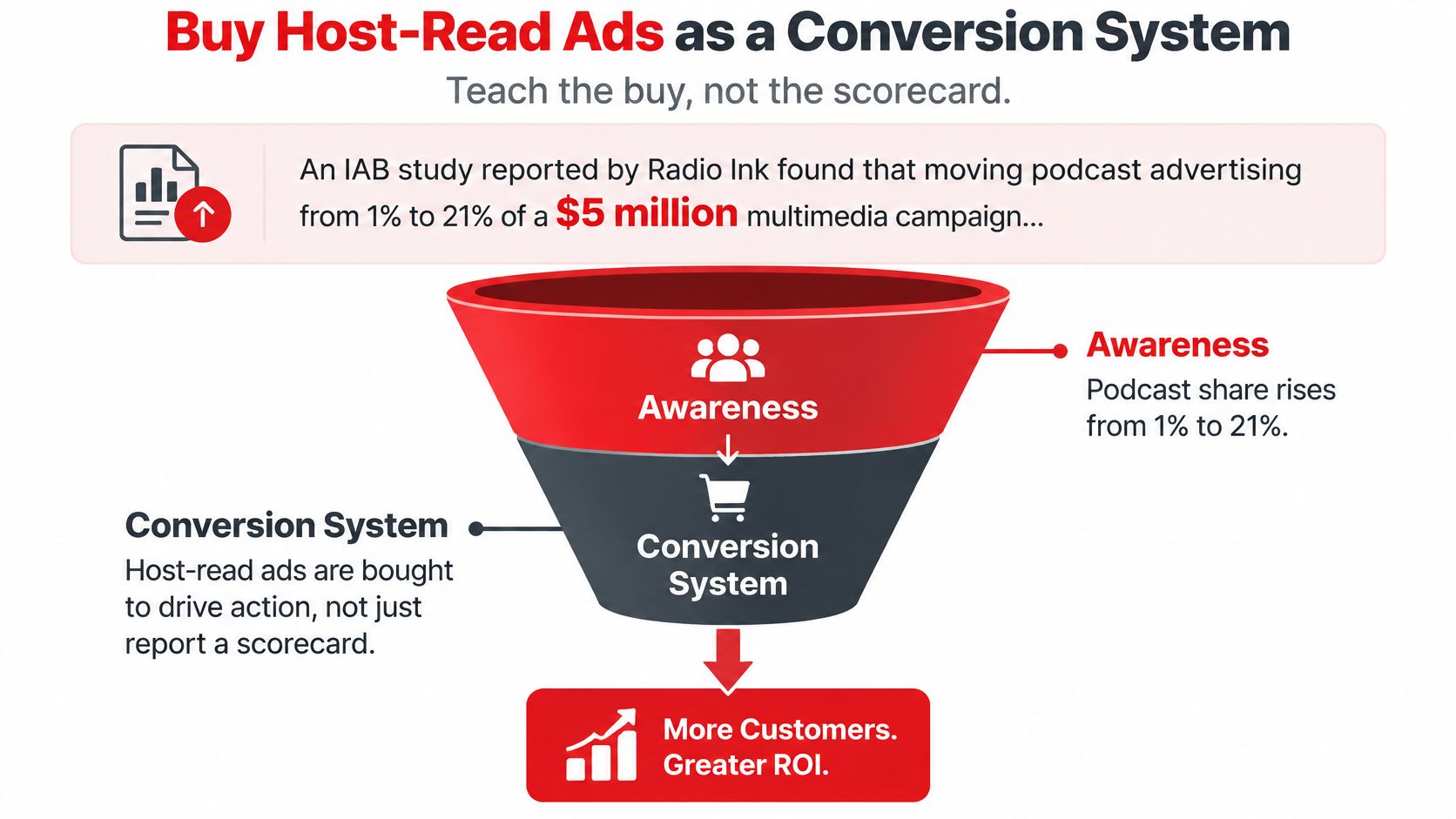
An IAB study reported by Radio Ink found that, in 2025, shifting podcast advertising from 1% to 21% of a $5 million multimedia campaign increased reach among adults aged 18-44 from 60% to 76%, a 27% lift without increasing total spend. That's a media-mix result, not a real estate conversion forecast, but it supports evaluating podcasts as a meaningful allocation rather than leftover budget.
The buying logic starts with the job you need the placement to perform.
Qualify the inventory before approving the read
Request audience geography, homeowner or renter composition, income information where available, and topical fit. Ask how the publisher estimates local reach and whether delivery comes from new episodes, the back catalog, or dynamically inserted inventory. A large national download count doesn't establish enough relevant listeners in your service area.
Use pre-roll when broad awareness is the assignment. For qualified inquiry, prioritize testing mid-roll: Nielsen's emerging-media analysis reports that host-read ads perform slightly better than non-host-read ads for awareness and have greater impact in mid- and lower-funnel activations. Placement still needs to earn its cost through audience relevance and a usable offer.
Build the host brief around a compact creative checklist:
Positioning: Tie the brand to a specific problem, such as neighborhood discovery, valuation, financing, or relocation.
Proof: Supply concrete, approved reasons to believe the positioning rather than a string of promotional adjectives.
Action: Give listeners a compliant next step that matches their likely readiness.
Spoken tracker: Use a memorable vanity URL, code, or call-tracking number, and confirm its pronunciation.
Let the host deliver the message conversationally. Lock factual claims, required disclosures, and the destination so authenticity doesn't become improvisation about lending terms or investment returns.
Negotiate delivery, not just a mention
Request CPM or flat-fee quotes for each shortlisted show and compare the quote with estimated relevant local delivery. Use the podcast advertising rates guide to structure the pricing discussion, not to substitute a generic benchmark for a show-specific proposal.
Confirm frequency controls where available, episode rotation, competitor adjacency, reporting, and what happens if delivery misses the agreement. Maintain separate creative and tracking IDs by host, position, market, and flight so the operations team can identify what ran.
For a closer look at the advertising format, use this video alongside the written buying brief.
Cut overlong property descriptions and copy that could advertise any agent. Unsupported claims about rates or returns don't become acceptable because a trusted host reads them. Treat the split between shows and positions as a test-and-learn decision, not a universal budget formula.
Read Lift Before You Read Cost per Lead
A podcast campaign can produce remembered advertising without producing an immediate appointment. It can also produce a tracked inquiry that would have happened anyway. Measurement needs to distinguish response from incremental influence.
Start by defining the market, property category, audience, and funnel job. Awareness among relocating professionals calls for a different evaluation than appointment generation among owners actively considering a sale.
Then build the observation system:
Separate placement destinations. Assign each placement its own landing page, vanity URL, promo code, or call-tracking number.
Record the baseline. Capture existing branded search, direct traffic, qualified inquiries, and appointment quality before launch.
Create a comparison. Use exposed listeners and a matched unexposed group for a brand-lift or conversion study, with comparable survey questions and timing.
Use norms without turning them into promises
The following are cross-category norms, not guaranteed real estate close rates. Nielsen's Podcasting Today report draws its podcast norms from nearly 2,000 case studies and reports the awareness, information-seeking, purchase-intent, and advertiser-fit findings below, alongside its broader emerging-media recall findings.
Podcast benchmarks for a real estate flight
Metric | Benchmark | When to read it | What hides it |
|---|---|---|---|
Awareness lift | About 10 percentage points | Brand-lift study | Treating downloads as success |
Information-seeking lift | About 8 percentage points | Same study | One URL shared across shows |
Purchase-intent lift | About 6 percentage points | Same study | Last-click cost per lead only |
Advertiser fit | 66% of exposed listeners | Post-exposure | Ignoring show-topic match |
Aided recall | 71% exposed vs 50% unexposed | Exposure study | No unexposed control |
Recall share of brand lift | 38.7% | Emerging-media analysis | Optimizing leads before the message |
Assisted conversions | CRM match or holdout, not a numeric benchmark | Recommended 30-90 days after flight | Stopping at form fills |
Use separate clocks for direct response during the flight and lagged assisted conversions afterward. Property searches and transactions require more patience than a checkout purchase, so the CRM review shouldn't end when ad delivery stops.
Watch for these scoring errors:
Inflated local reach: Counting an entire audience as reachable customers in your market.
Collapsed tracking: Reusing the same destination across shows and losing placement-level distinctions.
Last-click tunnel vision: Ignoring influenced branded search, direct visits, and offline inquiries.
Separate attribution from causation
Reconcile exposure logs with CRM records where available and appropriate, including source notes from telephone inquiries. A podcast attribution model can organize those touchpoints, but a recorded touchpoint alone doesn't prove incremental impact.
When budget allows, use a holdout market or an unexposed listener sample. SourceLoop's explanation of causal testing for ad effectiveness is useful for distinguishing outcomes associated with advertising from outcomes the advertising caused.
Optimize memorable brand-plus-benefit linkage before chasing cheaper leads. If listeners remember the host's story but can't name the advertiser or explain its value, the creative needs work before the sales team needs more traffic.
Stop the Mistakes That Burn the Next Flight
The weekly publishing promise is often the first avoidable mistake. A managing broker agrees to host, then client work repeatedly displaces recording. Choose a cadence the host can sustain and bank finished episodes before announcing the launch.
The next mistake is treating local relevance as a word swap. Changing the city name in a generic script doesn't explain why a listener should care. Rewrite the decision problem, supporting example, and offer for that market.
Fix the operating failure at its source
Protect neighborhood language: Keep fair-housing-sensitive claims in the approved script. Don't invite a host to improvise who a neighborhood is for.
Approve property visibility: Remove footage or identifying details the seller hasn't authorized before publishing a walkthrough.
Brief guests locally: Give guests a concise sheet of checked local facts and the intended offer. Cut answers that wander beyond their knowledge of the area.
Make clips discoverable: Put the neighborhood or decision problem in the title and caption. An inside joke doesn't explain why a prospective customer should watch.
Respect the decision window: Don't cancel because the opening episodes or a short flight haven't produced transactions. Check the agreed leading indicators before making the renewal decision.
A polished episode can still fail these checks. Production quality doesn't compensate for an irrelevant guest, an unapproved claim, or a destination that nobody on the sales team monitors.
Don't expand a campaign whose tracking and sales notes tell incompatible stories.
Keep the improvement order simple
Do test message recall, then qualified site behavior, then appointments. Don't add another market until the tracker, call records, and CRM notes provide a coherent account of the current market's inquiries.
When a program stalls, reconsider the selected path before adding another tactic. The path table is a funding decision tool, not a checklist of channels every brokerage needs to operate.
Brief One Market Before You Scale
Write a brief that someone outside the planning meeting could execute. Use podcast market research to challenge the audience assumption before approving production or inventory.
Local specificity starts with the questions a buyer needs answered. Dream Destin Realty's guide to buying a home in Destin is an example of a location-specific resource to review when developing relevant episode questions, rather than relying on generic national topics.
Assign the work your team can maintain
For an owned show, approve the launch slate and recording format. For advertising, approve the shortlist, placement position, locked claims, and host-specific tracking. For guesting, name the speaker and the programs whose audiences already care about the market.
Bring in outside help when your internal team wasn't hired to edit episodes, negotiate inventory, or maintain campaign reporting. At Podmuse, we produce and market podcasts for real estate brands, including residential and commercial developers, and build custom advertising plans covering host-read ads, programmatic placements, and in-app promotions.
Finish with these lines:
Market: The service area you can realistically convert.
Objective: The audience decision you intend to influence.
Path: The format you'll fund first.
Fair read: The primary KPI and agreed evaluation window.
Choose the contact option that matches that decision: advertise a product or service, create podcast content or grow a podcast, or book podcast and YouTube interviews. Run the defined market before adding another path.
Turn that brief into an executable production, advertising, or interview-placement plan with Podmuse. Bring your market, objective, chosen path, and measurement window so the conversation starts with the business outcome, not a default weekly show.


Comments