
Podcast Advertising Rates: A 2026 Buyer's Guide

In 2026, podcast advertising rates typically run $5–$15 CPM for programmatic spots and $25–$40 CPM for host-read sponsorships, so the first decision isn't “how much,” but which buying format fits the campaign objective. A cheap impression can be the wrong purchase if your offer depends on credibility, while a premium placement can waste budget if you only need broad reach.
You're probably comparing a media kit quoting one rate, a network proposal quoting another, and a programmatic platform promising scale at a fraction of the price. The numbers look comparable until you ask what each impression represents, how long the ad remains available, whether the host is involved, and how confidently you can connect a listen to a qualified action.
Podcast advertising rates are not a universal price list. They're the visible result of inventory type, audience value, placement, delivery method, and measurement quality. The buyer's job is to convert those variables into an economic decision.
Table of Contents
The Real Decision Behind Podcast Advertising Rates - Cheap reach and expensive attention
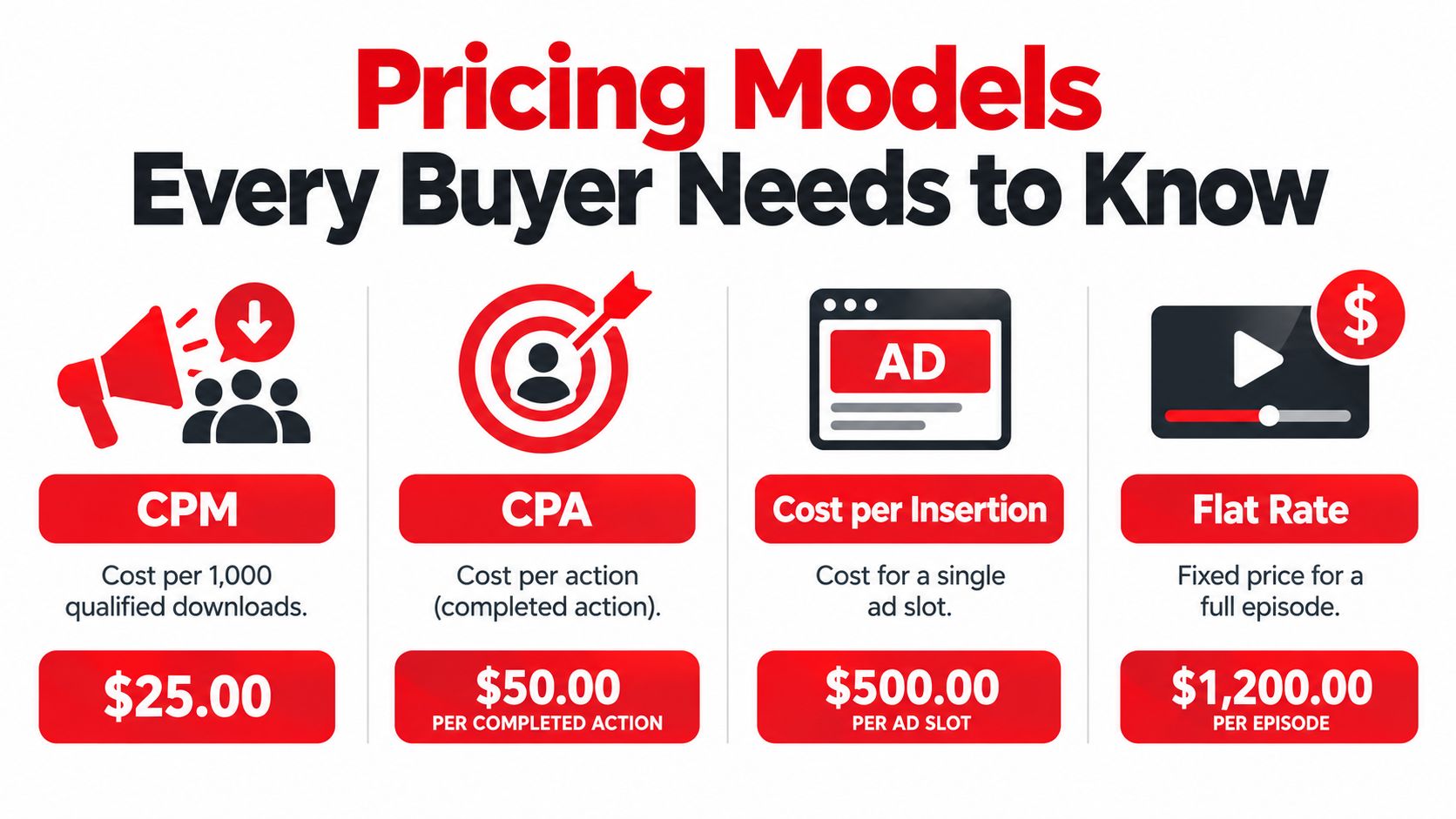
Pricing Models Every Buyer Needs to Know - CPM is the baseline - Flat fees simplify sponsorships - CPA shifts the risk - Insertion cost and format are separate decisions
What Moves the Rate - Audience value outranks raw size - Placement changes attention - Host involvement creates a different product - Delivery mechanics affect value
Benchmark Rate Cards by Audience Size - Turn the table into campaign cost - What to request before approving
Calculating Cost and ROI Step by Step - Step one is total media cost - Add the costs that appear outside the rate - Use response quality, not just response volume
When the Host-Read Premium Is Worth It - Pay the premium in three situations
Negotiation, Buying, and When to Bring in an Agency - Negotiate the parts that affect outcomes - Build measurement before launch - Decide whether you need an agency
The Real Decision Behind Podcast Advertising Rates
A demand-generation leader recently described the standard buying dilemma: a programmatic package offered efficient reach across relevant shows, while a host-read sponsorship cost several times more for fewer estimated impressions. The programmatic option looked rational in a spreadsheet. The host-read option looked more credible in the context of a complex product. Neither proposal was automatically better.
Programmatic placements commonly fall around $5–$15 CPM, while host-read sponsorships commonly range from approximately $25–$40 CPM. Those benchmarks are useful starting points, but they represent different products. Programmatic buying purchases scalable, dynamically inserted exposure. A host-read sponsorship purchases access to the host's voice, context, and relationship with listeners. Current podcast CPM benchmarks reflect that difference in format and audience economics.
Cheap reach and expensive attention
A programmatic spot can be the right answer when you need geographic targeting, controlled frequency, or fast delivery across a large set of shows. It gives media buyers more levers for scaling and optimization, especially when the creative is already proven and the offer has broad appeal.
A host-read placement earns its premium when the listener needs a reason to believe you. That's common in B2B software, financial products, professional services, health products, and high-consideration consumer categories. The host can add context that a produced spot cannot replicate, although the value still depends on the host's actual audience fit and ability to deliver a natural endorsement.
Buyer's rule: Never compare CPMs without comparing the attention, trust, lifespan, targeting, and measurement attached to each impression.
Two campaigns with the same CPM can produce radically different economics. One may count a downloadable impression across dynamically inserted inventory. The other may deliver a durable, baked-in endorsement that remains in an episode for future listeners. One may reach a broad audience with limited commercial relevance. The other may reach a smaller group of people who match your ideal customer profile.
That's why the cheapest rate rarely deserves the automatic win. Start with the campaign objective, then choose the inventory that can plausibly produce the required action. Awareness, qualified reach, direct response, and category authority require different buying decisions.
Pricing Models Every Buyer Needs to Know
A $30 CPM can describe a durable host endorsement, a dynamically inserted spot, or an impression estimate with limited delivery protection. Those purchases carry different response potential, so separate the billing model from the ad format before comparing proposals.
CPM is the baseline
CPM, or cost per thousand impressions, gives buyers a common comparison unit. Podcast sellers may define an impression through qualified downloads or listens, depending on their reporting method. The calculation is:
Total impressions ÷ 1,000 × CPM = media cost
At a $30 CPM, 100,000 qualified impressions imply $3,000 in media cost before production, agency, or platform charges. Use CPM to compare media cost, then inspect what sits behind it. Ask how the seller defines a qualified impression, whether delivery is guaranteed, and whether the placement is baked-in or dynamically inserted.
The gap between formats reflects different audience economics, not just different pricing.
Flat fees simplify sponsorships
A flat-rate sponsorship charges one fixed amount for an episode, package, or broader partnership. Shows with a highly specific audience, limited inventory, or a direct host relationship often use this structure. It provides budget certainty, but it removes the clean impression benchmark that CPM offers.
You can still evaluate a flat fee. Request expected downloads or listens, calculate the implied CPM, and judge audience quality separately. Do not reject the model because it lacks a CPM. Reject it when the seller cannot define delivery, placement, duration, or make-good terms.
CPA shifts the risk
CPA, or cost per acquisition, charges for a defined action rather than exposure. The action may be a purchase, lead, or completed application. This model can protect an advertiser from paying for uninterested reach, but it creates problems for longer B2B sales cycles. A podcast may influence a prospect who later converts through sales, search, or a referral, leaving direct CPA reporting incomplete.
Set the conversion definition before launch. Otherwise, the advertiser and publisher can report different outcomes from the same campaign.
Insertion cost and format are separate decisions
Cost per insertion charges for each ad placement, regardless of the final impression count. It suits a focused sponsorship where presence in a specific episode matters more than a standardized audience unit. Because the buyer carries more delivery risk, the agreement should specify expected audience, reporting, and make-goods.
Host-read and produced ads describe inventory types, not pricing models. A host-read placement comes from the show's talent and may allow personal interpretation. A produced ad is recorded in advance and inserted into one or multiple shows. Programmatic buying usually distributes produced creative through dynamic insertion at scale.
The IAB's 2023 study reported that programmatic represented approximately 11% of U.S. podcast advertising revenue, despite growing fivefold since 2021, compared with roughly 87% in other digital media. The IAB's podcast advertising study places podcast programmatic buying well behind more mature web and social markets.
For teams budgeting software and production alongside media, compare Captapi costs to see how non-media expenses affect the campaign total.
What Moves the Rate
A rate card shows the quote, not the commercial logic behind it. Buyers should separate the variables that shape price, then judge each one against expected response. Audience quality, placement, host involvement, and delivery mechanics can matter more than raw download volume.
Audience value outranks raw size
Downloads set the starting point, but audience composition often drives the premium. A broad entertainment show may deliver substantial reach at an efficient rate. A smaller finance or B2B show can charge more because its listeners are harder to reach and commercially valuable. Business, finance, and B2B audiences can clear $40 CPM for that reason. The market benchmark links pricing to commercial value and targeting scarcity, not popularity.
Ask for audience geography, professional composition, category relevance, and evidence that the show consistently reaches the claimed audience. A concentrated buyer audience can outperform a larger pool of low-value impressions, particularly in B2B campaigns where one qualified response may justify a host-read premium.
Placement changes attention
Mid-roll inventory generally commands the strongest pricing because the listener has already entered the episode. Pre-roll can provide efficient opening exposure, while post-roll may suit reminders and reinforcement. Require placement to appear as its own line in the proposal so a low headline CPM does not conceal a weaker position.
Ad length also changes value. A longer read gives the host room to explain a product, but it consumes more inventory and requires tighter creative discipline. Do not pay for extra seconds when the offer fits one clear benefit and one memorable action.
Host involvement creates a different product
Host familiarity with the product, freedom to adapt the script, and credibility with the audience all affect response quality. A tightly scripted read may be easier to coordinate, but it can sound artificial. A host who understands the product can connect it to a real listener problem, which is often the reason advertisers accept a premium.
That distinction matters in the cost-per-acquisition model. A cheaper produced placement may buy more impressions, while a host-read placement may generate fewer but better-qualified actions. Compare the resulting acquisition cost, not CPM alone.
Delivery mechanics affect value
Baked-in ads remain part of the episode. Dynamically inserted ads can be targeted, replaced, or frequency-capped. Baked-in inventory offers durable availability and contextual continuity. Dynamic insertion provides more operational control and audience targeting.
Seasonality and geography also affect the quote. Demand changes with advertiser budgets, category cycles, and audience location. U.S. inventory may carry a different rate from regional or international delivery because buying demand and commercial value differ.
Use this checklist when comparing proposals:
Audience: Who listens, and how closely do they match the buying audience?
Placement: Is the ad pre-roll, mid-roll, or post-roll?
Format: Is it host-read, produced, or programmatically inserted?
Delivery: Is inventory baked-in or dynamic?
Lifespan: How long does the ad remain available?
Control: Can you approve the script, offer, and host interpretation?
Protection: What happens if the show misses delivery or changes its schedule?
For platform-specific placement and buying context, read this analysis of Spotify podcast advertising. Choose the quote that buys the right kind of attention, then test whether that attention produces an acceptable acquisition cost.
Benchmark Rate Cards by Audience Size
Audience size helps organize a rate card, but it shouldn't be mistaken for a value score. The following table is a planning framework using the verified broad format ranges, not a promise that every show within a tier will quote the same price.
Downloads per Episode | Programmatic CPM | Produced CPM | Host-Read CPM |
|---|---|---|---|
Under 10,000 | $5–$15 | $5–$15 | $25–$40 |
10,000–50,000 | $5–$15 | $5–$15 | $25–$40 |
50,000–100,000 | $5–$15 | $5–$15 | $25–$40 |
Over 100,000 | $5–$15 | $5–$15 | $25–$40 |
These ranges describe format-level benchmarks, not audience-tier pricing. A premium niche show can quote above a broad-reach show in the same download tier. Business, finance, and B2B inventory may command more because the audience carries greater commercial value.
Turn the table into campaign cost
The formula is straightforward. A four-episode campaign delivering 10,000 impressions per episode produces 40,000 total impressions. At a $12 CPM, the media cost is $480. At a $30 CPM, the same delivery implies $1,200. Those examples isolate media cost only. A proposal may add production, agency, tracking, minimum-spend, or sponsorship fees.
At 50,000 impressions per episode across four episodes, total delivery reaches 200,000 impressions. The same $12 CPM implies $2,400, while $30 CPM implies $6,000. The higher-priced package needs to produce more than additional exposure. It must create better attention, stronger response, better audience quality, or greater durability.
The most useful sanity check is the historical transacted benchmark. Libsyn Ads reported an average price of $21.37 for a 60-second podcast advertisement in September 2024, based on monthly data published from 2020 through that month. The Libsyn benchmark discussion makes clear that this is a historical transaction average, not a current universal rate.
What to request before approving
Ask every seller to separate:
Guaranteed or estimated impressions
Media cost
Creative production
Agency or network fees
Tracking and measurement
Make-good terms
Minimum spend and cancellation rules
Don't let a rate card hide the effective cost. A $30 CPM with guaranteed delivery, strong audience evidence, and usable attribution can beat a $12 CPM based on weak definitions and limited reporting.
Calculating Cost and ROI Step by Step
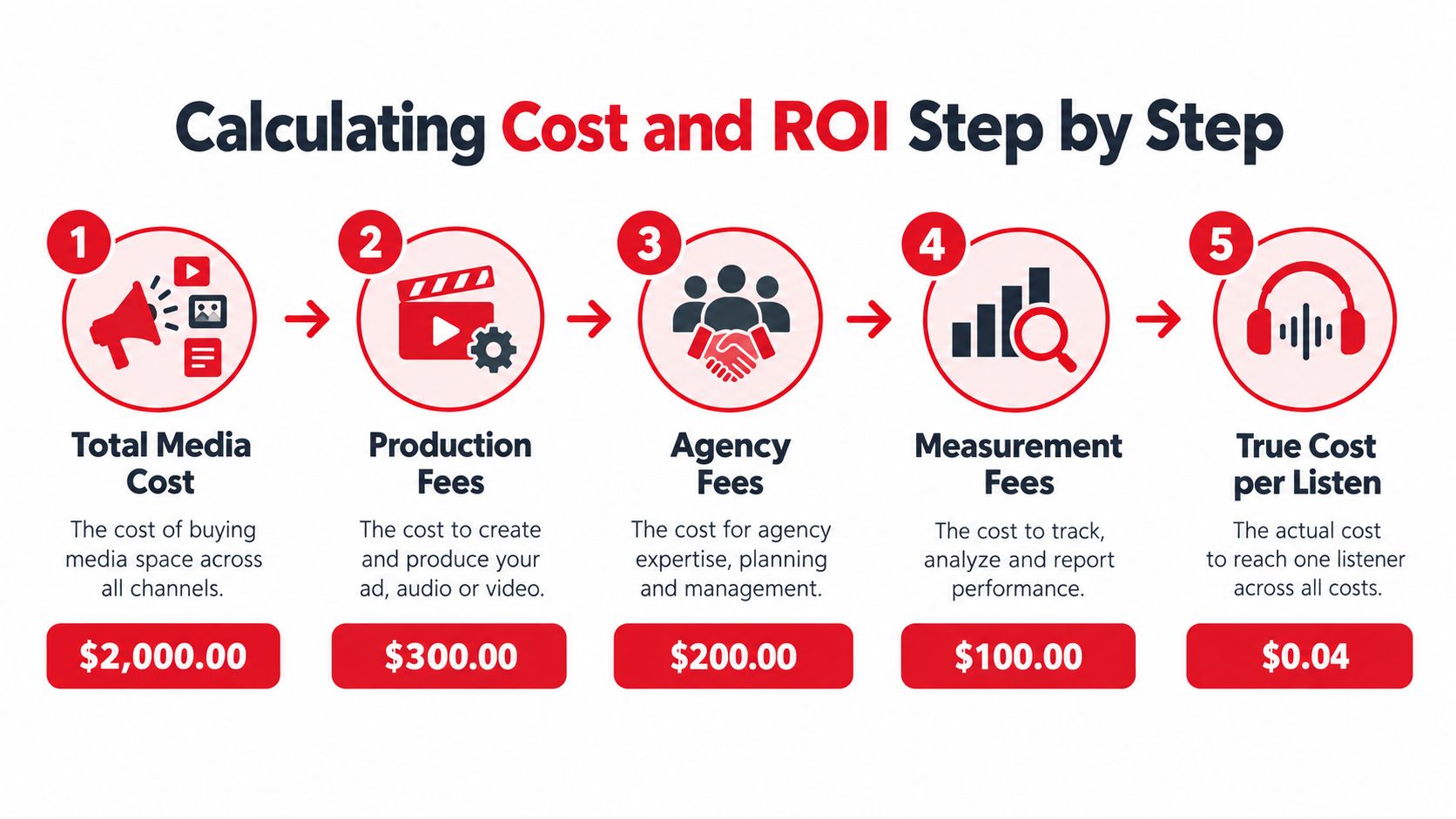
A rate card is only useful when it feeds a decision model. Build the model in layers, and keep media cost separate from total campaign cost.
Step one is total media cost
Use:
Impressions ÷ 1,000 × CPM = media cost
For 100,000 qualified impressions at a $30 CPM, the media cost is $3,000. For the same delivery at a $12 CPM, it is $1,200. Don't call either figure the campaign cost until you add the operational expenses.
Add the costs that appear outside the rate
Include production if the advertiser supplies a produced spot. Add agency, network, platform, tracking, and research costs where applicable. For a direct host-read deal, include any script development, creative review, or integrated sponsorship work that sits outside the quoted media line.
Your true cost formula is:
Media cost + production + agency + measurement = total campaign cost
Then calculate unit economics:
Total campaign cost ÷ qualified responses = cost per response
Total campaign cost ÷ acquisitions = cost per acquisition
You can adapt the framework to broader performance analysis with this guide to video ROI for creators, but keep podcast-specific delivery and attribution definitions intact.
Use response quality, not just response volume
Recent benchmark reporting found that host-read ads accounted for 46% of podcast advertising spend in Q3 2025, up from 43.8% a year earlier, and reported response rates of 2.45% for host-read, 1.93% for programmatic, and 1.51% for produced non-host-read placements. The host-read benchmark analysis gives buyers a useful way to test whether a higher CPM produces a lower cost per response.
For a simple illustration, suppose 100,000 impressions generate responses at those reported rates. The host-read format would produce 2,450 responses, programmatic would produce 1,930, and produced non-host-read would produce 1,510. At a $30 host-read CPM, media cost is $3,000, or roughly $1.22 per response before other fees. At a $12 programmatic CPM, media cost is $1,200, or roughly $0.62 per response before other fees.
That doesn't make programmatic the winner automatically. A response may be a site visit, a search, a lead, or another action. Your spreadsheet must define the action and then connect it to qualified pipeline or revenue. A B2B campaign should track sales-qualified opportunities and influenced revenue. A consumer campaign may prioritize purchases, new customers, or contribution margin.
For attribution design, use Podmuse's podcast attribution model guide to structure direct, assisted, and survey-based signals. Don't force every conversion into last-click reporting. Podcast listeners may remember a brand, search later, and convert through a different channel.
When the Host-Read Premium Is Worth It
The host-read premium is justified when the product needs trust transfer. If your offer is unfamiliar, expensive, technical, or tied to professional identity, the host's explanation can do work that a polished produced spot can't.
The benchmark gap supports testing rather than blind loyalty. Host-read ads reported a 2.45% response rate, compared with 1.93% for programmatic and 1.51% for produced non-host-read spots. Those response rates don't prove that every host-read campaign will generate better profit, but they show why CPM alone is an incomplete buying metric.
Pay the premium in three situations
Trust-dependent conversion: Products involving money, health, security, education, or professional reputation benefit when a credible host explains why they use or recommend the product.
Niche B2B demand: A specialized show may reach fewer people but place the message in front of decision-makers who are expensive to reach elsewhere. The commercial value of that audience can justify a higher CPM.
High-consideration consumer purchases: When listeners need context, comparison, and reassurance, a host can make the message feel native to the episode rather than interruptive.
The premium is less compelling when the goal is broad awareness, controlled frequency, or rapid audience optimization. In those cases, programmatic inventory can offer more operational control at a lower rate. Produced creative also makes sense when the message must remain identical across many placements or when legal and brand teams require strict consistency.
The break-even test: Pay more for host-read only when the additional cost is smaller than the value of the incremental qualified conversions it creates.
Attribution limits complicate the calculation. A listener may hear a host-read ad, search for the brand later, and convert without using a promo code or dedicated URL. A high response rate can also overstate business impact if the response isn't qualified. Measure direct actions, assisted conversions, customer surveys, and sales feedback together.
My recommendation is simple. Start with host-read placements when credibility is central to the offer. Use programmatic to extend reach after the message proves itself, or choose it first when scale and frequency control matter more than endorsement.
Negotiation, Buying, and When to Bring in an Agency
Treat the rate card as an opening position, not a final answer. Sellers have more flexibility when you offer a credible commitment, a clean brief, and a realistic approval process.

Negotiate the parts that affect outcomes
Ask for value in areas that improve response rather than demanding a lower CPM:
Commitment: Offer a multi-episode package when you can support sustained delivery, and ask for a better effective rate or added placement.
Exclusivity: Request category protection when competing products would weaken the host's endorsement.
Make-goods: Define replacement inventory before launch if delivery falls short or an episode is canceled.
Creative control: Agree on script review, host adaptation, legal approval, and recording timelines.
Reporting: Require delivery definitions, placement details, audience data, and response reporting in the contract.
A strong negotiation also clarifies what the host will and won't say. The most effective read usually gives the host enough structure to protect the offer while allowing a natural delivery. If you're building creator partnerships beyond audio, guidance on how to negotiate paid brand collaborations offers useful context for structuring expectations and deliverables.
Build measurement before launch
Use several signals because no single method captures the entire listener journey:
Unique promo codes for direct purchase tracking
Vanity URLs for response and landing-page behavior
Post-purchase surveys for self-reported influence
CRM source fields for lead and opportunity tracking
Brand-lift studies when awareness is the primary objective
Sales feedback for influenced opportunities that never use a code
Podcast advertising has become a substantial measured market. U.S. podcast advertising revenue reached approximately $1.9 billion in 2023, with the IAB projecting 12% growth in 2024 and a market approaching $2.6 billion by 2026. The IAB revenue study shows why more buyers are demanding delivery standards, comparable reporting, and accountable planning.
Watch the video below for a practical overview of buying podcast advertising.
Decide whether you need an agency
Bring in specialist support when your team is buying across several shows, negotiating host-read integrations, coordinating multiple creative versions, or reconciling podcast data with CRM and paid media reporting. A capable agency should improve show selection, negotiate terms, manage approvals, and make the measurement framework usable for finance and growth teams.
Podmuse is one option for teams that need podcast advertising and media buying across host-read, sponsorship, and programmatic inventory. Before an agency call, prepare your budget range, target audience, campaign objective, expected conversion, preferred markets, internal approval requirements, and existing tracking capabilities. Then ask the agency to explain how it will compare qualified reach, response quality, and acquisition cost across formats.
For a practical buying workflow, review how to buy podcast ads before requesting proposals. A good brief will prevent sellers from sending generic rate cards that hide the variables you need to evaluate.
Podmuse helps B2B and consumer brands plan, negotiate, and measure host-read sponsorships, produced placements, and programmatic podcast campaigns. Visit Podmuse to discuss your audience, campaign objective, and the rate structure that fits your growth target.
Comments