
Narrative Podcast Production for Brands

Your team may be weighing a polished brand show against another campaign that can produce results this quarter. The pitch sounds straightforward: make a podcast, publish episodes, cut clips, and build awareness. But if no one can explain how the show should affect audience trust, pipeline, or revenue, it's hard to defend the investment.
Narrative podcast production for brands works when creative decisions start with a business outcome and measurement is planned before recording. Downloads can tell you whether people found an episode. They can't, by themselves, tell you whether the right buyers heard it, remembered the brand, or moved closer to a decision.
Table of Contents
Why the Channel Now Earns a Real Budget - Build a media property, not just a campaign
Choosing the Right Narrative Format for Your Brand - Make the trade-off explicit
The Production Workflow That Keeps Episodes Consistent - Build the story before booking the studio - Mix the finished episode, not isolated tracks
When Audio-First Beats Going Video - Choose the format before recording
Real Branded Shows and What They Actually Proved - Use examples to sharpen the question
Measuring What Actually Matters - Design attribution before launch
What a Branded Narrative Podcast Actually Is
A branded narrative podcast is a show a company owns, built around deliberate storytelling rather than a rotating sequence of loosely connected interviews. The brand funds and shapes the production, but the listener should get a coherent story, useful insight, or compelling human experience, not a string of sales messages.
That distinction matters because three different tactics often get called “branded podcasts.” A host-read ad is a paid message delivered within someone else's show. A sponsored segment pays for placement or a defined brand mention. A branded narrative series is the show itself, with an editorial concept, characters or stakeholders, and a story structure designed to hold attention over time.
The format gives marketers more room to build context. Instead of asking an audience to care about a claim, a team can show the problem through a customer's experience, explain the stakes through an expert, and make the brand's relevance clear in the story. Edison Research's 2025 Infinite Dial study found that 70% of Americans aged 12 and older, roughly 202 million people, had listened to a podcast, while 73% had consumed podcasts in audio or video form (Edison Research's 2025 Infinite Dial study). That's a large audience already accustomed to spending time with episodic content, not a niche waiting to be created.
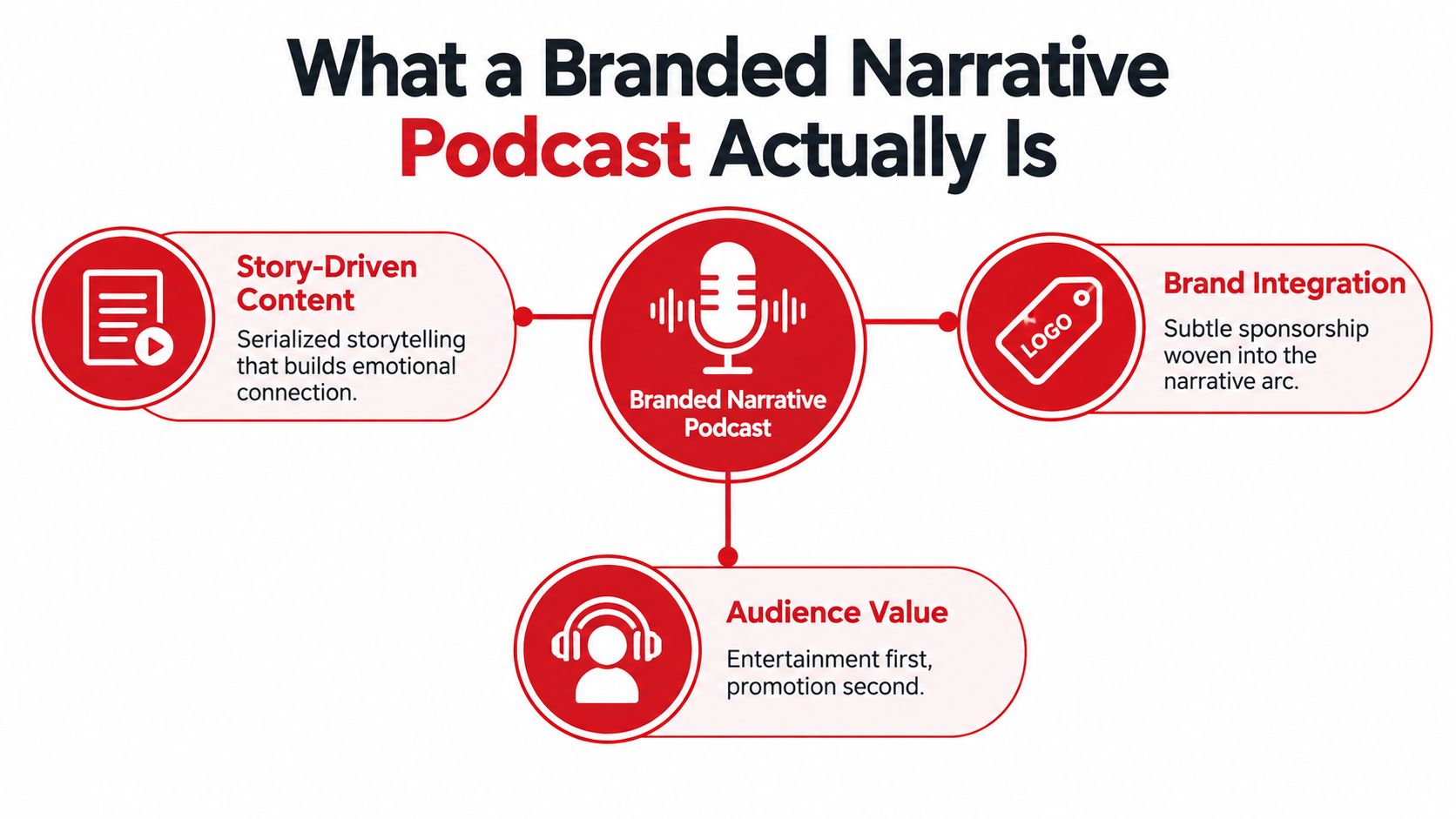
Three signals separate a real narrative show from a content marketing podcast wearing a narrative costume:
An editorial spine: Each episode serves a central question, tension, or idea. The brand's message supports that spine instead of replacing it.
Character or stakeholder design: The people in the show have a reason to be there beyond their job title. Customers, operators, researchers, and hosts each contribute a distinct point of view.
A season-level arc: Episodes add meaning as they accumulate. They don't need to end on a cliffhanger, but the audience should understand why the next one belongs.
If the episodes can be shuffled without changing what the audience learns, you may have a useful interview show. You probably don't have a narrative series.
Why the Channel Now Earns a Real Budget
Podcasting deserves a serious budget conversation because the audience is established and the advertising market has matured. Edison's audience findings, cited above, show reach across both audio and video. That reach makes branded storytelling a credible channel to test, but reach alone doesn't make the business case. The stronger case is that one season can become an integrated content asset, not a campaign that vanishes when its media flight ends.
The IAB's 2024 U.S. Podcast Advertising Revenue Study, prepared by PwC, projected that podcast ad revenue would grow 12% in 2024 to more than $2 billion and approach $2.6 billion by 2026, with consumer packaged goods and retail among categories continuing to expand (the IAB's podcast advertising revenue study). These are projections and market benchmarks, not a promise that a branded series will return the same amount. They do show that brands can plan podcast activity alongside a developed advertising ecosystem, rather than treating it as an experimental side project.
Build a media property, not just a campaign
A campaign usually has a defined flight and a concentrated burst of activity. A narrative show has a different job: it builds a library of stories and a recognizable point of view. Each episode can support audio distribution, a video version where appropriate, short clips, social posts, and a deeper page for people who want to explore the subject.
That system compounds when the content stays useful. A customer story may support sales conversations long after publication. An expert episode can give a field team a thoughtful resource to share with prospects. A strong series also creates opportunities for sponsorships, host-read integrations, and paid promotion without forcing the editorial premise to carry every message.
Budget test: Don't ask only whether a show can generate downloads. Ask which audience behavior, sales conversation, or brand outcome the season is designed to change, and how you'll know whether it did.
Generic interview formats can produce plenty of assets, but volume isn't the same as narrative value. A deliberate story arc gives the audience a reason to continue and gives marketing a stronger framework for connecting creative choices to business outcomes. Fund the series as a content system, then judge it against a defined marketing hypothesis.
Choosing the Right Narrative Format for Your Brand
Start with the job the show needs to do. A format should follow the audience and business objective, not the host who happens to be available. A brand trying to make a complex category understandable needs a different structure from one trying to make customer impact feel tangible.
Format | Best For | Production Complexity | Primary Risk |
|---|---|---|---|
Documentary-style customer stories | Making customer problems, decisions, and results relatable | High. Requires story development, multiple interviews, careful editing, and often sound design | The story feels like a testimonial if the customer has no agency or meaningful tension |
Serialized thought leadership | Teaching a complex subject through connected questions or debates | Medium to high. Requires a clear season arc and consistent editorial direction | Episodes drift into lectures or repeat the brand's point of view without testing it |
Founder memoir | Humanizing a company through the choices, setbacks, and beliefs behind it | Medium. The host and writing carry much of the show | The founder's story matters more to insiders than to the intended audience |
Interview-as-narrative | Exploring a shared problem through carefully selected voices | Medium. Guest research and host preparation shape the result | It becomes a standard interview feed with a thin brand wrapper |
Make the trade-off explicit
A documentary customer series offers emotional specificity, but it takes more editorial work and usually gives you less control over the final story. Serialized thought leadership offers a clear way to explain a complicated market, but the audience will hear the difference between expertise and a disguised product demo. Founder-led work can create a distinctive voice, though it depends heavily on a host who can be candid and engaging.
Interview-as-narrative is often the practical middle ground. The format still needs a through-line, deliberate guest choices, and an editor who can shape conversation into progression. If you're deciding whether episodes should stand alone or build on each other, Podmuse's guide to serial versus episodic podcast formats can help clarify the structural choice.
The common mistake is choosing a talking-head interview show because it feels safe. If the goal is emotional connection, category education, or a memorable customer story, an unstructured guest conversation may not do the work. Choose the format that matches the audience's question and your team's willingness to support the production it requires.
The Production Workflow That Keeps Episodes Consistent
Consistency doesn't come from recording on a regular schedule alone. It comes from a production system that makes the editorial promise clear before the microphones are on, then carries that promise through the final master.
Build the story before booking the studio
Start with a concept and season arc. Write down the audience, the business outcome, the story question, and the role the brand can credibly play. Then create episode briefs that define the central tension, key beats, potential scenes, and what a listener should understand by the end.
Research guests or characters for their perspective, not just their résumé. Prepare the host with questions that invite specific examples and moments of change. If you're drafting the first episode, use a podcast script template as a planning aid, then adapt it to the show's voice rather than reading every line verbatim.
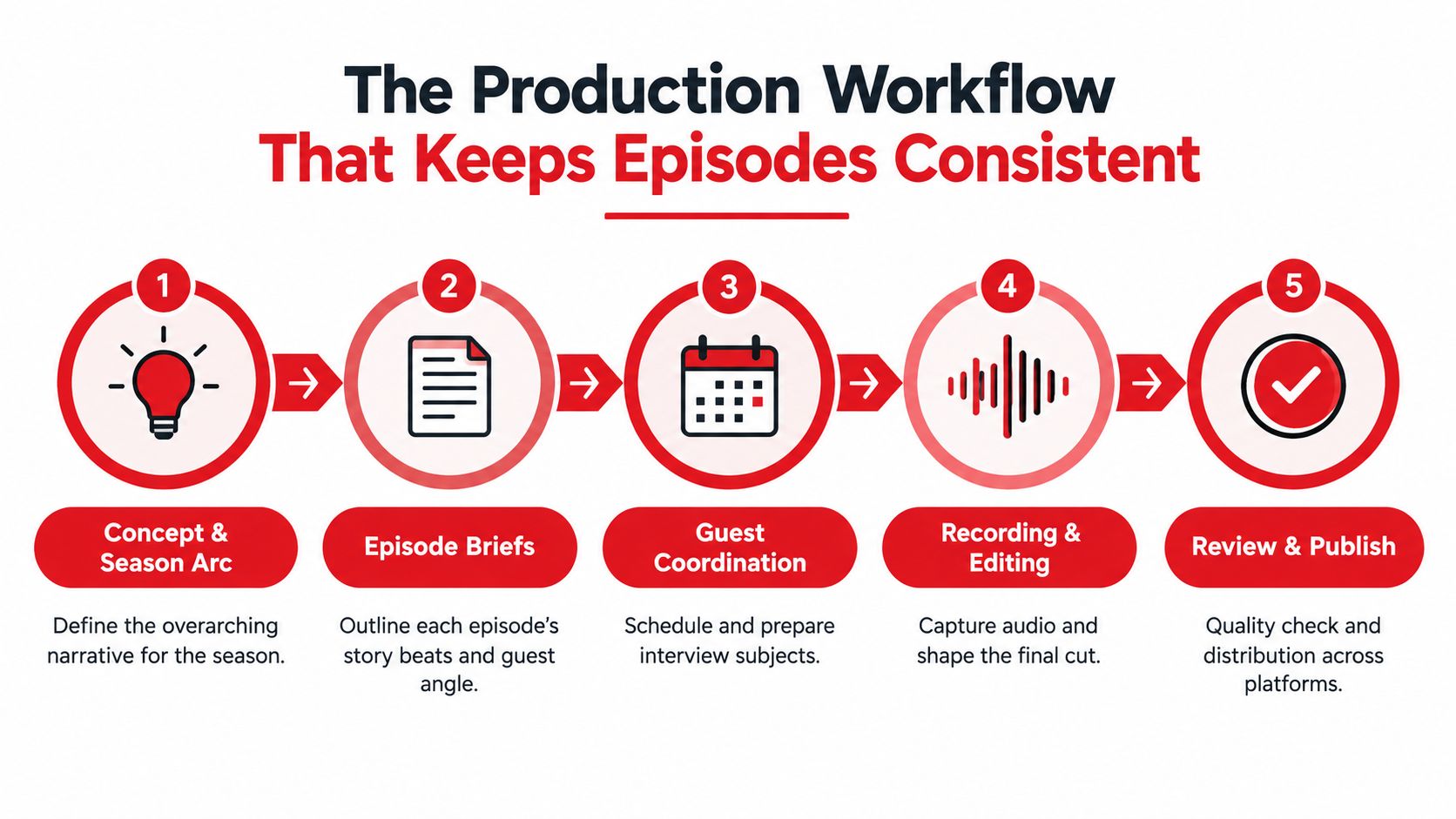
The production pipeline below keeps the handoffs visible:
Concept and season arc: Define the core story and how episodes build on it.
Episode briefs: Set the story beats, subject, and questions for each recording.
Guest coordination: Schedule subjects, prepare them, and confirm recording needs.
Recording and editing: Capture the conversation, then shape it into a clear narrative.
Review and publish: Check editorial accuracy, sound, platform assets, and distribution.
For teams tightening their edit process, this guide on how to cut hours off podcast editing offers practical workflow ideas. Use efficiency to protect time for story editing, not to remove the editorial judgment that makes a narrative episode coherent.
Mix the finished episode, not isolated tracks
Audio quality is part of the listener experience and the brand's credibility. Spotify's podcast-ad requirements specify a 44.1 kHz sample rate, a minimum 192 kbps encoding, integrated loudness of -16 LUFS with a ±1.5 LU tolerance, and a -2.0 dBTP true-peak ceiling (Spotify's podcast ad requirements). Treat these as delivery specifications for the relevant Spotify ad workflow, not as a replacement for checking every platform's requirements.
Measure the final stereo master after dialogue, music, ambience, sound design, and any host-read messages are combined. A clean voice track doesn't guarantee a balanced episode. Keep music and effects beneath dialogue with automation, then check integrated loudness and true peak with a compliant meter. Listen on earbuds, laptop speakers, and a car system before approval. If dynamically inserted advertising will sit beside editorial audio, consistent mastering helps avoid jarring changes in perceived volume.
When Audio-First Beats Going Video
Not every narrative show needs cameras. Video can extend distribution, but it can also burden a story that depends on interior detail, carefully paced narration, or an interview that works best when the subject isn't performing for a lens.
That doesn't mean video is a passing trend. YouTube was used by 55% of podcast consumers in 2025, up from 44% in 2023, and Gen Z podcast consumers were 28% more likely than the overall audience to mostly or always consume podcasts in video form, according to the audience figures summarized by Quill's branded podcast KPI guide. The numbers make video a serious distribution consideration. They don't prove that every branded story should be filmed.
Choose the format before recording
Audio-first suits intimate interviews, investigative arcs, and dense thought leadership when sound, narration, and editing carry the story. It also avoids spending production effort on footage that adds little to the listener's understanding.
Hybrid works when a host or guest benefits from being seen, but the main narrative still depends on audio. Record video for the central conversation, then decide which sections need visuals and which are stronger as audio with captions, graphics, or supporting footage.
Video-led makes sense when the story depends on visual evidence, a product demonstration, a founder's physical environment, or scenes the audience needs to see. In those cases, shot planning, b-roll, framing, and edit cadence belong in the script and production brief.
Practical rule: Don't add cameras after the story is finished. Decide which moments need a picture, which need sound, and how each cut will serve its platform before the recording date.
A cross-platform plan should specify how the long-form episode differs from social excerpts, how captions and transcripts will be handled, and whether the story has enough visual movement to sustain a video cut. Video can expand access, but a static frame and a strained edit won't improve a story that was built for audio. Protect the narrative first, then choose the distribution versions that preserve it.
Real Branded Shows and What They Actually Proved
A named brand or polished production credit doesn't prove a show created pipeline. Public examples are useful for seeing how a brand can participate in podcasting, but they don't establish business outcomes unless the brand has shared evidence for those outcomes. Treat the format as something to learn from, not as a substitute for measurement.
Podmuse's portfolio includes work involving Intel, PayPal, and Turkish Airlines, as described in the company's positioning. Those names show the range of brands associated with its podcast work. Without verified public details about each project's format, measurement design, and results, it would be irresponsible to claim that a particular show produced a specific commercial outcome.
Use examples to sharpen the question
When reviewing a branded show, ask what the creative demonstrates. Does the host have a credible relationship with the subject? Does the story give the audience information or perspective they wouldn't get from a product page? Does the brand's role make sense within the narrative, or does it arrive as a forced message?
Nielsen's Podcast Ad Effectiveness research found a 71% brand-recall rate for host-read podcast ads. The same research reported that ads lasting 60 seconds or more were nearly 70% more effective for driving information-seeking, with 40% higher purchase and recommendation intent than shorter versions (Nielsen's podcast ad effectiveness research). Those findings concern advertising effectiveness, not proof that a branded narrative series will drive the same outcomes. They do support a useful creative principle: trusted voices and enough time to make a message meaningful can matter more than inserting a brief, generic claim.
The lesson for marketing leaders is to judge examples in layers. First assess the editorial choice: format, host, characters, and progression. Then examine how the brand participates and whether the audience gets value independent of the promotion. Finally, ask what evidence the team collected: recall, information-seeking, sales conversations, or pipeline influence.
A show earns another season when its premise continues to serve an audience and its results justify continued investment. Production quality helps the work hold attention. It can't rescue a weak audience definition, an unconvincing host, or a measurement plan that stops at downloads.
Measuring What Actually Matters
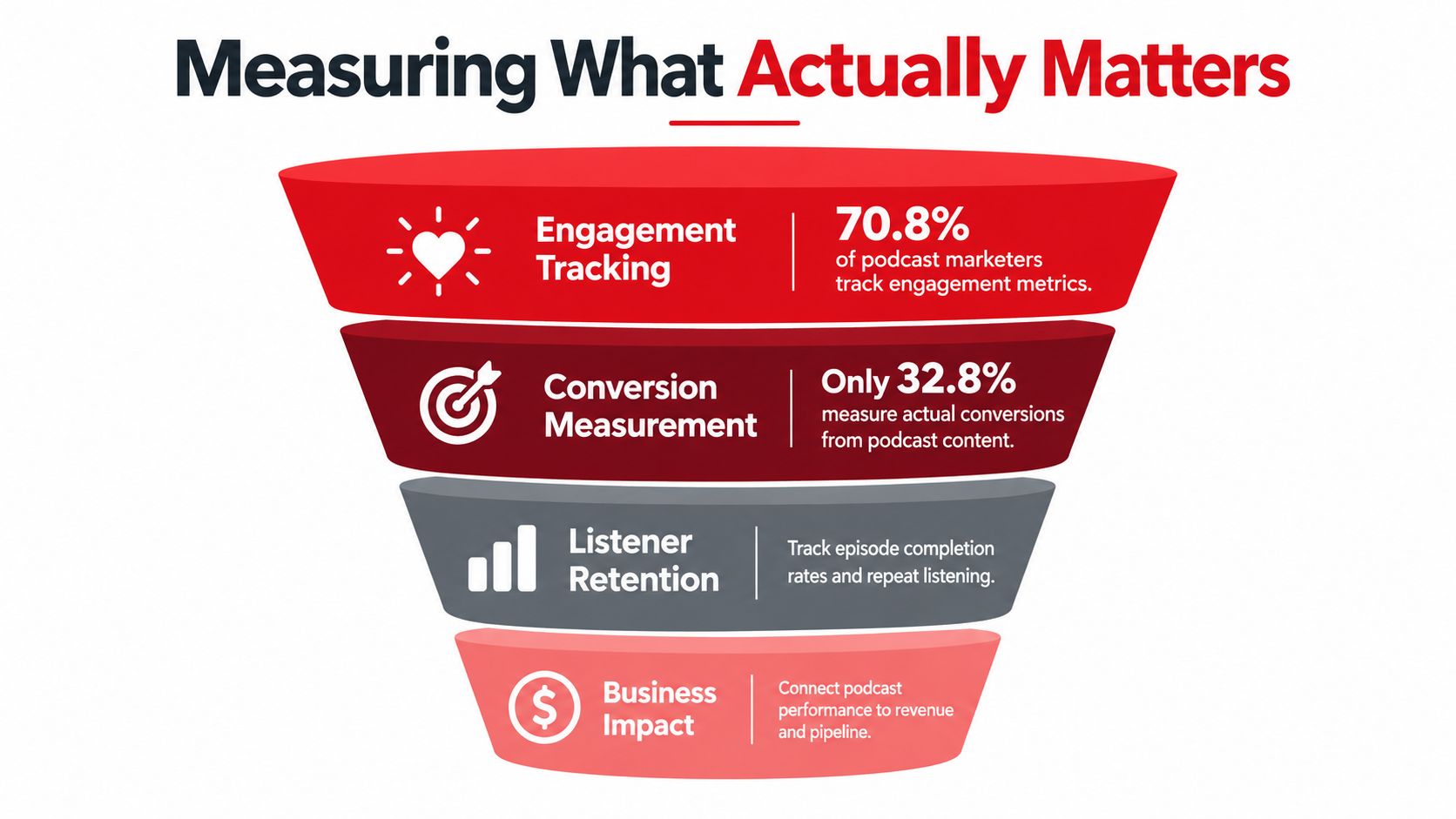
The measurement gap is hard to ignore. Survey data on podcast marketers shows 70.8% track engagement, while 32.8% track lead generation, 20.4% measure direct sales or revenue attribution, and 16.8% formally measure ROI. Even so, 47.3% report strong podcast ROI (the branded podcast survey data). The mismatch suggests that teams often describe performance confidently before they've connected attention to business impact.
Downloads and completion rates still matter. They tell you whether people found and stayed with an episode. They don't tell you whether those listeners match your target market or whether the show influenced a buying decision.
Design attribution before launch
Set a hypothesis for the series before production begins. For example: a customer story may increase branded search among a specific audience, or an expert episode may help sales teams restart conversations with accounts already in the pipeline. The hypothesis determines what evidence to collect.
Establish a baseline: Record the existing level of branded search, relevant site activity, and sales engagement before promotion begins.
Compare exposure: Where practical, compare exposed and unexposed audiences or accounts. Define what counts as exposure, and don't treat a download alone as proof someone heard the episode.
Set CRM influence rules: Agree with sales and operations on how podcast engagement enters the CRM and how the team will distinguish sourced demand from influence.
Track episode behavior: Review retention by segment and repeat listening to identify where the story holds attention or loses it.
Use research for long cycles: For consideration journeys that unfold over time, combine audience surveys and sales feedback with CRM signals instead of demanding an immediate last-click conversion.
For a B2B show, cost per target account reached and pipeline influence may be more useful than broad download totals. A niche episode can matter if it reaches the buying committee the business needs. A popular episode can underperform commercially if it attracts listeners who'll never become customers.
Teams building an attribution model can use this guide to podcast attribution for B2B as a starting point for thinking through channel touchpoints and business outcomes. Podmuse's guide to podcast data analytics can also help teams organize the performance signals they should review. The goal isn't to force every episode into last-click attribution. It's to make your assumptions explicit and gather evidence strong enough to defend the next investment.
Your First Three Steps and When to Bring in an Agency
Make the decision in sequence. Start by naming the business outcome, then audit the audience and content you already have, then choose one narrative bet for an initial season. Don't launch several formats at once before you know what the audience and measurement plan require.
An in-house team needs more than a host and an editor. Someone has to own production, sound design, guest or character preparation, publishing, and distribution. If those responsibilities sit with people already at capacity, consistency and quality will slip.
An agency makes sense when you need creative development, production, and distribution coordinated without building every capability internally. Podmuse is one option for brands that want support across podcast strategy, production, advertising, and strategic guest booking. This week, write the business hypothesis, identify the audience, and decide which skills your team can reliably supply. Then pressure-test the concept with a production partner before committing to a season.
Podmuse plans and produces branded audio and video podcasts, and supports podcast advertising and strategic guest bookings for founders and subject-matter experts. If you're evaluating narrative podcast production for your brand, visit Podmuse to discuss the audience, creative approach, and measurement plan before you commit to production.
Comments