
Video Podcast Repurposing Playbook for 2026

Your latest interview is exported, the master file is sitting in a shared folder, and someone's already asking when the clips are going up. You've got 35 to 50 minutes of solid conversation, one good quote circled in a doc, and no clear plan for what happens to the other 34 minutes. That's the usual backlog. Good video podcast repurposing doesn't start with opening a timeline and hunting for highlights. It starts with deciding, before anyone cuts, which viewing context each asset is built for and which outcome you'll judge it on.
Table of Contents
One Episode and the Six Assets It Should Spawn - The Six-Asset Map
How to Cut Clips from the Full Recording - The Six Steps in Order
Match the Cut to How People Watch - Three Treatments for the Same Moment - Three Worked Cases
Caption and Check Every Cut Before It Posts - The Caption Sequence
Set the Posting Cadence and Promotion Rules - A Weekly Publishing Order That Holds Up
Separate Attention Growth and Pipeline - Four Outcomes That Must Not Be Averaged Together
Decide What Your Team Keeps - What a Realistic In-House Load Looks Like
One Episode and the Six Assets It Should Spawn
Teams may treat repurposing as an afterthought because they still think of the podcast as an audio product with a video file attached. Your audience doesn't. Edison Research reported in October 2024 that 31% of weekly podcast listeners aged 13 and older selected YouTube as the service they used most for podcasts, compared with 27% for Spotify and 15% for Apple Podcasts. In that same reporting, 84% of Gen Z monthly podcast listeners had listened to or watched podcasts containing a video component, 49% of Gen Z podcast listeners said video helped them understand context and tone through facial expressions and gestures, and 45% said it made them feel more connected to the hosts.
That's why one recording should spawn a small, planned set of assets, not an unlimited pile of clips. If you're mapping this for the first time, it's worth learning how to reuse your strongest content across platforms so each output has a defined job instead of duplicating the same quote in six places.
The Six-Asset Map
Asset | Where it publishes | Frame and length | Required change | Job |
|---|---|---|---|---|
Full video episode | YouTube, Spotify video, Apple Podcasts video | 16:9, full runtime | Chapters, searchable title, end screen | Intentional and living-room viewing |
Audio cut | Other major podcast apps | Audio only, same episode | Tighten pauses, show notes, consistent episode ID | Commute and background listening |
YouTube discovery clip | YouTube | 16:9, 30 to 90 seconds | Hook in 3 seconds plus chapter link | Sends viewers into the full episode |
Social short | YouTube Shorts, Instagram Reels, TikTok | 9:16, 15 to 45 seconds | Active-speaker crop, burned-in captions, silent-first open | Reach and profile visits |
LinkedIn cut | 1:1, 45 to 90 seconds | One claim, business framing, muted captions | Authority and demand generation | |
Quote or audiogram | Newsletter, blog, and social text posts | Static card or short loop | One complete claim tied to the episode | Email, SEO, and branded search |
The full video episode is your anchor. We publish video podcasts on YouTube, Apple Podcasts, and Spotify as video, and on other major podcast apps as audio, which keeps the chaptered 16:9 version where intentional viewing happens and the tightened audio version where background listening happens. Don't strip chapters to save ten minutes. Chapters are what let a discovery clip send someone to the exact moment where a claim gets developed, instead of dumping them at minute zero.
The YouTube discovery clip and the social short look similar on a shot list, but they do different work. The discovery clip stays in YouTube's ecosystem and points back to a chapter, so length can run a bit longer and context can breathe. The social short has to survive a muted feed on Shorts, Reels, or TikTok, so the active-speaker crop, burned-in captions, and a silent-first open aren't optional polish. We send short clips of video podcasts to YouTube Shorts, Instagram, TikTok, and LinkedIn, but each destination gets its own treatment, not the same export renamed four times.
The LinkedIn cut carries one business claim, stated plainly, with the number or decision on screen if there is one. It isn't a teaser. A B2B buyer scrolling LinkedIn won't click through to finish your argument, so the cut itself has to make the argument complete. The quote or audiogram is your cheapest asset and often your most reused one, because it travels into email, blog posts, and search results where video doesn't always load or autoplay.
Practical rule: Circle two rows for this week's episode before anyone opens a timeline. If you can't name the job for a cut, don't export it.
How to Cut Clips from the Full Recording
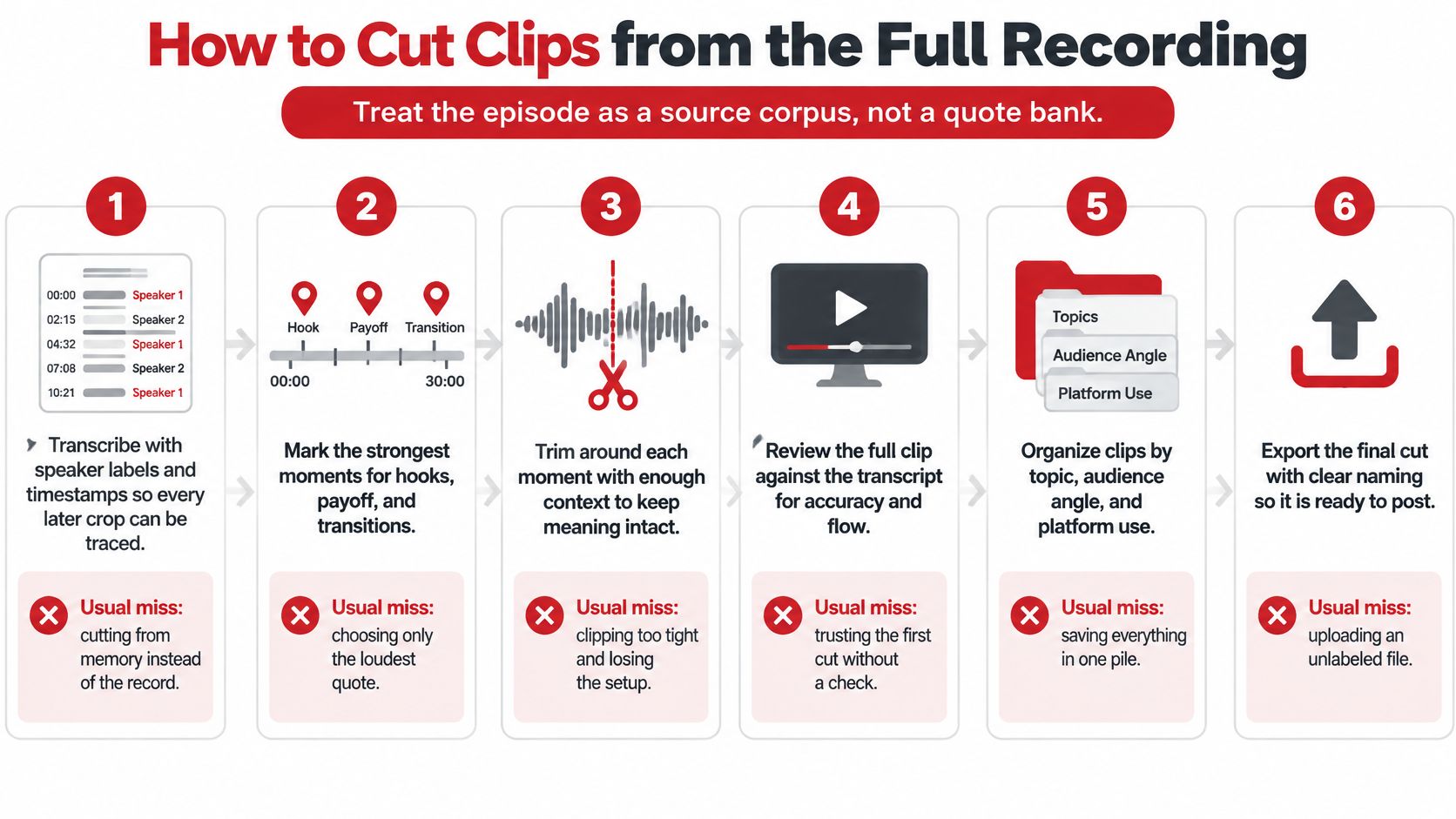
Treat the full episode as a source corpus, not a quote bank. A quote bank gives you punchy lines with no setup. A corpus gives you timestamped, searchable material you can return to when a clip underperforms and you need a different angle from the same conversation.
The six-step workflow below shows the order that keeps selection, editing, and quality control from collapsing into one rushed pass.
The Six Steps in Order
Transcribe with speaker labels and timestamps. Every later crop needs to be traceable back to a timecode and a speaker turn. The usual miss is working from a rough transcript that merges speakers, which makes it impossible to tell who made a claim when you reframe the shot.
Segment by topic, claim, story arc, and conversational completeness. Mark where an answer finishes, not where a sentence happens to end. The usual miss is cutting at a clean sentence boundary that still leaves the thought half-built.
Score each candidate on four tests. A strong opening hook, enough standalone context, an emotional or informational payoff, and low dependence on the previous five minutes. The usual miss is picking by keyword alone. A quotable sentence without setup dies in the feed, while a quieter complete exchange often holds viewers because the payoff lands.
Reframe each keeper for 9:16. Follow the active speaker, but keep a second person or a prop in frame when the reaction or the object is part of the point. The usual miss is a crop that cuts out the very thing the speaker is pointing at or describing.
Set platform metadata and one on-screen emphasis. Title, description, hashtags, and a single highlighted word or number should match the asset row you chose, not a generic template. Captions get built properly in the next stage, not rushed here. If your team doesn't have editing bandwidth for this step at volume, outside video editing services are worth evaluating for the reframing and export work specifically, while you keep clip selection in house.
Hand the cut to the pre-publish check. Don't let the editor who cut it be the only person who watches it before it posts.
This separation of jobs isn't just tidy process. The Repurpose-10K benchmark formalizes long-to-short repurposing across more than 10,000 source videos and over 120,000 annotated clips, which underlines that clip selection, narrative coherence, and publishability are separate tasks, not one automated step.
From each episode, I would cut three or four hypothesis variants that change only one variable at a time, such as hook, duration, crop, or call to action. Log which variant posted, where, and when. Without that log, you'll compare a Tuesday LinkedIn cut against a Friday TikTok cut and learn nothing.
Before the file leaves the project, the editor confirms:
Timecode and speaker labels match the source transcript
Clip stands alone without the preceding question
Crop keeps the subject of the claim in frame
Variant logged with hook, length, and destination
Match the Cut to How People Watch
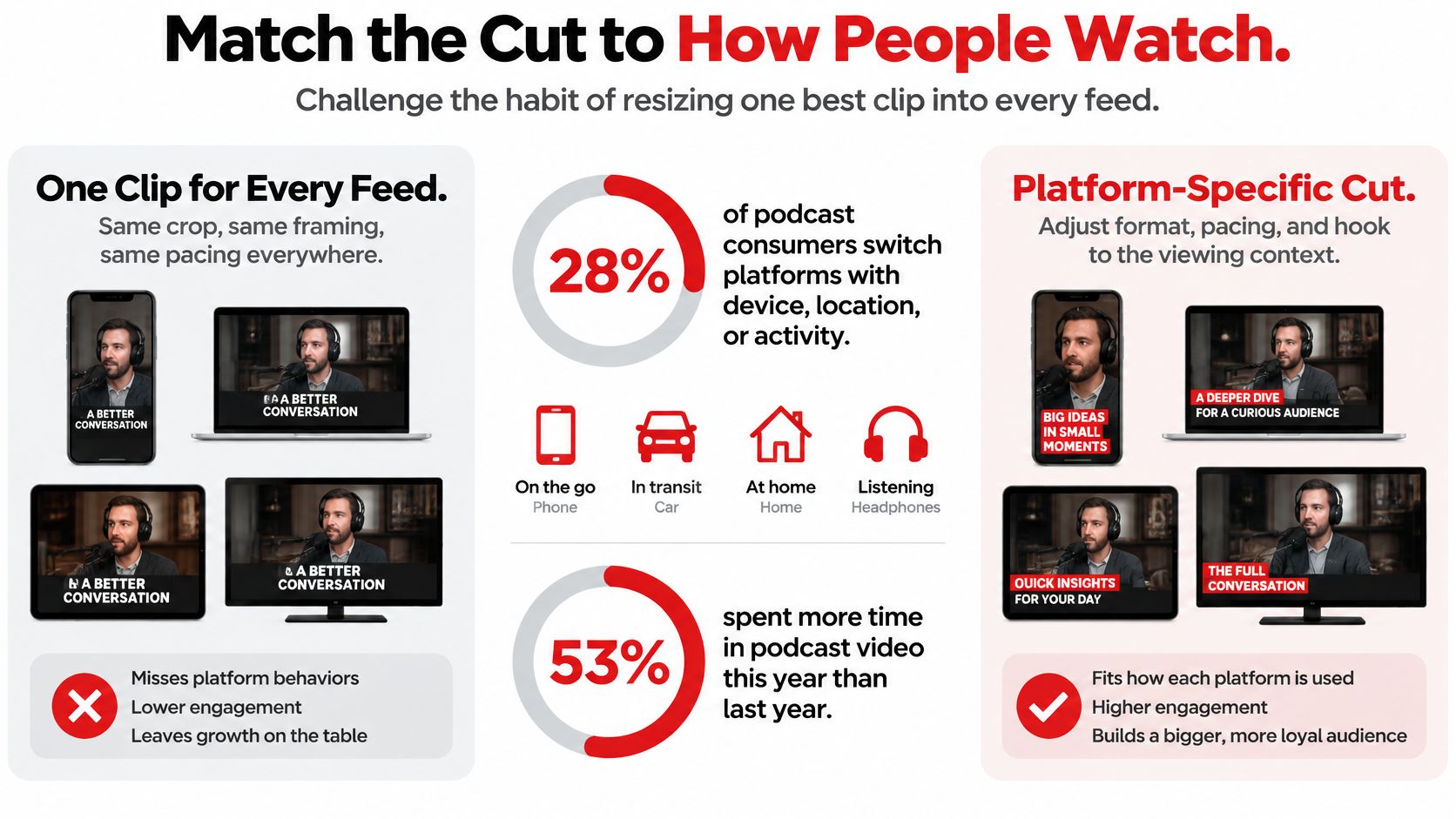
Resizing one best clip for every feed feels efficient. It usually isn't, because your audience isn't watching in one place or one way. SiriusXM Media reporting on podcast consumption habits found that 28% of podcast consumers switch platforms according to circumstances such as device, location, or activity, while 53% spent more than half of their recent podcast time watching video rather than consuming audio-only content.
The comparison below lays out what changes when you stop treating every feed as the same destination.
Three Treatments for the Same Moment
Preserve the conversation when the value is tone, a guest's reaction, or a demo that only makes sense on camera. Send that version to YouTube and video podcast feeds with chapters and a searchable title. Don't chop it into a 20-second fragment just because short-form is fashionable. Some exchanges earn trust precisely because they aren't rushed.
Keep it audio-first when the line works with eyes closed. A clear explanation, a story told in sequence, or a strong monologue doesn't need a face crop to justify its existence. That material serves commutes and non-video podcast apps well, and forcing it into vertical video adds production cost without adding meaning.
Rewrite it as a short-form story when the feed is muted and mobile. Open with the claim itself, use captions to carry the setup the long episode provided, and cut anything that needs the prior question to make sense. This requires new editorial work, not a shortened excerpt, and it is an area often underinvested in.
The short video below shows how pacing and framing shift when a conversation moment is rebuilt for a different viewing context rather than just cropped down.
Three Worked Cases
Say a founder explains a pricing change on your show. That moment becomes a 60-second LinkedIn cut with the new number on screen and one sentence of business framing in the post text. Buyers don't need the founder's backstory to evaluate the claim.
Say a travel or hospitality host walks a property while talking. That becomes a 9:16 sequence following the walk, because the room, the view, and the layout are the point. Stripping it to audio would remove the evidence.
Say a technical aside only lands after a five-minute setup. That stays in the full episode, or it gets a two-line narrator bridge recorded after the fact. Posting it as a naked quote invites confusion and comments asking what the speaker meant, which helps no one.
More clips can reduce performance if none of them are matched to why someone opened that app in the first place.
Before export, the producer marks each scored moment with one of the three treatments on the shot list. That single decision prevents the most common waste in video podcast repurposing, which is editing time spent on cuts that were never suited to their destination.
Caption and Check Every Cut Before It Posts
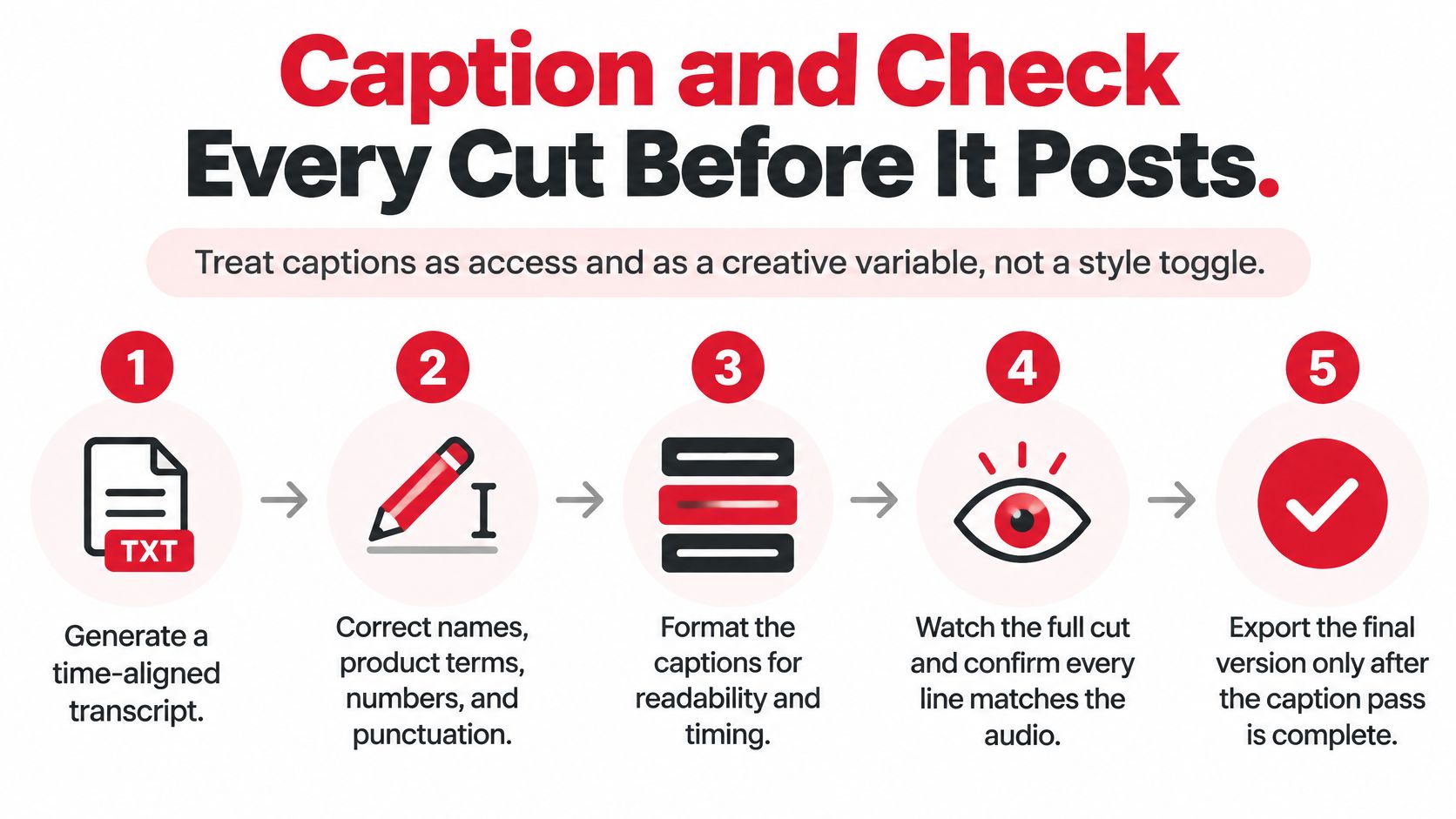
Captions aren't a style toggle you flip at export. They're an accessibility requirement and a creative variable you can test, and both jobs demand a proper sequence instead of trusting auto-generated text.
The five-step checklist below runs in the order that catches errors before they're burned into the file.
The Caption Sequence
Generate a time-aligned transcript. Timing matters as much as wording, because captions that lag the speaker by a second are harder to follow than no emphasis at all. If your transcript files are inconsistent between episodes, standardizing your podcast transcript format first will save correction time on every cut that follows.
Correct names, product terms, numbers, and punctuation against the audio. Automatic transcription misreads proper nouns reliably, and a guest whose company name is spelled wrong on screen will not share that clip.
Break lines into readable semantic units. Split at phrase boundaries, not at even word counts, so each caption card carries one complete thought a viewer can absorb at mobile speed.
Park text inside a safe area. Captions placed beneath like, comment, and share overlays disappear on the platforms where muted viewing is most common.
Emphasize only the word that carries the claim. Animated words filling the frame compete with the speaker's face and make the cut harder to read, not easier.
Watch the cut muted at mobile size. If you can't follow it without sound on a phone, it isn't ready.
The upside is real but shouldn't be oversold. Wistia's 2024 State of Video reporting cites TikTok research indicating captions increased viewer affinity by 95%, recall by 58%, likability by 31%, and perceived uniqueness by 25%, and Wistia also reported 254% more businesses captioned videos in 2023 than in 2022. Those figures aren't a guaranteed lift in your views or conversions.
Where platform rules permit, keep one captioned and one non-captioned control, and hold topic, hook, length, thumbnail, audience, and posting window as steady as you can. Judge the test on profile visits, signups, or branded search, not impressions alone. Retire a caption style once it stops beating your control, however much the team likes how it looks.
Run the pre-publish check last. Confirm guest likeness and music rights, claim accuracy against the source audio, brand-safe language, end-screen behavior, and a final frame that doesn't cut a word in half. A clip that fails any one of those doesn't post on schedule. It posts when it's fixed.
Set the Posting Cadence and Promotion Rules
A cadence isn't just a calendar. It's what makes your variant tests comparable, because a clip posted Tuesday morning and one posted Friday night aren't running the same race.
A Weekly Publishing Order That Holds Up
Publish the full episode on its usual day. Chapters go in the description at launch, not added later when someone remembers.
Post the YouTube discovery clip the same day or the next. Link it to the chapter where the clip's claim is developed, so interested viewers land mid-argument instead of at the intro.
Release one social short per day over the next three to five days. Each short gets its own hook. Repeating the same quote across consecutive days trains your existing followers to scroll past you.
Post the LinkedIn cut once a week. Pair it with a text post that states the business claim in one sentence, so the argument survives even if nobody presses play.
Send the quote card or audiogram to the newsletter and blog within the same week. Email and search pick up the episode's strongest claim while it's still current, and the blog version gives you a permanent, linkable home for it.
Put the same episode ID in every link, pinned comment, and caption. This small discipline is what lets you join the data later when you're trying to figure out which cut drove a result.
Cross-promote deliberately. Ask guests to share the cut that features them, and link every short back to the full episode. If you want a broader framework for this side of the work, our guide on how to promote a podcast on social media covers guest sharing and cross-posting in more detail.
Hold paid promotion until the data says otherwise. Wait until the first four episodes show which asset row earns a qualified outcome, then boost only that row.
Keep the same weekday and time for each platform so variants compete under the same posting window. A social media scheduler helps here because it locks your slots in advance and removes the daily scramble that leads to inconsistent posting times.
Promotion rule: Don't put spend behind a format that hasn't earned a qualified outcome organically yet. Paid reach amplifies what's already working. It doesn't fix a weak hook.
Separate Attention Growth and Pipeline
Your reporting is probably messier than your production. YouTube ranks podcast content by watch time, podcast apps still talk in downloads, and a single viewer can discover you in a Short, listen on Spotify, and convert on your site a week later with no shared tracking between those steps. That fragmentation isn't a dashboard problem you can style your way out of. It's a measurement architecture problem, and blending everything into one view count makes it worse.
The gap is widely felt. Digital Content Next's analysis of podcasting's next growth stage notes that pixel tracking is unavailable on YouTube and that nearly half of marketers identify limited performance data as their top barrier to podcast investment. The same analysis cites Deloitte projecting global podcast and vodcast advertising revenue of roughly $5 billion in 2026, up nearly 20% year over year, while 27% of U.S. consumers say they watch vodcasts weekly. The spend case is moving faster than the measurement teams have in place.
Four Outcomes That Must Not Be Averaged Together
Outcome | Metrics | Where it lives | Fair comparison | Do not treat as |
|---|---|---|---|---|
Attention quality | 1-3 second hold, midpoint retention, completion, rewatches | Native analytics on each platform | Variants of the same episode and topic | A single view total across apps |
Audience growth | Subscribers, follows, returning viewers | YouTube and social accounts | Follows per episode, not per impression | Vanity reach |
Assisted conversion | Profile visits, branded search, unique URLs or codes | Site analytics and search data | The same episode ID on every cut | Last-click credit |
Direct conversion | Demo requests, signups, redeemed codes | CRM or form analytics | Qualified outcomes per asset row | Every view as a lead |
Attention quality tells you whether the edit works. Read the first-three-second hold, midpoint retention, completion, and rewatches inside each platform's native analytics, and compare only variants of the same episode and topic. A retention curve from TikTok and one from YouTube describe different viewing behaviors, so averaging them produces a number that describes neither.
Audience growth tells you whether attention compounds. Subscribers, follows, and returning viewers measure people who chose to come back, which is a different claim from raw views. A clip can reach a large audience and add almost no followers if it entertains without giving anyone a reason to return for the next episode.
Assisted conversion is where most podcast value hides. Profile visits, newsletter starts, branded search lift, and traffic to a URL or code unique to that episode all signal that a clip moved someone closer without closing them. This is also why the episode ID discipline in your posting cadence matters. Without a consistent identifier on every cut, assisted conversion is invisible. If you need a structure for tying these signals together, our breakdown of the podcast attribution model walks through how to connect discovery, listening, and conversion without overclaiming credit.
Direct conversion is the narrowest and most valuable row. Demo requests, signups, and redeemed codes are outcomes sales can see in the CRM, and they're the only numbers you should use when calculating what an extra hour of editing returned.
Stamp one episode and campaign ID on every file, link, and landing page. Read each platform's native retention instead of chasing a blended CPM. Run an occasional incrementality test, such as holding one asset row back for an episode or two, rather than calling every view a lead because the timeline roughly lines up.
A view is not a lead, and a follower is not pipeline. Each row earns its own budget decision.
Close every quarter with one question. Which asset row earned a qualified outcome at an acceptable extra edit cost, and which row should be cut from the next batch? If your LinkedIn cuts drive demo requests and your fourth social short drives nothing measurable, the answer isn't to make the fourth short better. It's to stop making it and put those hours into the row that's paying.
Decide What Your Team Keeps
Staffing this well comes down to one split. Keep the host, guest choice, and point of view in house, because that's what your audience came for and no outside team can manufacture it. Hand off the repeatable production work once the backlog, not the ideas, becomes your constraint.
What a Realistic In-House Load Looks Like
For one weekly episode, a small team can usually sustain the master episode, two tested social cuts, and one LinkedIn cut without quality slipping. A fourth untreated clip typically costs more editing hours than it returns, especially once you add caption correction and the pre-publish check. I'd rather see a team ship three cuts they scored, captioned properly, and measured than six cuts nobody reviewed.
Transcription cleanup, reframing, caption building, chaptering, and the six-asset export are the tasks that scale worst internally. They're skilled work, but they're also systematic, which makes them the natural handoff once your show is past its first few episodes and publishing on a fixed day.
Watch for three triggers that say the split needs to change:
Missed publish dates that push clips into the following week, where they compete with the next episode
Captions nobody checks, which means guest names and product terms are going out wrong
A YouTube channel where no one reads retention, so every episode gets cut the same way regardless of what held viewers
Any one of those means you're producing volume without the feedback loop that makes video podcast repurposing worth doing.
Podmuse is one concrete way to take that handoff. Our podcast growth services include distribution, paid promotion, and content repurposing, and our video podcast service includes strategy and format, guest booking, recording, editing, graphics, publishing, YouTube channel management, social clips, YouTube ads, and reporting. We can typically launch a podcast within a month, depending on scope, including planning, setup, recording, editing, and distribution, so the handoff doesn't have to stall your publishing calendar while it's being set up.
The practical next step is a free consultation to decide which asset rows your team owns and which ones move to a production line. Then apply the four-outcome scorecard to your first four episodes under the new split. If a handed-off row doesn't earn a qualified outcome at an acceptable cost, you cut that row, the same way you'd cut an in-house one. The scorecard doesn't care who made the clip. Neither should you.
If your team is sitting on recorded episodes that never become more than one upload, Podmuse can turn each recording into a chaptered full episode, tested social cuts, LinkedIn assets, and reported outcomes across attention, growth, and pipeline. Book a free consultation and we'll map which asset rows your team should keep and which ones we should run for you, then score the first four episodes so you can see exactly what the repurposing earns.
Comments