
Private Podcast Platform Guide for 2026

Your CEO recorded a briefing that names an unreleased price, a customer list, and a rumor you hope is false. Someone asks whether you can "just put it on a private podcast." What they usually mean is an unlisted feed, a password mailed with an MP3, or a folder on the shared drive. None of those stay private once a link is forwarded.
A private podcast platform is hosting plus delivery that releases episodes only to people you have approved. Public podcasting is a radio anyone can tune. A private platform is a locked conference line. The habit is familiar. The audience list is not.
Table of Contents
What a Private Podcast Platform Is - Three setups that only look private
Controls That Keep a Feed Private - Access is a delivery problem - A file transfer is not a listen
Enterprise Jobs Audio Handles Well - Where audio is the wrong record
How to Choose and Budget a Platform - A KPI stack past downloads
How to Migrate and Distribute Episodes - Edges that break a clean cutover
What a Private Podcast Platform Is
Say product marketing needs a customer training series, and leadership needs a Monday update that cannot live on Apple Podcasts. Both jobs use the same locked line. A listener proves who they are, opens a feed or app that only authenticated people can reach, and the audio arrives through a link that expires.
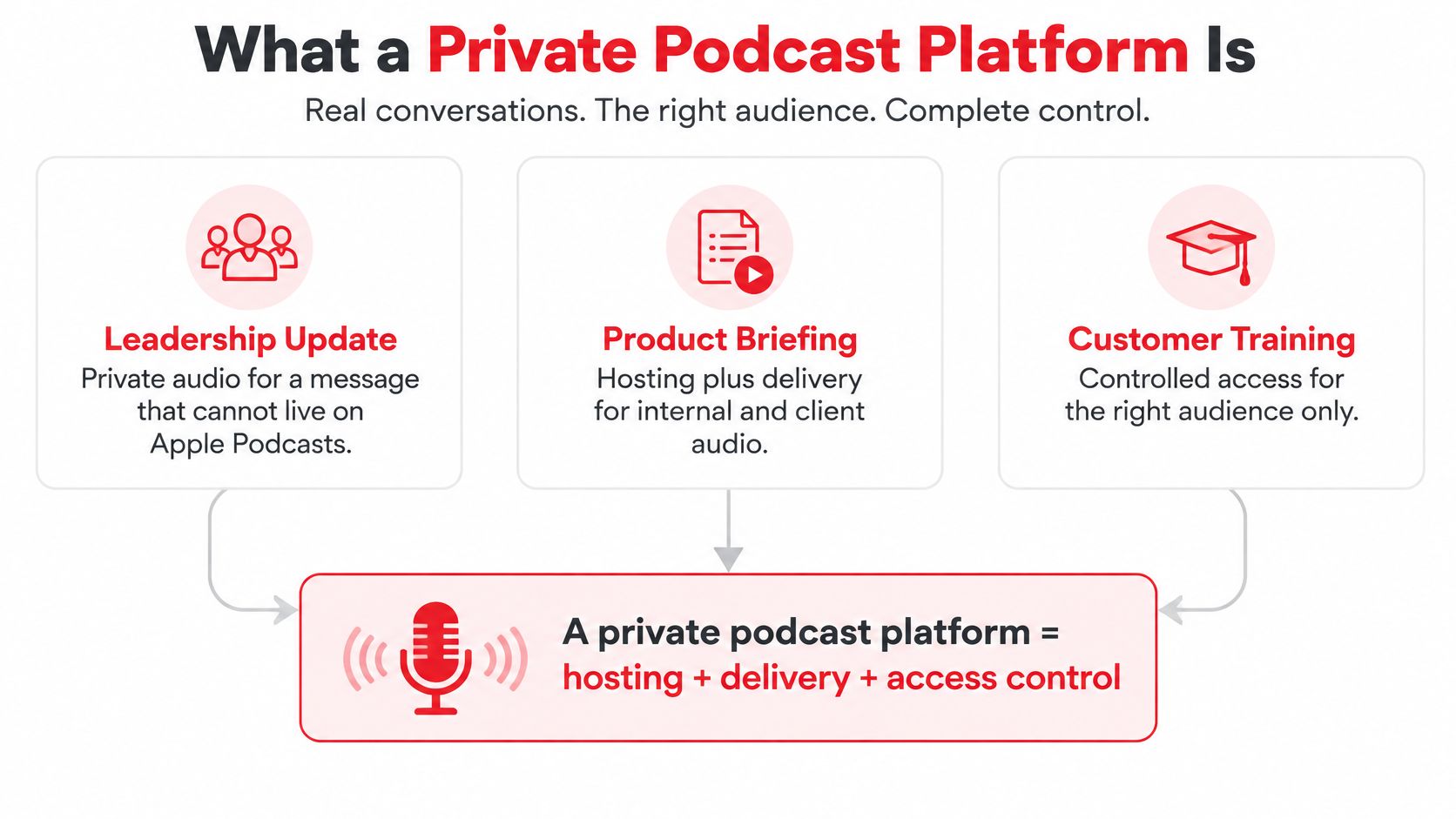
The identity check comes first. That is SSO, an allowed email domain, or a named invite. Next, the shelf itself refuses anonymous requests. Then each file is served with an expiring signed URL or a tokenized link, so a copied address stops working after the window you set. If any of those three steps is missing, you have a file share with a nicer player.
Three setups that only look private
Unlisted public feed: The directory hides it. Anyone with the RSS address still subscribes, and you cannot name who forwarded it.
Password emailed with an MP3: The password lives in inboxes, Slack, and screenshots. It does not expire when someone leaves.
A recording in a shared drive: Permissions drift. Search, sync, and "anyone in the company" links do the rest.
Practical rule: If a forwarded address still plays tomorrow, the show is not private.
The listening habit is already in place. Springcast's summary of business podcast use notes that 64% of Americans aged 12 and older listened to podcasts monthly in 2023, compared with 57% in 2020, and that global listenership grew by 40% from 2018 and exceeded 2 billion listeners by 2025. Those figures describe podcast listening broadly, not private platforms. They still matter. You are not teaching people a new medium.
Public shows maximize discovery through open feeds. Private ones add authorization, audience segmentation, and controlled access for confidential or audience-specific material. The same infrastructure can carry external thought leadership and restricted training, executive messages, partner education, or a customer community. What changes is who is allowed in, and how fast you can take them out. The controls, the jobs audio should take, and the buying tests come next.
Controls That Keep a Feed Private
Score a vendor against six controls before you look at a download chart. If a row fails, the rest of the demo is theater.
Control | What good looks like | What fails | Why it matters |
|---|---|---|---|
Identity and access | SSO, domain allowlists, cohort roles, central revoke | Shared password or unlisted RSS | Offboarding and partner access |
Media protection | Expiring signed URLs or tokenized enclosures on feed and files | Static MP3 links that work forever | Copied links leak content |
Device policy | Account separate from device tokens with expiry and concurrency limits | One token equals permanent access | Lost phones and shared devices |
Analytics truth | Auth events plus playback duration; IAB-style filters and 60-second download validity | Raw file transfers reported as listens | Training ROI and audits |
Privacy scope | Team-level reporting, retention limits, regional hosting | Manager view of every employee minute | GDPR and works-council risk |
Integrations | LMS, HRIS, CRM, and a BI API with documented identity | CSV exports only | Outcomes beyond the player |
Access is a delivery problem
An unlisted RSS address is not a lock. The feed and every media enclosure should require an authenticated request, typically an expiring signed URL or a tokenized proxy, so a forwarded link dies. Separate the person from the device. Revoke the account in one place. Limit device tokens by expiry, concurrency, or policy. That split is what makes offboarding, cohort permissions, geographic limits, and audit logs real rather than a settings screenshot.
The same delivery logic shows up in other gated media. Video security guidance for university staff is a useful parallel when legal asks how a copied media address is supposed to fail closed.
A file transfer is not a listen
IAB podcast measurement guidance defines a valid download from server logs and requires filtering duplicate, incomplete, automated, and invalid traffic, with at least 60 seconds of content delivery as the validity threshold. Ask the platform for authenticated delivery events plus playback duration or completion. Keep downloads labeled as delivery. For training, customer education, or an executive briefing, that label is what makes an ROI number and an audit defensible.
SSO, an LMS, an HRIS, a CRM, and a BI-ready API with documented identity stop the player from becoming a silo. A weekly CSV does not.
Reject any vendor that cannot revoke a person and a link on the same day.
Enterprise Jobs Audio Handles Well
Treat private audio as a communications and learning channel, not a locked version of an entertainment show. UStudio's account of private podcasting lists the jobs that fit: internal communications, onboarding, leadership updates, compliance training, product launches, and sales enablement. Dell's reported private-podcast rollout reached an 80% employee adoption rate in its first year. A survey cited in that same analysis found that 73% of employees would prefer listening to a private podcast over attending a meeting. Reach and preference are not the same as proof that anyone changed a behavior. Design each job around a listener and an outcome that is not a download.
Job | Listener | Episode fit | Non-download outcome |
|---|---|---|---|
Internal communications | All employees in the cohort | Commute or screen-free task | Fewer status meetings |
Employee onboarding | New hires | Short lessons across the first two weeks | Faster ramp |
Leadership updates | Managers and staff | A weekly commute-length briefing | A Monday decision without another meeting |
Compliance training | Named training cohort | One policy per short episode | Recorded policy acknowledgment path |
Product launches | Sellers and product teams | A brief before the customer call | Seller heard the launch brief before the call |
Sales or partner enablement | Sellers and partners | Short, task-friendly | Partner finishes the assigned next step |
A status update for the whole cohort replaces the meeting people already resent, if the episode is short enough for a commute or a task that does not need a screen. Onboarding works the same way for new hires: a few short lessons in week one, then a manager checks ramp, not a play count. Leadership updates should leave managers and staff with one decision they can act on Monday. Compliance audio can point a named cohort at a policy, but the acknowledgment still has to land in the system of record.
Where audio is the wrong record
Do not make a podcast the primary record for legally binding training that needs a scored quiz, or for a message people must see as a diagram. Use audio to brief, then send them to the quiz or the visual. Gated customer communities and partner education are valid external audiences when every listener is still approved. Fortune 500 teams that swapped email updates for internal podcasts show why a recurring voice can beat another newsletter, as long as the feed stays closed.
The walkthrough below is the distribution path most internal teams need, from a private shelf to the apps people already open.
Pick one job for the pilot. A company-wide feed on day one gives you every permission problem and no clean outcome.
How to Choose and Budget a Platform
Match the setup to the audience before you compare logos. Seat math, default analytics, and the integration you cannot live without change by job.
Situation | Access model | Analytics default | Must-have integration | Where cost shows up |
|---|---|---|---|---|
Employee communications | SSO and HRIS offboarding | Team aggregates, not named listeners | HRIS | Per seat across the company |
Compliance training | Cohort enrollment and audit log | Completion sent to the LMS | LMS | Seats plus storage of required episodes |
Sales enablement | Role groups and fast revoke | Starts tied to CRM activity | CRM | Field-team seat spikes |
Customer or member community | Email invite or paid entitlement | Aggregate engagement | Billing or community platform | Member tier or usage |
Partner enablement | Org accounts and geo limits | Partner-level completion | Partner portal | Fewer seats, higher admin time |
Executive briefing | Named allowlist and short retention | Minimal logs | None, or a secure alert | Low seats, high security tier |
Most vendors charge by seat or active user. Storage, bandwidth, and SSO often sit on a higher tier, and a migration or implementation fee lands once. There is no honest single rate card. Ask four price questions in writing.
Seat definition: Is the unit a provisioned person or a monthly active user, and what happens in a month someone never opens the app?
Overages: What do extra storage and bandwidth cost after a launch week or a long archive?
Security in the base tier: Are signed-URL delivery and audit logs included, or are they an add-on?
Headcount drops: What do you pay, and how fast does access end, when a cohort shrinks?
A KPI stack past downloads
Unique authenticated users, episode starts, median seconds consumed, and completion are the player metrics worth keeping. Then attach one downstream signal: an LMS quiz, a sales-enablement action, a pulse-survey item, a partner task, or influenced pipeline. Springcast's enterprise platform comparison notes that a 2025 report found leader podcasts effective according to 64% of internal communicators but used by only 9% of organizations. Build the case as a pilot. Individual listening logs can still fail to show whether knowledge stuck or a seller changed a call. Choose the downstream signal first, and report it at team level by default.
Buying a platform is closer to buying another system of record than buying a media host. WebinOne on evaluating CMS platforms is a fair checklist for integration depth, admin roles, and what "included" means. If production cost is the open question, podcast production services pricing separates making the episodes from locking the feed.
Employee and compliance shows need SSO plus an LMS or HRIS. Member shows need entitlements. Executive briefings need a short allowlist more than a large analytics suite. I would not buy the suite that wins on charts and loses on revoke speed.
Privacy Governance Questions Procurement Must Answer
Password protection is not governance. Put these seven questions in the order, and do not sign until each one comes back in writing.
Purpose limitation. State why listening data is collected, such as training completion or pipeline attribution, and ban every use beyond that purpose.
Lawful basis. Springcast's platform comparison notes that internal listening data can fall under GDPR personal-data rules. Confirm that with counsel and record the basis. Do not let a vendor slide "it's only analytics" into the contract.
Visibility. Decide who can see individual completion. Default to team or department aggregates. Show named minutes only to a named role, and write that role down.
Works council. The same comparison notes that employee monitoring may trigger works-council review in Germany. Schedule that review before launch, not after the first complaint.
Retention and deletion. Set the period for listening logs and the date they are purged. "We keep them for product improvement" is not a period.
Regional hosting. Confirm where audio, logs, and identity data sit, and whether a region can be pinned for a subsidiary.
Downloaded files. Ask how access is removed from episodes already saved to a phone, which revocations are impossible after download, and disclose that limit to listeners. Protection in transit is not control of a file on a device.
Privacy information for studio scheduling teams is a plain example of how a production vendor states purpose, retention, and access for people data. Expect the same clarity from the platform, not a slide that says "SSO included."
The most secure design is often less granular analytics, not more. Team reports still show whether a cohort heard the briefing. They do not build a surveillance file a manager will misuse. Procurement should reject any vendor that cannot answer all seven questions in writing.
How to Migrate and Distribute Episodes
Move the archive before you announce anything. A public RSS feed is a directory, not a backup.
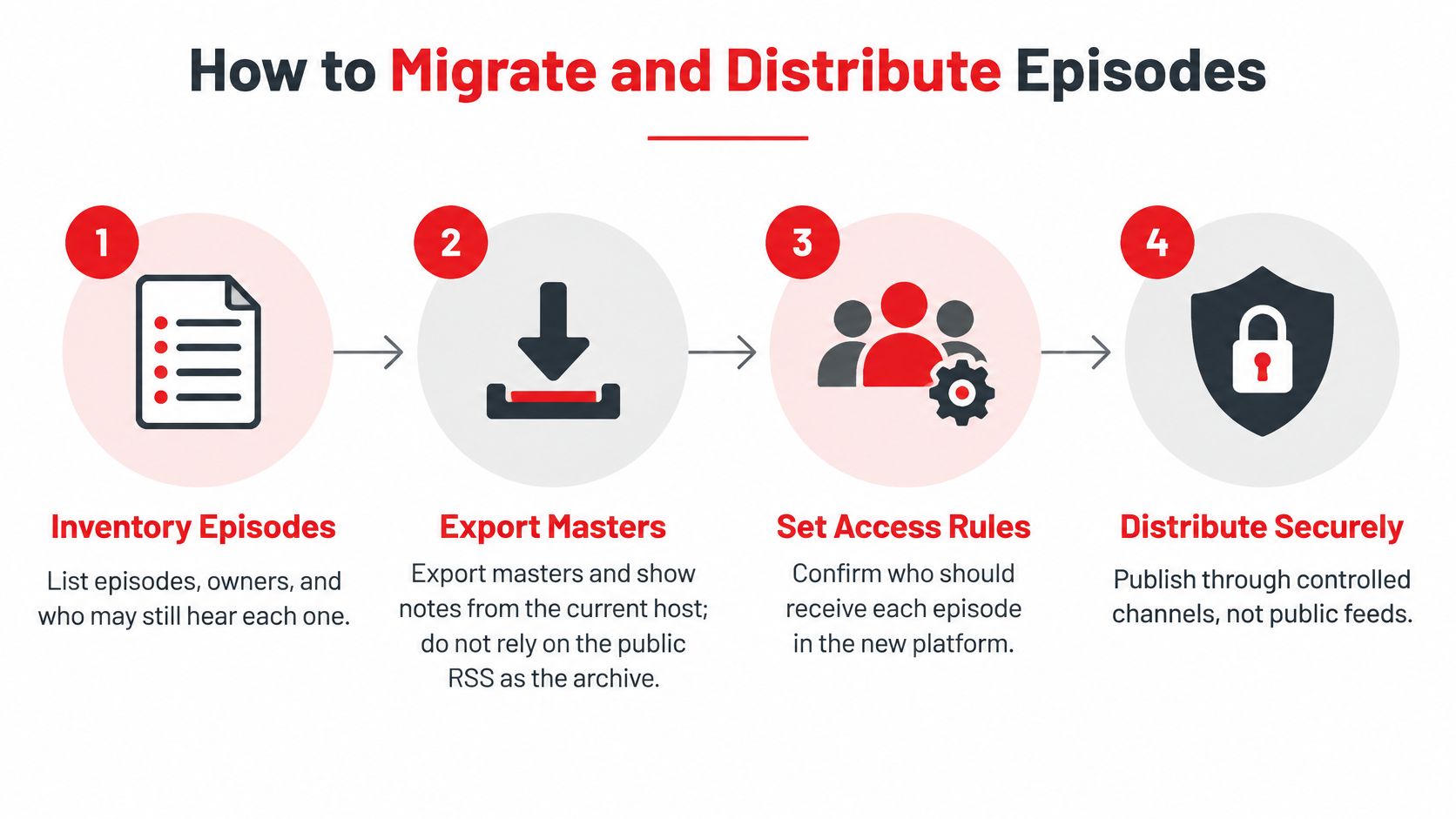
Inventory episodes, owners, and who may still hear each one. Kill or archive anything whose owner has left and whose audience you cannot name.
Export masters and show notes from the current host. Do not treat the public feed as the archive. You will not get clean files back from it later.
Map people to cohorts in the identity system before any file is uploaded. Uploading first and "fixing access later" is how the wrong cohort gets episode one.
Upload media, set artwork and descriptions, and attach the cohort to each episode. A file with no cohort is a public file waiting for a mistake.
Turn on signed or tokenized delivery and test a copied link from outside the account. The test fails the launch if that link still plays.
Publish the private feed or in-app shelf, then revoke a test user. Confirm that person cannot start the episode.
Redirect or retire the old public feed if the show was never meant to be open, and tell remaining listeners where to authenticate. How to distribute a podcast covers the open-directory path. Use it only for the cut you have cleared for the public.
For each new episode, record, approve, publish to the cohort, and log delivery versus completion. Same path every week. No side door through email attachments.
Edges that break a clean cutover
Some shows stay public for thought leadership and carry a private cut for customers. Keep two episode lists and two audiences. Do not "hide" the customer cut inside the public feed. Phones will cache audio for offline listening. Ask what the platform can still revoke after download, and tell listeners that a saved file may remain until they delete it. A dual release, video for an approved audience and audio in other apps, is fine only when policy allows that audio to leave the locked line.
Name a publisher, a backup admin, and a same-day revoke owner before the first real episode. If those three names are missing, you do not have an operation. You have a folder.
Launch Checklist Before the First Episode
Sign off in this order. A later item does not rescue an earlier fail.
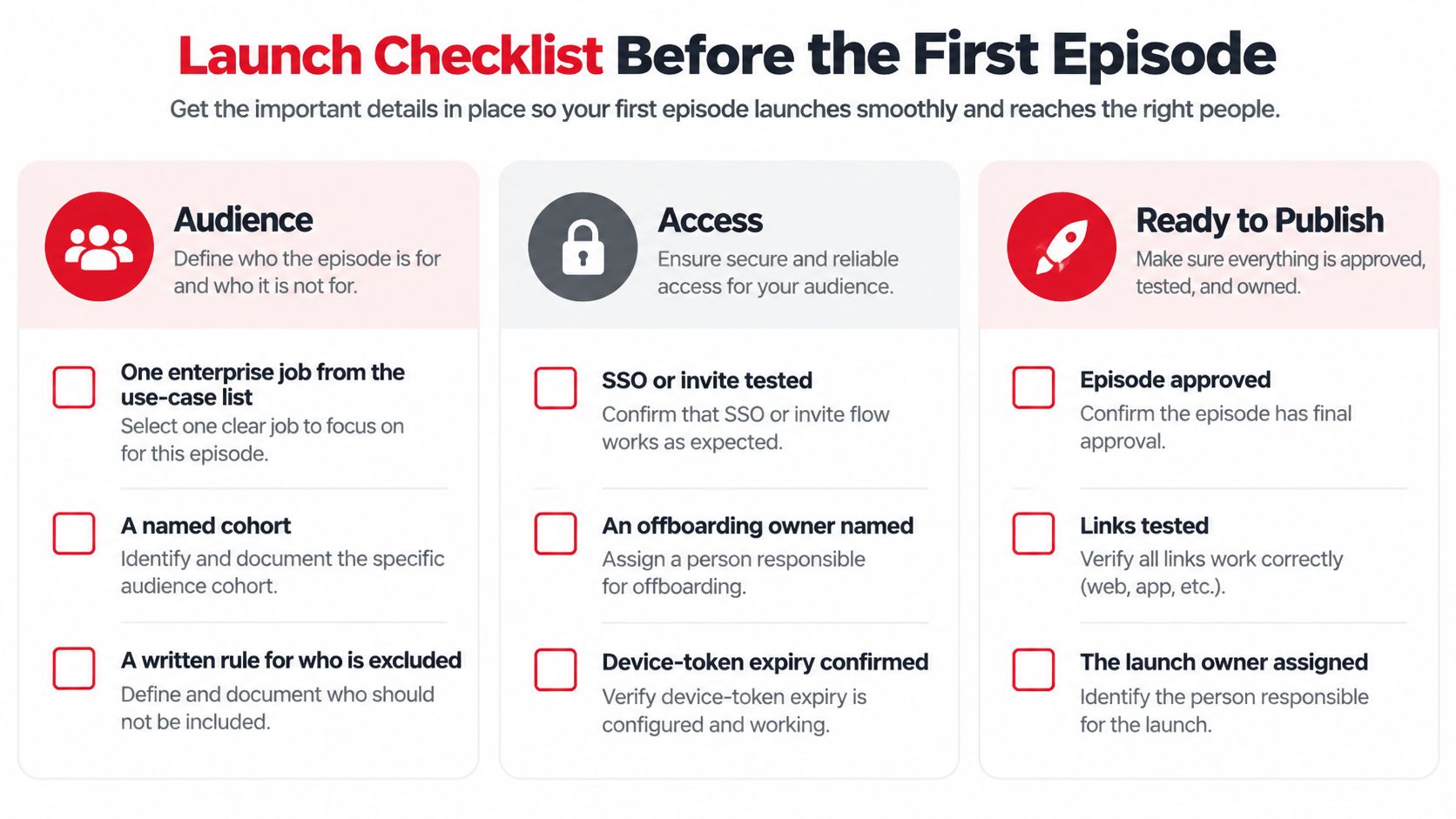
Audience. One enterprise job, a named cohort, and a written rule for who is excluded. "Everyone for now" fails.
Access. SSO or invite tested on a real account, an offboarding owner named, and device-token expiry set to a date you can explain.
Content. Length aimed at a commute. Script or outline approved by the person who owns the message. No material that legally needs a scored assessment unless the LMS step already exists.
Security. Signed links on. A copied-link test from outside the account failed closed. Downloaded-file limits written where listeners will see them.
Measurement. The dashboard shows authenticated users, starts, median seconds, and completion. Downloads are labeled as delivery. One downstream KPI is chosen and owned.
Privacy. Team-level report is the default. Retention period is written. Regional hosting is confirmed. Individual listening is visible only to a named role.
Operations. Two admins, a publish calendar, and a listener support path that is not a public social reply. Lost-access tickets should not land in a comment thread.
Promotion. An internal note or customer email explains how to sign in. No public directory submission. If the note has a shareable feed address, rewrite it.
The pilot is ready only when a revoked test user cannot play the episode and a manager can see cohort completion without a list of named listening minutes. If either test fails, you are not late. You are not ready.
Decide Whether to Partner on Production
The platform moves and locks the audio. It does not invent the series, book guests, edit, or tell leadership whether the pilot worked. Keep platform admin, access policy, and the KPI owner in-house. Those are control jobs, and a vendor should not hold the only keys.
Bring in a production partner when your team cannot sustain recording and editing, when a public companion show should run beside the private feed, or when guest interviews and promotion are part of the brief. Podmuse plans and produces audio and video shows from concept and recording through editing, publishing, and distribution, so the host can stay on hosting. Clients host the show while we handle the rest, including distribution across major platforms and cross-platform promotion through organic growth, paid media, and partnerships. For a private program, use that help on format, episode production, and any public version cleared for release. The platform vendor keeps the restricted feed.
Video that is meant to be public can publish as video on YouTube, Apple Podcasts, and Spotify, and as audio on other major podcast apps. Do not send a restricted briefing down that path because the upload button is familiar.
Shortlist two platforms against the control table, run the checklist on a ten-person cohort, and book a production consult only if making the episodes, or a public companion show, is the bottleneck.
Podmuse designs, produces, and manages audio and video podcasts for B2B brands, from concept and recording through editing, publishing, and distribution, while your team keeps the private feed and the access rules. If the restricted show needs a producible format, or a public companion cleared to leave the locked line, we can take that production load. Visit Podmuse to book a consultation and separate the platform decision from the show.
Comments