
Podcast Affiliate Marketing: A Step-by-Step Launch Guide

The usual advice for podcast affiliate marketing is to give hosts a discount code and keep the shows that generate redemptions. That's a useful payment mechanism, but a poor investment strategy. It confuses the sales you can easily assign with the demand a host creates.
Treat podcasts as a demand channel with affiliate payment terms. Set your economics before buying inventory, choose hosts who can make a credible recommendation, and judge customer cohorts against a planned comparison. Codes help settle commissions. They shouldn't decide the entire budget.
Table of Contents
Pick a Payout Model Before You Pitch Any Show - Separate host economics from brand break-even
Score Shows and Hosts Before You Commit - Downloads and host fit need inspection - Buy a controlled test, not a promise
Host-Read Ads Versus Sponsor Spots and Writing the Offer - Write for spoken recall
FTC Disclosure Rules Every Host Must Follow - Put the disclosure into the recording brief
Tracking and Attribution Beyond Promo Codes - Build separate payment and investment reports - Make the tracking implementation auditable
How to Launch Your First Podcast Affiliate Placement - Prepare the commercial and creative inputs - Verify delivery before judging results
Scale Winners and Decide Whether to Hire Help - Renew on cohort economics - Hire for the bottleneck you actually have
Launch Sheet and Cohort Report Templates - Launch sheet - Cohort report - Decision log
Pick a Payout Model Before You Pitch Any Show
Payout models for podcast affiliate deals
Payout model | How the host is paid | Best fit | Main risk |
|---|---|---|---|
Pure CPA | Commission per completed sale | Ecommerce with known margins | Code-free orders can leave the host underpaid |
Revenue share | Percentage of recurring revenue for a set period | Subscription and app products | Slow payback that's hard to judge early |
Flat fee plus CPA | Fixed fee per episode plus a bonus per sale | Shows with a large, loyal audience | Higher upfront cost with uncertain return |
Hybrid CPM plus CPA | Impression-based payment plus commission | Awareness campaigns with some tracking | Hard to reconcile exposure costs with sales |
Pure CPA transfers much of the commercial risk to the host. That makes it attractive to a brand, but a host with established sponsorship demand may decline it. A fixed payment buys access and production effort; the commission adds a performance incentive.
For context, impact.com's benchmark, reported by Howdy's affiliate-versus-sponsorship guide, puts average affiliate order value at $123 in 2025 across nearly a billion transactions from 2,368 North American retail brands. A hypothetical commission of ten percent on that order pays approximately twelve dollars.
Separate host economics from brand break-even
Say an episode fee is fifteen hundred dollars and the commission is twelve dollars per sale. Dividing the fee by the commission gives a commission-equivalent hurdle of 125 sales. That comparison helps during negotiation, but it isn't the brand's break-even calculation.
The brand must divide its fixed fee by contribution per order after commission. Deduct the discount, product cost, fulfillment, payment fees, expected refunds, and affiliate payout before calculating that contribution.
Use a small test to estimate eligible sales per placement, not a host's optimistic projection. For fixed-fee negotiations, the podcast sponsorship pricing guide helps distinguish what you're buying from how you're paying.
Retail order value isn't a substitute for your subscription app's retention economics or your software trial's eventual paid conversion. Set a maximum acceptable acquisition cost and payback period before pitching.
Before you negotiate: Does your margin per order cover the payout model you're proposing?
Score Shows and Hosts Before You Commit
Show and host scorecard
Criterion | What to check | Green flag | Red flag |
|---|---|---|---|
Audience fit | Listener job titles or buyer profile | Matches your buyer profile | Broad audience with no data source |
Listener quality | Downloads across recent episodes | Steady numbers over time | Spikes from one episode |
Host credibility | Whether the host has used the product | Host has used or meaningfully discussed it | Host has no connection to it |
Sponsor history | Past sponsors and whether they renewed | Repeat sponsors | One-off ads with no references |
Offer control | Who writes and approves claims | Brand approves final claims | Host improvises product claims |
Tracking support | Whether results can be reported by episode | Reporting by show and episode | Only total download numbers |
Start with audience fit, not the biggest download number. Ask where listener information comes from: an audience survey, platform reporting, subscriber records, or the host's estimate. Compare the answer with your customer records, including buying role, geography, purchasing authority, and the problem customers were trying to solve.
A business podcast can attract founders without attracting the operations leaders who buy your software. A wellness show can attract enthusiastic listeners whose budgets don't match your product. Topic overlap alone isn't buyer overlap.
Downloads and host fit need inspection
Ask for downloads across a sustained run of recent episodes, measured at the same age after publication. Comparing a mature episode with a newly released episode creates a misleading ranking. Separate regular episodes from celebrity interviews, giveaways, and cross-promotional spikes.
Then listen to the advertising, not just the editorial content. Does the host explain why a product matters, or rush through disconnected copy? Can they pronounce the brand and describe its use without sounding uncertain?
A smaller, closely matched show is worth testing against a larger general-interest show. Don't assume either will convert better before you've measured it. The podcast influencer marketing guide provides useful context for evaluating the host relationship alongside the inventory.
Buy a controlled test, not a promise
Repeat sponsors deserve follow-up, but renewal isn't proof of profitability. Ask whether the relationship involved performance goals, brand-building goals, or a bundled media agreement.
Before signing, agree on:
Claim approval: Who approves factual statements and revisions.
Placement records: How the publisher identifies the episode, creative, and delivery dates.
Test boundaries: The initial booking, spending cap, evaluation date, and renewal condition.
I'd start with a tightly scoped run on a well-matched show rather than spread the same budget across unrelated audiences. Write the stop rule before the host records, when nobody has an incentive to reinterpret disappointing results.
Host-Read Ads Versus Sponsor Spots and Writing the Offer
Host-read ads are the strongest starting point when the recommendation itself matters. A host can connect a familiar problem to a product, explain the offer naturally, and give listeners a memorable action.
The recording environment matters less than whether the recommendation sounds considered.
The IAB podcast advertising revenue study provides the commercial backdrop for measurable podcast advertising. For an affiliate placement, the practical advantage is that the host can attach a specific offer and response path to a recognizable show.
Pre-recorded sponsor spots give you tighter control over wording and sound. They don't automatically carry the host's personal endorsement. Programmatic insertion is a delivery method, not a creative style, and it needs reliable exposure records if you want to evaluate outcomes beyond clicks.
Branded segments suit products that need explanation or demonstration. They also introduce more production work and can make the commercial boundary harder to recognize unless you handle disclosure carefully.
Write for spoken recall
Give the host this sequence:
Experience: What they used, tested, or learned.
Problem: The customer frustration the product addresses.
Proof: A supported feature, demonstration, or result.
Offer: The exact approved incentive and eligibility.
Action: A memorable code and destination.
For a hypothetical offer, the host might say: Use code SHOWNAME for the introductory offer through the link in the episode notes. Add personal experience only when it's true, and keep the terms identical across the audio and landing page.
Let the host rephrase connective language. Don't let them improvise guarantees, results, or discount conditions. Keep competing offers out of the same placement.
This video offers additional context for planning the placement.
If you need to compare buying support, Silver Spoon Agency's directory can help you find a podcast advertising partner. Evaluate creative approval and measurement capability alongside access to shows.
FTC Disclosure Rules Every Host Must Follow
Burying an affiliate disclosure in episode notes doesn't make an undisclosed spoken endorsement safe. Under the FTC's Guides Concerning Endorsements and Testimonials, endorsements must reflect genuine experience, and material financial connections must be disclosed clearly and conspicuously.
A commission is a financial connection. Listeners shouldn't have to open a separate page to understand that the host benefits from their purchase.
Put the disclosure into the recording brief
Use this approval checklist:
Spoken disclosure: State the commercial relationship early enough for listeners to understand the recommendation.
Written disclosure: Include clear language beside affiliate links in the episode notes.
Honest experience: If the host hasn't used the product, don't script a first-person testimonial.
Supported claims: Match performance statements to evidence the brand holds.
Visible placement: Don't hide the explanation in a footnote, collapsed text, or linked policy.
A sample script could read: This episode is sponsored by the brand, and I earn a commission if you buy through my link. Adapt the sponsor reference to the actual arrangement rather than implying an upfront sponsorship where none exists.
Saying the host hasn't used a product doesn't excuse an otherwise misleading claim. The entire message still needs to be truthful.
Disclosure belongs wherever the endorsement appears, not just wherever the affiliate agreement was signed.
That includes the host's social posts, video clips, and promotional emails when they carry the endorsement or affiliate offer. Review those deliverables as part of the campaign, rather than treating them as unrelated extras.
Keep the approved script, final audio, episode publication record, and associated social copy together. Put disclosure language into the brief and have the host read it before recording, so correcting compliance doesn't become an expensive edit after publication.
Tracking and Attribution Beyond Promo Codes
Attribution methods and what each one misses
Method | What it captures | Blind spot | Use it for |
|---|---|---|---|
Unique promo code | Orders where listeners type the code | Code-free purchases | Commission settlement |
Vanity URL with UTM parameters | Visits and orders from the destination | Listeners who search the brand later | Comparing traffic by show |
Pixel or server-side tracking | Eligible conversion events and matched activity | Consent gaps, identity gaps, and privacy limits | Optimization within the agreed window |
Post-purchase survey | Self-reported source of discovery | Recall errors | Checking the channel mix |
Geo or matched holdout test | Lift versus a comparison group | Needs volume and careful planning | Incrementality decisions |
A redeemed code is evidence of response, not a census of podcast-driven purchases. Attribution benchmarks summarized by ScanKit's podcast attribution guide suggest promo-code redemptions may represent only 15–21% of attributable podcast conversions. In a separate digital-brand dataset discussed there, 53.7% of customers who said they discovered the brand through a podcast didn't use a code.
Those findings don't justify multiplying every code order by a universal correction factor. Different offers, audiences, and tracking systems produce different gaps.
Build separate payment and investment reports
Use the affiliate agreement's attribution rules to settle commissions. Define eligible orders, attribution priority, exclusions, refunds, and cancellation handling before launch.
Use blended evidence and incrementality to decide whether to renew a show. A survey response, matched exposure, and affiliate click may describe the same customer, so deduplicate them by order identifier rather than adding every system's totals together.
For considered purchases, set a 30-day initial evaluation window and document how you'll handle conversions outside it. Keep the commercial payout window distinct from the reporting window when the agreement requires that distinction.
Make the tracking implementation auditable
Create a show identifier and placement identifier, then carry them into your affiliate platform and analytics. Use UTM parameters consistently, preserve them through redirects, and test the complete checkout journey on mobile.
If destinations change during the campaign, RedirHub's guidance on how to manage campaign links with RedirHub is useful for planning redirects without scattering inconsistent links across episode notes.
A site conversion pixel alone doesn't prove podcast exposure. Exposure-based attribution also needs an appropriate matching method and publisher-side records, subject to consent and privacy requirements. The podcast attribution model guide can help frame those distinctions.
For a geographic holdout, choose comparable markets, establish a baseline, and keep other marketing changes documented. Compare changes in customer acquisition and contribution, not just raw sales totals.
Measurement rule: A holdout estimates whether advertising added demand. An attribution report assigns credit under a chosen set of rules.
If a show produces few code orders but credible survey responses and incremental lift, don't cut it merely because the easiest column looks weak.
How to Launch Your First Podcast Affiliate Placement
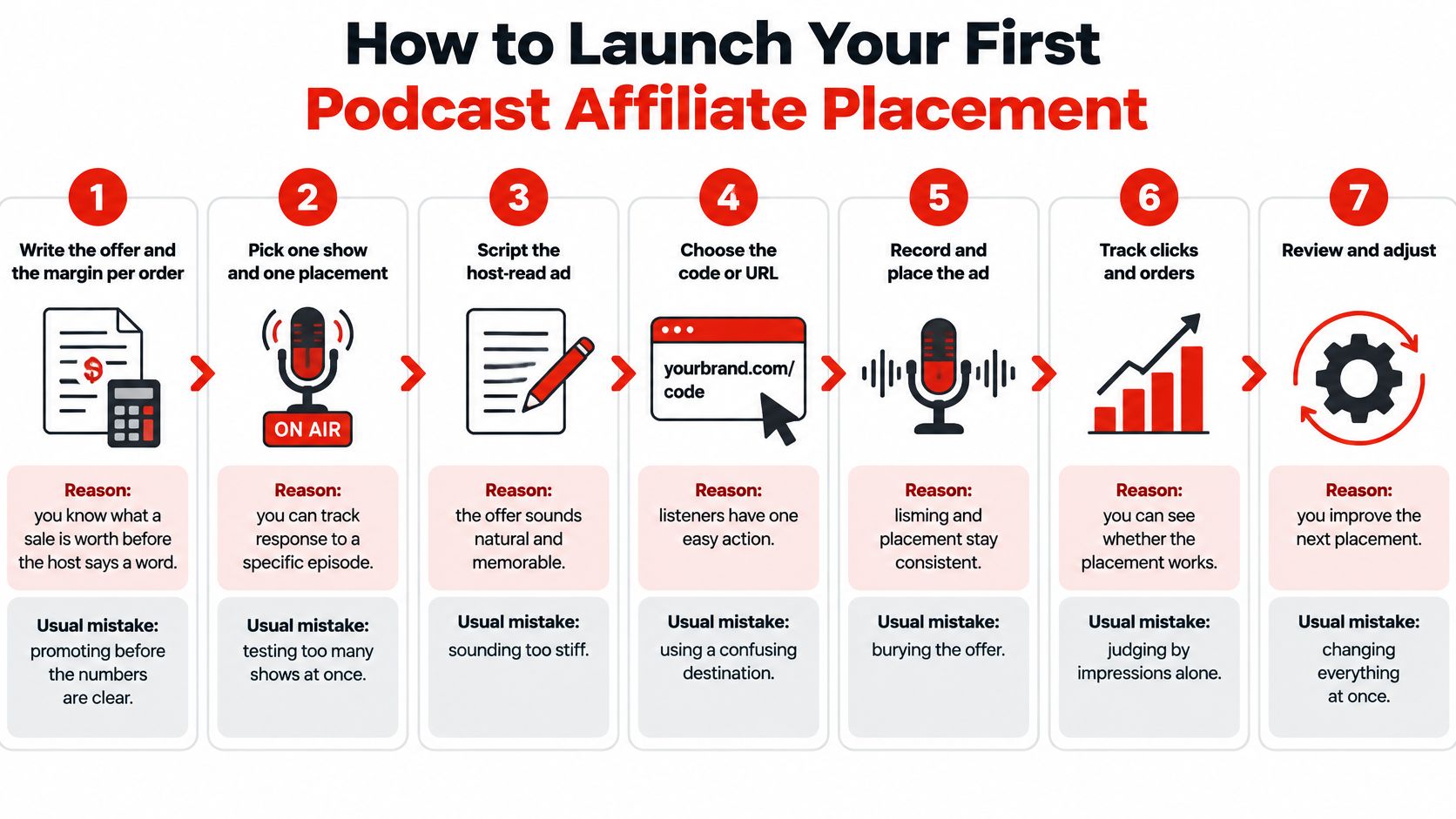
A controlled launch needs an operational owner, a tested purchase path, and a fixed review date. Use this workflow as the execution checklist.
Prepare the commercial and creative inputs
Write the offer and margin per order. Record the eligible product, discount conditions, commission, and contribution calculation. For a subscription, specify when a trial becomes commissionable and how cancellations affect payment. The usual mistake is approving creative before finance has confirmed what an acquired customer is worth.
Pick the show and initial placement. Select the audience match your scorecard supports and reserve a clear starting episode. Record whether the inventory is baked into the episode or dynamically inserted, because publication date and actual delivery may differ. Testing unrelated audiences simultaneously makes a weak result harder to diagnose.
Brief the host and approve the read. Supply the customer problem, supported product description, offer, code, destination, and disclosure. Mark factual language that must remain exact and conversational language the host may adapt. Request a recorded read before release; a technically correct script can still sound awkward when spoken.
Create the show-specific response paths. Build the promo code and vanity destination, add the agreed UTM structure, and check that the offer appears immediately after arrival. Keep spelling easy to hear and type. Shared codes and generic homepage links save setup time but undermine placement-level reporting.
Verify delivery before judging results
Connect the order feed and conversion tracking. Implement the tracking methods in the attribution table, with appropriate technical and legal review. Place a test order and confirm that the order identifier, eligible revenue, affiliate identifier, and refund status reach the reporting system. A successful page visit isn't proof that purchase tracking works.
Log delivery and lock the evaluation rules. Record publication dates, insertion schedules, creative versions, and the reporting-window end date. For this launch, use the agreed evaluation period consistently rather than shortening it when early results disappoint. Changing attribution settings mid-test makes the final comparison difficult to defend.
Run the placement, then review the completed cohort. Monitor broken links, incorrect offers, missing events, and delivery problems immediately. Hold commercial judgment until the evaluation window closes, unless a safety, compliance, or spending breach requires an earlier pause. Changing the host, offer, and landing page together may improve results, but it prevents you from learning which change helped.
A clean launch doesn't mean every sale can be traced with certainty to an episode. It means every directly attributed sale has a defensible record, while influenced and unattributed outcomes remain clearly labeled. That distinction keeps the report useful instead of artificially complete.
Scale Winners and Decide Whether to Hire Help
Benchmarks to compare your results against
The Acast performance marketing playbook provides the following podcast and broader affiliate benchmarks; their denominators make them unsuitable as interchangeable targets.
Metric | Published benchmark | How to read it |
|---|---|---|
Site visits per ad impression | About 0.24% | Sanity check, not a target |
Impression to event conversion | About 0.016% | Event-specific context |
Impression to app install | About 0.13% | Different outcome from a paid customer |
Broader affiliate conversion | 0.5% to 1% | Click-based comparison, not directly comparable |
Strong affiliate conversion | 5% to 10% | Strong affiliate context, not a podcast ceiling |
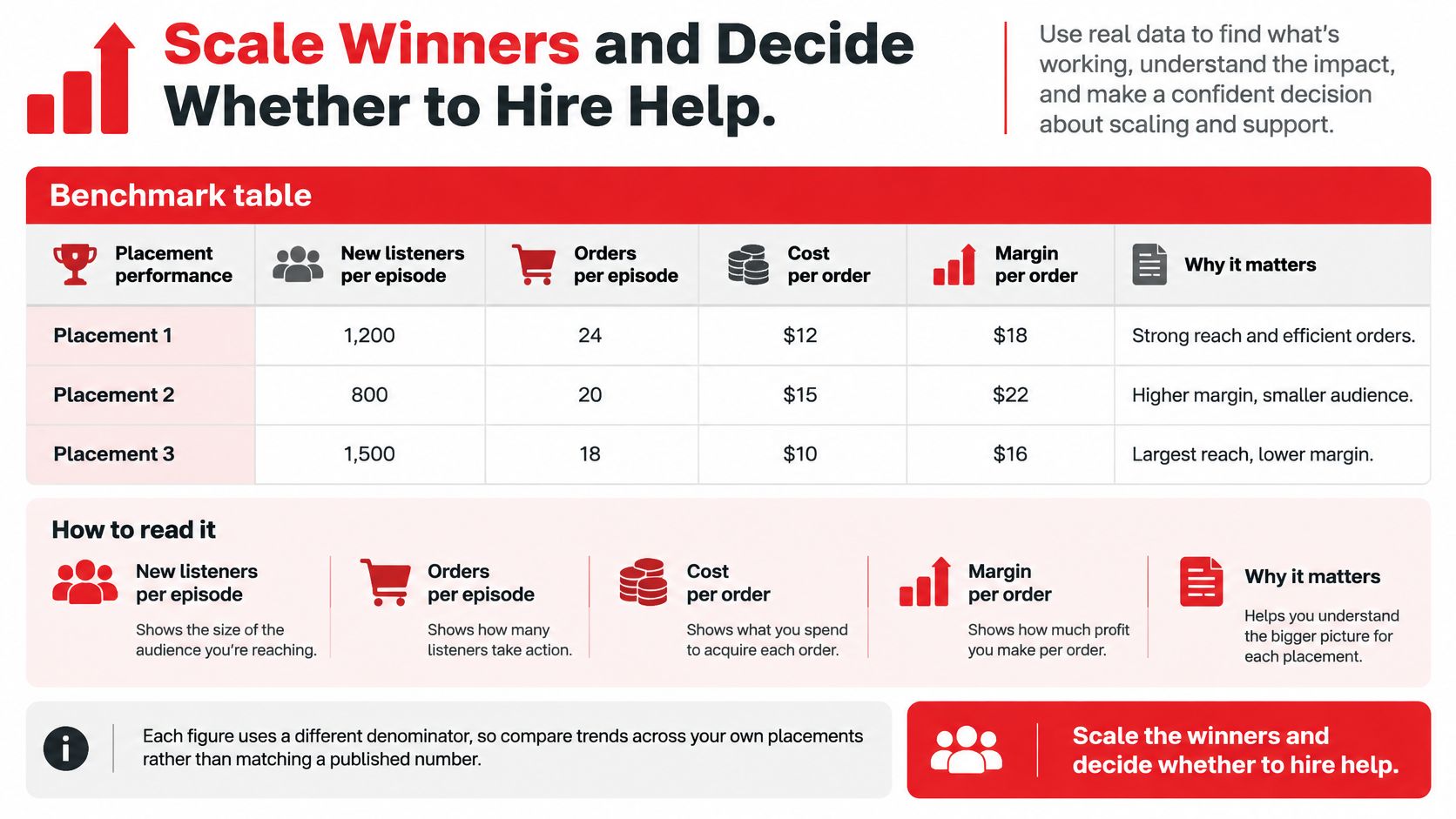
Don't compare an impression-to-purchase rate with a click-to-purchase rate and declare the podcast inefficient. Compare your own placements using the same eligibility rules, costs, and observation periods.
The illustration below uses hypothetical placement values, not published performance benchmarks.
Renew on cohort economics
Group acquired customers by show and acquisition period. Compare first-purchase contribution, new-customer share, repeat purchasing, refunds, and total contribution after campaign costs.
For B2B campaigns, preserve the originating show through lead qualification and closed-won reporting. A cheap lead that never becomes qualified pipeline isn't a winning acquisition.
Set decision rules before spending:
Keep: Acquisition cost remains within your approved ceiling across consecutive completed cohorts.
Cut: The pre-agreed test budget is exhausted without acceptable sales economics or credible incremental demand.
Scale: Profitable cohorts repeat, delivery is reliable, and a comparable audience is available.
Investigate: Direct attribution looks weak, but survey evidence or a controlled comparison suggests demand creation.
Rising branded search is a reason to investigate, not proof that a specific host caused the increase. Check other campaigns and the comparison group before granting credit.
Hire for the bottleneck you actually have
Keep the program in-house if your team can reconcile orders, maintain tracking, review claims, and produce cohort reports reliably. Bring in campaign support when those tasks become the constraint, not merely because the show list gets longer.
At Podmuse, we manage strategy, execution, and optimization across leading ad networks, publishers, and marketplaces for podcast campaigns. That operational scope is relevant when buying and reporting complexity outgrows the internal owner.
Sales follow-up is a different problem. If qualified podcast-generated leads arrive but your team can't progress them, evaluate sales capacity separately; LatHire's page discussing the best place to hire closers is relevant to that staffing decision, not to media attribution.
Choose help that resolves the constraint you've measured. More buying capacity won't repair a broken order feed or an unprofitable offer.
Launch Sheet and Cohort Report Templates
Keep these layouts in a shared workbook, with controlled access to customer-level records. Use stable identifiers so a renamed episode or revised offer doesn't break historical reporting.
Launch sheet
Create a row for each placement with these fields:
Identity: Show name, show identifier, host, episode title, placement identifier, and owner.
Delivery: Air date, insertion schedule, creative version, and approved-script file.
Offer: Product, eligibility, promo code, and vanity URL with UTM tags.
Tracking: Pixel or server-side status, test-order result, and attribution-window end date.
Economics: Placement cost, commission rule, contribution assumption, and acquisition-cost ceiling.
Cohort report
Create a row for each show and acquisition month:
Customer quality: Customers acquired, share of new customers, and qualified-customer definition.
Value: First-purchase value, repeat-purchase rate, refund rate, and commission paid.
Profitability: Placement costs, variable costs, and contribution profit per cohort.
Demand evidence: Branded-search change over the same weeks, survey responses, and holdout result where available.
Status: Preliminary or mature, with the observation period clearly recorded.
Keep missing evidence blank or marked unavailable. Don't turn missing survey responses into assumed podcast influence.
Decision log
Create a row for each decision:
Decision record: Date, show, cohort, metric checked, and approved threshold.
Action: Keep, cut, scale, or investigate.
Rationale: Supporting evidence, unresolved uncertainty, next review date, and accountable owner.
A hypothetical entry could read: Show A, March cohort, acquisition cost below the approved maximum, keep, awaiting a second mature cohort before scaling.
Store this log beside the approved disclosure scripts and delivery records. Someone reviewing the program later should be able to connect the commercial decision to the offer listeners heard, not just to the latest dashboard.
Podmuse plans and runs host-read and programmatic podcast advertising for brands that want a measurable demand channel. Visit Podmuse and choose the option to advertise a product or service, then bring your offer, margin assumptions, and acquisition-cost ceiling to the conversation.

Comments