
Podcast Sponsorship Pricing: 2026 CPM Rates and Examples

Average podcast advertising CPMs ran $18 to $50 in 2024, with pre-recorded spots at $15–$30 and host-read sponsorships at $25–$40. These are benchmarks, and the final price depends on delivery, placement and audience.

The more consequential question is what that rate buys. A download forecast, a guaranteed ad impression and a host endorsement aren't interchangeable, even when a seller puts the same CPM beside them. Sound podcast sponsorship pricing starts with the media rate, then accounts for the full invoice and the business outcome you need.
Table of Contents
Podcast Sponsorship Rates at a Glance - Podcast sponsorship CPM bands and episode costs by format
Four Pricing Models and How They Compare - Podcast sponsorship pricing models compared - Compare the unit before comparing the price
How to Calculate the Price of One Placement - Build the estimate from verifiable inputs - Placement cost by delivered downloads and CPM
What Moves the Rate and What the Invoice Adds - The factors behind the quoted rate - Cost lines that sit beyond the quoted CPM - Build the invoice before judging value
Measuring ROI and Choosing Host Reads or Programmatic - Match the format to the buying problem - Design the test before placing the order
Lock Contract Terms and Book Your First Sponsorship - Contract terms to confirm - Sample rate card for a show - Book a controlled test
Podcast Sponsorship Rates at a Glance
Average podcast advertising CPMs ranged from $18 to $50 in 2025, according to Million Podcasts, depending on show size, topic and engagement. That follows the $18 to $50 range in 2024 reported by PodcastVideos.com, citing Magellan AI and Inside Radio.
Neither range is a universal rate card. Buyers need narrower comparisons that distinguish the creative format, placement and audience being purchased.
Podcast sponsorship CPM bands and episode costs by format
The episode costs below are illustrative arithmetic at 10,000 delivered downloads, not additional market observations. Format benchmarks are detailed with their supporting publishers in the calculation and measurement discussions.
Format | Typical CPM range | Episode media cost at 10,000 delivered downloads | What the buyer gets |
|---|---|---|---|
Pre-recorded spot | $15–$30 | $150–$300 | Substitutable creative placed at scale |
Programmatic inventory | $15–$25 | $150–$250 | Reach, targeting and fast creative swaps |
Host-read sponsorship | $25–$40 | $250–$400 | Endorsement delivered in the host's voice |
Host-read mid-roll | $25–$50 | $250–$500 | Host integration after the listener has committed |
B2B, finance or high-value audience | Above $40 | Above $400 | Access to a specialized audience |
All podcast ads, 2025 | $18–$50 | $180–$500 | Broad benchmark across show size and topic |
The categories overlap. Programmatic describes how inventory is bought and delivered, while host-read describes who delivers the message. A host recording can also be dynamically inserted, so don't assume that every automated placement uses generic creative.
For initial planning, consider programmatic when you need scalable distribution and host reads when the speaker's credibility matters. For specialized business audiences, expect to negotiate around audience relevance rather than download volume alone.
Budgeting rule: Treat the range as an opening reference, not evidence that a particular show deserves the upper end.
The episode-cost column holds audience volume constant. Your actual media estimate needs the show's verified delivery and the unit specified in the offer.
Four Pricing Models and How They Compare
CPM is the default pricing language, not the only commercial arrangement. The IAB's U.S. Podcast Advertising Revenue Study reported that CPM buying represented 84% of U.S. podcast advertising revenue in 2019, rising to 94% in both 2020 and 2021. Over that period, flat-fee arrangements declined from 6% to 1%, while series ownership moved from 10% to 5%.
Those historical shares explain the market's pricing vocabulary. They shouldn't be read as a current forecast of how every network sells inventory.
Podcast sponsorship pricing models compared
The revenue-share figures below reproduce the IAB's historical categories. Performance arrangements don't have a separately stated share in that study's figures.
Model | How the price is set | Share of U.S. podcast ad revenue | Best fit | Main risk for the buyer |
|---|---|---|---|---|
CPM | Payment per thousand agreed delivery units | 84% in 2019; 94% in 2020 and 2021 | Scalable campaigns with verified delivery | Buying delivery outside the intended audience |
Flat fee | Fixed price per episode or campaign | 6% in 2019; 1% by 2021 | Small shows and one-off packages | Bundled deliverables conceal the effective media rate |
Series ownership | Sponsor buys an agreed season-long package of inventory | 10% in 2019; 5% in 2020 and 2021 | Sustained brand partnerships | Commitment persists if the show underperforms |
Performance, CPA or revenue share | Payment tied to an agreed action or revenue | Not separately reported | Trackable direct-response offers | Attribution disputes and insufficient volume |
Compare the unit before comparing the price
A flat fee can be sensible when the package includes creative work or assets beyond audio delivery. Separate those deliverables before calculating its implied CPM, otherwise you'll compare a production-inclusive package with media-only inventory.
Series ownership needs a precise inventory definition. Ask whether the agreement reserves every advertising position, a recurring segment or only specified placements. Ownership language alone doesn't establish category exclusivity.
A performance deal needs an agreed definition of a payable action. A form submission, a qualified sales lead and a completed purchase create different obligations.
Finally, delivery method is separate from payment model. Understanding podcast dynamic ad insertion helps you distinguish an episode sponsorship from inventory served during a defined campaign window.
Ask for a media-only CPM alongside every proposal. For a flat-fee offer, divide the allocated media charge by contracted delivery in thousands, not by an optimistic lifetime audience estimate.
How to Calculate the Price of One Placement
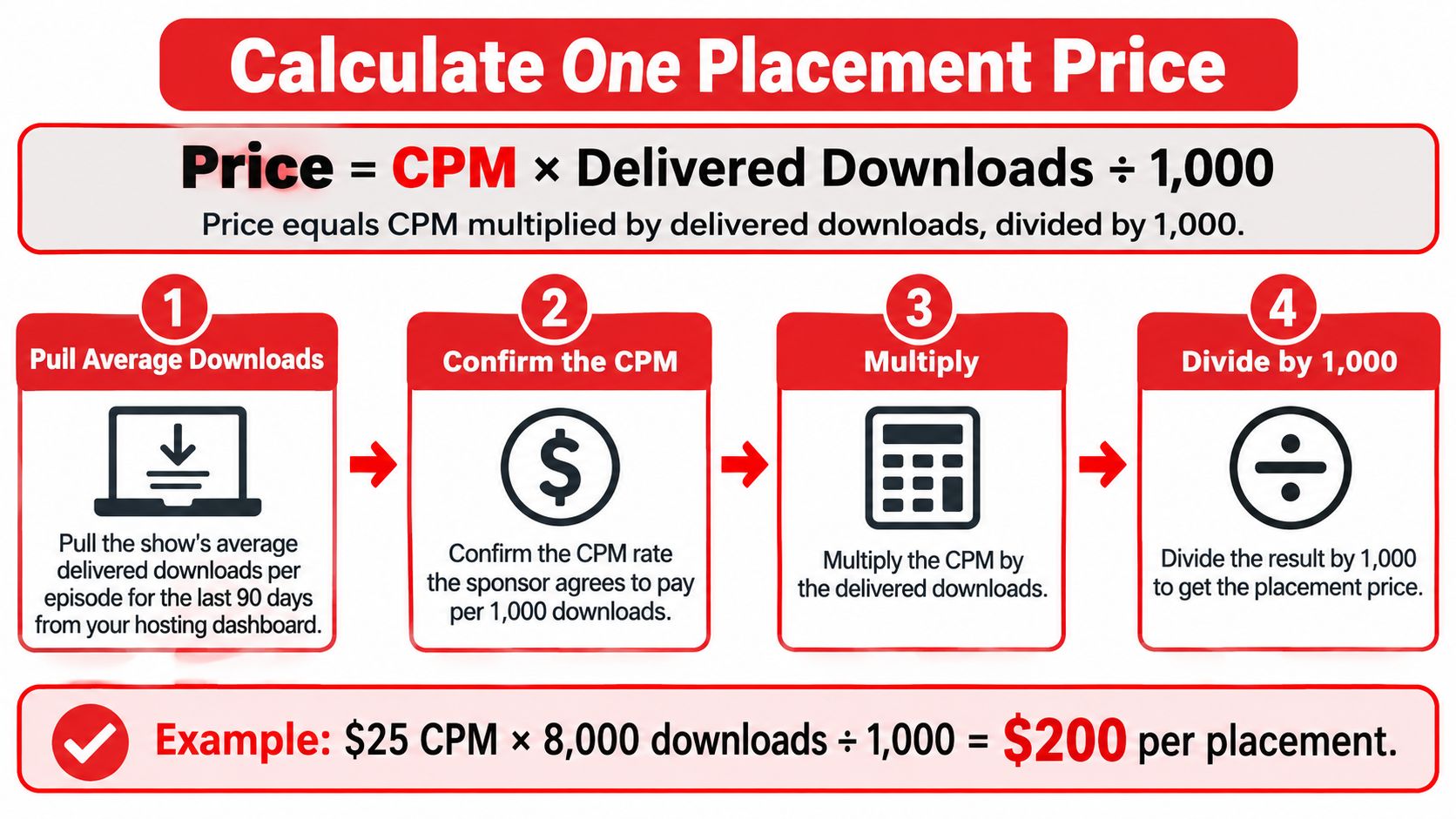
Placement price = CPM × delivered downloads ÷ 1,000. Acast's podcast advertising cost guide gives the practical example of 25,000 delivered downloads at a $30 CPM, producing a $750 placement before fees, production or premium targeting; its published benchmarks put pre-recorded spots at $15–$30 CPM, host-read sponsorships at $25–$40, and some high-value business audiences above $40.
Use delivered downloads only when downloads are the contracted unit. If the proposal guarantees served ad impressions, calculate against those impressions instead.
Build the estimate from verifiable inputs
Pull comparable episode delivery. Request a recent hosting-dashboard export with the same measurement window for each episode. Don't substitute subscribers, social followers or lifetime totals for the audience available during your campaign.
Apply the quoted media rate. Multiply the agreed CPM by the expected contracted delivery, then divide by the thousand-unit basis. Keep the forecast and guarantee in separate spreadsheet columns.
Confirm insertion and flight terms. Record whether the message is dynamically inserted or embedded in the episode. Specify which episodes and listening dates count toward delivery.
Separate creative and commercial additions. Obtain individual prices for host-read production, category exclusivity, premium targeting and measurement. A single bundled total prevents you from identifying what you're really negotiating.
Add buying and platform charges. Establish whether each fee applies to net media, gross media or the entire campaign. Don't calculate a percentage until the agreement identifies its billing base.
Write the under-delivery remedy. Specify whether a shortfall triggers replacement inventory, an extended flight, a credit or a refund. Require approval before the seller substitutes a different show or audience.
Placement cost by delivered downloads and CPM
These are worked planning scenarios, calculated with the formula above, not quoted offers or additional rate benchmarks.
Delivered downloads per episode | CPM | Calculated media cost |
|---|---|---|
5,000 | $25 | $125 |
25,000 | $30 | $750 |
50,000 | $40 | $2,000 |
100,000 | $18 | $1,800 |
100,000 | $40 | $4,000 |
The comparison shows why audience size alone doesn't determine price. A smaller placement at a premium rate can cost more than a larger placement bought at a lower rate.
Keep contracted delivery, actual delivery and qualified response separate. They answer different questions: what you bought, what the seller supplied and what the campaign achieved.
The calculated placement price belongs on the media line of the budget. It isn't permission to approve the campaign total.
What Moves the Rate and What the Invoice Adds
Two shows quoting the same CPM can produce different invoices because the sellers may include different services, guarantees and rights. Even before additional charges, the underlying inventory can differ in commercially important ways.
The factors behind the quoted rate
Placement. A mid-roll reaches someone who has already continued into the episode, giving the seller a different attention proposition from an opening placement.
Ad length. Castos's advertising-rate guide reports an average rate of $21.37 for a 60-second spot and explains the role of duration and placement; don't mistake that isolated benchmark for an all-in placement invoice.
Host involvement. A host can explain a use case, connect the offer to the episode and deliver a personal call to action. A supplied audio file doesn't automatically include that work.
Insertion type. Dynamic insertion permits creative and targeting changes, while embedded messages can remain in the episode beyond the purchased flight.
Audience requirements. Specify the geography and professional audience you need. A broad download forecast doesn't establish that the inventory reaches your buyers.
Delivery terms. A guarantee with an enforceable remedy provides a different commitment from an estimate with no obligation to replace missing delivery.
A longer message isn't automatically worth more in proportion to its duration. Pay for the explanation your offer needs, rather than buying extra seconds without a creative purpose.
Cost lines that sit beyond the quoted CPM
Use the following as a quote-review checklist, not a claim that every seller charges every fee. Require an explicit included, excluded or separately priced answer for each applicable item.
Cost line | How it is billed | What it does to the total |
|---|---|---|
Host-read production | Flat fee per script or spot, if charged separately | Adds a fixed creative cost |
Agency or buying fee | Contracted percentage or agreed service fee | Adds cost according to the stated billing base |
Category exclusivity | CPM premium or flat surcharge | Charges for blocking specified competitors |
Measurement and attribution | Platform, campaign or service charge | Adds the cost of tracking and analysis |
Minimum spend | Floor per show, network or campaign | Can require more spend than the initial media calculation |
Usage rights | Separately negotiated reuse permission | Adds cost for approved use beyond the placement |
Make-goods | Replacement delivery, credit or other agreed remedy | Addresses a shortfall rather than buying new scope |
Minimum spend deserves particular attention. A mathematically affordable placement may still be unavailable as a standalone purchase if the seller requires a larger commitment. Record both the calculated inventory cost and the amount you must authorize.
Usage rights also need boundaries. Buying a read doesn't establish permission to reuse the host's voice in paid social creative, sales presentations or other advertising.
Build the invoice before judging value
Podder's podcast CPM analysis describes host-read inventory as costing about 1.5–3 times programmatic inventory for a similar audience, while highlighting production, exclusivity, minimum spends and usage rights as additional cost variables. That premium buys a different execution, not simply a more expensive version of identical reach.
The useful comparison is therefore:
All-in campaign cost = media + production + buying fees + measurement + negotiated additions.
Don't populate that equation with an assumed standard agency percentage. Use the actual proposal, and confirm whether the fee is already included in the quoted CPM.
For a spreadsheet, give each charge its own row with the billing basis, quantity, inclusion status and approval owner. Keep optional additions outside the approved total until someone authorizes them.
A cheaper CPM is only a cheaper customer acquisition route if the lower-priced delivery produces enough qualified outcomes to offset its cost advantage.
For B2B campaigns, define qualification before launch. A response might need the right company profile, a relevant job function and genuine purchase interest before it counts toward the campaign's demand-generation target.
That definition prevents a media seller's response total from becoming your sales team's lead total by default. It also makes podcast spending more comparable with paid social or other channels using the same qualification rules.
Ask the seller to identify what drives every charge: delivery, creative labor, restricted inventory or additional rights. If a line has no clear deliverable or contractual obligation, resolve it before approving the budget.
Measuring ROI and Choosing Host Reads or Programmatic
Choose host reads when trust and explanation are central to the sale; choose programmatic when distribution, targeting and creative flexibility are the priority. Treat that as a testable buying hypothesis, not a promise that either format will outperform for your brand.
Castfox's CPM benchmark guide places host-read mid-rolls around $25–$50 CPM and programmatic inventory around $15–$25 CPM, with reported aided recall of approximately 60%–70% for host reads versus 24%–31% for programmatic placements. Those recall figures don't establish incremental purchases, qualified pipeline or causality.
Match the format to the buying problem
Campaign requirement | Starting format | What to validate |
|---|---|---|
Broad awareness and scalable distribution | Programmatic | On-target reach and controlled frequency |
Retargeting or rapid creative testing | Programmatic | Audience eligibility and response by creative |
Explaining a high-consideration product | Host-read | Message comprehension and qualified response |
Founder-led positioning or credibility | Host-read | Host fit and downstream buyer interest |
Recall isn't revenue. A listener can remember a message without needing the product, having purchasing authority or taking an incremental action.
For a performance comparison, calculate:
Effective CPA = total sponsorship cost ÷ incremental conversions.
For demand generation, use incremental qualified responses as the denominator instead. If you can't estimate incrementality, label the result attributed cost per qualified response, not incremental CPA.
Design the test before placing the order
Use matched markets or a holdout group where feasible. Keep the offer and qualification criteria consistent so that different sales propositions don't get mistaken for a format effect.
Assign each show a dedicated landing page and tracking identifier. Promo codes can capture some responses, but they shouldn't be the only evidence, particularly when buyers return through search or enter a longer sales process.
A practical podcast attribution model should distinguish observed responses from estimated campaign lift. Connect campaign records to your CRM, then review qualified leads, opportunities and revenue separately.
Set the evaluation window to reflect your buying cycle. Don't reject an explanatory host read solely because it hasn't generated immediate closed revenue, but don't excuse weak qualification indefinitely either.
Buy fewer trusted shows when the sale depends on belief. Buy broader distribution when the sale depends on volume, then require the outcomes to justify that choice.
A low-priced placement can win the media comparison and lose the customer-acquisition comparison. The decision belongs in the qualified-outcome report, not on the rate card alone.
Lock Contract Terms and Book Your First Sponsorship
Every term that changes delivery, payment or usage belongs in writing before signing. The insertion order should let a colleague verify what was purchased without reconstructing the negotiation from email.
Use the contract checklist to turn commercial assumptions into reviewable obligations.

Contract terms to confirm
Measurement source and delivery definition. Name the reporting platform and specify whether the unit is gross downloads, unique downloads or served ad impressions. State which report governs reconciliation.
Position, duration and insertion. Write the purchased placement as a clause, identifying its location, agreed duration, creative version and insertion method. Require approval for substitutions that change the audience or execution.
Frequency and attribution. Document any available frequency controls separately from the attribution window. Exposure management and conversion reporting aren't the same obligation.
Reporting and tracking setup. Assign responsibility for landing pages, tracking parameters, promo codes and reporting delivery. Test the destination and CRM capture before the ad goes live.
Cancellation and flight completion. Specify the campaign end date, cancellation process and treatment of unused budget. Include creative approval responsibilities so that neither party can leave a launch dependency unassigned.
Sample rate card for a show
A sample rate card should use the same delivery volume for every format. Below is illustrative arithmetic for a 25,000-download placement, applying the format benchmarks already identified, not a seller's offer or a forecast of results.
Format | Planning CPM | Calculated episode media cost |
|---|---|---|
Programmatic inventory | $15–$25 | $375–$625 |
Host-read sponsorship | $25–$40 | $625–$1,000 |
Host-read mid-roll | $25–$50 | $625–$1,250 |
B2B-tier host-read | Above $40 | Above $1,000 |
Keep production, services and rights outside this media-only card until they're priced. Attach the audience definition and delivery commitment so the table can't be mistaken for an unconditional offer.
For campaign execution, our custom media plans cover host-read ads, programmatic placements and in-app promotions. We run podcast advertising across more than 40 podcast ad networks, allowing the plan to consider different inventory sources rather than a single show's availability.
Book a controlled test
First, request comparable rate cards from shows serving the same audience profile. Use the podcast ad buying guide to organize the brief and purchasing requirements.
Next, calculate each offer's all-in cost and model the qualified responses needed to meet your acquisition target. Mark response assumptions explicitly rather than presenting them as expected performance.
Then approve a limited test flight with a holdout where feasible and a defined reporting decision. Scale when the evidence supports the purchase, comparing cost per qualified outcome, not just CPM.
Our podcast advertising service combines host-read ads, programmatic placements and in-app promotions in a media plan built around your goals. Podmuse's AI-Powered Podcast Media Plan delivers relevant podcasts and YouTube channels as a full campaign plan within 24 hours. Visit Podmuse to turn your audience brief and budget into a plan you can evaluate on all-in cost and qualified outcomes.


Comments