
How to Become a Thought Leader: 12-Month Plan

You're posting every week, accepting panels, and guesting on podcasts when invitations arrive. Your calendar looks busy, but buyers still can't explain what you stand for, what problem you solve better than anyone else, or why they should trust your judgment over a competitor's. That's the gap most executives hit when they try to learn how to become a thought leader. Visibility isn't authority. Authority comes from a narrow thesis, evidence you can defend, and content that helps an entire buying group make a better decision, including the people who never comment publicly.
Table of Contents
Why Most Thought Leadership Fails - The Cost of Generic Content
Define a Niche and a Defensible Point of View - Run a Self-Audit Before You Publish - Write the Thesis You Will Repeat
Build a Signature Content Engine With Podcasting - Turn Episodes Into Evidence Collection - Repurpose With a Hierarchy
Choose Distribution That Compounds Authority - Compare the Main Distribution Paths
Engage the Audience and the Hidden Buyers - Build Assets That Travel Internally
Measure Authority and Iterate Every Quarter - Run a 90-Day Learning Loop
Your 12-Month Thought Leadership Checklist - Months 1 to 3 Build the Foundation - Months 4 to 6 Publish the First Proof - Months 7 to 9 Expand Distribution Deliberately - Months 10 to 12 Turn the Body of Work Into an Asset
Why Most Thought Leadership Fails
Most executives don't have an expertise problem. They have a translation problem. Years of pattern recognition stay trapped in sales calls and internal meetings, while public content defaults to safe observations about leadership, growth, or innovation that any competitor could publish unchanged.
Buyers notice the difference quickly. In the 2021 Edelman and LinkedIn study of nearly 3,600 management-level professionals, 54% spent more than an hour per week consuming thought leadership, but 71% said half or less of what they consumed provided valuable insights. Attention exists. Useful insight is scarce.
The Cost of Generic Content
Weak content isn't neutral. The same study found 47% had discovered and ultimately purchased from a company not previously regarded as a category leader because of thought leadership, while 27% decided not to award business after engaging with weak content. A thin post can close a door you never knew was open.
Three habits create that outcome:
Volume without a thesis: You publish often, but each piece argues something different, so nothing compounds.
Opinion without evidence: You share strong views with no data, method, or documented experience behind them.
Executive topics without a decision: You discuss broad themes instead of helping a specific buyer choose, budget, implement, or avoid risk.
Thought leadership is repeated proof of useful expertise. If a buyer can't repeat your position after one episode or article, you don't have a position yet.
That standard also reframes personal branding. A polished profile supports credibility, but it doesn't replace proof, which is why personal branding insights from Legacy Builder work best when paired with a disciplined evidence habit. Treat every appearance as a test. Does it offer a new perspective, relevant evidence, or a practical solution for a defined audience? If not, don't publish it and call it authority building.
Define a Niche and a Defensible Point of View
Start narrower than feels comfortable. A defensible position needs four parts: one defined audience, one expensive decision problem, one arguable point of view, and one evidence standard. If a reasonable competitor couldn't disagree with your thesis, it's probably a platitude.
Buyers reward that specificity. The 2024 Edelman and LinkedIn B2B Thought Leadership Impact Study of nearly 3,500 professionals across seven countries found 55% viewed strong, original data and research as defining the highest quality thought leadership, 80% preferred third-party data and insights from trusted organizations or people, and 77% preferred deep subject-matter experts on specialized topics over senior executives discussing broad issues.
Run a Self-Audit Before You Publish
Pull evidence from work you already do:
Measurable topics: What can you observe in customer data, delivery, or operations that outsiders can't see easily?
Repeated mistakes: Which error do you correct in almost every engagement?
Risk questions: What do finance, legal, security, or operations ask late in a deal?
Defensible claims: Which beliefs could you support with a survey, operational data, or documented method?
Turn the strongest answers into one sentence. For example, owning podcast demand generation for high-consideration B2B brands is a niche. Talking about modern marketing leadership isn't. The first version tells a producer whom to invite, a buyer why to listen, and a sales team which asset to forward.
Pressure-test the sentence against real market examples. Studying concrete thought leadership examples helps you see whether recognized experts own a problem or merely occupy a topic. Then map content to that claim instead of chasing trends, a discipline reinforced by content strategy advice from RedactAI on building around expertise rather than volume.
Write the Thesis You Will Repeat
Use this format: For [audience] facing [decision], [common practice] fails because [mechanism], so they should [alternative] and measure [outcome]. You don't need to publish that sentence verbatim. You need every episode, article, and talk to advance it. That's the practical core of how to become a thought leader without sounding self-promotional. You're not promoting yourself. You're defending a useful idea in public, repeatedly, with receipts.
Build a Signature Content Engine With Podcasting
A podcast becomes an authority asset when it's built as an evidence system, not a recording habit. Chasing weekly posts produces fragments. A recurring research question produces a body of work buyers can cite.
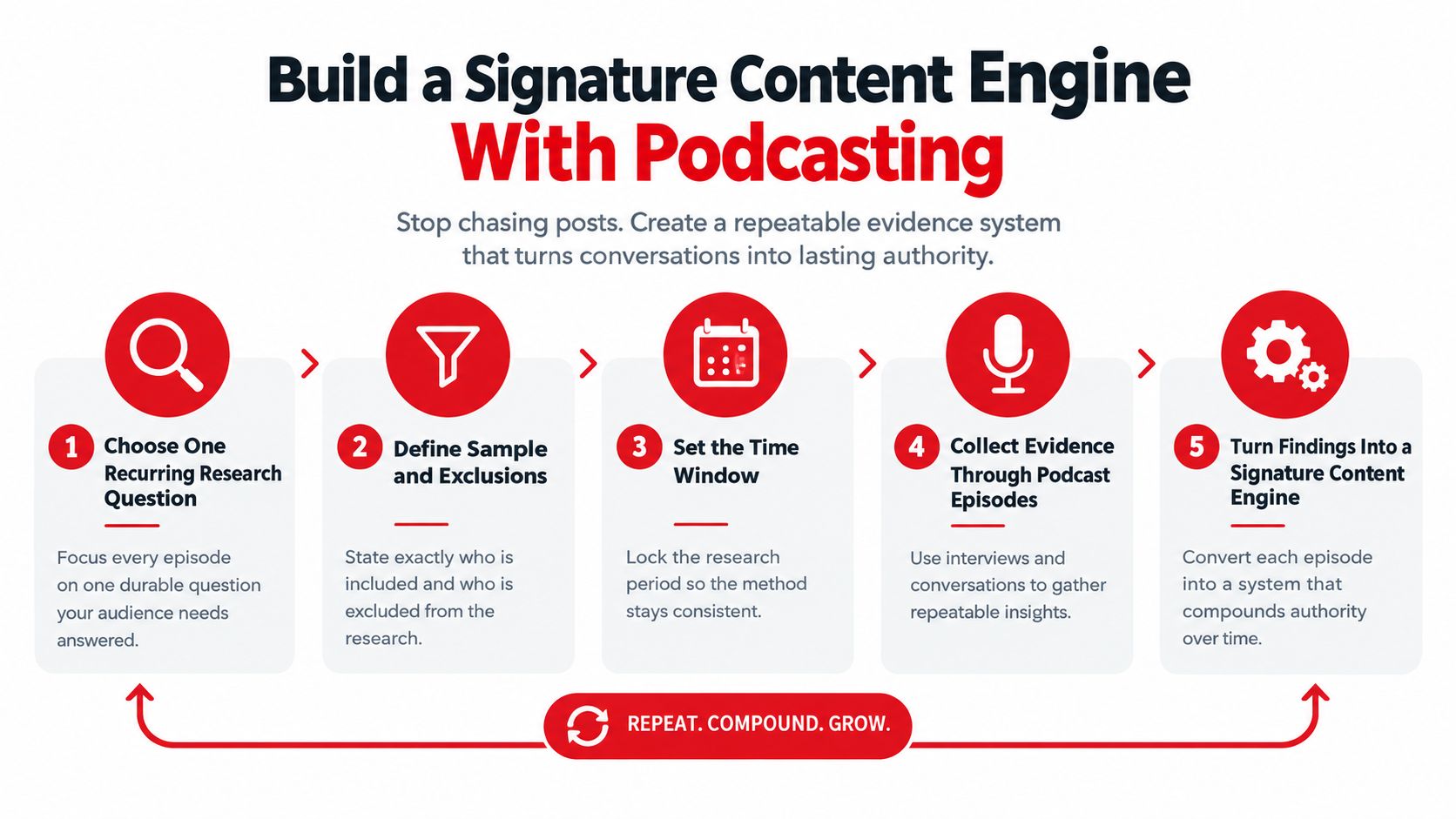
Start by selecting one narrowly defined decision problem. Before collecting data, specify the unit of analysis, population, time period, exclusions, and success metric. When you publish, place the sample size, recruitment method, fieldwork dates, question wording, weighting, cleaning rules, and limitations beside major claims, then convert each study into a point of view, a decision framework, and testable recommendations, as outlined in Directive guidance on building a research foundation.
Turn Episodes Into Evidence Collection
Design each episode around the same durable question, then vary the angle:
Practitioner interview: Ask a customer or operator what they tried, what failed, and what they'd measure differently.
Outside expert session: Bring in a respected specialist whose credibility strengthens, and sometimes challenges, your thesis.
Findings episode: Present survey or operational results, state limitations plainly, and separate data from anecdotes.
Decision workshop: Convert findings into a checklist, scoring model, or implementation sequence.
That structure also solves topic fatigue. Instead of brainstorming from zero, pull questions from sales calls, support tickets, and lost deals, then expand them with focused podcast topic ideas that map back to your thesis.
Repurpose With a Hierarchy
Every recording should produce assets in a deliberate order: the full episode, a short research brief, clips for social and YouTube, a newsletter section, and talking points for guest appearances. If you're adapting older articles into episodes, you can repurpose blog content with VeloCMS as a starting workflow, but don't publish a summary and call it research. Add new evidence or a sharper framework.
Guest placements follow the same rule. Pitch one thesis, one relevant finding, and one practical takeaway for that show's audience. Prepare a one-page sheet with your position, proof points, limitations, and the resource listeners should read next. If an appearance doesn't advance the thesis, decline it.
Production is a capacity decision. Keep it in-house when you have consistent editorial ownership and editing time. Use an end-to-end partner when concept, recording, post-production, and distribution keep slipping, because inconsistent publishing breaks the evidence chain faster than modest production values do.
Choose Distribution That Compounds Authority
Creating insight and distributing insight are different jobs. A strong episode buried on one feed won't build consensus inside target accounts. You need a mix where each channel does the work it's best suited to do.
Owned channels give you depth and control. Your podcast feed, newsletter, and research pages hold the full method and the downloadable assets. Earned placements borrow trust from hosts and publications your buyers already respect. Paid distribution adds frequency and precise reach, especially when organic discovery is slow.
Compare the Main Distribution Paths
Path | Best use | Main risk | Podmuse role |
|---|---|---|---|
Owned podcast and newsletter | Depth, method, repeat engagement | Slow initial discovery | Production and distribution support |
Guest appearances | Borrowed trust, thesis reinforcement | Off-topic shows dilute positioning | Research, pitching, booking |
Host-read ads and sponsorships | Credible endorsement in trusted shows | Poor audience fit wastes spend | Media planning and buying |
Programmatic audio | Scale and frequency across inventory | Less contextual trust than host-read | Buying across networks and publishers |
Promo swaps and in-app placements | Discovery by active podcast listeners | Mismatched audience intent | Placement coordination |
Paid social clips | Retargeting and clip testing | Optimizing for views instead of buyers | Cross-platform promotion |
Host-read placements work for credibility because the recommendation arrives in a voice listeners chose. Programmatic audio and paid social work differently. They extend reach and repetition after you've proven which clips and claims earn attention. Don't reverse that sequence by buying scale for an untested message.
Every placement should point to the underlying research, decision brief, or episode, not a generic homepage. A buyer who lands on proof can forward proof. A buyer who lands on a slogan has nothing to share internally.
Podmuse is one operational option. The agency plans and buys podcast advertising across 40+ ad networks and publishers, books guest appearances for founders and subject-matter experts, and produces and distributes shows across Spotify, Apple Podcasts, YouTube, and social platforms. Whether you use a partner or build internally, apply the fundamentals in a practical guide to podcast distribution before you spend on promotion.
Engage the Audience and the Hidden Buyers
Your most important reader may never follow you. In complex B2B deals, procurement, finance, legal, operations, and security shape the outcome. They read the brief your champion forwards, challenge the risk assumptions, and ask whether implementation will create work for their team.
The 2025 Edelman and LinkedIn study of 1,934 management-level professionals found hidden buyers consume thought leadership at nearly the same rate as target buyers, with 63% spending more than an hour per week on it. Among them, 91% want insights that reveal overlooked risks or opportunities, 86% prefer perspectives that challenge assumptions, and more than 40% of deals reportedly stall because of misalignment within the buying group.
Build Assets That Travel Internally
Public engagement metrics won't capture that influence. Create formats a champion can use in a meeting:
Decision brief: State the problem, options, evidence, trade-offs, and recommended next step on a few pages.
Risk analysis: Name implementation, compliance, budget, and adoption risks before stakeholders raise them.
Benchmark framework: Give teams a way to compare current performance without relying on a single anecdote.
Implementation checklist: Show owners, sequencing, dependencies, and what done looks like.
Short stakeholder clips: Cut podcast segments around finance, legal, or operations questions, not just executive soundbites.
Practical rule: If an asset can't help your champion win an internal argument you're not in, it's content. It isn't sales enablement yet.
Engagement should feed the same system. Run office-hour episodes where listeners submit decision problems. Use surveys to find which risks stakeholders rank highest. Host small practitioner roundtables and publish the synthesis, with permission, as a briefing. Ask sales which assets get forwarded and which objections keep recurring.
Then measure what matters. Track forwards, downloads of briefs, sales-team usage, and multi-stakeholder engagement within target accounts. Applause on a post feels good. Alignment inside a buying group closes deals.
Measure Authority and Iterate Every Quarter
Downloads and follower growth tell you distribution happened. They don't tell you authority grew. Separate signals that appear early from business outcomes that arrive later, or you'll kill a working thesis because revenue lagged, or scale a popular show that never influences buyers.
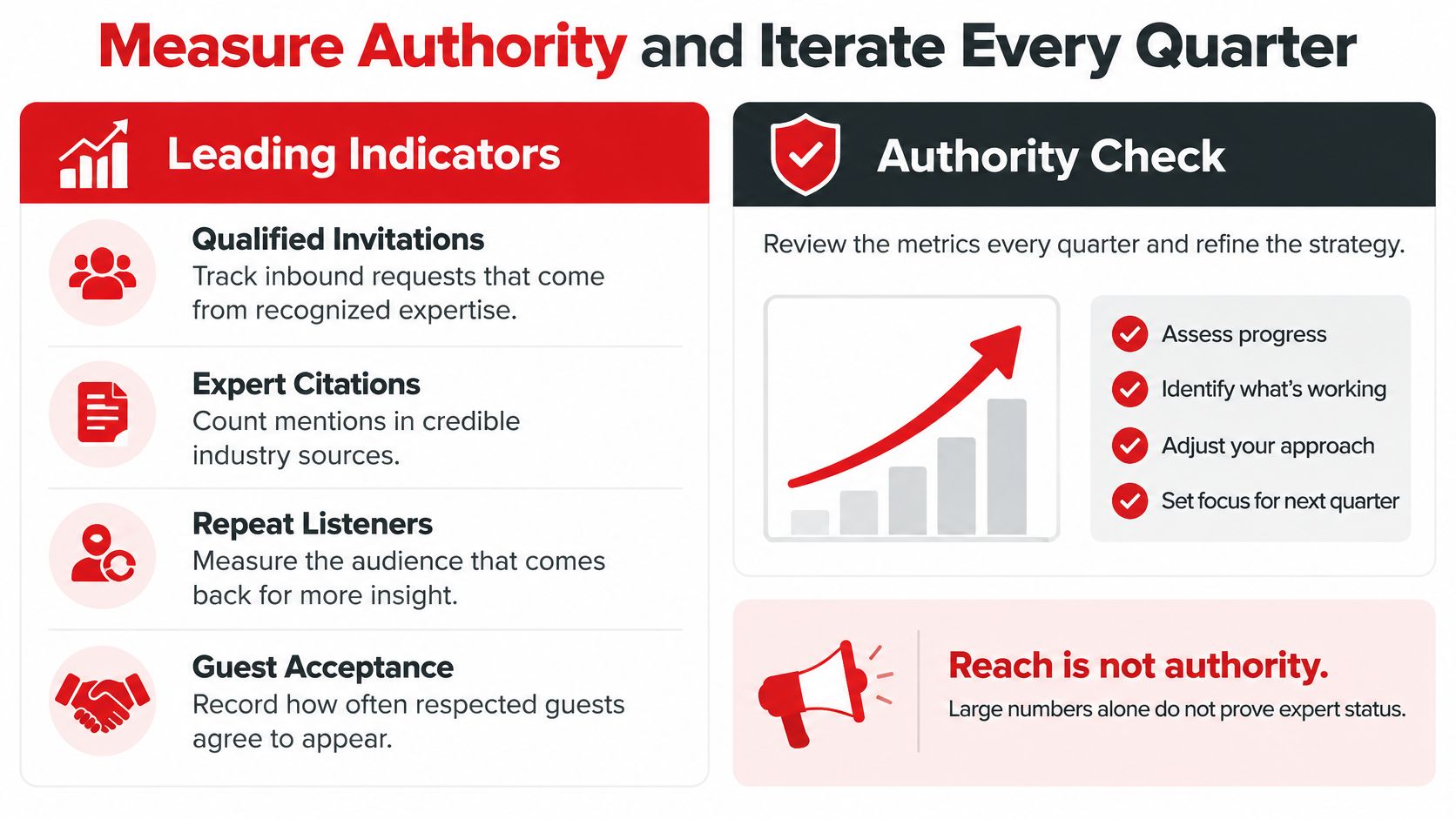
Track leading indicators such as qualified invitations, expert citations, repeat listeners, guest acceptance rate, sales-team usage of assets, and decision-maker conversations. Track lagging indicators separately, including influenced opportunities, win rate, sales-cycle velocity, branded search lift, assisted conversions, and cost per engaged account.
Run a 90-Day Learning Loop
Each quarter, state one category thesis, collect at least three independent evidence types, test it in a real engagement, publish a transparent briefing, and present implications to a relevant audience. Then update or retire claims that new evidence contradicts. That willingness to revise is itself a credibility signal.
Expertise maintenance needs its own rhythm. A 2020 study of more than 220 thought leaders found reading was the most common method for maintaining expertise at 46%, more than 38% cited learning from other thought leaders, and roughly one-third cited presentations or teaching. Convert that into practice with scheduled reading, practitioner interviews, small experiments, and teaching sessions where you must defend your framework.
Watch for warning signs. Reach climbs but qualified invitations don't. Guests accept, but sales never uses the clips. Your point of view hasn't changed despite new customer evidence. Episodes publish on schedule, yet none produces a brief, framework, or testable recommendation. Those patterns mean you're running a media calendar, not learning how to become a thought leader in a way buyers can verify.
Your 12-Month Thought Leadership Checklist
A year is enough time to build a recognizable position if you stop treating each quarter as a fresh start. Keep the same thesis, deepen the evidence, and expand distribution only after the core asset earns trust.
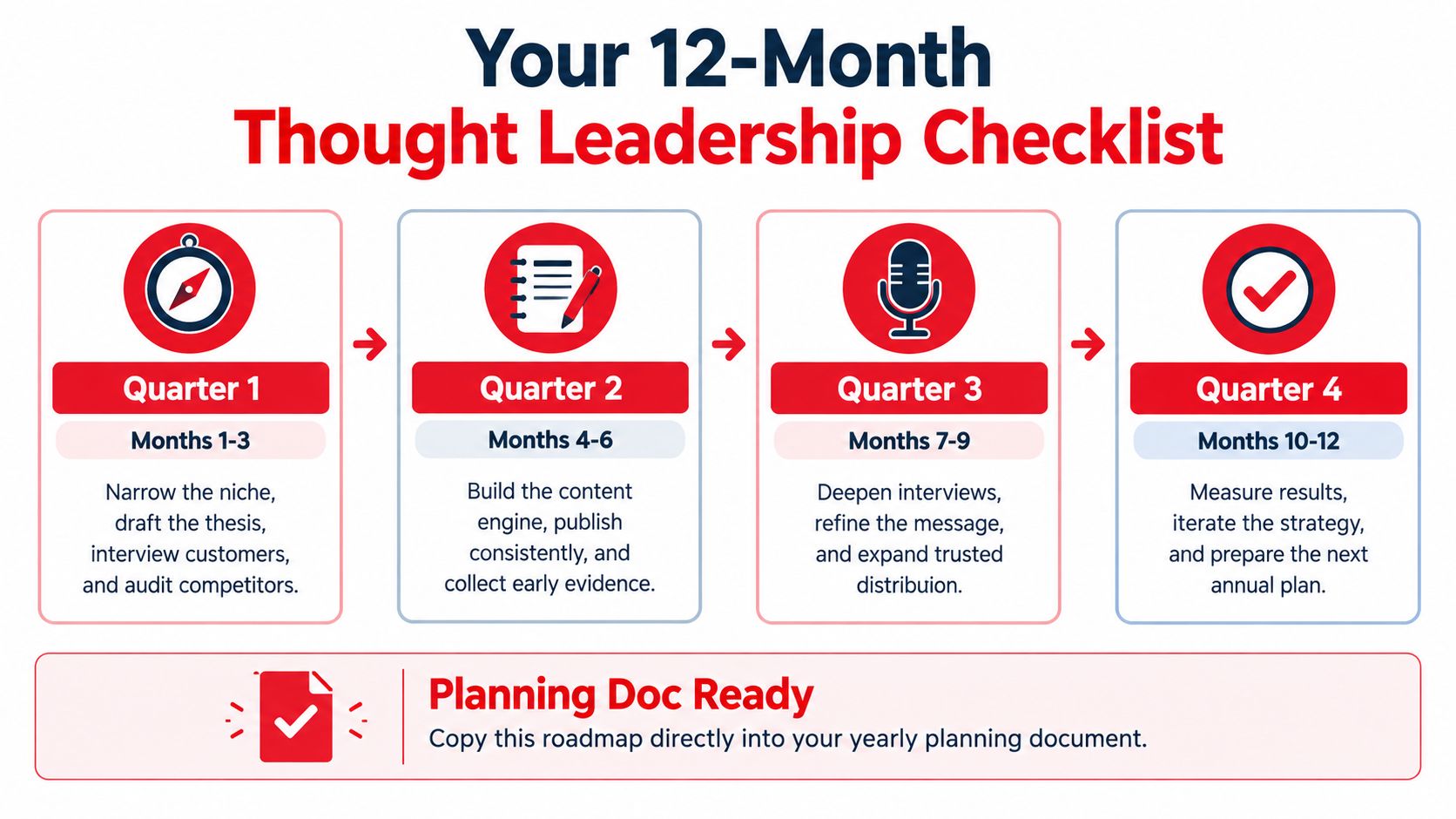
Months 1 to 3 Build the Foundation
Narrow the niche to one audience and one expensive decision. Draft the one-sentence thesis, interview customers about mistakes and risks, and audit competitors for claims they repeat without proof. Choose the flagship format, define your research question, population, exclusions, time period, and success metric, and record pilot episodes you don't need to publish.
Your exit criteria are concrete. You can state your position in one sentence, name the evidence you'll collect, and list the stakeholder questions your first assets must answer.
Months 4 to 6 Publish the First Proof
Launch the first research-backed batch of episodes and briefs. Book three right-fit guest appearances that reinforce the same thesis, each with a prep sheet and a link back to your underlying research. Build the first stakeholder assets, starting with a decision brief and a risk checklist your sales team can forward.
Don't chase every channel yet. Learn which claims prompt replies, forwards, and decision-maker conversations. Retire topics that attract attention from people who will never buy, influence, or cite your work.
Months 7 to 9 Expand Distribution Deliberately
Add promo swaps with adjacent shows, test host-read placements in trusted podcasts, and consider sponsorships or programmatic support for episodes already proven with your core audience. Run the first quarterly refresh in public. Show what changed, what held up, and which recommendation you'd revise.
This quarter also tests operational honesty. If editing, pitching, or media buying keeps delaying publication, fix the bottleneck instead of lowering the evidence standard. Authority compounds through consistency, but only when consistency doesn't mean thinner insight.
Months 10 to 12 Turn the Body of Work Into an Asset
Publish a signature report that synthesizes the year, with method, limitations, framework, and testable recommendations in one place. Repackage the strongest episodes into clips, a briefing deck, and sales enablement organized by stakeholder objection. Review leading and lagging indicators separately, then choose next year's thesis refinement based on evidence, not boredom.
If bandwidth or buying expertise is the blocker, scope production, guest bookings, and media placement in one free consultation before committing to a calendar you can't sustain. The goal isn't to look busy for twelve months. It's to end the year with a position buyers can repeat, evidence they can inspect, and assets a champion can use when you're not in the room.
If you're ready to turn one defensible thesis into a research-backed podcast, right-fit guest placements, and distribution that reaches the full buying group, Podmuse can help you scope production, marketing, and media buying in a free consultation. Visit the site to plan the mix that fits your audience, your evidence, and your next quarter.
Comments