
Podcast Dynamic Ad Insertion Explained for Marketers

You're sitting with two quotes for the same podcast buy. One rep wants you to lock a host-read sponsorship into new episodes and leave it there. The other wants you to run dynamically, swap creative mid-flight, and target by market. The CPMs don't tell you which one will drive pipeline, and neither rep will volunteer what their format can't do.
That choice isn't a technology preference. It's an operating decision about control, trust, and proof. Get it wrong and you'll either pay a premium for permanence you don't need or buy cheap scale that never earns credibility with a B2B buyer.
Table of Contents
What Podcast Dynamic Ad Insertion Actually Does - The Pipeline Analogy That Makes It Click - Why That Separation Matters to You
How the DAI Workflow Works Step by Step - From Tap to Assembled File - Creative Format Is Separate From Delivery Method - The Vendor Hand-Offs You Must Reconcile
DAI vs Host-Read Ads and When Each One Wins - DAI vs Host-Read Placements Decision Criteria - Three Scenarios With a Clear Answer
Building a DAI Campaign From Planning to Optimization - Phases One to Three Set the Ceiling - Phases Four to Six Protect the Money
Privacy-Safe Targeting and Attribution in a Cookie-Less Channel - What Contextual Targeting Really Includes - Delivery Metrics Are Not Causal Proof
Best Practices for Creative, Frequency Capping, and Compliance - Creative That Survives Automation - Frequency Capping Without Fatigue - Disclosure and Category Compliance
How an Agency Operationalizes DAI for Brands - What the Agency Owns and What Stays With You
What Podcast Dynamic Ad Insertion Actually Does
You're likely in one of two camps. You've bought baked-in sponsorships before and you're tired of ads living forever after the offer expires. Or you've bought programmatic display and video and you expect podcasting to work the same way, with swaps, caps, and targeting you can change on Tuesday. Podcast dynamic ad insertion exists to serve the second instinct, but you shouldn't adopt it just because it feels familiar.
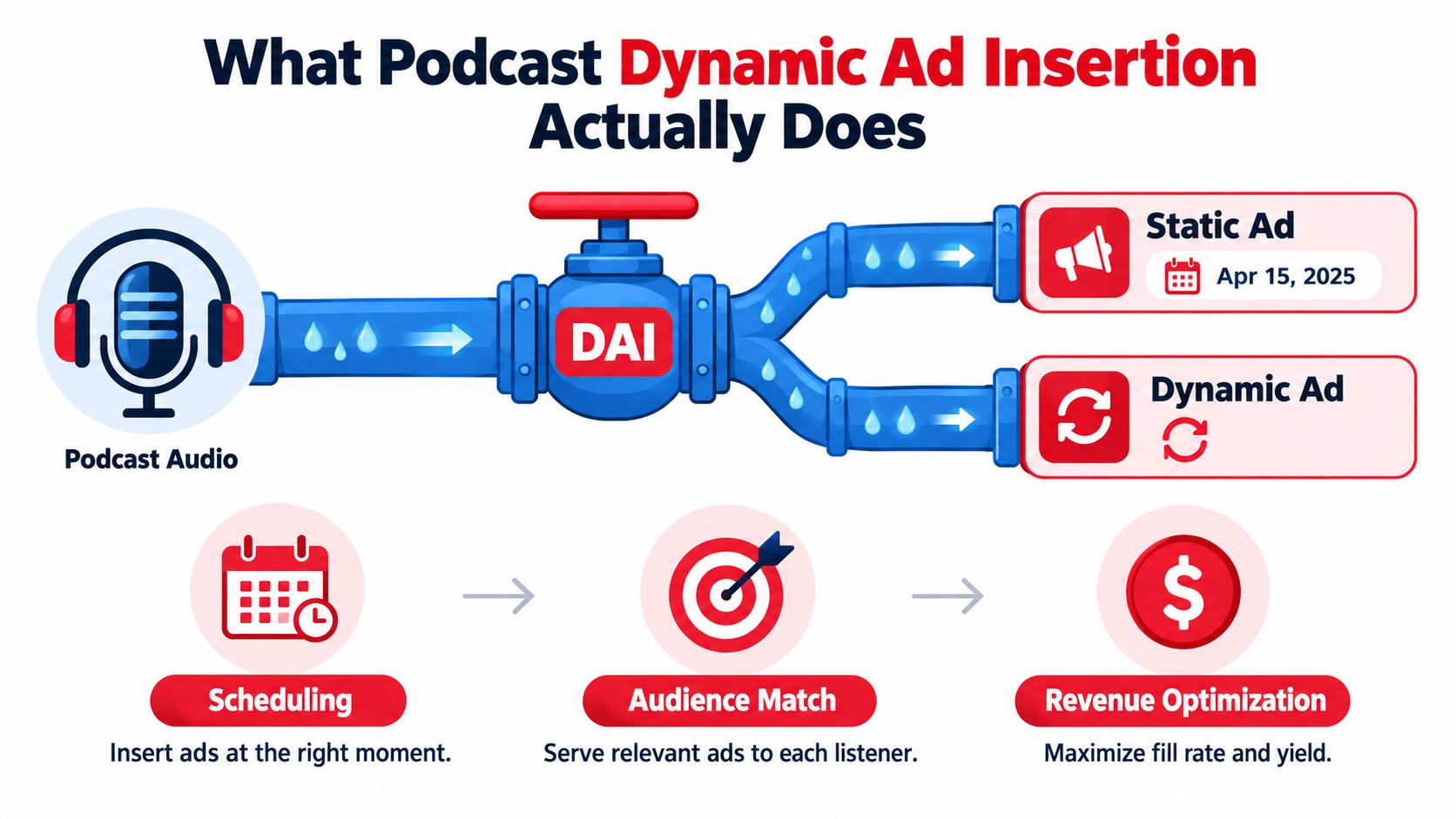
In plain language, DAI inserts an ad at the moment an episode is downloaded or streamed, rather than permanently embedding it in the original audio file, a distinction described in IAB reporting on the growth of dynamically inserted podcast advertising. A baked-in ad is part of the episode forever. A dynamically inserted ad is decided when the listener shows up.
The Pipeline Analogy That Makes It Click
Think of the episode as a water pipeline. The content flows through it every time someone presses play. An ad break is a valve in that pipe. DAI is the system standing at the valve, deciding which ad flows through for this specific request, on this day, in this place.
That New Yorker opening a finance podcast on Monday morning triggers a request. The valve opens, the system checks which campaigns are live and eligible, and she hears a current offer. A listener in another market opening the same episode next month can hear different creative through the same valve. The episode itself never changes.
Why That Separation Matters to You
Because the ad and the episode are separate files, you can refresh, pause, or replace creative after publication. You can sell against newer audience or geographic information instead of guessing who will listen months later. You can also run the same campaign across new releases and back catalog without re-editing audio.
If you're evaluating shows, don't rely on a media kit alone. Read what hosts say episode to episode with a tool like the Scribiz podcast transcript tool, so you can judge topic fit and tone before you commit inventory. DAI gives you distribution flexibility. It doesn't fix a bad contextual match.
Practical rule: If you can't explain DAI as "the ad is chosen when the listener requests the episode, not when the episode was recorded," your team isn't ready to buy it well.
This is no longer an experiment you need to justify internally. It's the default plumbing for podcast advertising, and the question is how you operate it, not whether it exists.
How the DAI Workflow Works Step by Step
Follow one download and the abstraction disappears. A listener taps play in her podcast app. That tap sends a request for the episode file, and everything useful happens in the seconds before she hears the host's voice.
From Tap to Assembled File
The publisher's RSS feed or app calls the ad server with available signals tied to that request. The ad server evaluates campaign rules, including dates, geography, audience segment, and frequency policy, then selects a creative that fits an open break. If no paid campaign is eligible, it can serve a house promo or leave the break empty depending on the publisher's setup.
The selected ad is then stitched into the requested audio at a marked break point and the assembled file is delivered to the listener. She doesn't hear a technical seam when it's done well. She hears content, then an ad, then content again, as if it had always been recorded that way.
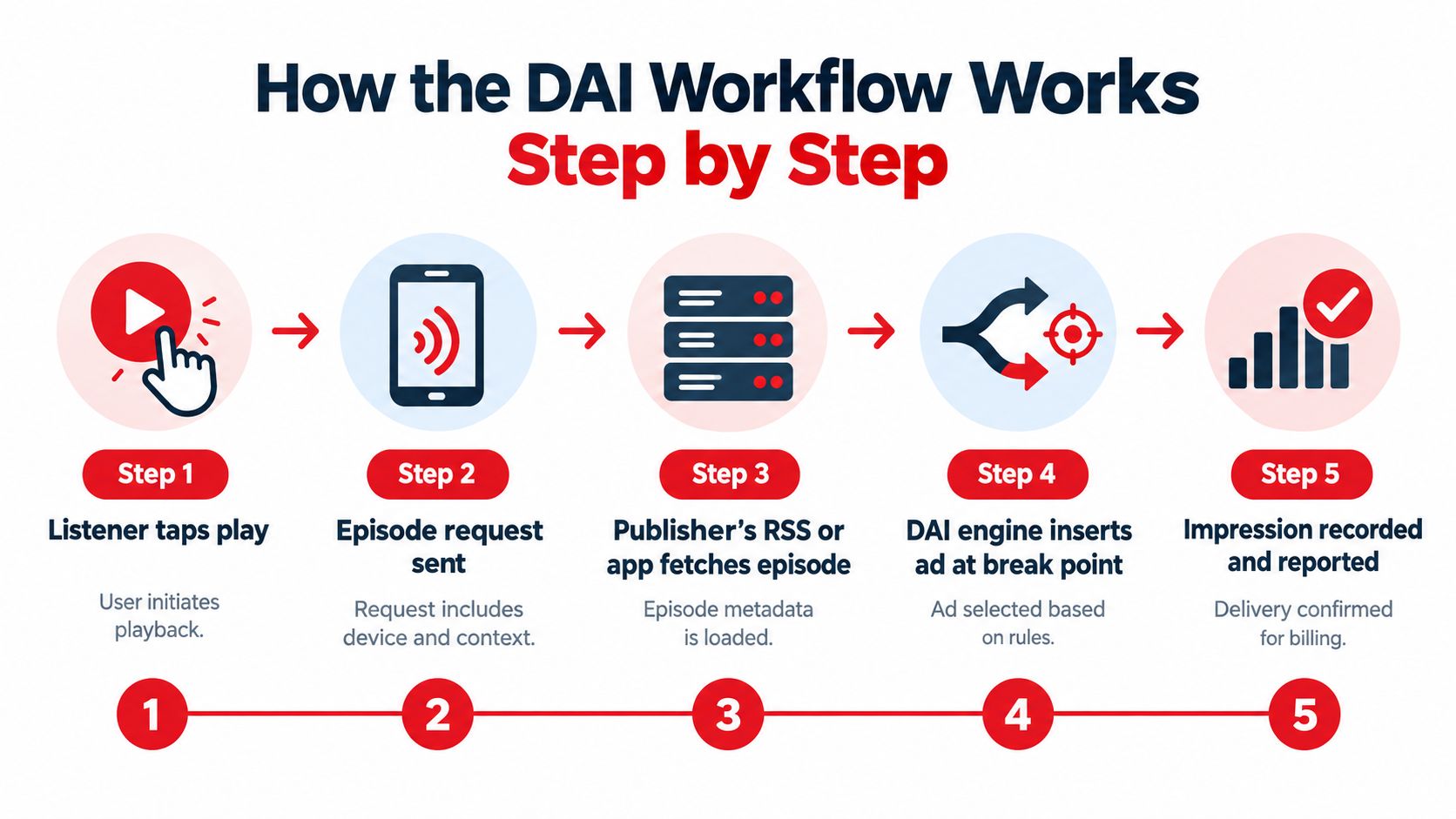
Those breaks come in three standard positions:
Pre-roll: Runs before the episode starts. It's easy to place and hard to miss, but attention is still settling.
Mid-roll: Runs during the episode at a natural pause. It typically commands premium pricing because the listener is already engaged and less likely to abandon.
Post-roll: Runs after the content ends. Reach drops because some listeners leave early, so treat it as support inventory, not your primary message.
Creative Format Is Separate From Delivery Method
Don't confuse how an ad is delivered with who reads it. DAI can deliver a polished announcer-read spot or a host-read endorsement recorded separately and inserted dynamically. Industry reporting citing IAB data found DAI represented 84% of podcast advertising revenue in 2021, including 84% of host-read ad revenue and 85% of announcer-read ad revenue, as summarized in Digiday coverage of the IAB Podcast Upfront and DAI growth. Dynamic doesn't mean generic. It means separable.
The Vendor Hand-Offs You Must Reconcile
Four categories sit behind that simple playback moment. Hosting platforms store the episode and often provide native insertion markers. Ad servers make the selection decision. Programmatic exchanges bring in outside demand when a publisher opens inventory to them. Measurement partners verify what was delivered. If you're also building owned audio distribution, this guide for creators building streaming apps is useful context for how playback infrastructure shapes what ad calls are even possible.
Every hand-off is a place where numbers can diverge. Before you trust a report, reconcile what the ad server says it served against what the hosting platform logged as downloaded. If those two don't line up within an agreed tolerance, you don't have performance data yet. You have a billing dispute waiting to happen.
DAI vs Host-Read Ads and When Each One Wins
Stop asking which format is better. Ask which format wins for this objective, this audience relationship, and this level of purchase complexity. DAI is not automatically superior because it's data-driven. Its advantage is scalability and flexibility, not universal persuasion, a trade-off explored in Podscan analysis of when host-read placements outperform dynamic insertion. When audience and show fit is high, a trusted host explaining your product in their own voice can convert in ways a rotated spot won't.
DAI vs Host-Read Placements Decision Criteria
Criterion | DAI Strength | Host-Read Strength |
|---|---|---|
Scalability | Buys across many shows and back catalog from one campaign setup | Scales show by show, limited by host availability |
Trust transfer | Borrows show context but not necessarily host credibility | Directly borrows the host's relationship with listeners |
Creative flexibility | Swap, version, and expire creative without re-editing episodes | Strongest when woven into conversation, hardest to update |
Targeting precision | Geography, timing, and portfolio-level controls at request time | Targeting comes from show selection, not listener-level rules |
Attribution quality | Cleaner flighting and testing windows for comparison | Promo codes and vanity URLs tie response to a specific voice |
Use that table as a filter, not a scorecard. If trust transfer is your binding constraint, DAI's targeting precision won't compensate. If speed and controlled testing are the constraint, a perfect host read that takes weeks to schedule and can't be updated will cost you the window. Our deeper breakdown of why host-read podcast ads work for reaching potential customers covers the credibility mechanics behind that trust column.
Three Scenarios With a Clear Answer
A DTC launch with a time-sensitive offer should lead with DAI. You need reach quickly, you'll iterate on the offer, and an expired code baked into episodes will actively hurt you. Freshness beats intimacy here.
A B2B demand-gen push for a considered purchase should lead with host-read placements on a tight list of high-fit shows, delivered dynamically when possible. Your buyer needs explanation from someone they already trust. Use DAI as the delivery layer for flight control, not as a substitute for the host's voice.
A back-catalog monetization or evergreen prospecting play belongs to DAI, full stop in operational terms. Older episodes still get discovered through search and recommendations. Dynamic insertion is the only practical way to put a current message into that long-tail listening without re-editing an archive.
Judge both formats on incremental reach, qualified attention, conversion rate, cost per incremental customer, and brand lift, not on CPM or completion rate alone.
My recommendation for most first-time B2B buyers is a hybrid. Anchor with host-read on a small set of shows where fit is undeniable. Layer DAI prospecting across a broader portfolio to learn which contexts respond. Then promote winners into deeper host relationships instead of buying intimacy everywhere at once.
Building a DAI Campaign From Planning to Optimization
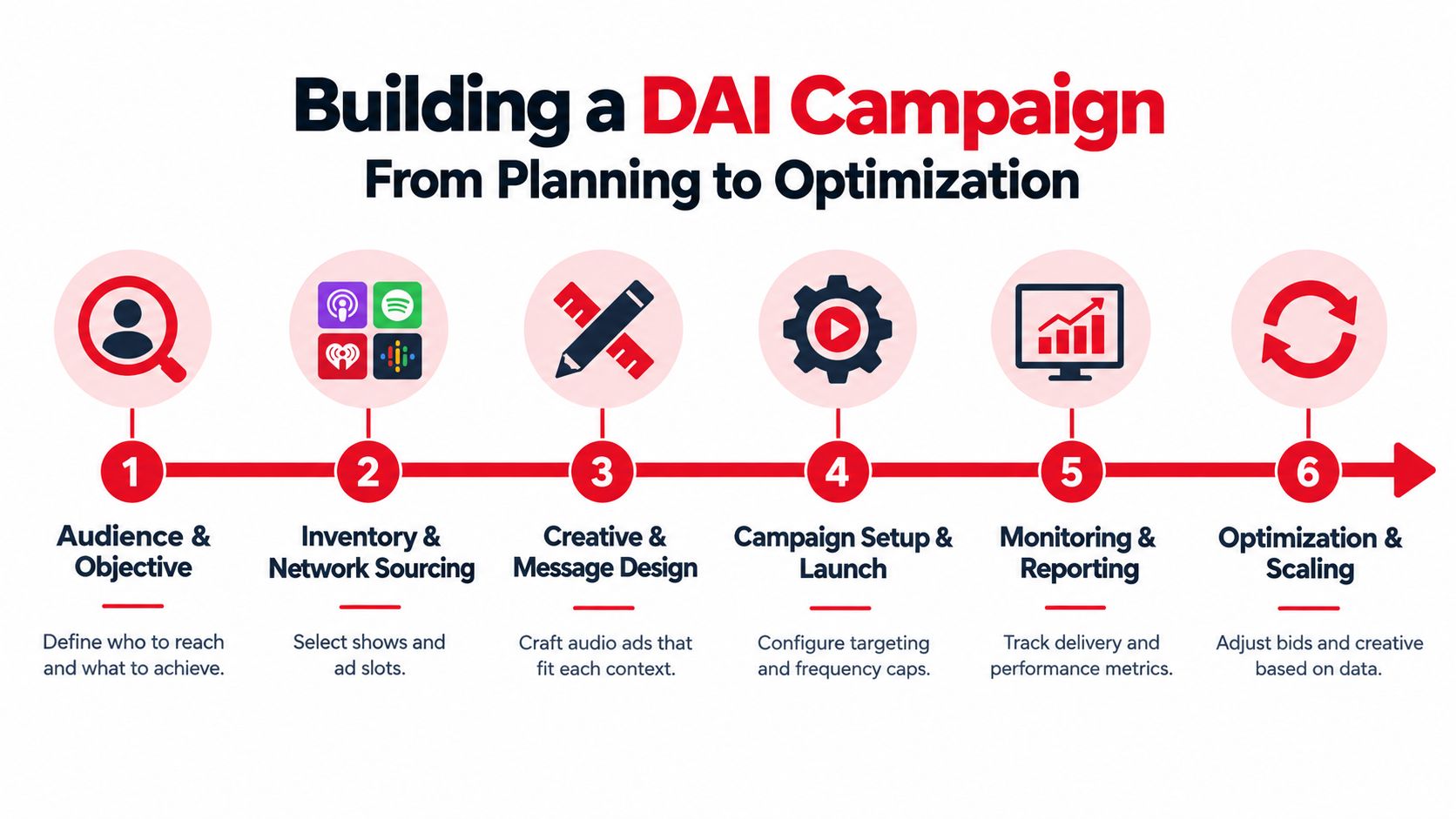
A DAI campaign fails in operations more often than in media selection. Run it as six phases with owners and checkpoints, not as a single insertion order you hope a network manages for you.
Phases One to Three Set the Ceiling
Phase 1, audience and objective definition, is yours to own. State whether this flight exists to create awareness in a new segment, drive demo requests, or retarget known interest through contextual presence. Vague objectives produce vague inventory. Your agency can challenge the brief, but it can't invent your business priority.
Phase 2, inventory and network sourcing, is where route selection matters. Publisher-direct buys give you show-level certainty. Host-read networks give you curated access with managed talent coordination. Programmatic exchanges give you scale and speed with less show-level control. My rule of thumb is simple. Buy direct or through networks when specific shows matter, and use programmatic when category and context matter more than any single title.
Phase 3, creative production, must match the delivery plan. Record host-read scripts that can stand alone as insertable files, without references to a specific episode's opening segment. Produce announcer-read versions at the lengths your placements require, and lock promo codes and vanity URLs before trafficking, not after launch. If you're new to the buying mechanics behind these routes, start with this overview of how podcast ad buying works from planning through placement.
Phases Four to Six Protect the Money
Phase 4, trafficking and QA, catches the unglamorous errors that ruin flights. Confirm markers exist where you think they do. Listen to test downloads in each target geography. Verify start and end dates, frequency rules, and category exclusions in the live setup, not just in a screenshot from a rep.
Phase 5, launch and in-flight optimization, should follow rules you agreed before launch. Decide in advance what evidence triggers a creative swap, a show pause, or a budget shift across the portfolio. Without pre-set thresholds, teams either overreact to daily noise or let a weak placement run untouched for a month.
Phase 6, wrap-up measurement, is a reconciliation exercise first and a performance story second. Compare ad-server logs, hosting platform stats, and third-party verification before you report results internally. Document which shows delivered complete downloads versus mere ad responses, which creative earned repeat investment, and which contexts you'll exclude next flight. That written record is what turns one campaign into a buying advantage.
Privacy-Safe Targeting and Attribution in a Cookie-Less Channel
Most DAI pitches imply listener-level targeting is straightforward. It isn't. Podcasting has no third-party cookie sitting in a browser, identity signals are thin, and GDPR-style consent requirements make personalization operationally different across markets, a shift toward anonymized and contextual signals described in AdsWizz reporting on the state of audio adtech and privacy-safe targeting. When a vendor promises precision, ask what signal they're using. In practice, it's usually contextual.
What Contextual Targeting Really Includes
The usable signals are geography, daypart, language, episode topic, and sometimes weather or listening context. That's not a weakness. Matching a message to the subject a person deliberately chose to hear can be more relevant, and far more defensible, than inferring who they are from opaque behavioral data. For B2B brands, a finance operations message inside a finance leadership episode is a strong signal on its own.
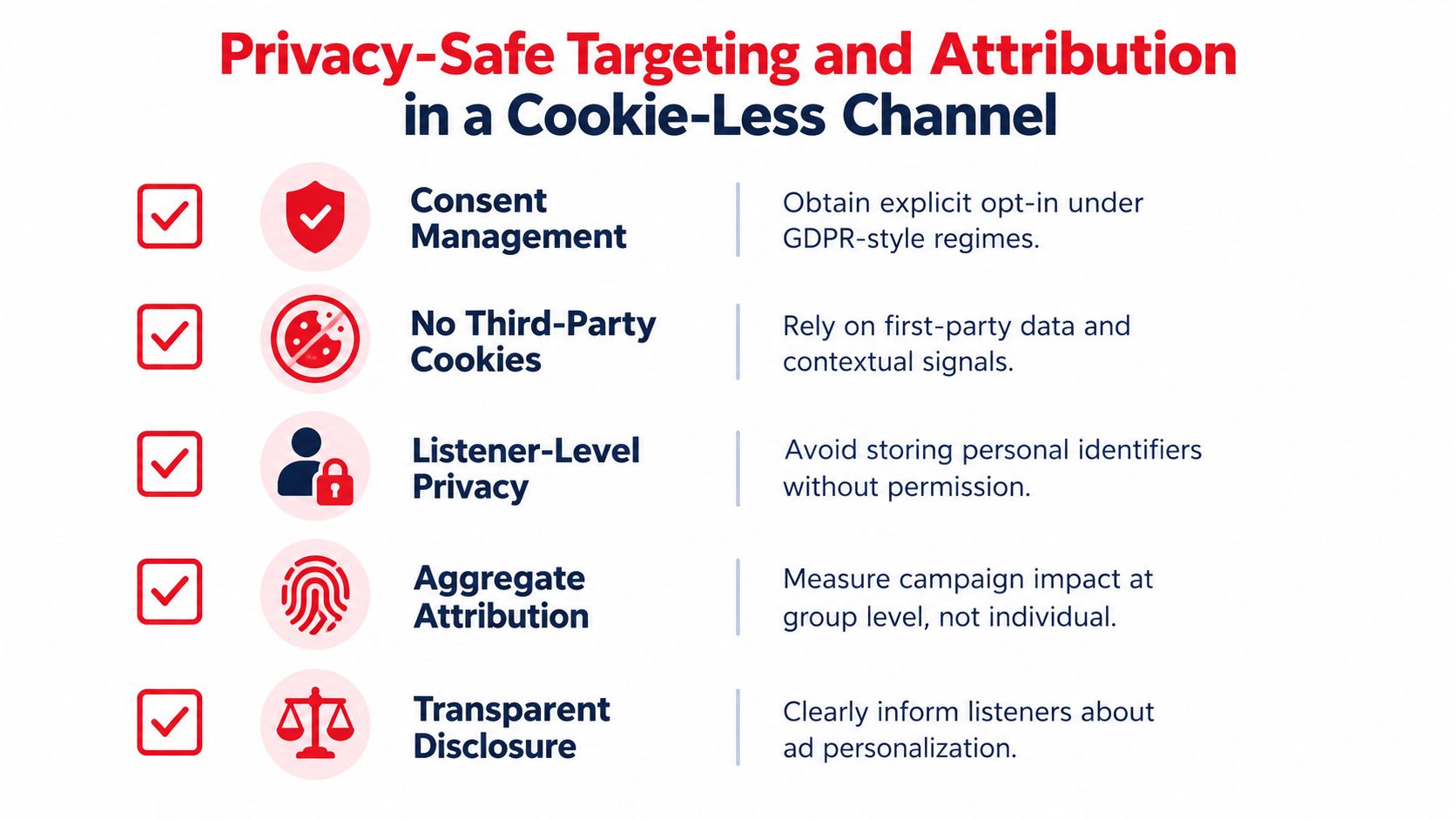
Here's my contrarian position. The most scalable DAI strategy may be the least individually personalized one. Contextual targeting preserves relevance while reducing data exposure, consent complexity, and the cross-market legal review that slows global campaigns down. If you're building the underlying data posture for that approach, The AI CMO data strategy guide is a solid reference for organizing first-party signals without leaning on invasive tracking.
Delivery Metrics Are Not Causal Proof
Separate two questions that vendors love to blur. Was the ad delivered? Downloads, impressions, and completion-oriented delivery metrics answer that. Did the ad cause a conversion? That's a causal question, and no single podcast metric answers it alone.
Promo codes capture only buyers who remember and use them. Vanity URLs capture only listeners who type what they heard. Post-exposure surveys capture claimed recall, not verified behavior. Modeled attribution fills gaps with assumptions you should inspect, not accept. Our guide to building a podcast attribution model that separates delivery from impact walks through how to combine these inputs without over-trusting any one of them.
For B2B campaigns, I recommend content-context fit plus account-level lift studies over opaque listener-level retargeting. Compare exposed markets, accounts, or show portfolios against a credible holdout where you can. Ask every vendor three questions before you sign. Which signals require consent in each market? What identifiers, if any, do you store? How would this report change if modeled conversions were removed? If they can't answer plainly, don't buy the precision they're selling.
Best Practices for Creative, Frequency Capping, and Compliance
Good strategy dies in a bad audio file. Treat the creative, the repetition rules, and the disclosure layer as one craft problem, because listeners experience them as one interruption.
Creative That Survives Automation
Match length to placement and message complexity. Use shorter dynamically inserted spots for simple reminders and offer refreshes, and give host-read creative enough room to explain why a B2B buyer should care. Don't force a complex consideration message into a format built for a quick brand mention.
Write the call to action for ears, not eyes. Say one URL or one code, spell anything ambiguous, and repeat it. Listeners are driving, walking, or working out. If your CTA requires them to stop and write something down, you've designed it to be forgotten.
Host-read scripts delivered through DAI need special discipline. Give hosts talking points, mandatory claims language, and clear guardrails, then let them speak naturally. Ban references to "today's episode" or a specific guest if that file will rotate across other episodes. Pre-clear every promo code and vanity URL so operations never traffic an ad pointing to a page that isn't live.
Frequency Capping Without Fatigue
Repetition builds recall. Excessive repetition across a portfolio creates fatigue, because the same listener can encounter your identical spot in several shows in one week. That's the hidden cost of buying scale dynamically without portfolio-level controls.
Do cap by network or publisher portfolio, not only by individual episode, so cross-show duplication stays visible.
Do rotate multiple creative versions when frequency will be high, so repetition reinforces the message without replaying identical audio.
Don't judge fatigue by completion alone. A listener can endure your ad and still like your brand less.
Disclosure and Category Compliance
Sponsorship identification isn't optional decoration. Follow FTC endorsement guidance for host-read material, make paid relationships clear, and confirm each platform's current sponsorship read requirements before launch. Regulated categories such as alcohol, finance, and health carry additional restrictions that vary by publisher and market, so route creative through legal review early.
Assign someone to re-check platform and category policies quarterly. Rules evolve, host contracts change, and a compliant flight last quarter can become a problem this quarter if nobody owns the review.
How an Agency Operationalizes DAI for Brands
Technology access isn't the differentiator anymore. Any competent buyer can get dynamic inventory. The differentiator is operating discipline across planning, buying, creative, trafficking, and measurement reconciliation, applied consistently flight after flight.
Podmuse, a full-service podcast agency partnering with 40+ ad networks and publishers and with case studies spanning Intel, PayPal, and Turkish Airlines, illustrates the integrated model I recommend evaluating. Host-read buying, programmatic inventory, and branded podcast production sit in one planning conversation instead of separate silos. That matters because your best-performing DAI context may deserve a deeper host partnership or owned content, and siloed teams miss that handoff.
What the Agency Owns and What Stays With You
A strong agency owns inventory sourcing, rate and placement negotiation, creative coordination, trafficking, QA, and delivery reconciliation. It should also manage cross-channel amplification where it fits, including promo swaps, in-app placements, and paid social support that extends a strong audio message beyond the episode.
You still own the offer, the landing experience, the sales follow-up, and the business definition of a qualified outcome. No agency can fix a weak demo page or a sales team that never works the accounts your campaign influenced. Insist on a shared scorecard before launch so both sides know which outcomes the media can and can't control.
Measurement deserves a specific contractual conversation. IAB guidance recommends analyzing server logs with filtering, download-threshold logic, unique identification, metric generation, and an audit feedback loop, and states a dynamically inserted ad should count as delivered only when 100% of the ad bytes have been downloaded, as detailed in IAB podcast measurement guidance on log analysis and ad delivery counting. Ask any partner whether their reporting represents ad responses, complete ad-file downloads, or client-confirmed playback. Those are three different numbers, and stricter byte-completion rules will lower reported delivery while reducing inflated impressions.
Hire for transparency you can audit, not for a dashboard that always looks good.
Evaluate any DAI partner on four criteria. Can they explain their reporting definitions without jargon? Does their network coverage match your actual audience contexts? Can they produce or meaningfully improve creative, not just traffic what you hand them? Do they feed post-campaign learnings into the next flight's show list and exclusions? If the answer to any of those is vague, you're buying access, not an operating partner.
DAI is now the default plumbing of podcast advertising. Brands that win with it won't be the ones that discovered the technology first. They'll be the ones that run it with clear objectives, honest measurement, and creative that respects the listener's trust.
If you're weighing your first DAI flight against host-read sponsorships and want a buying plan built on outcome metrics rather than CPM alone, Podmuse can help you source inventory, produce creative that fits each context, and reconcile delivery before you scale spend. Book a consultation to map the right mix of dynamic, host-read, and branded podcast activity for your next campaign.
Comments