
B2B Podcast Attribution: How to Prove Pipeline Impact

Your podcast has steady listeners. Sales has opened an opportunity with a target account, and someone on the buying committee mentions hearing your executive on a show. Yet the pipeline dashboard credits branded search or a rep's email. You need to decide whether to renew the podcast investment, but the report doesn't tell you whether that opportunity would have happened anyway.
That's the distinction a useful measurement program must resolve. Delivery, influence, and incremental impact answer different questions. Combining them into a single attributed-revenue figure makes the dashboard simpler, not necessarily more credible.
Table of Contents
Why Podcast Attribution Breaks Down in B2B - The planting and the response happen separately - Build an evidence portfolio
Four Attribution Models and What Each One Credits - Start with observable paths - Separate attribution from causation
How to Build the Tracking Setup Step by Step - Configure the collection and matching rules - Test the entire path
Tech Stack and Metrics B2B Pipelines Need - Define the denominator before the metric - Keep outcome ownership in the CRM
Running Lift Tests and Validating the Results - Size the test before buying media - Work through the arithmetic - Make a small test honest
Case Study Examples Worth Copying - Illustrative scenario of a named-account campaign - Illustrative scenario of a small publisher holdout - Illustrative scenario of a case-study audit
Pitfalls That Inflate or Hide Podcast Results - Fix the reporting errors you control - Preserve what you don't know
Plan Your First B2B Podcast Attribution Test - Put the launch agreement in writing
Why Podcast Attribution Breaks Down in B2B
B2B podcast attribution links exposure to a show, advertisement, or guest appearance with account engagement, meetings, and pipeline.
Say a software company publishes a branded show for operations leaders. A director listens, shares an episode with a colleague, and later asks a procurement manager to investigate the vendor. The procurement manager searches the company's name and books a meeting through a sales email.
Last-click reporting records the final response correctly. It doesn't establish where consideration began.
The planting and the response happen separately
A podcast can plant awareness during a long growing season. When the sprout finally appears through search or outbound sales, the conversion report records that visible event, not the earlier planting. The problem becomes harder when several people participate in the purchase and only some leave identifiable digital traces.
The adoption-to-measurement gap is substantial. A survey of 861 marketing and public-relations professionals summarized in the IAB's audio and podcast planning guide found that 44.9% used podcasts, while only 20.4% tracked revenue attribution.
That sample isn't a benchmark for enterprise demand generation. It does illustrate why podcast adoption alone shouldn't be mistaken for measurement maturity.
An account-level review gives marketing and sales a shared view of these disconnected interactions.

Build an evidence portfolio
Use standardized delivery records to establish potential exposure, brand studies to assess perception, and CRM or marketing-mix analysis to examine commercial contribution. None substitutes for the others.
Big Moves Marketing's discussion of rethinking how B2B marketing gets measured provides useful context for moving beyond a report that assigns all value to the final identifiable action.
Watch these early signals without labeling them causal proof:
Target-account visits: Record relevant website activity and whether identification is observed or inferred.
Branded search: Monitor aggregate changes, but don't claim account-specific searches unless your tooling supports that identification.
Sales conversations: Capture buyer mentions of the show, including what they remember and when they encountered it.
These signals justify investigation. They don't yet justify assigning the entire opportunity to podcasting.
Four Attribution Models and What Each One Credits
Attribution models compared for B2B podcast campaigns
Model | What It Credits | Main Strength | Main Blind Spot | Best Use |
|---|---|---|---|---|
First-touch | Earliest recorded exposure to a show | Easy to set up and shows recorded discovery | Ignores everything after the first touch | Awareness reporting |
Last-touch | Final touch before the conversion | Simple and familiar to sales teams | Over-credits branded search and direct visits | Quick checks of bottom-funnel response |
Multi-touch (linear, time-decay, position-based) | Shares credit across all tracked touches | Shows tracked paths and assist roles | Skewed when a touch is untracked | Optimizing mixed-channel budgets |
Data-driven multi-touch | Weights touches by modeled contribution | Adapts to observed account patterns | Needs substantial volume and clean CRM history | Mature programs with stable data |
Incrementality (holdout or lift test) | Estimates conversions caused by exposure | Closest to causal proof with a sound design | Requires adequate accounts and controlled comparisons | Budget, renewal, and channel-mix decisions |
The table includes rule-based and data-driven multi-touch as separate implementations of the same model family. Their assumptions differ enough to matter when choosing a reporting method.
Start with observable paths
First-touch answers where a recorded journey began. It's useful for discovery reporting, provided you call it the earliest recorded interaction rather than the buyer's first actual encounter with your company.
Last-touch answers which interaction immediately preceded the conversion. Use it to inspect landing pages, booking flows, and offers. Don't use it to conclude that the final channel created the demand.
Multi-touch distributes credit across captured interactions. Linear weighting treats them equally; time-decay favors recent interactions; position-based weighting emphasizes selected positions. Data-driven implementations estimate weights from observed patterns, but incomplete tracking still limits what the model can learn.
A precise-looking allocation isn't automatically a better explanation. If your CRM misses an executive's podcast listening but records every retargeting click, additional modeling can formalize that imbalance.
Separate attribution from causation
Incrementality asks what changed because the campaign ran. Podscribe's explanation of incrementality testing distinguishes conversions following exposure from conversions that wouldn't otherwise have occurred.
That distinction matters when sales outreach, retargeting, search, and podcast placements reach overlapping accounts. A matched conversion can be genuine without being incremental.
Budget rule: Use multi-touch reporting to diagnose tracked journeys. Use a credible holdout or lift analysis to support claims that additional investment creates additional outcomes.
For weekly optimization, inspect channel combinations and response quality. For renewal decisions, ask whether the campaign changed the outcome compared with a defensible alternative.
How to Build the Tracking Setup Step by Step
Build the account and campaign structure before publishing the first placement. Retrofitting source fields after opportunities appear leaves you reconstructing history from incomplete records.
The workflow should connect eligible accounts, touchpoints, engagement, and commercial outcomes.
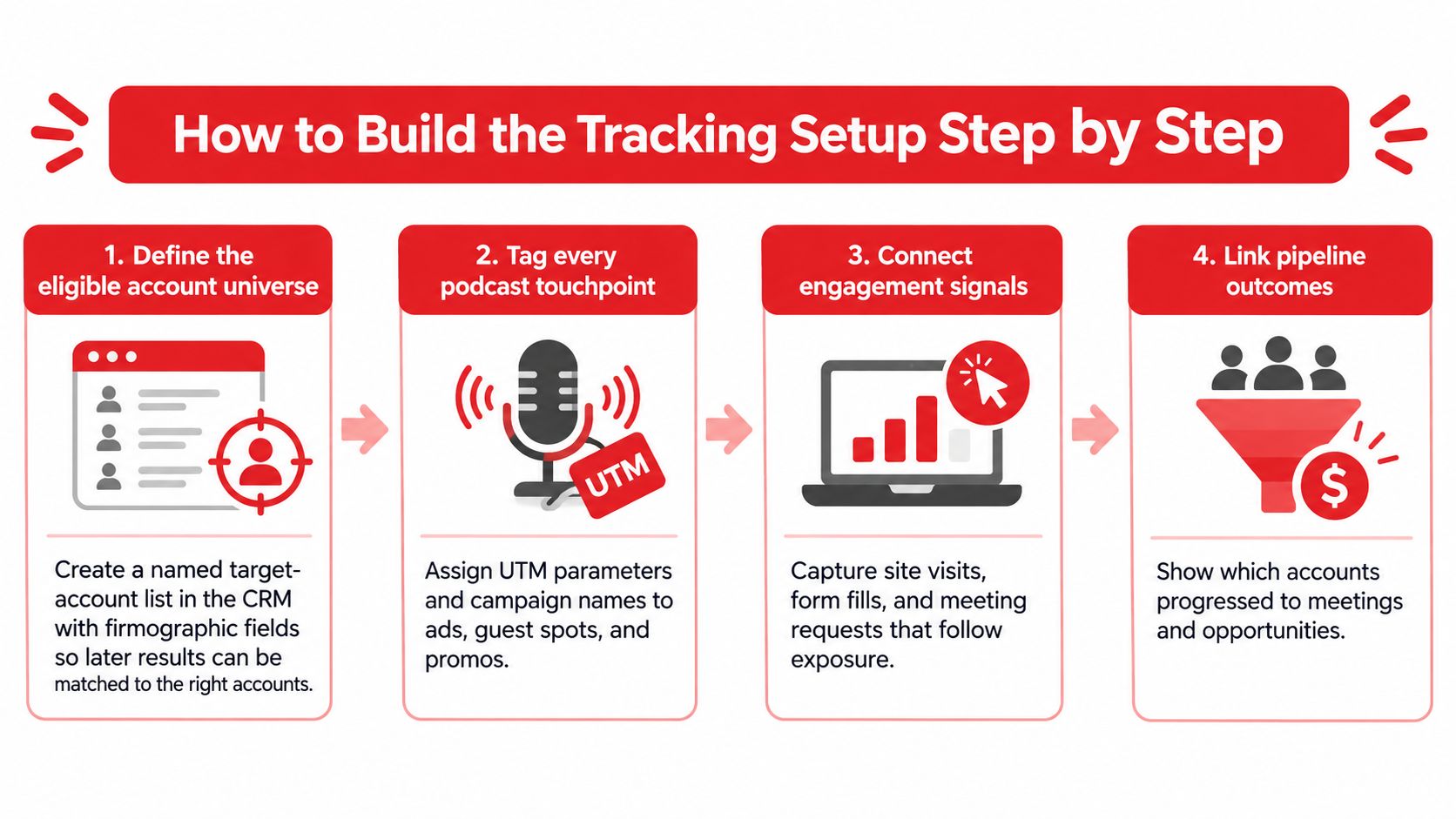
Configure the collection and matching rules
Define the eligible account universe. Create a named-account list in Salesforce or HubSpot with account ID, industry, size, region, and current opportunity status. Freeze an export before launch so later account additions don't change the denominator.
Create show-specific response paths. Give each show a memorable vanity address that redirects to a UTM-tagged landing page, then have the host speak the short address. Test whether the redirect preserves campaign parameters; a broken redirect can make an otherwise identifiable response appear as direct traffic.
Assign codes or booking links. Use distinct identifiers for offers, guest appearances, and sponsorships. Treat redemptions as observed responses, not a census of influenced listeners, and avoid reusing a code across unrelated campaigns.
Configure call tracking. Put campaign-specific numbers in show notes and use dynamic numbers on relevant landing pages. Test the number-replacement rules so an unrelated visitor's call isn't assigned to the podcast campaign.
Arrange host or ad-server exports. Request episode, placement, campaign, delivery timestamp, and metric-definition fields, with passback tagging where supported. Confirm whether each field describes a download, estimated ad delivery, or an audience estimate before loading it into the warehouse.
Map signals into the CRM. Store campaign, response type, first observed date, account ID, and self-reported source separately. Preserve the original response record instead of repeatedly overwriting a single contact-source field.
Build a layered dashboard. Keep delivery, first-party visits, qualified accounts, meetings, and opportunity stages in distinct views. Deduplicate account outcomes so several responding employees don't become several supposedly independent buying opportunities.
Test the entire path
Send a test form, booking, code redemption, call, and survey response through the system. Confirm that each reaches the correct account and campaign, and document the expected refresh schedule rather than assuming every integration updates immediately.
The IAB Tech Lab's Podcast Measurement Technical Guidelines distinguish content delivery, audience reach, and ad-delivery metrics. Require those distinctions in your export specification so your CRM integration doesn't erase them.
Use the video alongside the implementation checklist when reviewing the workflow with marketing operations.
Tech Stack and Metrics B2B Pipelines Need
Measurement stack layers for B2B podcast attribution
Layer | Typical Tools | Metric It Feeds | Owner |
|---|---|---|---|
Delivery measurement | Host or ad-server logs filtered to IAB guidelines | Qualified downloads and audience reach | Podcast or media team |
Link and code tracking | UTM builder, vanity URLs, promo codes | Site visits and direct responses by show | Marketing operations |
Call tracking | Dynamic phone numbers on notes and landing pages | Inbound calls by episode | Marketing operations |
CRM | Salesforce or HubSpot | Account engagement, meetings, opportunities | Sales operations |
Surveys | Post-exposure survey tool | Self-reported influence tracking cannot see | Marketing research |
Lift testing | Holdout design with a statistics workbook | Incremental meetings and pipeline | Marketing analytics |
Dashboard | Looker Studio or Power BI | Combined account-level view | Marketing analytics |
Start with the CRM, tagged response paths, and a dashboard your team can reconcile. Add tools when they resolve a specific missing signal, not because a larger stack appears more rigorous.
For example, call tracking matters when buyers inquire by phone. A survey is more useful when sales regularly hears about podcast influence that digital records can't identify.
Define the denominator before the metric
A pipeline scorecard should carry the following measures, with definitions visible beside the dashboard:
Target-account reach: Eligible accounts with supported exposure evidence, with inferred matches labeled separately.
Share of target accounts engaged: Eligible accounts meeting a predefined engagement rule, divided by the eligible account list.
Meetings and opportunities: Unique accounts reaching each stage, with existing opportunities separated from newly created ones.
Pipeline value per exposed account: Pipeline associated with the defined cohort divided by that cohort's account count.
Win rate and sales-cycle length: Outcomes measured on comparable, sufficiently mature opportunity cohorts.
Cost per opportunity: Defined campaign costs divided by qualifying opportunities, with the inclusion rules stated.
The denominator determines what you can claim. Pipeline divided by responding accounts answers a different question from pipeline divided by all eligible accounts.
Keep outcome ownership in the CRM
Use the CRM as the system of record for meetings, stages, and revenue. Platform dashboards remain useful for delivery diagnostics, but platform-attributed conversions shouldn't overwrite sales-validated outcomes.
A podcast lead-generation workflow can help connect response mechanisms with account follow-up. Measurement also needs a record of whether sales accepted the meeting and whether the opportunity met qualification criteria.
A campaign can generate recognizable responses without generating commercially useful opportunities. Report both, and let the difference guide the next creative or audience decision.
Review delivery integrity, response quality, and account progression weekly. Reserve mature win rates, incremental pipeline, and channel-level budget changes for reviews that allow enough time for outcomes to develop.
Running Lift Tests and Validating the Results
Relative lift is the difference between treatment and holdout outcome rates, divided by the holdout rate. The formula is straightforward; making the groups comparable is the difficult part.
Before launch, define the eligible accounts and the decision the test will inform. Randomly assign accounts where possible, balancing important characteristics such as company size, industry, region, and pre-existing engagement.
Size the test before buying media
Estimate the minimum detectable effect using the available account count, baseline meeting rate, chosen significance threshold, and desired statistical power. Have an analyst document those assumptions before anyone sees the results.
If the test can detect only an implausibly large improvement, broaden the eligible audience, accumulate additional comparable campaign waves, or choose a more frequent qualified-engagement outcome. Extending the window helps only if additional relevant outcomes can occur without making the comparison unreliable.
Don't describe accounts as an exposure holdout unless you can withhold the placement. Targeted inventory may support suppression; a publicly available host-read sponsorship generally doesn't let you prevent selected companies from hearing it.
Work through the arithmetic
Consider a hypothetical example, not a benchmark. Suppose a campaign assigns 400 eligible accounts evenly between treatment and holdout, and 30 treatment accounts book a meeting compared with 18 holdout accounts.
Hypothetical measure | Treatment | Holdout |
|---|---|---|
Eligible accounts | 200 | 200 |
Accounts booking a meeting | 30 | 18 |
Meeting rate | 30 ÷ 200 = 15% | 18 ÷ 200 = 9% |
The hypothetical absolute difference is 6 percentage points. Relative lift is (15% − 9%) ÷ 9% = 66.7%.
That point estimate doesn't establish the precision of the result. Report a confidence interval calculated for the chosen design, and distinguish failure to detect an effect from evidence that a commercially meaningful effect is absent.
Make a small test honest
When randomization isn't feasible, match treatment and comparison accounts on firmographics, baseline engagement, and opportunity status. Examine pre-campaign trends, document remaining differences, and describe the result as quasi-experimental rather than equivalent to random assignment.
A geographic or publisher-level holdout can help when inventory is isolatable. However, the independent units are the geographies or publishers, not every account inside them; a large account count doesn't erase a small number of independent groups.
Validate timestamps against CRM records, inspect network-based matches, and log accidental podcast exposure in the holdout. Record ordinary sales outreach separately: it may be an intended background activity rather than contamination, unless it differs systematically between groups.
Podzone's metrics for credible coverage reporting offer a useful reporting companion, while podcast advertising benchmarks provide planning context. Neither replaces your own baseline, control group, or uncertainty estimate.
Case Study Examples Worth Copying
Useful examples reveal the comparison behind the claim. Copy the design logic, not a headline result from an audience or sales motion unlike yours.
Illustrative scenario of a named-account campaign
A software vendor buys targeted inventory and assigns eligible accounts to treatment and holdout groups before delivery begins. It checks that suppression works, fixes the observation window in advance, and compares meeting creation and opportunity progression.
The report includes baseline account engagement, outcome definitions, uncertainty, and any holdout accounts accidentally reached. The decisive metric is qualified meetings per eligible account, not meetings per person who clicked.
Illustrative scenario of a small publisher holdout
An enterprise vendor can't suppress individual companies from a host-read campaign. Instead, it tests placements across comparable publisher audiences, withholding the campaign from selected inventory where feasible.
The analyst checks audience overlap and whether the publishers differ in buyer seniority or existing brand familiarity. If those differences can't be addressed, the result remains suggestive rather than causal.
Comparison unit: The publisher or audience cluster assigned to treatment.
Observation window: A period fixed before launch and matched to the selected outcome.
Decision metric: Qualified-account progression, with account-level activity nested under its assigned cluster.
Illustrative scenario of a case-study audit
Our case studies include B2B ad spots with branded content and targeted audio campaigns. The Wonolo podcast-placement and branded-content case study provides a campaign structure to examine, not an automatic incrementality benchmark.
An adjacent example, Captiwate's account of Salesforge's results with inbound sales engagement, can prompt useful questions about demo capture and follow-up. It isn't evidence of podcast lift.
For either format, request the eligible audience, comparison group, measurement window, and CRM outcome definitions before treating a reported result as evidence for your own budget.
Pitfalls That Inflate or Hide Podcast Results
The most damaging mistake is counting raw downloads as people who heard the advertisement. The IAB Audio Measurement Guide describes filtering bots and spiders, applying a qualifying threshold of at least one minute of downloaded content, and identifying unique IP-address and user-agent combinations within a 24-hour period.
Those are delivery-processing rules, not confirmation that a buyer listened attentively or acted. Raw downloads can exaggerate exposure, while a download-to-lead ratio can miss influence that appears elsewhere in the buying journey.
Fix the reporting errors you control
Treat the following timings as planning tasks, not guaranteed implementation promises. Start with configuration changes and give experimental or behavioral changes their own project plan.
Misreading branded-search credit: Stop labeling all search conversions after launch as podcast-generated. Designing a defensible holdout requires media coordination and an outcome window, not a quick dashboard edit.
Treating codes as complete coverage: Add a neutral self-reported source question and retain the buyer's wording. Configuring the question may fit into a short operations session; collecting useful responses takes longer.
Counting leads instead of qualified progression: Add sales acceptance, meetings held, and opportunity qualification to the scorecard. Changing the report is straightforward only if those stages already have consistent definitions.
Reporting small differences as certainty: Add uncertainty estimates and the test's detection limits. If the original design wasn't documented, don't manufacture retrospective confidence by selecting whichever method makes the result look strongest.
Blending platform and CRM totals: Maintain separate fields for platform-attributed events and CRM-validated outcomes. Reconcile identity rules, timestamps, and duplicates before presenting a combined account view.
Losing sales-led mentions: Add a call-note prompt and a CRM field with options for confirmed mention, no mention, and unknown. Don't force reps to invent an answer just to save a record.
Preserve what you don't know
An unmatched exposure isn't proof of no influence. A matched household or network isn't necessarily proof that the buying committee heard the placement.
Reporting discipline: Label evidence as observed, self-reported, inferred, or experimentally estimated. Don't let those categories become interchangeable when the report reaches leadership.
Prioritize fixes that preserve evidence at collection. A more elaborate attribution model can't recover a buyer's unrecorded explanation or repair a campaign identifier that was never stored.
Plan Your First B2B Podcast Attribution Test
Begin with a narrow decision you can inform. Renewing a particular placement is a more manageable question than proving podcasting's total contribution to the business.
Put the launch agreement in writing
Choose the scope. Select a show, an eligible account list, and the commercial decision the test supports.
Complete the instrumentation. Test the response paths, delivery exports, identity mapping, and CRM fields before launch.
Agree with sales. Define accepted meetings, qualifying opportunities, and how existing pipeline will be handled.
Lock the comparison. Document assignment, suppression feasibility, observation window, and detectable effect.
Book the review. Judge the result against uncertainty and commercial relevance, not the most flattering point estimate.
Send any campaign partner, Podmuse included, these questions before committing:
Delivery: How are requests filtered, and what exactly does each reported metric mean?
Control: Can holdout accounts or inventory be suppressed, and how will that be verified?
CRM mapping: Which response fields attach to account and opportunity records?
Data ownership: Who can access the underlying exports, definitions, and matching logic?
If suppression isn't possible, change the design or narrow the claim. A candid influence report is more useful than an unsupported lift claim.
Podmuse plans podcast advertising and secures relevant interview placements for entrepreneurs, executives, and subject matter experts. Visit Podmuse to discuss a campaign, and bring your target-account list, CRM outcome definitions, and proposed holdout questions so measurement is part of the launch conversation.
Comments