
Podcast Audience Growth: The 2026 Playbook
Many teams don't struggle to launch a podcast. They struggle six months later, when the guest pipeline is thinner, the internal excitement is gone, and the download curve has flattened. Marketing leaders usually react in one of two ways. They either push the team to publish more, or they spend money on promotion before the show has earned retention.
Both moves are expensive.
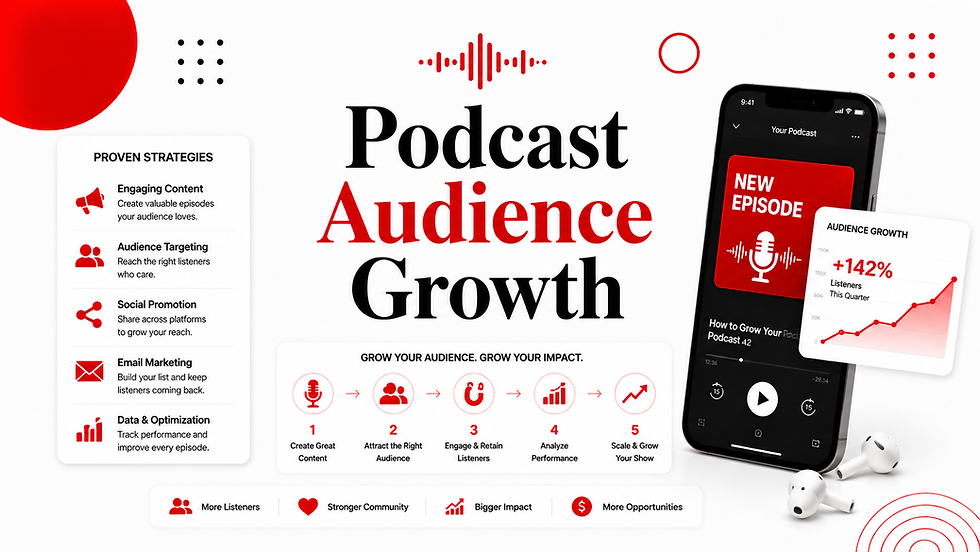
Podcast audience growth works better when you treat the show like a performance channel with an operating system behind it. That means clear audience definition, retention design, discoverability workflows, paid distribution logic, partnership strategy, and a measurement loop that tells you what to change next. Without that system, growth feels random. With it, you can make disciplined decisions across both B2B and B2C campaigns.
Table of Contents
Building Your Audience Blueprint - Build a listener persona a media team can actually use - Position against audience substitutes - Use a one-page blueprint before you publish
Designing Content for Retention and Shareability - The first five minutes decide the rest - Structure episodes like products, not recordings - Shareability comes from moments, not summaries - What usually hurts retention
Engineering Discoverability Across Platforms - Use a platform checklist, not a generic publishing flow - Treat YouTube as search inventory, not just a hosting destination - Match channel behavior to listener behavior
The Paid Growth and Promotion Playbook - Host-read ads, programmatic, paid social, and search - When host-read ads win - When programmatic is the right move - Paid social is creative testing, not just promotion - Search helps when people already want the topic - A practical media mix
Amplifying Reach with Partnerships and Guesting - A promo swap works when the audiences overlap, not when the formats match - Guesting works best when the expert can teach, not just represent the brand - A practical outreach sequence - Turn one appearance into a campaign
From Data to Decisions How to Measure Growth - Build a dashboard around leading indicators - Don't let downloads become the only story - A simple decision model for weekly reviews
Beyond the Launch Your Growth Operating System
The most common plateau looks familiar. A brand launches with a strong first month, driven by employees, customers, founders, and partners. Then the easy reach runs out. The team starts asking whether the problem is the host, the format, or the category itself.
Usually, it's none of those in isolation.
What's missing is an operating system. Strong podcast audience growth comes from managing a set of connected levers: audience fit, episode construction, distribution, media buying, partnerships, and reporting. If one breaks, the rest get less efficient. A show with good promotion and weak retention wastes acquisition. A show with great content and poor discoverability stays invisible.
For B2B brands, that often means the show sounds smart but never becomes a repeatable demand generation asset. For B2C brands, it often means the content is entertaining enough, but nobody has built a reliable path from awareness to subscription.
Practical rule: Don't diagnose a growth problem by looking at downloads alone. Diagnose the system that creates or limits them.
That's also why outsourced support tends to work best when it covers more than production. A podcast management service is useful when it coordinates planning, publishing, promotion, and analytics into one workflow instead of treating each task as a separate handoff.
The teams that scale aren't chasing tricks. They're running a channel.
Building Your Audience Blueprint
A show launches, the team promotes the first few episodes, and early numbers look promising. Then growth slows because nobody agreed on a basic operating question: who is this show supposed to acquire, retain, and move toward action?
That decision shapes everything. Audience blueprint work is where podcast growth starts to look less like editorial planning and more like channel design.
According to Edison Research's The Infinite Dial 2024, podcast listening in the U.S. is now mainstream, with monthly reach extending across a large share of consumers. That matters for two reasons. There is enough scale to treat podcasting as a real acquisition channel, and there is enough competition that broad targeting wastes budget.

Build a listener persona a media team can actually use
A usable persona goes beyond age, title, and interests. It needs to inform editorial decisions, paid distribution, creative hooks, and conversion paths.
For a B2B show, that usually means defining the listener in buying-context terms:
Role: VP of Marketing, demand gen lead, RevOps manager, founder, or product marketer
Current pressure: pipeline targets, CAC efficiency, sales alignment, category education, or team credibility
Decision stage: researching vendors, fixing an underperforming program, or building the case for budget
Listening context: commute, travel, gym, or between meetings
Proof threshold: operator stories, benchmarks, tactical walkthroughs, or executive interviews
That level of detail changes the show brief fast. “A marketing podcast” is too broad to program or promote well. “A show for SaaS growth leaders trying to improve paid efficiency without sacrificing pipeline” gives the content team a lane and gives the media team targeting options.
The same logic applies in B2C, but the purchase dynamic is different. A wellness brand may reach first-time habit builders, high-intent enthusiasts, or shoppers comparing product claims. Those are different audiences, with different episode framing, clip strategy, and calls to action.
Position against audience substitutes
Your show does not compete only with other podcasts. It competes with YouTube interviews, creator clips, newsletters, webinars, audiobooks, and the option to ignore branded content altogether.
That changes how positioning should work.
A good audience blueprint answers three practical questions:
Who should subscribe after one episode?
What recurring job does the show help them do?
Why is this format a better use of time than the alternatives they already trust?
For example, a cloud infrastructure company may want a show about AI trends. That framing is too wide to buy against, too generic to share internally, and too vague to convert. A stronger position is a show for technical decision-makers who need help turning infrastructure shifts into budget, architecture, and risk decisions they can defend.
Specificity improves efficiency. It lowers content drift, sharpens paid creative, and makes guest selection easier.
Use a one-page blueprint before you publish
I recommend a short working brief that brand, content, and paid teams can all use. If it cannot fit on one page, it usually means the positioning is still fuzzy.
Element | What to define |
|---|---|
Primary listener | One audience segment with a clear role, identity, or buying intent |
Core problem | The repeated challenge that makes the show worth returning to |
Content promise | What the listener will get every episode |
Point of view | The angle that separates the show from generic category coverage |
Conversion goal | Subscribe, join email, start trial, book demo, or visit a landing page |
Distribution fit | Where this audience already consumes short-form and long-form content |
That final row matters more than many teams expect. If the audience already spends time on LinkedIn, YouTube Shorts, Instagram Reels, or TikTok, the show needs a repurposing system built in. Using a strategy for repurposing one podcast recording into 20 social media assets ensures this remains an audience strategy rather than just a production task. It also creates more surface area for creating viral reels from simple audio clips without producing a separate video-first show.
A blueprint like this creates trade-offs on purpose. It helps a B2B brand choose pipeline relevance over broad reach. It helps a B2C brand decide whether the show should drive subscriptions, product consideration, or community growth. Teams that make those choices early spend less on promotion that attracts the wrong listener and more on a system that can scale.
Designing Content for Retention and Shareability
Many production groups overvalue reach and undervalue completion. That's backwards. If an episode doesn't hold attention, promotion just buys more disappointment.
The retention benchmarks make the problem plain. Analysis of listener behavior shows that 68% of listeners finish podcast episodes globally, while 35% drop off within the first 5 minutes. It also notes that the ideal episode length is 20 to 40 minutes, aligned with 70% listener preference, according to listener retention benchmarks for podcasts.
The first five minutes decide the rest
A surprising number of branded podcasts waste the opening with housekeeping. Long intros, vague host banter, and delayed payoff tell the listener there's no urgency.
A stronger opening does three things fast:
States the value: Tell the listener what problem or question this episode will answer.
Establishes stakes: Why should they care now?
Signals momentum: Start with tension, a sharp claim, or a revealing moment from the conversation.
For a B2B show, that may be a host saying, “Today's episode is about why so many paid acquisition programs stall after the first wave of efficient demand.” For a B2C show, it may be a guest story that lands immediately instead of a slow biography.
Structure episodes like products, not recordings
Good retention is usually designed, not improvised. The episode needs movement.
I advise teams to think in segments:
Hook
Context
Core insight
Practical application
Close and next action
That doesn't mean every episode sounds mechanical. It means the listener always feels progress.
A listener will forgive imperfect audio before they forgive wasted time.
This is also where edit discipline matters. Removing repetition, tightening transitions, and trimming meandering answers often does more for podcast audience growth than adding another promotional channel.
Shareability comes from moments, not summaries
People rarely share an episode because the topic sounded reasonable. They share a clip because one moment made them react.
That's why short-form extraction should be built into your workflow. Teams that get more from each recording usually identify a few high-contrast ideas, then turn them into social assets, quote cards, and video snippets. If you want a practical workflow for creating viral reels from simple audio clips, that process is worth studying because it matches how listeners discover shows on visual platforms.
A single recording should also feed a wider repurposing system. An approach like repurposing one episode into multiple social assets means a strategy stops being a content exercise and becomes a distribution engine.
What usually hurts retention
A few patterns show up repeatedly:
Front-loaded setup: Too much biography before the insight.
Uncontrolled host energy: Hosts who interrupt pacing with unnecessary commentary.
Flat edit rhythm: No variation in speed, tone, or segment shape.
Weak narrative spine: Interesting points with no sequence connecting them.
Mismatched length: Episodes that outlast the value they contain.
If you fix retention first, every other growth lever performs better. Not because the algorithm rewards you. Because listeners do.
Engineering Discoverability Across Platforms
A team ships a strong episode on Tuesday. By Friday, performance is flat. The problem usually is not the conversation. It is the operating system around discovery. Titles are too vague to rank, descriptions are written like summaries instead of acquisition copy, and the assets sent to YouTube, Spotify, and Apple all ignore how those platforms surface content.

Treat discoverability like channel engineering. Each platform has its own inputs, ranking signals, and user behavior. If those inputs are wrong, good content stays invisible. If they are right, the same episode can produce search traffic, suggested views, repeat listening, and downstream conversions.
Use a platform checklist, not a generic publishing flow
A scalable workflow starts with a pre-publish checklist tied to distribution outcomes.
For every episode, review these:
Episode title: Use the problem, outcome, or named topic people search for. Clear usually outperforms clever.
Show description: State the audience, the promise, and the reason to subscribe.
Episode description: Add the guest's relevance, core topics, and the specific takeaway. This copy helps both discovery and click-through.
Thumbnail strategy for video: On YouTube, packaging drives the first decision. If the thumbnail does not earn the click, the episode never gets a chance.
Category hygiene: Put the show where the right listener expects to find it.
Transcripts and supporting text: These create searchable context and improve accessibility.
A practical guide to podcast SEO fundamentals is useful here, especially for teams that need a repeatable editorial checklist instead of one-off judgment calls.
Treat YouTube as search inventory, not just a hosting destination
YouTube gives podcast marketers something the audio apps usually do not. It combines search, recommendations, comments, visual packaging, and clips in one system.
That changes how smart teams use it.
A B2B show can package episodes around high-intent questions such as hiring, pricing, RevOps, or product adoption. A B2C show can package around identity, entertainment, or utility, then use clips to widen top-of-funnel reach. In both cases, YouTube works less like passive distribution and more like a performance channel that compounds when metadata, packaging, and watch behavior line up.
This video is a useful reference point for how platform presentation affects visibility:
Match channel behavior to listener behavior
Apple Podcasts, Spotify, and YouTube do not reward the same habits from publishers. Treating them as one bucket creates wasted effort.
Platform | What matters most | Common mistake |
|---|---|---|
YouTube | Search intent, thumbnails, clips, watch behavior | Posting full episodes without adapting for browsing and recommendations |
Spotify | Show packaging, consistency, listener habit | Assuming uploads alone will create growth |
Apple Podcasts | Category fit, authority, reviews, clear positioning | Generic copy that does not signal who the show serves |
This matters for ROI. If a B2B brand wants pipeline influence, YouTube clips and search-oriented titles often do more work at the top of the funnel than Apple alone. If a B2C brand wants habitual listening, Spotify and social reinforcement may carry more weight after initial discovery. The trade-off is clear. Broad reach channels get attention. High-habit channels hold it.
If your social team also owns supporting distribution, align episode promotion with the platform where community behavior already exists. A team building discussion loops around clips, comments, and reposts can borrow useful ideas from this Facebook growth playbook for 2026, especially around consistency and audience interaction.
Discoverability improves when every platform answers three questions fast. What is this episode about? Who is it for? Why should I start now? Teams that answer those questions clearly do not just get more impressions. They build a repeatable acquisition system.
The Paid Growth and Promotion Playbook
Organic growth gives you signal. Paid promotion gives you speed. The mistake is assuming one paid tactic can do everything.
It can't.
Different paid channels solve different problems in podcast audience growth. Some channels are better for precision. Some are better for scale. Some are best used only after your show has proven it can hold attention and convert interest into regular listening.

The broader ad case for podcasting is strong. Listenership is growing across generations, and the medium is 23X more trusted than social media, which gives brands a meaningful opening to reach diverse audience segments through targeted advertising, according to iHeartMedia's podcast advertising insights.
Host-read ads, programmatic, paid social, and search
Here's how I'd compare the core options.
Channel | Best use case | Strength | Risk |
|---|---|---|---|
Host-read ads | Niche audience fit and credibility | Strong trust transfer | Harder to scale neatly |
Programmatic audio | Reach and frequency across broader inventory | Efficient distribution at scale | Weak creative can blur into background |
Paid social | Clip distribution, retargeting, audience testing | Strong creative and audience control | Can generate views without downstream listening |
Search engine marketing | Capturing explicit topic intent | High-intent traffic | Requires good landing and conversion path |
When host-read ads win
Host-read ads work best when you know exactly who you want. They're especially useful for B2B shows targeting job functions, industry communities, or adjacent operator audiences. They also work well for B2C brands with a clear lifestyle or identity match.
The value is not just reach. It's context. The recommendation comes from a trusted host inside a listening environment the audience already values.
A strong host-read campaign usually includes:
A close audience match: Similar buyers, similar interests, or adjacent pain points.
A custom angle: The ad should explain why this show is worth adding to the listener's rotation.
A dedicated destination: A podcast landing page, subscriber page, or platform-specific link.
Post-flight analysis: Look beyond impression delivery and check downstream listening behavior.
When programmatic is the right move
Programmatic is useful when your goal is efficient scale, broader frequency, or multi-show reach without negotiating every placement individually. This often fits brands that already know their listener profile and need volume beyond hand-built host partnerships.
In practice, programmatic works best when the creative is concise and repeated consistently enough to build memory. It also works better when paired with audience exclusions and platform reporting that can separate real listening from cheap inventory.
Paid reach should amplify a show that already has a reason to be remembered.
Paid social is creative testing, not just promotion
Paid social is often misunderstood. It's not ideal because it sends people directly from feed to long-form audio. It's useful because it lets you test hooks, guests, clips, and audience framing quickly.
For B2B, a short clip featuring a sharp operator opinion can outperform a polished trailer because it signals expertise immediately. For B2C, emotional or identity-based moments often pull stronger response than generic episode announcements.
Use paid social for:
Clip testing: Which ideas stop the scroll?
Retargeting: People who watched, visited, or engaged but didn't subscribe.
Creative iteration: Headlines, visuals, guest framing, and CTA language.
Search helps when people already want the topic
Search engine marketing is often ignored in podcast promotion, but it can be effective when your show aligns with active intent. If someone is already looking for a category topic, problem, or guest theme, a paid search path to your episode hub or landing page can work.
This is especially relevant for B2B shows tied to recurring business questions. It's less about “listen to our podcast” and more about “here is the exact conversation related to the issue you are researching.”
A practical media mix
I rarely recommend a single-channel paid plan. Better mixes tend to look like this:
B2B show launch: Host-read placements on relevant industry podcasts, supported by paid social clips for retargeting and creative testing.
B2C lifestyle show: Paid social to identify top-performing moments, then host-read or programmatic expansion where audience fit is clear.
Maturing branded show: Programmatic for steady reach, partnerships for qualified audience transfer, and selective host-read placements for trust.
The trade-off is always the same. Broad reach is easier to buy than relevant habit. Paid promotion should accelerate a subscription engine, not hide the fact that one doesn't exist yet.
Amplifying Reach with Partnerships and Guesting
Some of the fastest growth I've seen didn't come from buying more reach. It came from borrowing trust from adjacent audiences.
That's why partnerships still work long after a show has matured. Even as podcasts scale past major audience milestones, collaborations and guest appearances remain the “only consistent strategy” for breaking through plateaus and reaching tapped-out niche audiences, according to Signal Hill Insights on podcast audience gaps.

A promo swap works when the audiences overlap, not when the formats match
Consider two shows that aren't competitors but serve the same decision-maker from different angles. One is a B2B operations podcast for RevOps leaders. The other is a demand generation show for growth marketers. The overlap is strong. The content is different enough to feel additive.
A good promo swap between these shows doesn't start with “Want to trade trailers?” It starts with a tighter offer:
One host records a custom endorsement for the other show
Each show runs the swap during a relevant episode, not randomly
Both teams support the exchange with clips, newsletter mentions, and social posts
The landing experience reflects the partnership, so the listener understands why they were sent there
That's much stronger than dropping a generic thirty-second trailer into a random slot.
Guesting works best when the expert can teach, not just represent the brand
A founder or executive guest spot often fails because the pitch is really a disguised PR request. Hosts don't want brand presence. They want a guest who can give their audience something useful.
The best outreach is simple and specific. It sounds more like this:
We can offer a conversation on how enterprise buying teams evaluate podcast sponsorships differently from social spend, including what breaks in attribution and where trust changes conversion behavior.
That gives the host a clear editorial angle. It also gives your speaker a chance to earn authority rather than announce it.
A practical outreach sequence
I keep this process lean.
Build a target list of shows with real audience overlap.
Listen before pitching so you can reference format, tone, and topic fit.
Pitch one timely idea instead of a generic bio.
Offer proof of usefulness through prior talks, articles, or a clear point of view.
Follow up once or twice without changing the core message unless the timing shifted.
Here's where teams often get it wrong:
They chase size over fit
They pitch the company instead of the insight
They ignore audience transfer assets after the appearance
Turn one appearance into a campaign
The appearance itself is only the first move. Once it goes live, turn it into a coordinated distribution package:
Clip the strongest moments for LinkedIn, YouTube Shorts, or Reels
Reference the appearance in sales enablement or brand trust materials
Link related episodes from your own feed so new listeners have an easy next step
Invite the guest host into your ecosystem for a return interview, webinar, or co-created asset
Partnerships create lift when both sides make the audience handoff easy.
For B2C, the same principle applies with creators, newsletter operators, and adjacent media brands. A wellness podcast might partner with a running community, a nutrition creator, or a mindfulness newsletter. The format changes. The growth logic doesn't.
From Data to Decisions How to Measure Growth
Measurement is where most podcast strategies become honest. A team can say the show is growing, but the dashboard usually tells a more nuanced story. Maybe awareness is rising while retention is soft. Maybe paid campaigns are driving traffic but not regular listening. Maybe a smaller set of episodes is doing almost all the work.
The benchmark that matters most here is engagement quality. Data on engaged shows shows an average of 80% retention per started episode, while monetization targets commonly sit at 1,000 downloads per episode for direct support and 10,000 monthly downloads for ad placements, according to podcast analytics benchmarks and monetization thresholds.
Build a dashboard around leading indicators
A useful podcast growth dashboard doesn't need to be complex. It needs to connect inputs to outcomes.
Track these as a baseline:
Retention by episode: Which episodes keep listeners?
Subscriber trend: Is the audience becoming habitual?
Traffic source by campaign: Which channels are driving quality listeners?
Episode theme performance: What topics produce stronger completion and return behavior?
Conversion action: Are listeners taking the next step you care about?
For B2B teams, that next step might be newsletter signup, demo page visit, or branded search lift. For B2C teams, it may be product interest, repeat listening, or community participation.
Don't let downloads become the only story
Downloads still matter. They tell you whether distribution is working at all. They just don't tell you enough on their own.
A show can post decent download numbers and still fail strategically if listeners don't finish episodes, don't return, and don't move into owned brand channels. Customer understanding starts to matter as much as analytics in these situations. Teams that already work with survey and feedback loops often have an advantage, and frameworks around practical CX tools and strategies can help when you want to combine listener behavior with direct audience feedback.
A simple decision model for weekly reviews
In a weekly review, I'd ask four questions:
Question | What it tells you |
|---|---|
Did retention improve or decline? | Whether the content got stronger |
Which distribution sources drove quality listeners? | Where to keep or cut spend |
Which topics created repeat behavior? | What the audience wants more of |
Did the CTA match listener intent? | Whether conversion friction is hurting results |
The whole operating system becomes useful here. Content informs distribution. Distribution informs budget decisions. Budget decisions create new audience signals. Then you revise the next batch of episodes based on what the audience did.
The point of measurement isn't reporting. It's deciding what to do next with more confidence.
A podcast becomes a scalable channel when that feedback loop is active. Without it, teams keep publishing and hoping. With it, they can improve retention, spend more intelligently, and make audience growth predictable enough to plan around.
Frequently Asked Questions
What is podcast audience growth?
Podcast audience growth is the process of increasing the number of listeners and improving engagement through content strategy, distribution, promotion, and audience retention efforts.
What are the most effective ways to grow a podcast in 2026?
The most effective strategies include consistent publishing, video podcasting, short-form content repurposing, guest collaborations, SEO optimization, and multi-platform distribution.
Why is video becoming important for podcast growth?
Video podcasts increase discoverability and allow creators to distribute content on platforms like YouTube, where recommendation algorithms can drive significant audience expansion.
How does repurposing content help audience growth?
Repurposing turns a single episode into multiple assets such as clips, social posts, blog articles, newsletters, and short videos, increasing exposure across channels.
How important are guests for growing a podcast?
Guests can expand audience reach by introducing your podcast to their own communities and creating opportunities for cross-promotion.
Does podcast SEO matter for audience growth?
Yes, optimizing titles, descriptions, show notes, keywords, and transcripts improves discoverability across search engines and podcast platforms.
How often should podcasts publish new episodes?
Consistency matters more than frequency, but most successful podcasts publish weekly or biweekly to build audience expectations and maintain momentum.
How long does it take to grow a podcast audience?
Podcast growth usually takes several months of consistent effort, with meaningful traction often building gradually through compounding content and distribution effects.
What are common mistakes that slow audience growth?
Common mistakes include inconsistent publishing, poor promotion, overly broad topics, weak titles and thumbnails, and failing to distribute content across multiple channels.
What trends are shaping podcast growth in 2026?
Key trends include AI-powered content workflows, increased video consumption, stronger integration with AI search discovery, and more emphasis on multi-channel content ecosystems.
If you want help turning your show into a measurable acquisition and brand channel, Podmuse works across strategy, production, promotion, guest booking, and paid podcast distribution so internal teams can run podcast growth with a clearer system.


Con mình đi làm ở một công ty tại Cao Bằng nên mình hay xem thoitiethomnay.org/cao-bang/ để biết tình hình thời tiết bên đó, phòng khi cần nhắc con mang thêm áo ấm lúc phải di chuyển xa vào mùa đông. Trang hiển thị thông tin khá đầy đủ, dễ đọc dù mình không rành công nghệ nhiều. Load nhanh, mở lên là xem được ngay không mất thời gian chờ đợi. Giao diện đơn giản, không có chi tiết thừa gây rối mắt. Từ khi biết trang này, mình yên tâm hơn khi con đi làm xa nhà, có thể chủ động nhắc nhở con chuẩn bị đồ đạc phù hợp mỗi ngày.
I noticed thedriftboss.com mentioned in the comment section of another post, so I clicked through out of curiosity. The interface is minimal, nothing distracting, fully centered on the actual gameplay. Tried a few rounds and the difficulty curve felt reasonable, not overwhelming right from the start. A light game that's good for short bursts of entertainment without needing much time to learn.
Mình làm giao hàng bằng ô tô nên hay cần biết trước tình hình thời tiết trên các tuyến đường sẽ đi qua trong ngày. Dùng thử Thời Tiết Hôm Nay Org sau khi thấy đồng nghiệp trong công ty dùng và giới thiệu lại. Trang cho xem dự báo nhiều khu vực khá nhanh, giúp sắp xếp lộ trình hợp lý hơn để tránh đoạn đường mưa lớn. Load nhanh, xem được ngay trên điện thoại gắn trên xe. Giao diện rõ ràng, không mất công tìm kiếm lâu giữa lúc đang lái. Vài lần thông tin khá sát với thực tế mình gặp trên đường. Ai làm nghề lái xe đường dài cũng nên thử qua công cụ này.