
White Label Podcast Production: Agency Growth Guide

Your next episode is recorded, but the editor is waiting for feedback, the guest hasn't approved the clips, and someone still needs to fix the show notes. Meanwhile, your client wants a launch date and your demand generation lead wants to know what the podcast contributes.
That's the moment to consider white label podcast production. Not because your team can't make a good episode, but because making a good episode and running a reliable media program are different jobs. Buy production capacity, certainly. But insist on an operating system that covers approvals, measurement, ownership, and an orderly exit.
Table of Contents
Why More Teams Are Outsourcing Podcast Production - A mainstream channel needs a production plan - Outsource before the calendar becomes unreliable
What White Label Podcast Production Means - Define the service before comparing providers - Require separate audio and video deliverables
What to Outsource and What to Keep In House - Assign ownership by layer - Keep a named internal owner
Engagement Models and Pricing Structures Compared - White Label Podcast Production Engagement Models - Separate production obligations from commercial outcomes
Measurement and Attribution Handoffs That Work - Write the handoff spec before the first episode ships - Report influence without inflating it
The Hidden Risks of Going White Label - Write the risk register into the agreement - Treat AI permission as its own clause - Price the exit before you sign
Evaluating Providers and Planning Your Rollout - Evaluate evidence, not the sales presentation - Roll out through decision gates
Frequently Asked Questions and Next Steps - How long does onboarding take? - What should we prepare before kickoff? - When does per-episode pricing beat a retainer? - How do we evaluate quality before signing a long contract?
Why More Teams Are Outsourcing Podcast Production
A marketing leader opens the production calendar and discovers that every task depends on someone doing podcast work between other responsibilities. The designer hasn't finished the artwork. The host hasn't reviewed the introduction. The campaign manager is manually reconciling reports.
Treat that as a capacity problem, not a motivation problem. Asking committed people to work harder won't establish a repeatable publishing process.
A mainstream channel needs a production plan
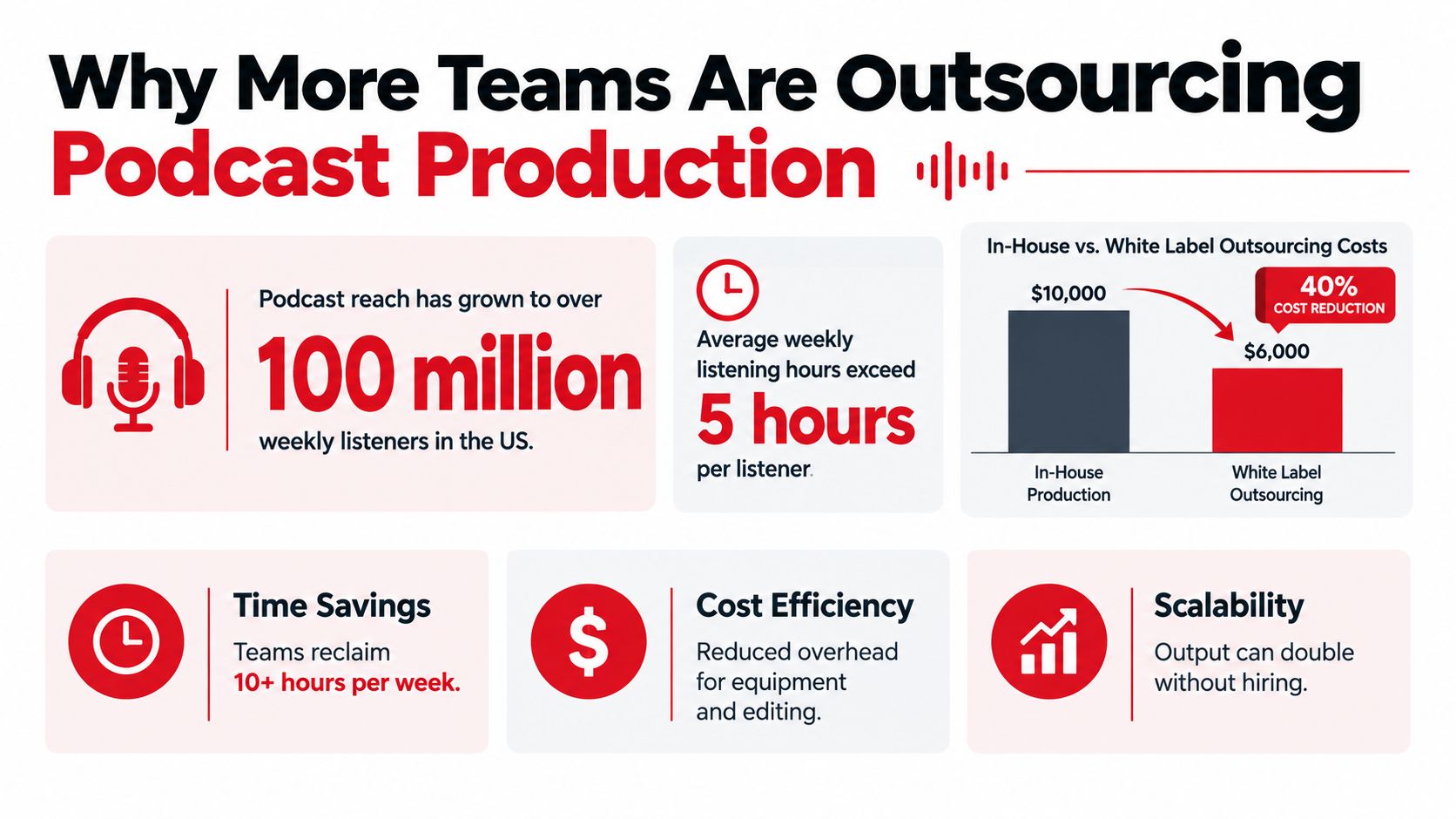
In 2025, 73% of Americans aged 12 and older had consumed a podcast, while 55% consumed one monthly and 40% weekly; weekly listening time among Americans aged 13 and older reached 773 million hours, up from approximately 170 million in 2015, according to Edison Research's Podcast Consumer report.
That audience justifies serious consideration. It doesn't justify launching without an operational owner.
Outsourcing should address a specific constraint:
Agencies adding services need dependable fulfillment without promising clients capacity they haven't secured.
B2B marketing leaders need a way to turn executive expertise into publishable material without making executives manage production.
Consumer brands need continuity across an ongoing editorial calendar.
Media buyers need production schedules that fit campaign launches and advertising commitments.
The practical benefits depend on your scope, internal workload, and approval process, not a universal savings formula.
Outsource before the calendar becomes unreliable
My recommendation is to outsource when production coordination starts displacing the work your marketing team was hired to do. Don't wait until missed releases become normal.
Practical rule: Outsource repeatable execution before you outsource responsibility for what the show should accomplish.
The strategic move isn't replacing your team. It's giving that team a production system they can direct without personally operating every part.
What White Label Podcast Production Means
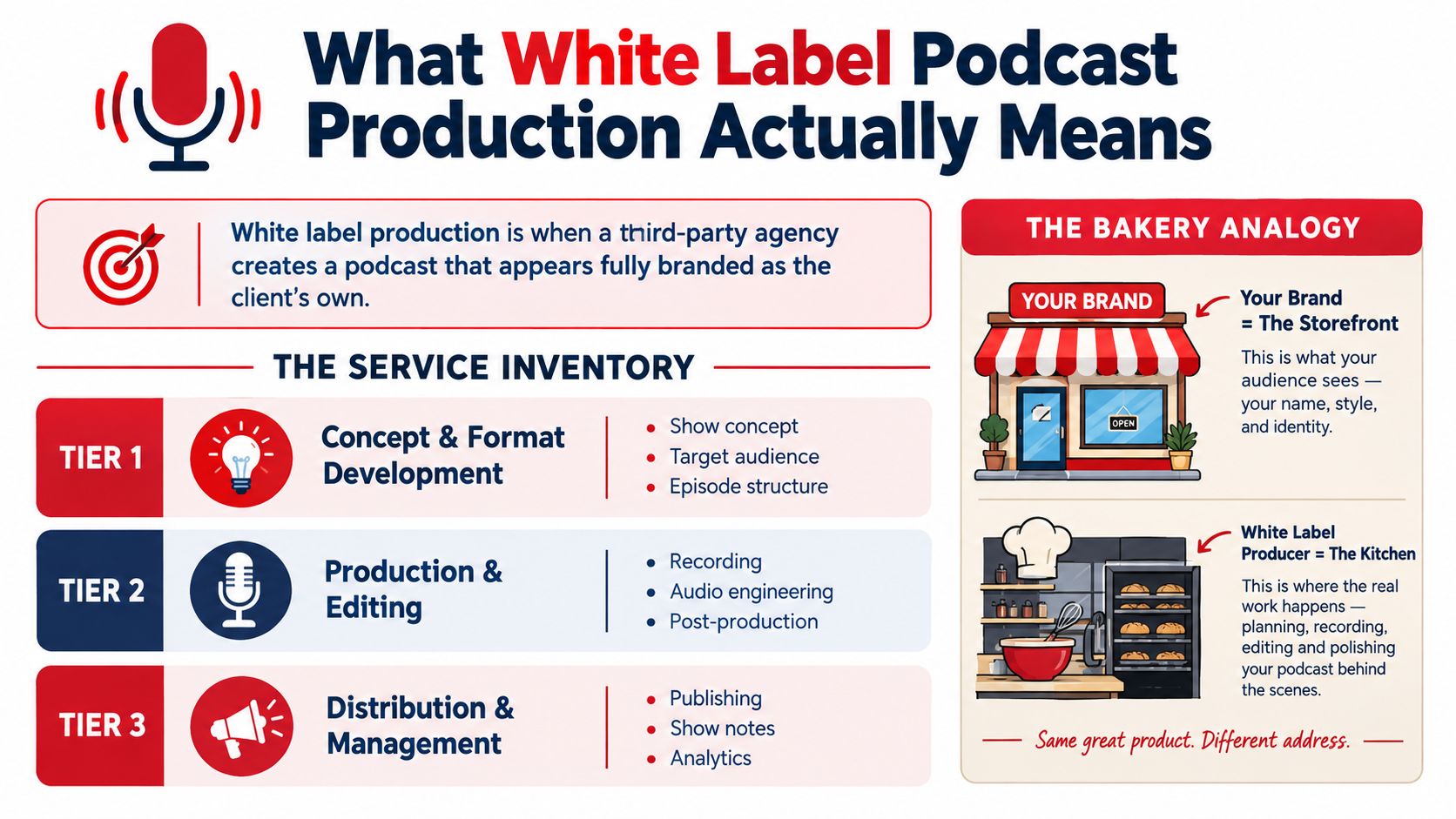
White label podcast production is an arrangement in which a production partner makes and manages a podcast that appears under the agency's or client's brand. A specialist kitchen supplies the product while your brand runs the storefront, which is the division of labor this model formalizes.
The analogy covers the service layers. It says nothing about the operating system you are buying, and that system is where engagements succeed or fail. The contract has to define what the kitchen delivers, who approves it, who receives the data it generates, and what you keep when the relationship ends.
Define the service before comparing providers
Use this inventory to build your scope:
Development. Audience definition, concept development, format design, episode planning, research, and host scripts or interview briefs.
Recording. Studio coordination or remote capture, guest preparation, technical checks, session management, and backup procedures.
Post-production. Audio editing, sound design, mixing, video editing, music licensing, artwork, and thumbnails.
Publishing and promotion. Transcripts, captions, show notes, metadata, distribution to Spotify, Apple Podcasts, and YouTube, plus agreed social assets and cross-channel promotion.
These are scope options, not automatic inclusions. A quote for editing isn't a quote for guest coordination, campaign planning, or ongoing channel management.
For an additional visual introduction, use the video below.
Require separate audio and video deliverables
Don't accept a video export with the picture removed as the entire audio workflow. Specify separate masters, independent quality checks, captions, platform artwork, metadata, and version control, consistent with the distinctions discussed in the IAB Audio Measurement Guide.
The defining commercial feature is brand invisibility, not unlimited service. The production partner's name stays off the finished product unless you agree otherwise.
Treat the agreement as an operating system, not a price sheet. Spell out three things most explainers skip: who owns the show, feed, artwork, and raw recordings; who receives measurement exports and in what format; and what happens to every asset if you switch providers. The words "white label" establish none of those rights on their own.
What to Outsource and What to Keep In House
Keep authority close to the brand. Move specialized execution to the people equipped to perform it. That's a more useful dividing line than deciding whether strategy or production belongs entirely inside or outside your company.
A producer can help develop the concept. Your leadership still needs to decide whose attention matters, what position the brand will take, and which conversations it's prepared to publish.
Assign ownership by layer
Layer | Client responsibility | Production partner responsibility |
|---|---|---|
Concept | Business objective, audience priorities, positioning | Format proposals, feasibility, editorial development |
Editorial | Host selection, brand voice, sensitive claims, final approval | Research, interview preparation, structural editing |
Production | Access to speakers and timely feedback | Recording logistics, editing, finishing, quality control |
Distribution | Channel priorities and campaign coordination | Publishing, metadata, captions, approved clips |
Measurement | Business definitions and interpretation | Technical setup, exports, documentation, reporting support |
The production layer is the clearest outsourcing candidate. A defined podcast audio editing workflow lets your team judge intelligibility, pacing, and consistency without managing every edit.
Editorial judgment needs closer collaboration. Don't ask an unfamiliar editor to decide whether an executive's provocative statement represents your company's actual position.
Keep a named internal owner
Assign someone who can consolidate feedback, secure approvals, and resolve disagreements. Giving the producer comments from marketing, sales, legal, and the host without reconciliation isn't collaboration. It's transferring an unresolved decision.
The client should supply decisions. The producer should supply a dependable way to execute them.
Budget internal attention as deliberately as production spend. Hosts need preparation, subject-matter experts need to verify claims, and approvers need protected review time.
Warning signs include a producer inventing the business objective, a client rewriting every episode after editing, or nobody knowing who can authorize publication. Those aren't problems you solve by buying a larger package. Redraw the responsibility map before increasing output.
Engagement Models and Pricing Structures Compared
Choose the commercial model around how your team can commit, not which proposal has the smallest headline fee. A predictable publishing program and an exploratory series need different agreements.
Ask every provider to price the same deliverable specification. Otherwise, you're comparing a finished audio file with an entire managed production service.
White Label Podcast Production Engagement Models
Model | Best For | Cost Shape | Watch Out For |
|---|---|---|---|
Monthly retainer | An ongoing show with a dependable publishing schedule | Recurring fee for defined capacity and deliverables | Unused capacity, unclear rollover rules, revision exclusions |
Per episode | Pilots, seasonal series, event-led content | Fee per approved scope, with separately priced additions | Setup charges, cancellation terms, variable recording complexity |
Revenue share or bundled arrangement | A program combining production with sponsorship or media activity | Production fees combined with an agreed share or bundled services | Incentive conflicts, opaque allocations, disputed revenue definitions |
A retainer makes sense when your team can reliably supply speakers and approvals. It's a poor choice if recording dates constantly move and nobody can make editorial decisions.
Per-episode pricing buys flexibility. Define what qualifies as an episode, especially when recording overruns, reshoots, or substantial restructuring change the workload.
Separate production obligations from commercial outcomes
Revenue participation deserves extra scrutiny. If the partner also sells advertising, specify who approves sponsors, how revenue is calculated, what expenses are deducted, and whether commercial commitments can affect editorial decisions.
For a broader way to interrogate incentive alignment, consult Fluidwave's take on pricing models. Use it to frame questions, not to assume podcast outcomes can all be assigned to a producer.
Review podcast production services pricing against your actual scope rather than searching for a universal market rate.
Your service agreement should define deliverables, revision allowances, approval dependencies, turnaround commitments, cancellation terms, and out-of-scope charges. It should also say what happens when either party misses a deadline.
A cheaper episode isn't a better purchase if your account manager becomes its unpaid production coordinator. Compare total responsibilities, not just invoices.
Measurement and Attribution Handoffs That Work
A producer's dashboard reports numbers; a measurement strategy defines what those numbers mean, where each figure originates, and which business question it can reasonably answer. Lock down that mapping before launch, with the producer's reporting owner and your analytics lead in the same room.
In reporting cited by PodWires, 50% of surveyed major advertisers identified limited performance data as the main constraint on podcast investment; the same article reports Nielsen's average advertising lifts of 10 percentage points in awareness, 8 in information seeking, and 6 in purchase intent in its Q2 2025 norms (PodWires' measurement analysis). Read that as a warning. Sponsors pull budget when reporting stops at delivery counts, so the handoff has to carry brand and demand signals too.
Write the handoff spec before the first episode ships
The IAB Tech Lab's podcast measurement guidelines describe a five-step validation process: filter requests, apply a content threshold, aggregate unique requests, generate metrics, and audit results. Turn that process into a launch document the producer signs off on:
Area | What to document |
|---|---|
Infrastructure | RSS host, content delivery network, dynamic-ad-insertion system |
Identifiers | Episode GUIDs, ad asset identifiers, campaign parameters, naming conventions |
Counting rules | Filtering methods, deduplication logic, metric definitions, reporting windows |
Access | Raw or normalized delivery logs, export procedures, named reporting owners |
Treat the document as part of the production operating system. Attach it to the service agreement, and update it whenever a platform, feed, or insertion system changes.
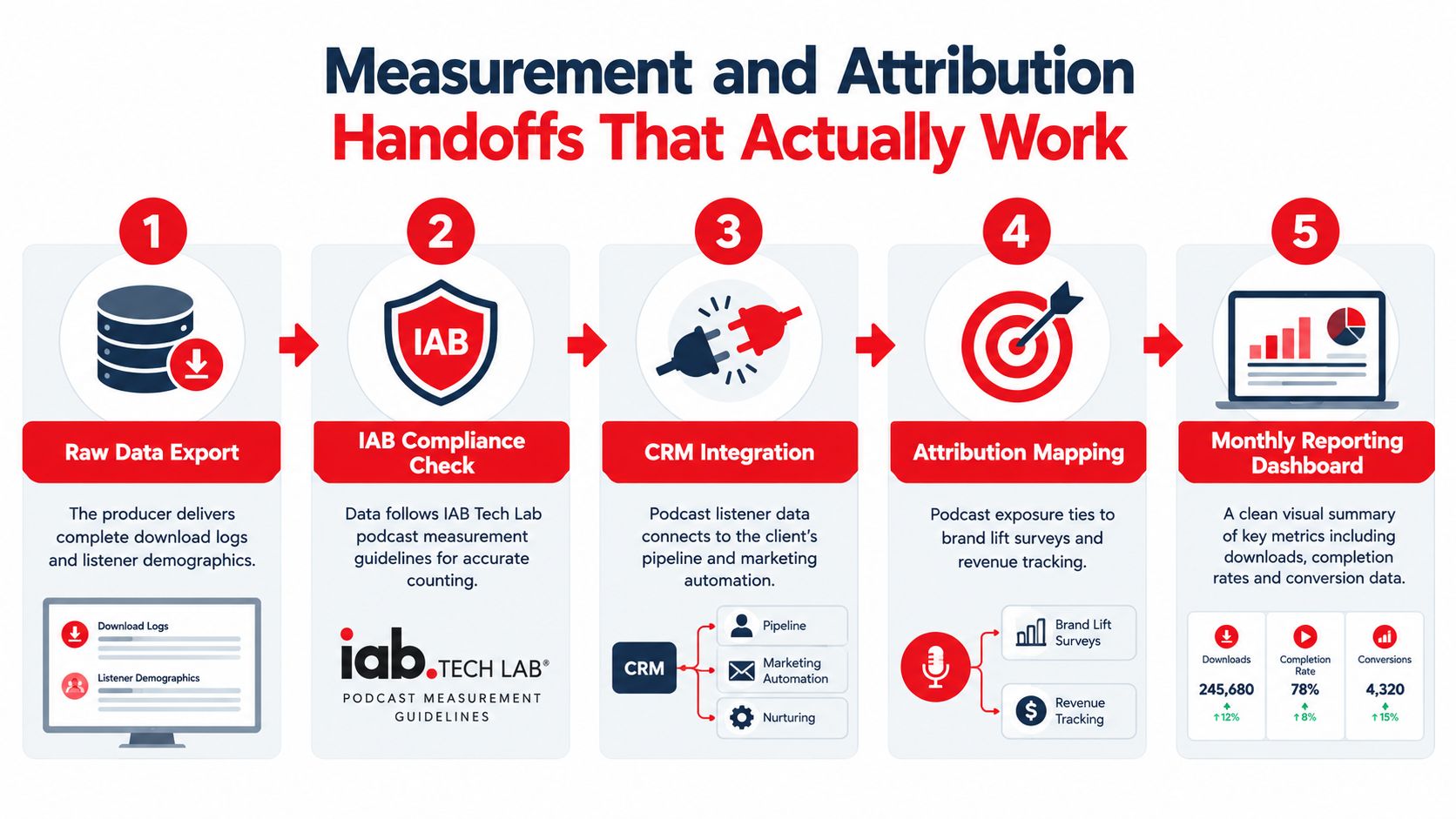
The framework above is a planning baseline. Platform APIs decide which fields you can pull in practice.
Report influence without inflating it
A download confirms delivery to a device. It confirms nothing about whether anyone listened, and an inferred listener may never surface as an identifiable CRM contact. Keep download delivery, unique listeners, ad delivery, and supported playback measures in separate columns, and require the producer to report them separately.
For demand generation, report qualified referral traffic, self-reported discovery, assisted conversions, and account-level engagement where available. For brand objectives, use lift research or matched comparisons rather than forcing every episode into last-click attribution.
A documented podcast attribution model separates observed actions from inferred influence. For the wider reporting program, Taja AI's resource on how to track content performance in 2026 works as a planning reference.
Refuse any report that sums Spotify, Apple Podcasts, YouTube, host-read, and programmatic figures as though they describe identical behavior. Label platform differences, mark unavailable data explicitly, and accept that a visible gap beats a confident number on a channel you cannot verify.
The Hidden Risks of Going White Label
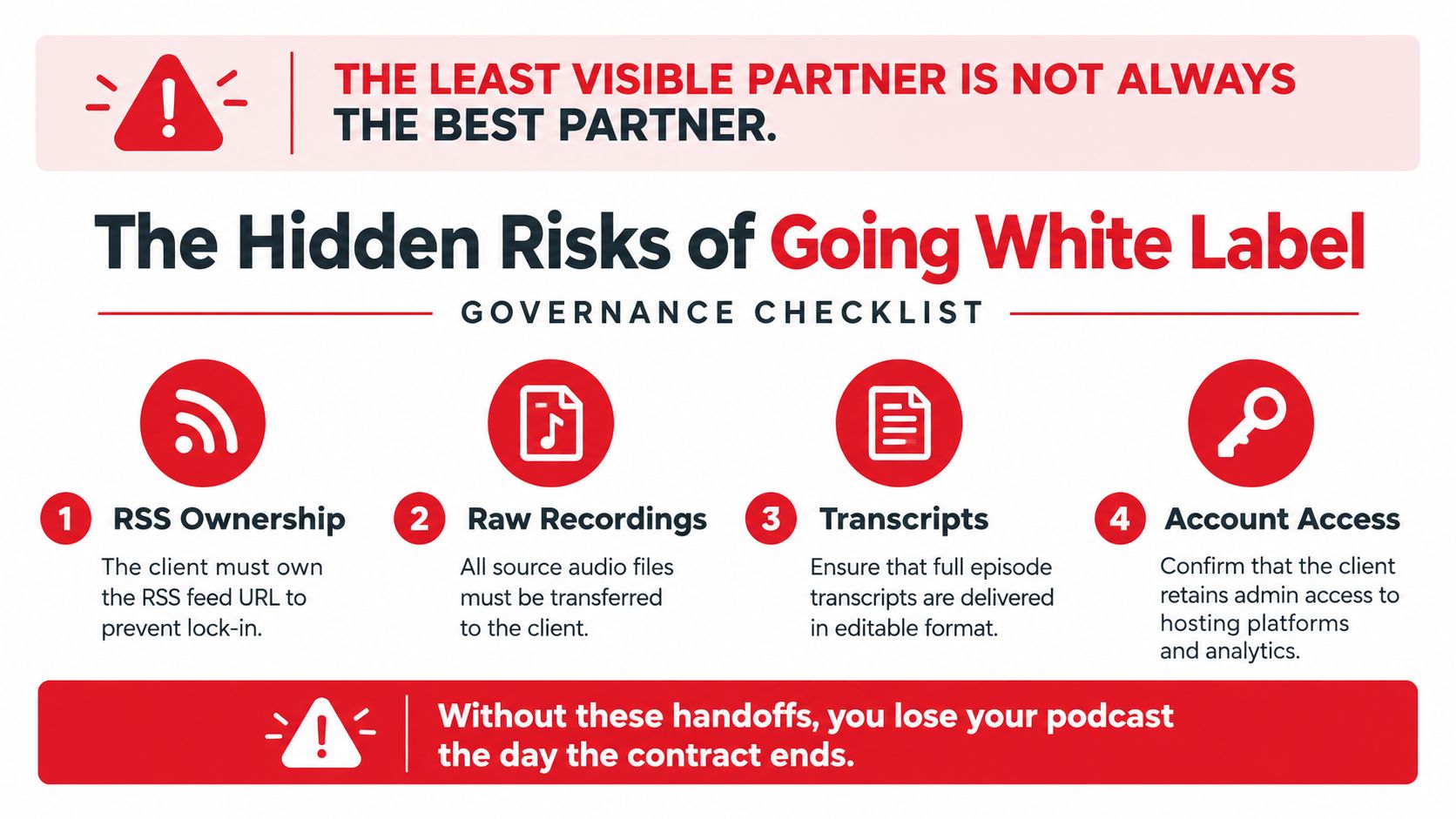
An agency loses its white label producer in month nine. The published episodes sound fine, but the hosting account sits under the producer's credentials, the raw recordings live on a drive the agency can't access, and none of the guest releases covered promotional clips. The show is legally theirs and practically unrecoverable.
Failures like that one live in the contract layer. The audio quality is irrelevant to them. Invisible production makes it easy to assume someone else is minding the assets, accounts, and permissions underneath, and governance questions around access, approvals, assets, and handover also appear in Heymato's white-label podcast guidance. They belong in the agreement, not in assumptions.
Write the risk register into the agreement
Handle continuity clause by clause, covering who owns what, who controls what, and what gets handed over:
Area | What to pin down |
|---|---|
Ownership and licensing | Raw recordings, project files, masters, transcripts, artwork, and derivative clips, plus documentation for licensed elements that can't transfer |
Guest permissions | Releases signed before recording that cover approved channels, territories, promotional reuse, voice, and likeness |
Account control | Client administrative access to hosting, distribution, and analytics, with defined permission levels for the producer |
Third-party materials | Records for music, footage, fonts, and other licensed assets, including restrictions on reuse |
Archiving and deletion | Storage locations, retrieval rights, and what happens to backups after termination |
Treat this register as a starting point. Counsel should adapt the agreement to your circumstances.
Treat AI permission as its own clause
Recording consent doesn't cover voice synthesis. Specify permitted AI uses, disclosure requirements, human review, and restrictions on uploading confidential recordings into external services. Automated show notes and clips need the same gate: a person verifying claims, preserving context, and approving publication before anything ships.
Contract test: If the relationship ended today, could your team continue publishing without asking the departing producer for permission?
Price the exit before you sign
Exit rights decide whether the rest of the contract means anything. Write an exit schedule covering exports, credentials, transferable licenses, analytics history, and migration assistance, then rehearse the procedure while the relationship is healthy. Ownership on paper is useful. Recoverable files and working access are what keep the work auditable, transferable, and under your control.
Evaluating Providers and Planning Your Rollout
Ask a prospective provider to explain how a raw recording becomes an approved release. Their answer should identify responsible people, review gates, and delivery artifacts, not just editing software.
Portfolio samples establish taste. A walkthrough of the workflow establishes whether you can work together.
Evaluate evidence, not the sales presentation
Relevant samples: Request complete audio and video episodes, not just trailers. Review openings, difficult edits, captions, and sponsor transitions.
Operational references: Ask former or current clients about communication, corrections, and deadline changes.
Technical access: Examine a sample report, export, delivery folder, and quality-control document.
Commercial independence: Ask which hosting, studio, or distribution relationships influence their recommendations.
Contract readiness: Review the proposed scope and governance terms before committing to ongoing production.
For help structuring a requirements-led consultation, MakeAutomation's SaaS design consultation guide is a supplementary reference. Keep your podcast evaluation focused on its own editorial and delivery requirements.
Roll out through decision gates
Discovery and concept lock. Agree on the audience, objective, format, host, responsibilities, and approval route. Advance when decision-makers accept the same brief.
Pilot and quality baseline. Produce a representative episode using the intended workflow. Test real review behavior, not a special demonstration with unusually generous attention.
Production cadence and measurement setup. Confirm that people can meet their obligations and that reporting exports work. Don't scale on the strength of a good pilot alone.
Scale and optimization. Expand formats or publishing volume only when the existing process is dependable. Use editorial feedback and performance evidence to decide what deserves more investment.
Require signed rights and consent arrangements, an accepted measurement handoff, and a successful migration test before expansion. These gates give an operations lead observable acceptance criteria instead of a launch calendar built on optimism.
Frequently Asked Questions and Next Steps
How long does onboarding take?
Ask for a dependency-based schedule rather than accepting a generic turnaround promise. Onboarding depends on whether the concept, host, recording setup, brand materials, permissions, and approval route are ready.
Require milestones with named owners and acceptance criteria. If a provider gives you a launch date without asking about those dependencies, challenge the estimate.
What should we prepare before kickoff?
Bring an audience brief, a business objective, brand guidelines, host availability, subject-matter access, and examples of work you like or dislike. Explain why the examples matter, whether it's interview depth, visual restraint, pacing, or editorial tone.
Choose the decision-maker. Someone must resolve conflicting feedback.
List the constraints. Include sensitive topics, required reviewers, and recording limitations.
State the desired action. Decide what you want an engaged listener or viewer to do next.
You don't need finished scripts. You do need enough direction to judge the producer's recommendations.
When does per-episode pricing beat a retainer?
Choose per-episode pricing when you're still validating your ability to supply content or when the series has a defined endpoint. Don't buy reserved capacity because the unit price looks attractive.
Move to a recurring commitment when your own team can support it. A producer can reserve time, but can't manufacture executive availability or internal agreement.
How do we evaluate quality before signing a long contract?
Commission a paid pilot under realistic conditions. Include the actual host, normal approval team, intended recording environment, and required deliverables.
Judge more than sound quality. Check whether the producer understands the argument, handles corrections accurately, communicates trade-offs, and delivers usable files.
Your next step this week is to assemble a short requirements brief and request a consultation around it. Ask the provider to identify what they would refuse to launch without. That answer is often more useful than a promise to handle everything.
Podmuse offers end-to-end audio and video podcast production, from concept development and recording to post-production, publishing, and ongoing management. Visit Podmuse to request a free consultation, and bring your requirements brief so you can discuss production scope, measurement handoffs, and client-control terms before committing.


Comments