
The 10 Best Video Podcast Software Tools for 2026

Your team has a strong concept for a show. The problem is everything that comes after the concept. One person wants a browser recorder because guests won't install anything. Another wants a desktop setup for cleaner control. Someone else wants an all-in-one platform so the team isn't stitching together five tools every week.
That tension is normal. The best video podcast software isn't just a recorder anymore. Since the shift from audio-first podcasting into mainstream video distribution around 2020 to 2021, software has expanded from simple editing apps into broader systems for capture, hosting, clipping, and publishing, as noted in this overview of how video podcast software evolved. That matters because your software choice now affects quality, turnaround speed, guest experience, and how easily your team can publish to multiple channels.

For most brands, the key question isn't "Which tool has the most features?" It's "Which production model are we constructing?" Remote interviews, studio panels, live shows, and repurposed short clips all need different workflows. This guide focuses on that decision. It covers the top tools, what they do well, where they create friction, and which setup fits a brand trying to scale without building an internal production department from scratch. If you're also evaluating desktop capture options, these 2026 Mac video software insights are a useful companion read.
Table of Contents
1. Riverside.fm

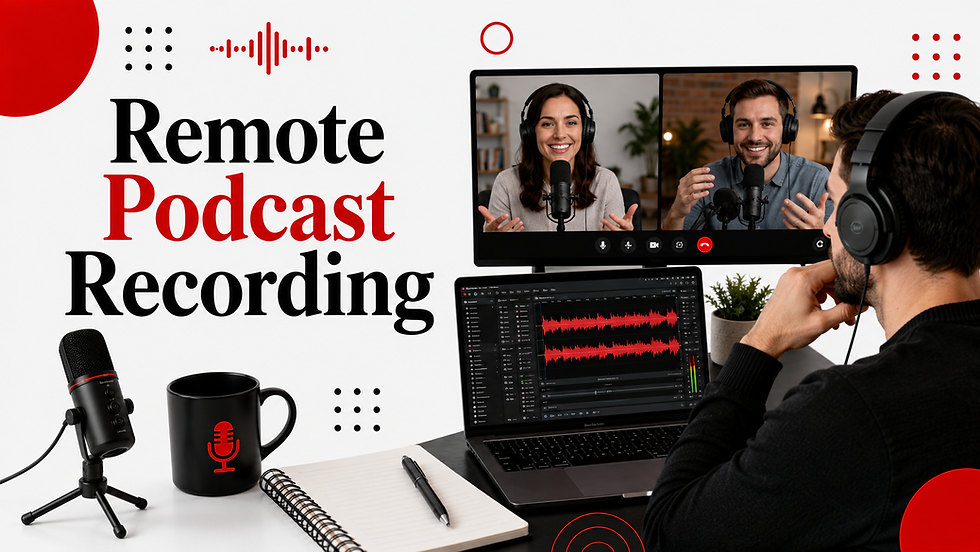
A remote guest freezes for two seconds, their Wi-Fi stutters, and the live call looks rough. If the platform records each participant locally, the final episode can still come out clean. That production reality is why Riverside is usually my first recommendation for brands built around remote interviews.
Riverside fits teams that want to record, clean up, clip, and publish in one place without building a complicated stack. The core advantage is separate local audio and video tracks for each guest. That protects episode quality when internet conditions are inconsistent, which matters a lot for executive interviews, customer stories, and partner conversations that are hard to reschedule.
This is also a strategic workflow choice, not just a feature choice. If your production model is remote-first and recorded-first, Riverside makes sense. If your show is studio-based or built around live switching, another tool will usually fit better.
Why Riverside works
Riverside is best for teams that need reliable capture first and convenience second, then want enough post-production built in to keep turnaround times reasonable.
Best for remote interviews: Guests join through a browser link, and producers still get isolated tracks that are much easier to fix in post.
Best for marketing teams repurposing every episode: Transcripts, text-based editing, clips, and show notes help turn one recording session into multiple assets.
Best for brands reducing tool sprawl: Recording, light editing, publishing, and basic analytics can live in one workflow.
The trade-off is control. Riverside is strong for capture and efficient repurposing, but it is not the tool I would choose for a highly produced show with complex scene-building, advanced live switching, or a heavy finishing process. Teams with a dedicated editor may still export into a separate post-production tool.
The free plan is mainly for evaluation. Once a show is client-facing or tied to brand reputation, its demands quickly exceed the quality caps and branding limitations.
One rule holds up across almost every remote show I have worked on: if outside guests are part of the format and missed recordings are expensive, local capture should be near the top of the buying criteria.
If you are designing the wider system around guest booking, recording, editing, and content reuse, this guide to video podcast production workflows for marketing teams is a useful next step.
Website: Riverside.fm
2. StreamYard
StreamYard is less about deep post-production and more about getting a show live, branded, and on-air fast. If your show behaves more like a recurring live program than a polished documentary-style edit, StreamYard is one of the easiest ways to run it.
Its strength is operational simplicity. Hosts can manage scenes, overlays, lower thirds, backstage guests, and multistreaming without asking a producer to babysit every episode. That makes it attractive for lean marketing teams that need consistency more than granular editing control.
Where StreamYard fits
StreamYard is best for brands that think in terms of episodes as events.
Best for live-first shows: It handles multicasting and on-screen branding well.
Best for non-technical hosts: The interface is easy to learn compared with desktop switchers.
Best for executive-led content: If leadership wants a polished LinkedIn Live, YouTube stream, or panel discussion, this is a practical choice.
The trade-off is that StreamYard isn't the strongest option if your workflow depends on detailed cleanup after the fact. You can record locally on paid plans, but the editing side still isn't the main reason to choose it.
What works is the speed from guest invite to live show. What doesn't is trying to force it into a deep post-production workflow it wasn't really designed to own.
Website: StreamYard
3. SquadCast by Descript

SquadCast makes the most sense when your team already likes Descript or wants editing to start from a transcript instead of a traditional timeline. Its value isn't just the recording room. It's the handoff.
The platform focuses on separate local tracks, resilient uploads, and a clean guest experience. For teams that hate chasing missing files or reconciling messy recordings, that reliability matters more than flashy features.
Who should choose it
SquadCast is best for organizations that want a stable remote recorder feeding directly into a text-first editing workflow.
That means it's a good fit for content teams producing interview-led thought leadership, internal communications series, or executive content where speed of revision matters. Marketing teams often care less about cinematic editing and more about quickly removing tangents, tightening answers, and producing a few derivative clips.
Stable capture plus easy editing usually beats a feature-rich recorder with a messy post-production process.
The limitation is strategic. SquadCast feels strongest when paired with Descript. If your editors prefer a more traditional finishing workflow, that native advantage matters less.
Website: SquadCast
4. Zencastr

A common scenario looks like this. The team starts with a remote recorder, then adds a hosting platform, then another tool for analytics, clips, and ad support. Six months later, the workflow is harder to manage than the show itself.
Zencastr appeals to teams trying to avoid that sprawl. It combines remote recording with hosting, basic editing, analytics, and monetization tools in one platform. That makes it less of a specialist recorder and more of an operating system for a podcast program.
Best use case
Zencastr fits brands that want one system for capture, publishing, and early-stage growth operations.
That matters if the primary challenge is not just recording guests. It is keeping production organized, publishing on time, and giving marketing a clearer path from episode to distribution. Teams building a visual podcast strategy often run into this exact decision. They can assemble a stack of specialist tools, or choose a platform that covers more of the full workflow with fewer handoffs.
Best for consolidation: Recording, hosting, analytics, and monetization live in one place.
Best for lean teams: Useful for small marketing departments that do not want to manage multiple vendors.
Watch for trade-offs: Breadth is helpful, but some teams will still want stronger editing or more polished live production tools elsewhere.
That trade-off is the key point. Zencastr usually makes the most sense for recorded remote shows where operational simplicity matters more than getting the strongest tool in every category.
If your production model depends on advanced post-production, a dedicated editor may still be the better choice. If your goal is to run a reliable show with fewer moving parts, Zencastr is a practical option.
Website: Zencastr
5. Descript

Descript is the tool that changes how many marketing teams think about editing. Instead of treating post-production like a specialist craft that only video editors can touch, it lets teams edit by working directly in the transcript.
That changes staffing as much as software. A content marketer, producer, or strategist can clean up an episode, trim weak answers, and pull social clips without opening a complex timeline editor first.
Why teams buy Descript
Descript is best for high-volume content teams. If your show feeds YouTube, sales enablement, social clips, and internal approvals, transcript-based editing can speed up the whole chain.
Audience behavior supports that multi-format mindset. Triton Digital reports that 80% of monthly podcast consumers both watch and listen, while 13% are listen-only and 7% are watch-only, according to Triton Digital's video podcasting data. That's why Descript is so useful. It helps teams turn one conversation into multiple formats quickly.
Best for transcript-first editing: Fast cleanup and rough cuts.
Best for collaboration: Non-editors can participate in revisions more easily.
Watch the usage model: Media hours and AI credits need planning on active teams.
If your team is building a more visual show identity, this overview of the visual podcast format pairs well with Descript's workflow.
Website: Descript
6. Ecamm Live
Ecamm Live is for Mac-based teams that want their show to look produced in real time. It sits in a useful middle ground between browser simplicity and full broadcast complexity.
You get scene switching, graphics, remote guests through Interview Mode, isolated audio capture, virtual camera support, and strong integrations with tools like Stream Deck. That's a good package for branded live or live-to-tape shows.
Best for Mac-first brands
Ecamm Live is best for organizations with a reliable recurring format and someone on the team who cares about live presentation quality.
It works especially well for founder shows, education series, recurring webinars that double as podcasts, and interview programs where visual consistency matters. It doesn't ask the team to become a broadcast engineering department, but it gives much more control than a basic browser tool.
The main limitation is obvious. If your production environment isn't Mac-based, Ecamm is out. If it is, Ecamm often becomes the anchor for a dependable live workflow.
A clean recurring live format usually benefits more from scene discipline and hardware integration than from another layer of AI editing.
Website: Ecamm Live
7. vMix

A quarterly interview show can run on a simple remote recorder. A branded media operation with multiple cameras, live switching, remote contributors, sponsor graphics, and separate recording feeds needs a different class of tool. vMix sits in that second category.
This is production infrastructure. It fits teams building a studio workflow, a live event format, or a producer-led show where the switcher matters as much as the host.
Where vMix wins
vMix is best for organizations that already know their format is getting more complex. It handles multi-camera inputs, caller management, titles, audio routing, ISO recording, replay, and custom outputs in one environment. That matters when the video podcast is also feeding YouTube, LinkedIn Live, in-room screens, or downstream editors who need clean isolated files.
The trade-off is clear. vMix asks for planning, operator skill, and a stable production setup. If your show is remote-first and built around sending guests a link, this will feel heavier than it needs to be. If your model is closer to a control room than a browser studio, the added control is worth it.
Use vMix when production complexity is part of the brand experience, not an edge case.
Best for studio and event formats: Strong fit for multi-source shows, live switching, and controlled outputs.
Best for producer-led teams: Someone should own setup, routing, and show operation.
Best for scaling format complexity: Useful when one show becomes a repeatable media property with stricter technical requirements.
For a simple one-host, one-guest interview, vMix is usually too much software. For a network-style production with recurring segments, guest feeds, and distribution needs beyond a single recording, it's one of the strongest options available.
Website: vMix
8. OBS Studio
OBS Studio remains one of the best values in the category because it's powerful, flexible, and free. But it isn't easy in the way browser podcast tools are easy. It's easy only after someone on your team understands routing, scenes, sources, filters, and plugin behavior.
That makes OBS a foundation tool, not always a complete tool.
What OBS does best
OBS is best when you need a production hub. It handles scene composition, capture cards, audio filters, recording, live streaming, and a wide plugin ecosystem across Windows, Mac, and Linux.
The catch is remote guest handling. OBS doesn't solve that natively in the same integrated manner purpose-built remote podcast tools do. Teams often pair it with Zoom, NDI, a browser studio, or another ingest method.
A useful way to think about OBS is this:
Best for custom setups: Great when your team wants control over sources and outputs.
Best for budget-conscious production: The software cost isn't the issue.
Weakest for guest convenience: You'll need another layer for smooth remote interviews.
OBS is excellent if your producer likes building systems. It's frustrating if your host expects a single link and a clean green room experience out of the box.
Website: OBS Studio
9. Restream Studio
Restream Studio is often undervalued because people think of Restream only as a multistreaming service. In practice, it can play two roles. It can be your browser-based studio, or it can be the distribution spine behind another production tool like OBS or vMix.
That flexibility is useful for brands publishing the same show to multiple destinations and wanting centralized stream management.
Best for distribution-heavy workflows
Restream Studio is best when publishing complexity is part of the problem you're solving. If your team cares about sending one production to several endpoints, aggregating chat, managing captions, and preserving a record of sessions, Restream earns its place.
This aligns with a gap in many roundup articles. Buyers increasingly need to evaluate workflow fit beyond recording quality alone, as highlighted in Switcher Studio's take on video podcast recording software. Distribution and repurposing aren't side tasks anymore. They're central to the system.
If your team already produces clean video elsewhere, the smartest software decision may be the tool that removes publishing friction, not the tool with the longest feature list.
For teams prioritizing YouTube as a growth channel, this guide on how to start a podcast on YouTube is a practical companion.
Website: Restream
10. DaVinci Resolve
DaVinci Resolve isn't a remote recording tool. That's exactly why it belongs on this list. A lot of branded shows don't fail at capture. They fail at finishing. The audio is uneven, the color looks inconsistent, the clips feel rushed, and the final exports aren't packaged properly for different channels.
Resolve solves the back half of that problem better than almost any lightweight recorder can.
When Resolve is the right choice
DaVinci Resolve is best for teams that already have footage and need premium finishing, versioning, and control. Its editing, color, effects, and Fairlight audio tools make it a serious post-production environment for long-form episodes and short-form cutdowns.
The best video podcast software often isn't one tool. Independent commentary on the category points to a shift toward all-in-one remote recording tools for capture, while finishing still often relies on software like DaVinci Resolve, Adobe Premiere, or Adobe Audition, as discussed in this review of free and paid video podcasting software stacks.
Best for premium polish: Audio cleanup, color consistency, graphics, and final mastering.
Best for editors: Especially if the show has multiple cameras or recurring templates.
Not for guest capture: Pair it with a remote recorder or studio workflow.
If you're comparing finishing tools specifically, this roundup of pro and free podcast editors is worth reviewing.
Website: DaVinci Resolve
Top 10 Video Podcast Software Comparison
Tool | Core Features | Quality (★) | Price/Value (💰) | Target Audience (👥) | Unique Selling Point (✨/🏆) |
|---|---|---|---|---|---|
Riverside.fm | Local multitrack 4K/48k capture, AI edit, live stream, hosting | ★★★★★ studio-quality; resilient to bad internet | 💰 Free (watermark/720p); paid tiers with hour limits | 👥 Remote video podcasters & agencies | ✨ Best-in-class remote capture & repurposing; 🏆 |
StreamYard | Browser live studio, multistream, overlays, greenroom | ★★★★ very reliable & simple live production | 💰 Free (watermark); paid for 1080p/4K & unlimited | 👥 Live show hosts, marketers, creators | ✨ Easiest branded multicasting studio |
SquadCast (Descript) | Separate local tracks, Progressive Upload, Descript tie-in | ★★★★ reliable capture with fail-safes | 💰 Paid plans; optimized for Descript workflows | 👥 Podcasters needing stable remote capture + edit handoff | ✨ Progressive Upload + seamless Descript integration |
Zencastr | 4K multitrack, AI clipping, hosting, dynamic ads, analytics | ★★★★ all-in-one capture-to-monetize platform | 💰 Freemium; detailed pricing often behind login | 👥 Creators seeking integrated hosting & monetization | ✨ End-to-end platform with dynamic ad insertion |
Descript | Text-first editor, overdub, AI cleanup, 4K export | ★★★★★ fastest post-production & repurposing | 💰 Usage-based media hours & AI credits; tiered plans | 👥 Editors & teams focused on speed and repurposing | ✨ Text-based editing + Overdub; workflow accelerator |
Ecamm Live | Mac live studio, Interview Mode, ISO audio, scene switching | ★★★★ broadcast-style Mac UX | 💰 macOS subscription; Pro for advanced features | 👥 Mac users & creators wanting polished live shows | ✨ Tight Mac/hardware integration for pro broadcasts |
vMix | Windows live switcher: multi-cam, replays, vMix Call, 4K | ★★★★★ broadcast-grade for complex productions | 💰 One-time licenses or editions; trial available | 👥 Studios and advanced Windows productions | ✨ Pro-grade switcher with one-time license; 🏆 |
OBS Studio | Open-source scenes/sources, plugins, scripting, RTMP | ★★★★ very powerful but more technical | 💰 💰 Free & extensible (open-source) | 👥 Technical users & pros who customize workflows | ✨ Free, highly extensible production hub |
Restream Studio | Browser studio, multistream, chat aggregation, recording | ★★★★ mature multistream distribution | 💰 Free tier limits; paid for 1080p/record features | 👥 Multicasting creators & distribution teams | ✨ Flexible studio + routing for external encoders |
DaVinci Resolve | Full NLE: editing, Fairlight audio, Fusion VFX, color | ★★★★★ industry-grade finishing & audio | 💰 Strong free version; Studio paid for advanced tools | 👥 Post-production pros & agencies | ✨ Pro editing/color/audio suite for final polish; 🏆 |
Making Your Choice From Software to a Scalable System
A marketing team usually feels the software decision when production starts slipping. Guests miss setup steps. Editors wait on uploads. Review rounds drag out. Clips ship late, or not at all. At that point, the question is no longer which platform has the longest feature list. The question is which production model your team can run every week without adding friction.
That is the useful way to choose video podcast software. Start with the format, then build the stack around it. Remote interview shows need dependable local recording and a guest flow that does not create support tickets. Live shows need switching, graphics, moderation, and publishing control. Studio-led productions need stronger routing, monitoring, and post-production standards. If the primary business goal is content velocity, editing and repurposing matter as much as capture quality.
As noted earlier, the podcast market is large and still attracting serious brand investment. For marketing leaders, that changes the buying criteria. This is no longer a side project tool decision. It is an operating system decision for a repeatable content channel.
A practical shortlist looks like this:
Choose Riverside for remote-first shows where recording reliability, local tracks, and repurposing speed matter most.
Choose StreamYard or Ecamm Live for live-led formats where presentation, guest management, and on-screen control drive the show.
Choose SquadCast plus Descript for teams that want stable capture tied closely to transcript-based editing.
Choose vMix or OBS Studio if you have a producer, multiple inputs, and a significant need for production control.
Choose DaVinci Resolve if recording is already handled well and the primary gap is editing, color, audio cleanup, and final polish.
Choose Zencastr or Restream if your priority is simplifying the stack around recording, publishing, or distribution.
In practice, the best choice is often the tool that removes the most weekly friction. Guest onboarding matters. File handoff matters. Approval cycles matter. Clip extraction matters. A platform with fewer advanced controls can still be the better business decision if it cuts hours from production and helps the team publish on schedule.
Some brands should run a mixed stack. That is common, especially when one tool handles recording well and another handles editing or live distribution better. Other brands are better served by using a production partner with the workflow already built. Podmuse is one option if you want support across planning, production, post-production, and distribution without building the full system in-house. And if short-form distribution is part of your episode strategy, these PostClaw social media tool recommendations add useful context.
Pick the system your team will sustain. Consistency is what turns a video podcast from a promising idea into a reliable marketing asset.
If you want help choosing the right recording stack, production workflow, and post-production process for a branded show, Podmuse can help you plan and run the system end to end.


Comments