
International Podcast Marketing Strategy: A 2026 Playbook

The most repeated advice about taking a podcast campaign across borders is to translate the assets and add distribution. Localize the show notes, subtitle the clips, submit the feed to more directories, and let listeners find you.
That advice gets the cheap part right and the expensive part wrong. Translation changes what people can read. It doesn't change whether they can buy, whether the offer makes sense at their local price point, or whether the host they already trust is anyone you've heard of. A campaign can pile up downloads in a dozen countries and still convert in one.
I treat language reach and market reach as two different measurements with two different budgets. An English-language show reaches listeners in Toronto, Lagos, Manchester, and Manila at the same time. Only some of those listeners sit in a market where your pricing, your regulatory claims, and your fulfillment work. A credible international podcast marketing strategy starts by ranking markets, not by expanding into every country at once.
Table of Contents
Why Podcast Growth Starts With Markets, Not Media - Three inputs to collect before the first planning call
Score Markets and Segment Your Audience - A scorecard beats a gut call - Five steps from raw data to a shortlist
Localize the Show, Script and Offer - The host question is a budget question - Claims travel worse than words
Measure Incremental Impact Across Markets - Separate delivery from playback - Stack attribution instead of picking one signal - Brand lift belongs in the read-out
Build a Media Buying Mix Market by Market - A launch sequence that respects the trade-offs - Two complications that distort the read
Why Podcast Growth Starts With Markets, Not Media
A team builds a podcast buy in the U.S., finds a cost per acquisition it can defend, then copies the plan into five countries with translated scripts. Six weeks later the read-out is a mess. One market converts under the home benchmark, another burns its full budget on downloads that never touch a landing page, and a third produces a cost per lead so low that nobody in finance believes it. The media didn't break. The market selection did.
The channel question is settled for many buyers. In 2025, 91% of surveyed advertising agencies and advertisers had discussed podcast advertising as a potential media investment, according to Cumulus Media and Signal Hill Insights. What's still open is where to start and how much to change per country.
The supply side explains the interest. U.S. podcast advertising revenue reached $2.43 billion in 2024, up 26.4% year over year, yet the format still accounted for only 0.9% of total U.S. digital advertising revenue, according to the IAB's digital ad revenue report. Fast growth from a small base is the profile of a channel worth testing early and testing in a structured way, not a channel you buy everywhere on instinct.
Three inputs to collect before the first planning call
Listener location and language data. Export the last 90 days from your hosting platform and from each app dashboard. Country totals alone are misleading; you need country crossed with language.
A relationship list. Every show, host, publisher, and creator you've worked with or been introduced to, sorted by country and audience size. Warm relationships shorten launch timelines more than rate cards do.
One conversion metric per candidate market. Pick the outcome that the local sales or e-commerce team already reports against. If they can't name one, that market isn't ready for budget.
With those three in hand, the remaining decisions run in a sequence: which markets deserve money first, what gets localized, how the show is distributed and partnered, how the buy is mixed, and how each market is measured on its own terms. Do them out of order and you'll fund a market you can't measure, or measure a market you never localized.
By the end of that sequence a team should hold four working documents: a market shortlist with scores, a localization map by element, a media mix with budget tranches, and a KPI set with a read-out date. That's a quarter of work, not a year.
Score Markets and Segment Your Audience
A show built for a professional audience collects listeners in countries it never targeted. Shared language, diaspora communities, and industry interest carry a feed across borders without asking. That spread is reach. Whether any of it is demand is a separate question, and standard cross-border advice tends to skip it: translating metadata and adding platforms says nothing about whether a listener in another country can become a buyer.
Usage itself is uneven. Survey data compiled across 48 markets puts podcast use at 11%, with country-level movement ranging from a 4-point increase in Australia to a 3-point increase in Peru, per Statistics Global's compilation of Reuters Institute podcast data. Uneven movement signals uneven maturity, and maturity is what you're buying when you enter a market.
The consumption spread is wider than a typical first plan assumes. The Reuters Institute's 2021 Digital News Report, covering 46 markets, found that 31% of respondents across 20 countries with comparable data had accessed a podcast in the previous month, including 41% in Ireland, 38% in Spain, and 37% in the United States. Those numbers date from 2021, so check a newer survey wave for any candidate market before a figure like that anchors a budget.
Language reach and market reach are different things. A Portuguese speaker in Lisbon and a Portuguese speaker in São Paulo look identical in a language filter, but only one sits inside the market you're evaluating. That distinction is why markets get scored and split into cohorts rather than funded equally everywhere downloads appear.
A scorecard beats a gut call
Score each candidate on five criteria before any budget conversation:
Criterion | What to check | Signal to act |
|---|---|---|
Language reach | Share of listeners who speak the show language and live in the target country | Majority in-market listeners, not only expatriates |
In-market listening | Local podcast consumption from survey or platform data | Stable or rising listening compared with peer markets |
Commercial value | Average order value or lead value in the market | Margin covers localized scripts and production |
Competitive ad load | Number of brands already running host-reads in the category | Room for a distinct voice in the category |
Measurement readiness | Currency, consent rules, and ability to tag conversions by market | Conversions can be reported per market within the test window |
The point of the scorecard is cohort assignment, not a single ranking. Every candidate ends up in one of three buckets: test now, test later, or skip. Markets in the same cohort get treated the same way; markets across cohorts do not.
Five steps from raw data to a shortlist
Start from the 90-day listener geography and language export. If it isn't pulled yet, every step after this one waits.
Tag each market as expatriate, cross-border, or in-market. What share of listeners sit in the target country, and what share of those speak the target language as a first or working language. A diaspora cluster inflates language reach without adding market reach.
Score against the five criteria and assign cohorts. Force a rank order first, then bucket. A market that scores well on listening but fails measurement readiness goes to "test later" until conversion tracking catches up.
Choose two test markets and one comparable holdout. The holdout keeps baseline spend so lift has something to be measured against.
Define one or two buyer segments per market by role, need, and language. Two is the ceiling for a first test. Deeper work on creative and competitor fit belongs to a separate round of podcast market research once the shortlist exists.
Warning sign: if English-language downloads cluster in one country but conversions arrive from another, you're reading reach as demand. Fix the segmentation before you add budget.
Localize the Show, Script and Offer
Translation produces a script that is grammatically correct and emotionally flat. A host-read is a performance, and performances don't survive word-for-word transfer. Plan a rewrite from the brief for every market, then decide element by element how far the change should go.
Element | Localize fully | Adapt | Keep global |
|---|---|---|---|
Host and voice | Native-speaker or local host | Bilingual host with a local guest | Recognized brand spokesperson, if the voice travels |
Host-read script | Rewrite from the brief for each market | Adapt examples, claims, and references | Core product facts and offer definition |
Offer and pricing | Local currency and local promo terms | Adjusted bundles and thresholds | Product definition and brand promise |
Landing page and CTA | Local language and URL path | Local proof points and reviews | Brand design system |
Episode length and format | Test two lengths per market | Adjust to local commute and listening habits | Show identity and format name |
The host question is a budget question
A local host costs more than a voiceover and often more than a translated script plus studio time. Pay for one when the show's value depends on trust in a personality rather than on a product claim. Financial advice, health, hiring, and B2B categories where the audience follows individuals all fall on that side of the line. A straightforward product feature read usually doesn't.
Between the two extremes sits the bilingual host with a local guest. It's the practical middle for a first test: the voice sounds native, the guest supplies local credibility, and the production team you already have can run it.
Claims travel worse than words
Health, finance, and food claims need local legal review before recording, not after. Words that are ordinary in one market are regulated in another, and a host reading an unapproved claim is a compliance problem the publisher won't absorb for you. Build the review into the script timeline and you'll rarely lose a release date.
References are the other trap. Humor, seasonal anchors, sports, and music cues that land in one country can confuse or offend in the next. Cut the ones you can't defend, and hand the host a list of local anchors to improvise from instead.
If the show's value rests on trust in a person, pay for a local person.
Titles, show notes, and cover copy run on the same logic. For the production mechanics of running scripts and recordings across several languages at once, the workflow in this guide to multilingual podcast production covers the handoff between translators, hosts, and editors.
Distribute Across Platforms and Borders
Distribution is where a good market plan falls apart. If the show lives on one platform in one country and three in another, your audience counts stop being comparable, and every later budget decision inherits the error. Set the routine once and apply it in the same order in every market.
Here's how the pieces fit together before the steps.
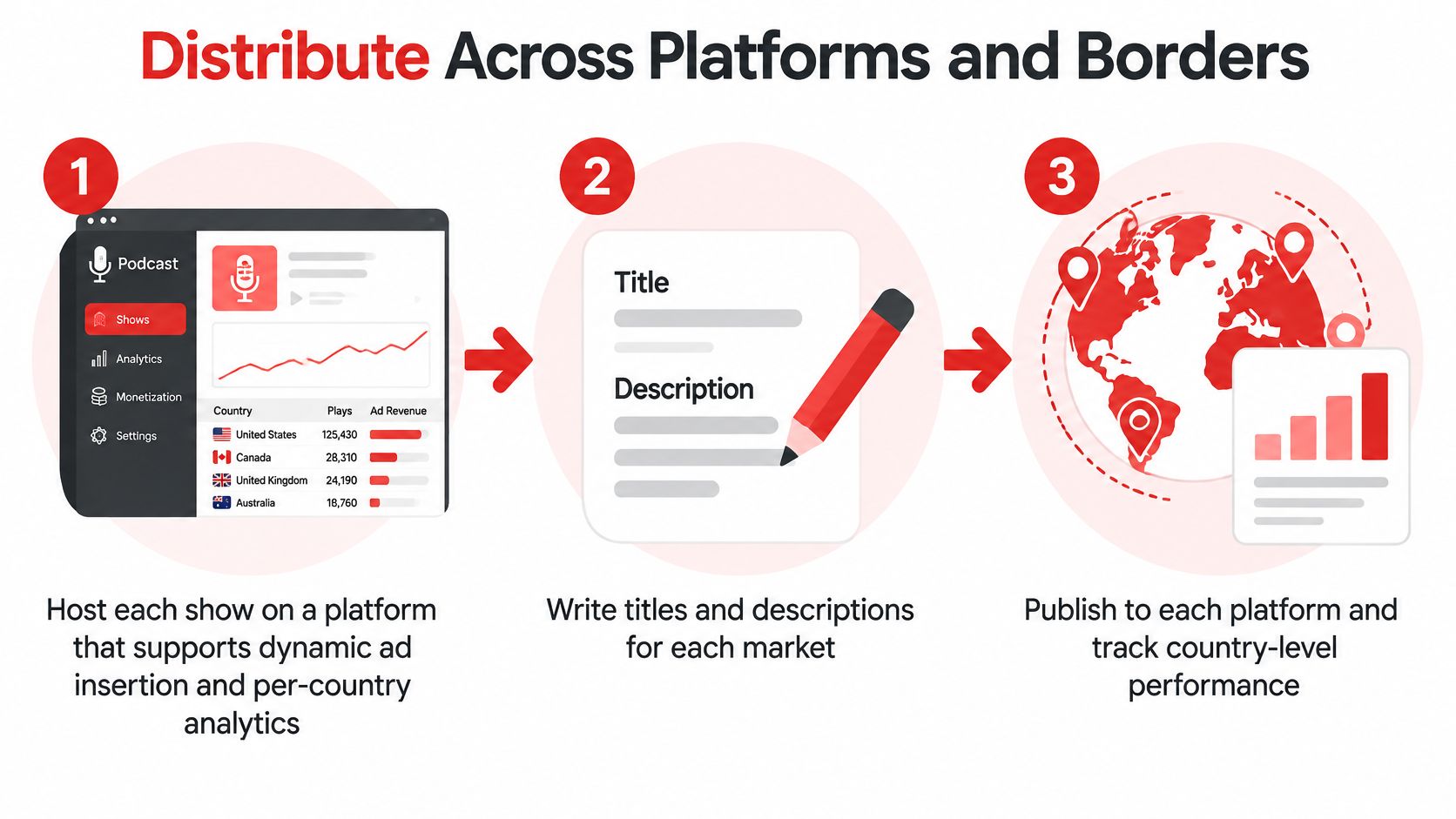
Host on a platform with dynamic ad insertion and per-country analytics. Without country-level reporting at the host level, you can't separate a weak market from a weak creative. This decision constrains everything downstream, so make it first.
Write titles, descriptions, and cover text in each market language. Keep the show name identical across markets so search results and brand recall accumulate in one place rather than fragmenting.
Submit to Apple Podcasts, Spotify, and YouTube before anything else. Those three carry the bulk of discovery in most markets. Add regional directories only where a market's listening share justifies the maintenance.
Cut vertical clips and short episodes in the local language for YouTube and social, with burned-in captions for silent viewing. Most social views happen without sound, and untranslated clips waste the traffic.
Schedule releases into local morning or commute windows. A single global publish time means some markets always get the episode at a dead hour. Test the local window against the global default rather than assuming it.
Put market-specific tracking links or landing paths in the show notes. One URL per market, every time. This is the cheapest attribution you'll ever set up.
Check platform rules on explicit content, sponsorship disclosure, and country availability. Disclosure requirements differ by market, and a region-blocked episode will distort your reporting.
Three pitfalls cause most of the damage later.
Split availability. An episode live on Spotify but missing on Apple splits the audience count and makes the market look smaller than it is.
Accidental region blocks. Rights or rights-adjacent settings can restrict a country you're actively buying in, and the loss never appears as an error.
Translated titles that miss local search terms. Listeners search in the words they use, not the words a translation tool produces.
Earn Reach Through Guest Bookings and Promo Swaps
Paid inventory buys certainty. Earned and partnership reach buys credibility at a lower cash cost, and in smaller markets it often outperforms a display-style buy because the audience already trusts the voice introducing you.

Start with a fit test before you pitch anyone. Four filters, applied in order: does the show's audience speak your target language, does it sit in your target country, does it match the buyer segment you defined, and is there an agreed measurement method before a single episode is recorded. A show that passes all four is worth pursuing even at modest size. A show that fails the language or country filter is worth skipping no matter how large its following.
Guest bookings work best when your spokesperson has something specific to teach that market's audience. Check the back catalog before you commit: consistent episode cadence, recent activity, and comments or reviews that show a real listener base. Follower counts on the host's social accounts tell you far less.
Promo swaps are the cheapest test in the playbook. Two shows of similar audience size in the same language trade mentions, and each swap carries its own tracking code so results stay separable. The mistake is treating a swap as free. It costs you inventory, so log it as a media cost and judge it on the same thresholds as paid.
The video below walks through the outreach side of partnership building.
Local trade press is underused. Pitch with local data and a local spokesperson, not a translated global press release. Editors in a smaller market can tell immediately when a story was written for somewhere else.
Co-branded creator partnerships carry two risks worth naming. Sponsored claims may need local approval before publication, and paid placements dressed as organic endorsements destroy trust faster than a bad ad. Disclose clearly, and brief the creator on the claims they can and cannot make. When you're building that partner list from scratch, finding content creator emails directly beats waiting on a contact form.
Selection rule: audience language, country, buyer-segment fit, and an agreed measurement method. All four, before the recording date.
Measure Incremental Impact Across Markets
The first measurement decision isn't which tool to use. It's what counts as one observation. Country, language, or audience cohort each give a different answer, and mixing them produces a report nobody can act on. Pick one unit before any media is bought, then report everything against it.
Separate delivery from playback
Downloads are not plays. The IAB Tech Lab's podcast measurement framework draws a hard line between an ad delivered, where validated server logs show the ad bytes were sent, and a client-confirmed ad play, where a playback device fires a tracking beacon. Both are legitimate metrics. They are not interchangeable, and the gap between them widens when you compare host-read, dynamic, and programmatic inventory across countries.
The standard workflow holds up across markets: filter server logs for bots, spiders, duplicate requests, and invalid traffic; apply a file-download threshold; deduplicate listeners using defined IP and user-agent rules; calculate downloads, audience, and delivery metrics; then audit the process on a recurring loop. Ask every publisher and vendor to document the filter logic, the threshold, the time window, and whether the reported number is delivery or confirmed playback. The recurring pitfall is stacking publisher-reported downloads next to platform-level plays and calling the total reach.
Stack attribution instead of picking one signal
The IAB's audio measurement guide recommends linking impressions to outcomes through unique coupon codes, vanity URLs, listener surveys, and pixel-based analytics. Layered, in this order: assign each market, show, creative, and placement its own tracking code; capture direct response; compare exposed markets against a matched holdout or pre-campaign baseline; then reconcile delayed conversions inside one agreed attribution window.
Codes and vanity URLs are high-intent instruments, and they leak. Listeners search the brand name directly, switch devices, or forget the code entirely. Surveys and pixels recover part of that loss, and geo-based lift testing covers markets where user-level tracking is restricted by consent rules. Reporting only last-click conversions systematically undervalues a channel that creates awareness before a branded search happens three days later.
Brand lift belongs in the read-out
Conversion data alone will make podcasting look worse than it is, especially in markets where the sales cycle is long. In 2025, podcast advertising campaigns generated an average 10-point lift in brand awareness, an 8-point lift in information-seeking behavior, and a 6-point lift in purchase intent, according to Nielsen research reported by Radio Ink.
Receptivity supports the channel but doesn't prove a return. Edison Research's The Podcast Consumer 2025 reports that 88% of U.S. weekly podcast consumers consider advertising a fair exchange for free content, and 68% say they don't mind hearing podcast ads. Those numbers describe an audience willing to listen. They can't tell you which market produced pipeline.
KPI | Definition | Data source | Read |
|---|---|---|---|
Ad delivered | Validated server logs show the ad bytes were sent | Hosting or ad server logs | Weekly |
Client-confirmed ad play | A playback device fires a tracking beacon | Ad vendor tracking | Weekly |
Unique listeners | Deduplicated listeners using agreed IP and user-agent rules | Hosting analytics | Monthly |
Market promo redemptions | Conversions tied to a market-specific code | Commerce data | Daily |
Brand lift | Awareness, information seeking, and purchase intent | Survey or lift study | Per campaign |
Qualified pipeline | Leads that pass sales qualification, tagged by market | CRM | Monthly |
Practical rule: report reach, lift, qualified pipeline, and conversion quality on separate lines. A blended number hides exactly the market you need to cut.
Running this across several countries without a written structure invites drift, so anchor the plan to a documented podcast attribution model that names the unit of analysis, the window, and the holdout before launch.
Build a Media Buying Mix Market by Market
Competition for the best host-read slots is rising. In 2025, 78% of surveyed marketers actively advertised in podcasts, up from 59% in 2024, according to Cumulus Media and Signal Hill Insights. The shows worth buying in the markets most brands target first are the ones that fill earliest, which means the buying format you choose has as much to do with availability as with strategy.
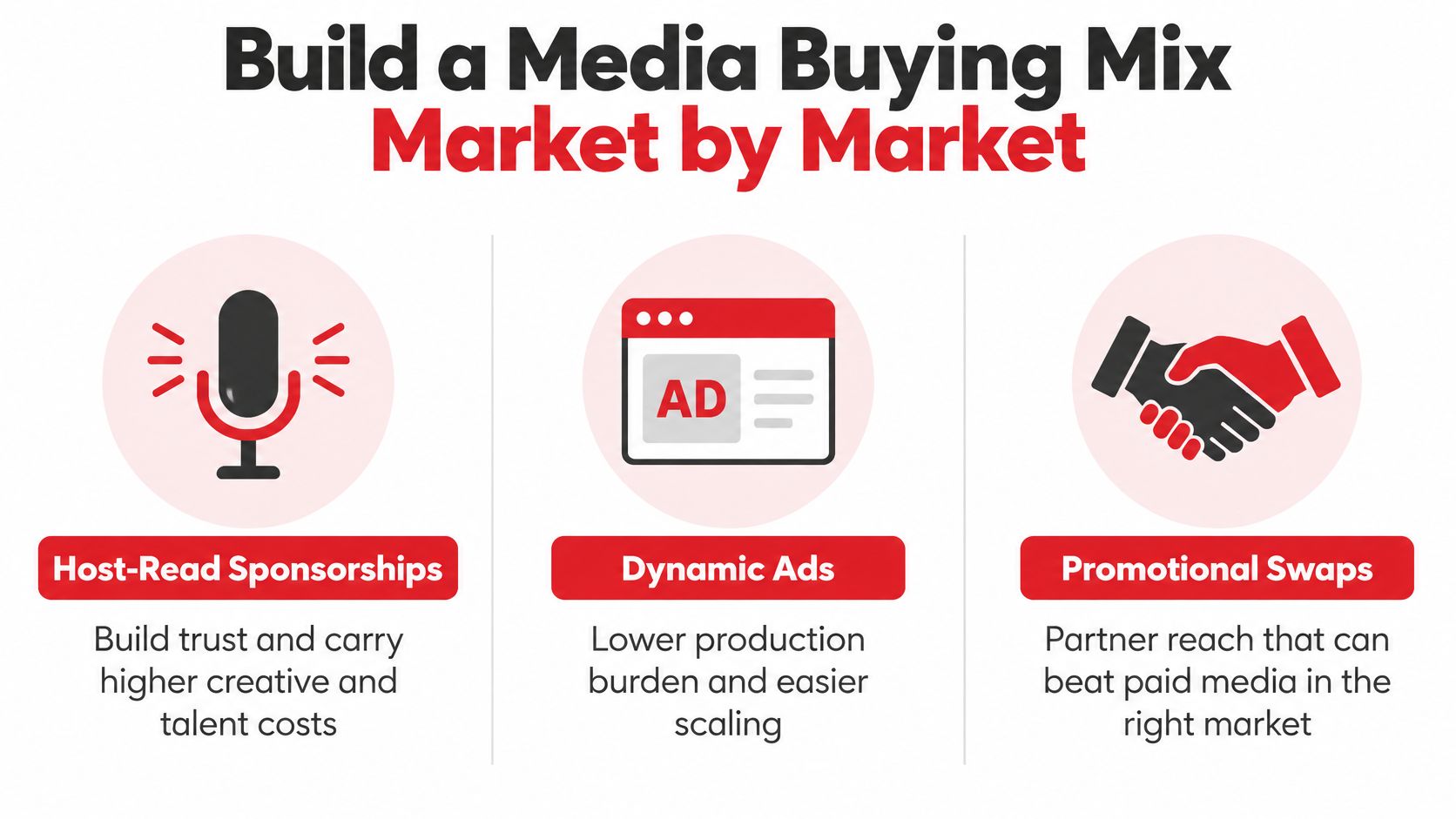
Format | Best for | Cost trade-off | Measurement caveat |
|---|---|---|---|
Host-read sponsorship | Building trust in a launch market | Higher creative and talent cost, often flat fee or CPM | Hard to attribute without codes or surveys |
Dynamically inserted ads | Scaling reach across many shows | CPM with flexible targeting | Ad delivery and confirmed playback can differ |
Programmatic audio | Frequency and audience segments | Auction CPM that varies by market | Inventory quality varies by country and vendor |
Sponsored show integration | Long-term category ownership | Retainer or per-season fee | Results build slowly and are harder to isolate |
Paid social and YouTube clips | Discovery beyond audio | CPM or CPC by platform | Same listener may see several formats |
A launch sequence that respects the trade-offs
Start with host-reads in the first test market. They're expensive and clumsy to measure, but they teach you the fastest lesson available: whether the offer converts when a trusted voice explains it. If a native host can't make the offer land, a programmatic buy won't rescue it.
Once the offer converts, add dynamic inserts and programmatic audio to scale reach and control frequency. Set frequency caps per market rather than globally, since listening volume differs and a cap that's gentle in one country can be heavy in another.
Treat any starting split, including a 70/30 host-read to programmatic ratio, as a hypothesis with an expiry date. Write down what would prove it wrong, then check at the read-out.
Two complications that distort the read
Paid social and YouTube clips improve discovery and make attribution harder, because the same listener may meet the show in audio, on video, and in a feed within the same week. Isolate formats by market, or accept that the podcast line will carry some credit that belongs to social.
Budget tranches solve the rest. Fund the two test markets first, hold the holdout market at baseline spend, and release the next tranche only when the read-out clears the pipeline or acquisition threshold you set in advance. Approval by calendar is how international programs double in cost without a corresponding result.
Launch Your First Two-Market Test
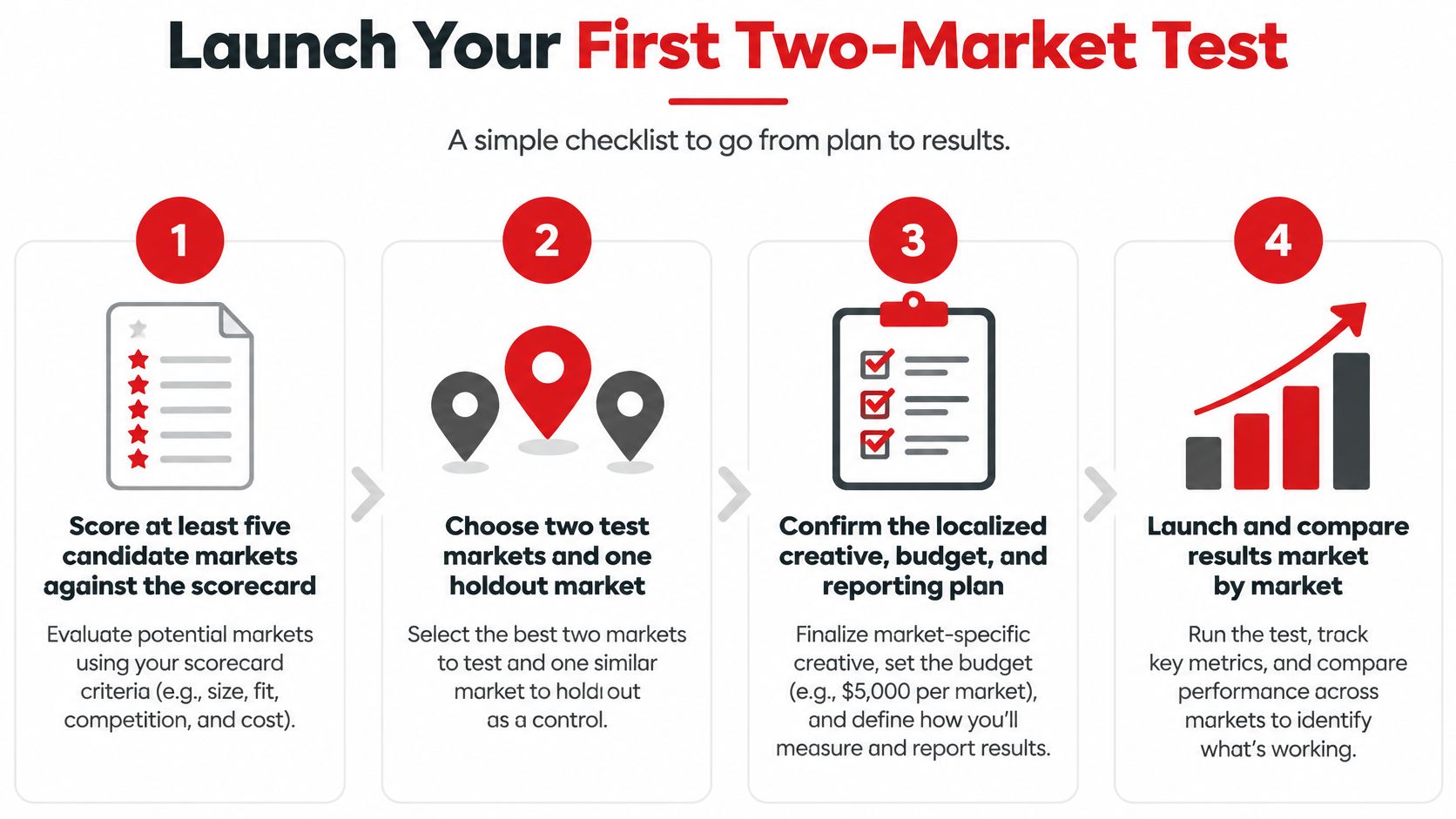
Score at least five candidate markets against the scorecard, then pick two test markets and one holdout.
Confirm the localized script, host choice, offer terms, and landing path for each test market before booking anything.
Set up tracking: market-specific codes, delivery and confirmed-play reporting, and a CRM field for market.
Book a host-read in the first market and a dynamic or programmatic campaign in the second. Keep the holdout at baseline spend.
Agree the attribution window and read-out date before launch. Sixty to ninety days fits most first tests.
Review brand lift, qualified pipeline, and conversion quality by market, then decide to scale, adjust, or stop.
If the team lacks local production, network access, or measurement tooling, those gaps close with a specialist partner or in-house hires before step one. Podmuse's agency services cover localization, extensive reporting, and media buying alongside production, so a single engagement can hold the creative and the measurement in the same place.
The decision after the read-out is the only one that matters: which market gets the next tranche, and which markets pause until the localization or the offer is fixed. Write that decision rule down before the data arrives, while nobody is emotionally attached to a result.
Podmuse plans and buys podcast advertising across host-read, sponsorship, and programmatic inventory, and produces the localized audio and video that makes a market entry sound native rather than translated. If you're weighing which two markets to test first, our AI-powered media plan returns a full shortlist of relevant podcasts and YouTube channels within 24 hours. Visit Podmuse to start with a market shortlist instead of a translated copy of your U.S. buy.

Comments