
SaaS Podcast Production: A Step-by-Step Playbook

The microphones arrived before the plan did. A marketing lead got budget for a podcast, the team booked a studio for a day, and eight episodes went live to a few hundred downloads each, a third of them from the company's own Slack channel. The guests were credible. The audio was clean. Nothing about it moved a deal.
That's the usual shape of a stalled B2B show, and the cause is almost never the gear. The format got chosen before anyone wrote down the question the show answers, and guests got booked before anyone wrote down the accounts the show needs to reach. SaaS podcast production is an editorial discipline first and a technical one second, which is why the sequence below starts with a sentence you write on a single page and ends with a dashboard you review every quarter.
Work through it in order. Each step assumes the previous one is settled, and the expensive mistakes happen when a team skips ahead to the enjoyable parts: buying cameras, naming the show, designing cover art.
Table of Contents
Pick a Show Format Your Buyers Will Finish
Before anyone opens a hosting account, write three lines on one page.
The buyer question, in the buyer's words. One sentence, phrased the way a customer would say it out loud. "How do we justify a security budget when the board treats it as overhead" is a question. "Security leadership" is a topic.
Three job titles who feel that question every week, named precisely enough to search on LinkedIn.
The one business outcome an episode should move. A demo request, a shortlist inclusion, a renewal conversation, a callback from a senior engineer you failed to hire last year.
Those three lines pick the format. Teams that choose the format first end up with a generic interview show that only their own employees finish, then blame the audience.
Here's how the four formats SaaS teams choose between compare.
Format | Best for | Typical episode length | Production effort |
|---|---|---|---|
Customer interview | Proof, case studies and ROI stories | 25-40 minutes | Medium. Scheduling plus a pre-call |
Solo founder or expert | Point of view and thought leadership | 15-25 minutes | Low. One speaker, fast turnaround |
Product or technical deep dive | Engineers and technical buyers | 30-50 minutes | Medium-high. Screen shares and diagrams |
Video-first with clips | Discovery on YouTube and social | 20-35 minutes | High. Multi-camera, captions, vertical cuts |
The column worth staring at is production effort, because it's a scheduling problem more than a gear problem. Customer interviews need a pre-call and a calendar that survives two reschedules. Solo shows need one prepared speaker and a fast edit. Deep dives need someone who can build diagrams and share a screen without leaking a roadmap. Video-first shows need two cameras, captions and vertical cuts from episode one, and retrofitting video in season two costs more than planning it in.
The decision rule: match the format to the buyer question and to the person who can hold a recurring slot. If nobody can protect that slot for six months, run a limited series instead of a show.
The multi-format case is now the default rather than a bonus. Edison Research's 2025 Infinite Dial study found that 70% of Americans aged 12 and older, roughly 202 million people, had listened to a podcast, while 51% had watched one. 48% had done both, 55% consumed a podcast monthly, and YouTube was the service used most often for podcasts among 33% of U.S. weekly podcast listeners. One recorded conversation can feed an audio feed, a video channel, short clips and a sales follow-up, but only if the format was designed to be filmed.
Settle one more structural question early, whether the show runs as a narrative season or as standalone episodes, because it changes your guest list and your editing load. The trade-offs between serial and episodic podcast structures deserve an hour of argument before episode one.
Then read the show promise aloud to someone outside marketing. If they can't repeat it back after hearing one episode, change the format before you record the second.
Book Guests Who Move Pipeline, Not Just Downloads
Start with the buyer list, not the guest list. Take the three job titles from your one-page plan and the two problems your product solves, then screen every candidate against role, company stage, and the specific problem they discuss in public. A guest who clears all three gives a prospect a reason to keep listening past the intro. A guest who clears none gives you reach.
Fit beats fame, and the gap is wider than expected. Say you sell procurement software to mid-market manufacturers. A 30-minute conversation with an operations director who moved her team off spreadsheets and onto a three-way match workflow teaches a prospect more than a well-known author with a general audience ever will. The author earns shares. The operations director earns a follow-up call from someone who recognized their own week.
Where to look, in order: your own customers and advisors, because they say yes and they have proof; founders and operators who speak at the events your buyers attend; and experts who appear on the shows your buyers already hear, since that audience overlap is the cheapest targeting available.
The outreach sequence is three touches, not a campaign.
A personal note with the episode angle. One paragraph, the actual question you want answered, and why you think this person is the one to answer it.
A 15-minute pre-call. Confirm the story, agree the outcome the guest will name on air, and find out what they won't discuss.
A written brief before recording. Five bullets: the promise of the episode, three questions you'll ask, and the asset or link the guest wants mentioned.
Two things break at this stage. Teams chase the biggest name they can reach, then build a thin brief around them. Or they book a strong practitioner and skip the pre-call, so the recording wanders for twenty minutes before anyone says something useful.
Practical rule: before the first invitation goes out, write one sentence naming the buyer problem that guest addresses. If you can't write it, you're booking for prestige.
Booking your own founder onto other people's shows runs on the same research and compounds the same relationships, so keep one shared list of target shows and target guests rather than two.
Record and Edit Episodes Without Losing Quality
Production quality is mostly decided before anyone presses record. The six steps below run in order, each with the reason it matters and the failure it prevents.
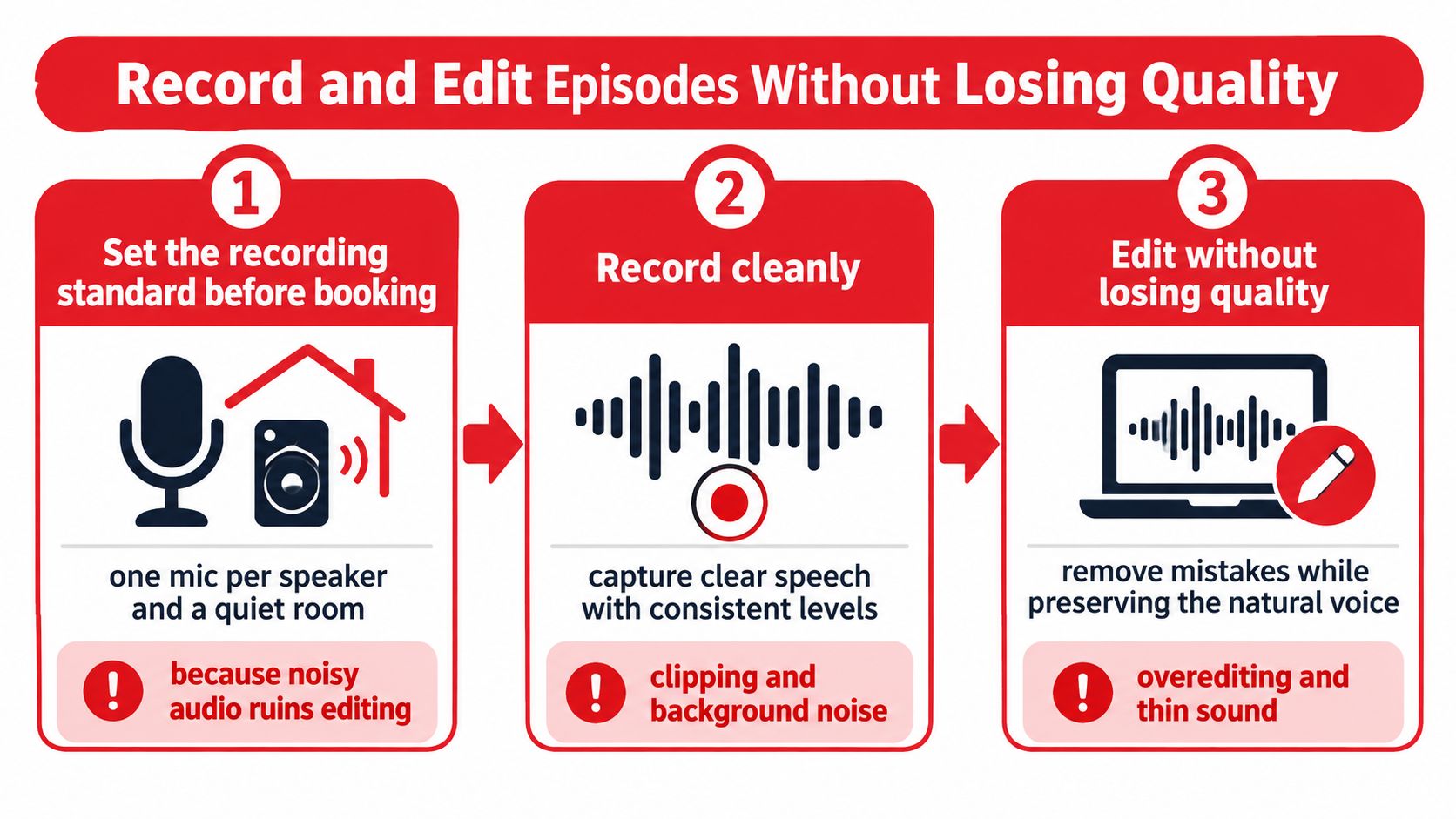
The six-step recording sequence
Set the recording standard before you book the guest. One microphone per speaker and a quiet room with soft surfaces. A hissing vent or a laptop fan under the desk isn't a post-production problem, because noisy audio can't be fully repaired, only masked.
Record remote guests on a tool that captures local tracks. A compressed video call flattens every edit you'll want later. Riverside and similar local-recording tools keep each speaker on a separate file, which is the difference between tightening a tangent and losing the sentence.
Run a 60-second level and room check. Ask the guest to say their name and company, watch the meters for clipping, and listen for echo on their side. Clipping or a hollow room tone is the most common reason an otherwise good episode gets shelved.
For video-first shows, lock two camera angles and a reference frame on episode one. A wide and a tight, matched lighting, the same crop every week. Rebuilding the look mid-season is what makes a channel feel amateur.
Edit to the promise you made in minute one. Cut pauses, false starts and tangents, but don't sand off every "um", because over-editing turns a host into a text-to-speech reader and flattens the trust the show exists to build. If your team would rather edit by deleting text than by scrubbing waveforms, assessing Descript for creator workflows is worth an hour before you commit to an annual plan.
Export one master, then everything else from that session. Clips, captions and the transcript come off the same timeline, so a correction propagates instead of being made three times. This walkthrough of editing a podcast covers the cut order and the mix in more detail.
Expect the better part of a working day in post for a 30-minute conversation. Schedule the calendar around that, not around the recording, or the backlog becomes the reason the show stalls in month four.
Does video earn its budget
Treat video as a distribution choice, not a results guarantee. Research across 38,704 listeners and viewers found no notable difference in brand lift between audio and video, with only modest lower-funnel advantages for video of about 1.1 points in brand rating, 1.5 in consideration and 2 in purchase intent, even though 82% of weekly podcast consumers watch video, according to Cohost's collection of branded podcast statistics. Spend on cameras and multi-camera studios when the job of the episode is discovery or social clips. Skip it when the job is depth.
There's a harder production constraint underneath that decision. Measurement gaps are one of the leading barriers to podcast investment, and 76% of surveyed brands said they would spend more if YouTube-podcast attribution matched audio attribution, per Podnews's summary of the What Brands Want survey. Episode landing pages, UTM conventions and CRM touchpoints belong in the production brief, not the post-season analytics cleanup.
Distribute Episodes to Spotify, Apple and YouTube
One master file, four places to be found. Publish the same episode everywhere, then configure each platform for how its users search and watch.
Platform | Setup to complete | Why it matters |
|---|---|---|
Spotify | Claim the show and submit video episodes if you publish video | Keeps the show under your control and recognisable in search |
Apple Podcasts | Submit the RSS feed with chapters and a transcript | Makes episodes searchable by topic and guest name |
YouTube | Full-length upload with chapters, thumbnail and series playlist | Drives discovery and watch time for video-first audiences |
Social clips | 30-60 second vertical cuts with captions linking to the full episode | Reaches buyers who will not open a podcast app |
Claim the listing on Spotify so the show sits under your control, and submit a video version there if you film. Ownership matters later, when a distributor changes its terms or a duplicate listing appears.
Apple Podcasts runs on your RSS feed, so publish through your host and let the feed do the work. Add chapters and a transcript to every episode. Apple indexes titles, descriptions and transcripts, which is the difference between an episode that surfaces on a topic search and one that never does.
YouTube wants the full conversation, not clips alone. Chapter markers at each major question, a title that names the buyer problem instead of the guest's job, a thumbnail with a face in it, and a playlist per series. If queuing uploads from one screen beats living inside YouTube Studio, managing YouTube with FoPost handles the scheduling without changing how episodes are produced.
Vertical clips are a separate step, not a byproduct. Cut 30 to 60 seconds around a single claim, caption them for sound-off viewing, and post where your buyers scroll.
Two rules keep all of this sane. Use the same episode title and description on every platform, so search results match whatever a buyer finds first. And keep one publishing calendar with a fixed release day, batch recording two or three episodes at a time so a guest cancellation never empties the feed.
After launch, check that each episode appears in every feed and that every clip links back to the full version. A dead link on a promoted clip wastes the only expensive part of the campaign.
Promote Episodes With Swaps, Ads and Paid Social
Promotion is where SaaS often stops. The episode ships, someone posts it once on LinkedIn, and the audience curve stays flat. Promotion needs the same planning as the recording.

Podcast advertising is big enough to plan around. The Interactive Advertising Bureau recorded U.S. podcast advertising revenue of $2.43 billion in 2024, up 26.4% from 2023, when it reached approximately $1.9 billion after 5% growth, per the IAB's digital ad revenue report. Podcasting still represented only 0.9% of total U.S. digital ad revenue, which means the buying infrastructure exists while the inventory stays relatively cheap for a narrow, well-chosen audience.
Tactic | Best for | Typical lead time | Main risk |
|---|---|---|---|
Promo swap | Cross-promotion with peer shows buyers already hear | Days to a few weeks | Audience mismatch if shows are not matched |
Host-read ad | Trusted reach inside a relevant show | Several weeks to book | Hard to track without unique links |
Programmatic ad | Targeting specific job titles or account lists | Days to weeks | Broad reach with weak buyer fit |
Paid social clip | Short video clips aimed at target roles | Days | Creative fatigue and unclear attribution |
One testing order that works
Start with promo swaps across two or three shows your buyers already hear, matched on audience and episode length. A swap is cheap, trusted, and the only tactic here that costs nothing but calendar time.
Then test a host-read ad on one relevant show for a full quarter. One quarter, one show, one unique link per episode, so you can see which listeners reach the landing page rather than which ones merely heard the mid-roll.
Use programmatic buys only against a narrow list of accounts or job titles. Broad programmatic reach buys you impressions among people who will never book a demo, and the cheap CPM hides it.
Finally, boost two or three clips a week on paid social, and change the first three seconds rather than the whole ad. The hook is what's failing when a clip underperforms.
If you'd rather watch the workflow than read it, this session runs through the promotion sequence.
Before you spend anything, set up one landing page per episode and one tracked link per tactic. That single rule makes each method comparable on the same evidence instead of on a platform's own dashboard.
Measure Retention and Pipeline Impact Each Quarter
Downloads are the easiest number to report and the least useful one for decisions. Judge episodes on attention first, then on pipeline influence among named accounts.
Metric | Benchmark | What a weak result means |
|---|---|---|
Average audio consumption | 50-70%; above 70% is strong | Title or opening promise not delivered |
Completion for episodes over 45 minutes | At least 60% | Length or topic drift in the back half |
Completion overall | Below 40% is a mismatch | Title, opening and content do not match |
30-second introductory hold | Median of the prior five episodes | Early drop before the episode promise |
Returning-listener share | Compare with your own prior quarter | Weak series loyalty or no clear next episode |
Pipeline influence in target accounts | Count of target accounts with a tagged touch | Missing UTMs, landing pages or CRM touchpoints |
Those attention benchmarks come from Content Allies' podcast retention guidance, which recommends establishing a baseline from the median of the previous five comparable episodes before you judge a new one. 50-70% average audio consumption is the normal band, above 70% is strong, and episodes longer than 45 minutes should generally clear 60% completion. A rate below 40% usually means the title or the opening promised something the episode didn't deliver.
Scale is the trap. 2,000 downloads at 62% completion can represent more valuable attention than 4,000 at 28%, because the second number is mostly people who left and never came back.
Read a weak number before you change anything
Open the retention curve and find where people leave. An early drop points at an intro that doesn't deliver the episode's promise. A late decline points at topic drift and length. Then change one thing: a cold open in place of a branded preamble, tighter pauses, or an interview structured around one promised business outcome. Hold that change across at least four episodes, because a single episode is noise.
Do the same for pipeline, and report it quarterly. Count how many target accounts had a tagged touch, how many returned for a second episode, and which episodes preceded an assisted conversion. Publishing broadly for reach is fine, but the tagged distribution is what makes influence observable. The mechanics of tying episodes to revenue, including B2B podcast attribution across platforms, are worth reading before your first quarterly review.
Then act on the review. Keep what held attention, cut what lost it, and retire any format experiment that hasn't earned a fourth episode.
Decide Whether to Outsource Your SaaS Podcast
Keeping production in-house is the normal path, not a failure of ambition. In 2024, 72.13% of more than 100 surveyed businesses reported handling all podcast production internally, according to Databox's B2B Podcast Marketing survey.
So the question isn't whether in-house is legitimate. It's whether it's holding.
Where I'd draw the line: outsource the production chain, never the editorial judgement. The buyer question, the guest relationships and the final approval of each episode's promise stay with the host.
Keep production in-house while one person can own the buyer list, guest booking and a fixed weekly block for recording and editing, and episodes still ship on the release day. Move work out when the backlog, the audio and video standard, or multi-platform distribution is what's stopping the publish. A full-service partner covers concept development, recording, editing, publishing and distribution, which is the scope Podmuse works to, so the host's job stays hosting and content.
Hand an agency the concept support, the recording, the edit, the publishing and the distribution. Never hand over the buyer question or the definition of a qualified lead, because those decide whether the show is worth producing at all.
If you're on the selling side of this decision rather than the buying side, client acquisition for podcast production companies covers how studios fill their own pipeline.
Then take one step inside two weeks. Write the buyer question on that single page, pick one format from the comparison above, name the attention metric you'll judge the first three episodes against, and assign four owners by name: booking, recording, editing, publishing. If a name is missing, that's the part you outsource.
Podmuse designs, produces and manages audio and video podcasts end to end, covering concept, guest booking, recording, editing, publishing and distribution, so your team keeps the hosting and the point of view. If you want the format tested properly before you hire a producer, we can typically launch within a month of scope sign-off, including planning, setup, recording and distribution. Bring your buyer question, your three job titles and the format you're leaning toward to a free consultation at Podmuse.

Comments