
New York Podcast Agencies: 7 Partners Worth a Look

A budget line for podcasting is easy to approve and hard to spend well. One team wants a branded show, another wants sponsorships that convert, a founder wants interview slots on other people's shows, and all three get the same vague pitch from the same five agencies. New York sharpens that problem and solves part of it. The country's densest cluster of networks, studios, ad sellers, and producers sits within a few subway stops, and the five largest New York podcast networks generated more than 1.3 billion downloads during 2016, against an annual average of 199 million from 2013 through 2015, per the Mayor's Office of Media and Entertainment podcast report. Density also means every conversation starts with a pitch instead of a diagnosis.
What follows maps seven New York partners by function: who buys ads, who plans and produces a full show, who records it, who books guests, and who builds the sound. Assemble the stack that matches your stage, then use the planning and promotion playbook at the end.
Table of Contents
1. Podmuse
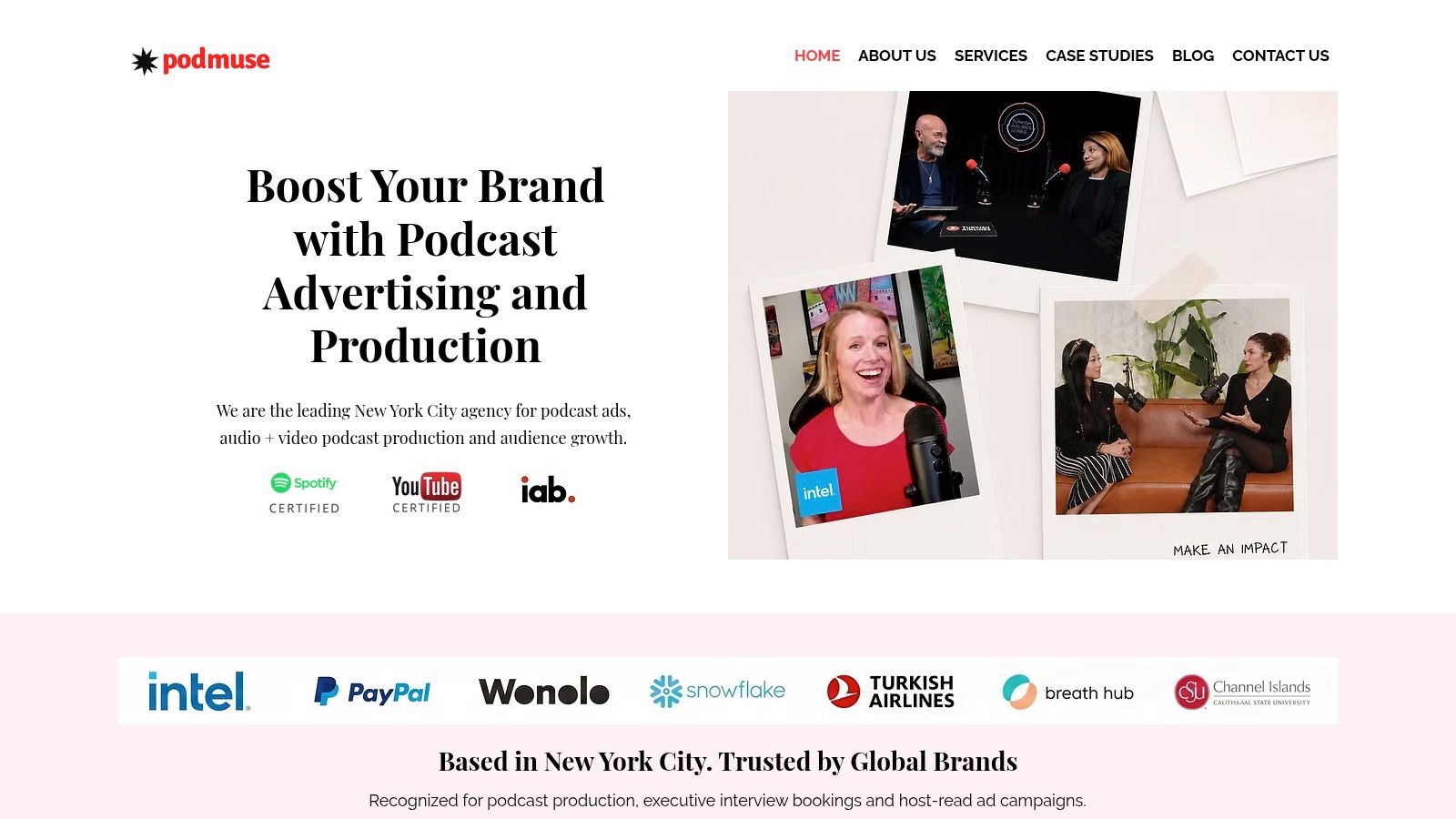
Most agencies sell one slice of the work: a studio, a media buy, or a producer. Podmuse, working out of Chelsea, sells the whole chain. That's the reason to shortlist it for a brand that wants production and distribution handled together, and the reason to pin down scope before anything gets signed.
One vendor for media, production, and guest bookings
Podmuse runs podcast advertising and branded show production as a single engagement. Campaigns can combine host-read ads, sponsorships, programmatic placements, and in-app promotions across 40+ ad networks and publishers. For brands building their own show, the team covers concept and content strategy through audio or video production, post-production, distribution, and cross-platform promotion on Spotify, Apple Podcasts, YouTube, and social. It also books podcast interview placements for founders and executives, which is the piece production shops usually leave out.
That combination is what the New York City podcast agency service is built around: one plan covering the show and the media that carries it, instead of three vendors trading blame when numbers stall.
Proof, and a low-risk way in
Case studies feature Intel, PayPal, and Turkish Airlines, which signals the team is used to brand-level approval chains rather than scrappy indie launches.
The low-risk entry point is the free consultation. Use it to test fit. Ask which shows they'd book your founder on and which networks they'd buy against, then check those picks against the audience you've already defined. If the answers are generic, the rest of the pitch won't fix it.
Strengths: advertising, branded audio and video, promotion, distribution, and guest booking under one roof, with enough network access to target rather than spray.
Watch for: pricing isn't published, so ask for a scope split across production, media, and promotion before you compare bids.
Best for: teams that want a show and the media plan around it built by the same people.
Practical rule: when one vendor handles both production and buying, insist on separate line items. Otherwise you can't tell whether the show is working or the media buy is.
Full service details sit at Podmuse.
2. The Podglomerate
Launching a show is the easy half. The hard half is the twelve months after episode one, when downloads flatten and the internal sponsor asks what the show is for. The Podglomerate is structured around that second half as much as the first, pairing branded-show production with marketing, publicity, cross-promotion, and monetization support.
Discovery is where most shows stall, and the mechanics are less mysterious than they look. In a national Edison Research survey commissioned by WNYC Studios, 29% of podcast listeners said friends or family were their first source of podcast discovery, while 21% cited social media (WNYC Studios and Edison Research). Neither is a paid channel. Both reward a show designed to be passed along.
The same survey hinted at why retention beats reach: 70% of WNYC Studios listeners had ever subscribed to a podcast, against 59% of the overall podcast audience. Recurring listeners are the ones who hear the second and third brand message.
Branded production: strategy, format, and launch handled from concept through release.
Marketing and publicity: launch campaigns, press work, and promo swaps with other shows.
Revenue guidance: sponsorship and monetization support once the audience is real.
Pros: production and growth live in one contract, and the service mix suits brands, media organizations, and institutions alike.
Cons: pricing comes by quote only, and a full-service engagement is more than you need if you just want hourly studio time or an editor.
Start at The Podglomerate's website.
3. Hangar Studios
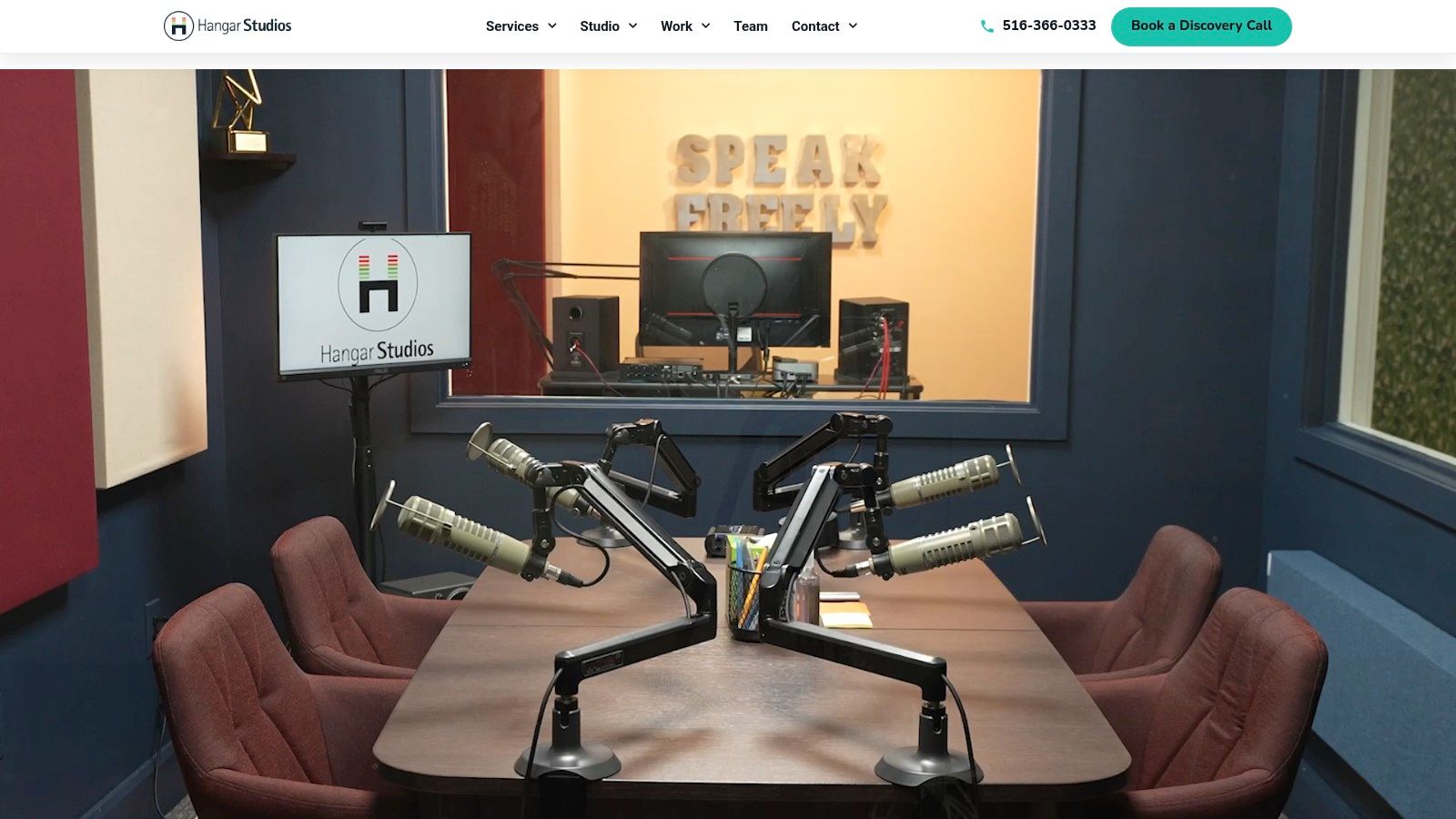
Recording day is where shows fail. An uncoached host rambles, a guest cancels an hour out, the room sounds like a tiled bathroom, and the editor inherits 90 minutes that can't be rescued. Hangar Studios, with a Midtown Manhattan room plus remote workflows, is built to prevent that failure rather than just capture it. The company says it has served more than 600 clients since 2009.
Concept work, not just capture
The service line runs wider than studio time: concept development, show strategy, host coaching, in-studio or remote recording, editing and sound design, publishing and distribution, plus social clips cut for the platforms where listeners find shows.
If you're comparing rooms on price alone, read the guide to New York podcast studios first. Microphone count tells you almost nothing about whether a session will sound professional.
Audio and video: both formats, so one taping feeds the feed and the social calendar.
Host coaching: the cheapest fix for episodes that drag, and the step many producers skip.
Delivery: editing, publishing, distribution, and short clips handled after the session.
Pros: you can start with a single recording and add production later, and the team works remotely when travel doesn't make sense.
Cons: most services are custom scoped rather than listed on a public rate card, and recording and post-production may be billed separately. Check quotes for what's included.
See current work at Hangar Studios.
4. DCP Entertainment
A podcast that lives only inside podcast apps is a podcast with a ceiling. DCP Entertainment treats audio as source material for social, marketing, and sales, which fits brands whose podcast budget has to justify itself against a wider content calendar. The New York media agency handles podcast and social-content production, distribution, marketing, and sales.
The scope is broader than most podcast shops:
Pre-production: concept development, research, writing, and talent booking.
Production: recording and editing, run through dedicated project management.
Post-launch: distribution, marketing, audience development, and sales support.
It also operates Podstream Studios in Times Square, and publishes hourly studio rates, which is rarer than it should be in this market. That matters when your guests are already in Midtown and you need a tape date, not a six-week production cycle.
Pros: social and sales activity connect to the audio instead of running parallel to it, and the published hourly rate lets you budget before the first call.
Cons: the wider media and commerce offering can be more than a podcast-only engagement needs, and agency production or marketing is quoted separately. Studio rental alone doesn't produce a finished show.
Rates and services are at DCP Entertainment.
5. Sonic Union
Two shows can cover the same topic and sound nothing alike in the first ten seconds. Sonic Union competes on that difference. It's a New York-headquartered audio production company whose sound design, music composition, and sonic identity work is the reason to hire it, not its booking calendar. Brands that want a story-led, produced sound rather than two microphones and a laptop are the fit.
The offer covers creative development and production, production logistics and distribution support, and branded or original podcast work. Its portfolio includes projects associated with Expedia and Saveur, and the team says it has received Ambies and Webby podcast nominations.
When to call them: if your show's differentiator is how it sounds, not how fast it ships.
Pros: audio craft gives a brand a consistent sonic signature across a series, ads, and social cutdowns, which is hard to retrofit later.
Cons: the public material leans toward creative production rather than podcast media buying, pricing isn't listed, and the scope can be heavy for a simple interview format.
Listen to the reel at Sonic Union.
6. Borough House Creative
Video stopped being optional. Nationally, 73% of Americans age 12 and older consumed podcasts in audio or video form in 2025, and 51% had watched a podcast, according to Edison Research's Infinite Dial 2025. Among Gen Z podcast listeners, YouTube search was the most common discovery route at 28%. A studio that can't shoot is now a partial solution.
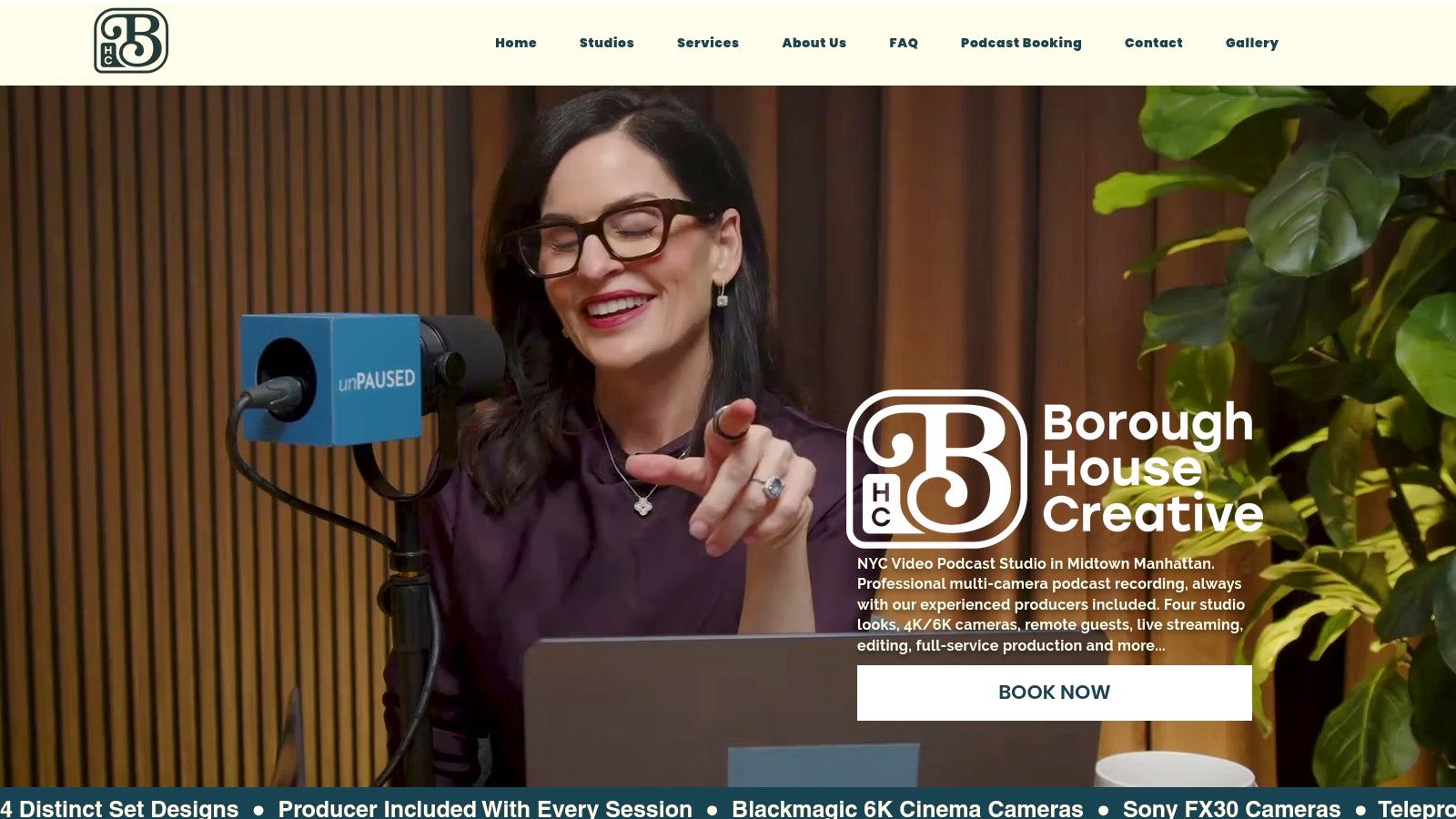
Borough House Creative runs a Midtown Manhattan room built for multi-camera video podcast recording, with audio, lighting, and an engineer included in the session. Remote guests are supported, 4K or 6K capture is available, and editing, social clips, publishing, and distribution can be added to the booking.
The flexibility is the selling point. Book recording only if you have post handled in-house. Add production if you don't. Teams weighing a Brooklyn studio against a Manhattan one will find the trade-offs mapped in this guide to choosing a podcast agency in Brooklyn.
Pros: clearer studio pricing than most full-service agencies, a location that's easy for guests passing through Manhattan, and a menu you can buy à la carte.
Cons: it's a production studio, not a podcast ad-buying agency, and full production plus extra deliverables will push the total well past the recording rate.
Book a session at Borough House Creative.
7. Pod-Frog
If the plan is to rent an audience rather than build one, the buying side matters more than the creative side. U.S. podcast advertising revenue reached about $167 million in 2016, a 48% rise over 2015, according to the New York City podcast industry report. That same report cited a 2017 national survey of 2,545 adults who had listened to a podcast in the previous month, in which 55% said they paid attention to podcast advertising either always or sometimes.
Pod-Frog is a New York advertising broker that connects brands with podcast talent and publishers, so the work starts with inventory rather than with a show concept:
Host-read placements: pre-roll, mid-roll, and post-roll spots in the host's own voice.
Dynamic insertion: including geographic targeting, useful for regional offers.
Sponsored content: integrated brand segments rather than a pre-recorded spot.
Reporting: campaign planning, tracking, and results analysis after the flight.
Pros: focused entirely on sponsorship, with multiple formats and a quote request you can submit without a production commitment.
Cons: it's a broker and network, not an end-to-end production partner. Pricing is customized, and specific dates, reach, downloads, or performance aren't guaranteed unless they're written into the agreement.
Request terms at Pod-Frog.
New York Podcast Partners at a Glance
Partner | Primary Focus | Location | Best For |
|---|---|---|---|
Podmuse | Podcast advertising, production, promotion, and guest booking | Chelsea, New York City | Brands seeking integrated podcast marketing and production |
The Podglomerate | Branded podcast production, audience growth, and monetization | New York City | Brands seeking show development and post-launch growth |
Hangar Studios | Audio and video podcast production | Midtown Manhattan; remote options | Teams wanting end-to-end production or studio and remote recording |
DCP Entertainment | Podcast and social-content production, marketing, and sales | New York City; Times Square studio | Organizations connecting podcasts with social content and sales |
Sonic Union | Podcast development, production, and sound design | New York City | Brands seeking distinctive, story-led audio |
Borough House Creative | Multi-camera podcast recording and production | Midtown Manhattan | Teams seeking studio recording with optional production services |
Pod-Frog | Podcast advertising campaigns and placements | New York-based | Brands looking to sponsor podcasts rather than produce a show |
Build Your Podcast Stack and Take the Next Step
Start with the job the podcast must do, then match the partner type to that job. A brand that needs a show, a sponsor test, and guest placements is buying three different kinds of work, even if one agency can supply all three.
Own the show. Choose full-service production, or pair a studio-first partner with in-house marketing if your content team can run positioning and promotion. A recording-only studio leaves launch strategy, clips, and distribution on your desk.
Rent attention. Use an ad broker or the media arm of a full-service agency. Judge targeting logic, audience fit, and reporting cadence rather than network count.
Borrow trust. Buy booking support for this goal; keep production separate unless you also need a show. The deliverable is appearances on podcasts your buyers already follow, which is a different skill from making your own audio.
Vet every shortlisted partner on three questions. What exactly is in scope, in writing: recording hours, editing rounds, video capture, clips, distribution? Who owns promotion after launch, and on which platforms? How will success be measured, branded search, qualified leads, or direct response, and by when?
Demand has already shown up. Edison Research found that 55% of Americans age 12 and older had consumed a podcast in the last month in 2025, and 88% of weekly podcast consumers view advertising as a fair exchange for free content (The Podcast Consumer 2025). The harder problem is reaching the right slice of that audience and proving what it did. Podmuse runs that combination from Chelsea, meeting teams in person across New York City or working remotely.
This week, write one sentence on the show's role in the funnel, request consultations from two or three shortlisted partners, and compare proposals on audience match, scope, and measurement.
Podmuse plans and buys podcast advertising across host-read, sponsorship, and programmatic inventory through 40+ podcast networks, and produces audio and video shows from concept to distribution on Spotify, Apple Podcasts, YouTube, and social. If the decision is between building a show, testing sponsorships, or pushing guest placements, a free consultation can recommend the right mix of production, marketing, and ad placements. Start at Podmuse.
Comments