
Restaurant Podcast Production: Step-by-Step Guide 2026

You've got a microphone on loan, a back room that goes quiet after 3 p.m., and three recorded episodes that nobody outside the company has heard. The audio is fine. The guests are good. What's missing is a reason for the show to exist beyond the fact that every other hospitality brand seems to have one.
That gap is fixable, and it's fixable before you record another session. What follows is the sequence I'd run: name the outcome first, decide per episode whether the cameras come out, record clean audio, publish where people search, promote with owned channels before paid ones, and measure against one action per episode.
Table of Contents
Choose Your Goal, Audience and Episode Format - Judge Video per Episode, Not per Show - Brief the First Three Episodes Before You Book Anything
Studio and Remote Recording Setup Checklist - Settle the Room and the Hour First - Give Every Speaker Their Own Microphone - Brief Remote Guests a Week Ahead, Not Five Minutes Before
Publishing and Discovery on Spotify, Apple and YouTube - Ship One Master to Two Audio Platforms - Build a YouTube Version That Earns Search - Cut Clips With One Takeaway Each
Decide Whether to Hire a Production Partner - What to Bring to the First Call
Choose Your Goal, Audience and Episode Format
Before you buy anything, answer one question in one sentence. What business outcome must this show move? Catering inquiries, supplier leads, franchise interest, investor attention, or staff recruitment. Pick one. A show built to generate catering inquiries books different guests, runs at a different length, and closes with a different call to action than a show built to attract franchisees.
Then pick one audience segment. Operators, franchisees, diners, vendors, or investors. The category is crowded enough that a narrow show gets found faster than a general one. Restaurant Business reported in 2025 that the number of B2B restaurant podcasts had expanded to at least the "high dozens," with new shows appearing regularly after the pandemic (Restaurant Business). In a field that size, "a podcast about food" disappears, while "a show for operators opening their second and third location" gets forwarded to a colleague.
The brief, the format and the capture tier get settled in the same conversation, usually at a table like this one.
Judge Video per Episode, Not per Show
The default advice is to film everything, which is how restaurants end up with a season of unused footage and a host who dreads recording day. The audience doesn't support that math. Triton Digital's 2025 U.S. report found that 80% of monthly podcast consumers both listen and watch, 13% consume audio only, and 7% consume video only (Triton Digital U.S. podcast report). Both formats reach the same person on different days, so the central question isn't audio or video. It's which episodes earn cameras.
Format | Best for | Capture tier | Visual priority |
|---|---|---|---|
Operator interview | Owners, general managers, franchise economics | Efficient remote or studio capture | Low, audio-first |
Chef technique or menu demo | Menu launches, kitchen skills | Premium multi-camera | High, with short clips |
Supplier or kitchen visit | Sourcing and process stories | On-location, two cameras | High |
Founder or leadership talk | Investors, hiring, thought leadership | Studio or remote, simple video | Medium |
Vendor or technology showcase | Operators comparing tools | Remote, audio-first | Low, audio-only if visuals add little |
Tiers follow the content, not the budget. Chef technique, menu launches, kitchen tours and supplier visits reward multiple angles and produce the short clips that travel on social. Operator interviews, franchise economics and leadership conversations survive on strong audio with a single clean camera, because nobody needs a close-up of a margin discussion.
Practical rule: if you can't name what the camera adds to an episode in one sentence, that episode is audio-first.
Brief the First Three Episodes Before You Book Anything
Write one line per episode covering audience, outcome, format and capture tier. Three lines is enough to test whether the show has legs. Here's a workable one: multi-unit operators, catering inquiry, interview with a catering director, efficient remote capture. If you can't justify the tier column with a reason, that episode is filler and you'll feel it in the edit.
Then set the calendar. Two to four episodes a month on one fixed publishing day beats a burst of six followed by silence. Tie each quarter to the goal: catering inquiries in Q1, franchise economics in Q2, hiring and retention in Q3. Keep one shared row per episode naming audience, outcome, format, capture tier and clip plan, and fill the first quarter before you record a session. Staring at a blank page is the most common way this stalls, and a bank of podcast topic ideas sorted by format fills a quarter faster than brainstorming in a group chat.
Studio and Remote Recording Setup Checklist
The room decides more of your sound than the microphone does. Walk the space at the hour you plan to record before you commit to it, because a dining room that sounds warm and lively at 7 p.m. sounds like a tin can at 10 a.m. with no bodies in it to absorb reflections.
Settle the Room and the Hour First
Choose the quietest room, not the prettiest one. Soft furnishings, rugs, curtains and upholstered booths absorb reflections. Tile, glass and stainless bounce them straight back into the mic.
Record during off-hours and close the doors. A service kitchen is a percussion section.
Kill the constant noise you can control. Unplug or switch off fridges, chest freezers, ice machines, extractor fans and the HVAC zone serving the room.
Capture 30 seconds of room tone with everyone silent. That sample is what an editor uses later to reduce noise without eating consonants, and it costs you half a minute.
Give Every Speaker Their Own Microphone
One dedicated microphone per person, positioned close to the mouth, a fist-width or two away. Headphones are mandatory for remote guests, and speakerphones are banned, because a laptop speaker feeding back into a laptop microphone creates an echo that no denoiser fully removes.
Silence notifications, put phones face down, and keep water within reach so nobody dry-swallows through a sentence.
Brief Remote Guests a Week Ahead, Not Five Minutes Before
Send a checklist covering four things: headphones on, microphone close to the mouth, a soft-furnished room rather than a glass-walled office or a car, and a short test recording they send back. Use a remote platform that records each speaker locally rather than relying on a single stream, and keep a backup recorder running for anything live.
Then run a 60-second test per speaker, listen back on earbuds, and fix problems before the conversation starts. Discovered in the edit, a bad guest track is a reshoot. Discovered in the test, it's a two-minute adjustment.
Scenario | Microphone | Recording setup | Room and checks |
|---|---|---|---|
Solo or two-person in-restaurant recording | One dedicated microphone per speaker, close to the mouth | Portable recorder or audio interface with headphones | Quiet back room off-hours, doors closed, record 30 seconds of room tone |
Remote guest interview | Guest's own microphone, placed close with headphones | Remote platform that records each speaker locally | Soft-furnished room, short test recording a week ahead |
On-location event or kitchen | Lavalier or handheld for each speaker | Portable recorder plus backup recorder | Check HVAC and fans, capture ambience separately |
Studio video episode | Dynamic microphone per speaker | Multi-camera setup with controlled lighting | Treated room, clean audio track kept separately |
If you're still assembling a kit, this walkthrough of a home podcast studio setup covers the interfaces, microphones and treatment that map onto a restaurant back room without overspending.
If fitting out a back room you'll use four times a year feels wasteful, production teams can record in their own studio networks, remotely with hosts and guests in different locations, or on location at your site with a crew and gear. We work that way at Podmuse, and it takes the equipment purchase and the acoustic treatment off your list entirely.
Recording and Post-Production Workflow Steps
A 40-seat dining room at 7 pm gives you room tone, clatter and a guest who keeps drifting off mic. The edit decides whether any of it survives. Restaurant episodes rarely fail at the microphone. They fail in post, because nobody declared the takeaway before recording and every tangent got defended. A repeatable sequence protects the episode and the outcome it was booked to produce.
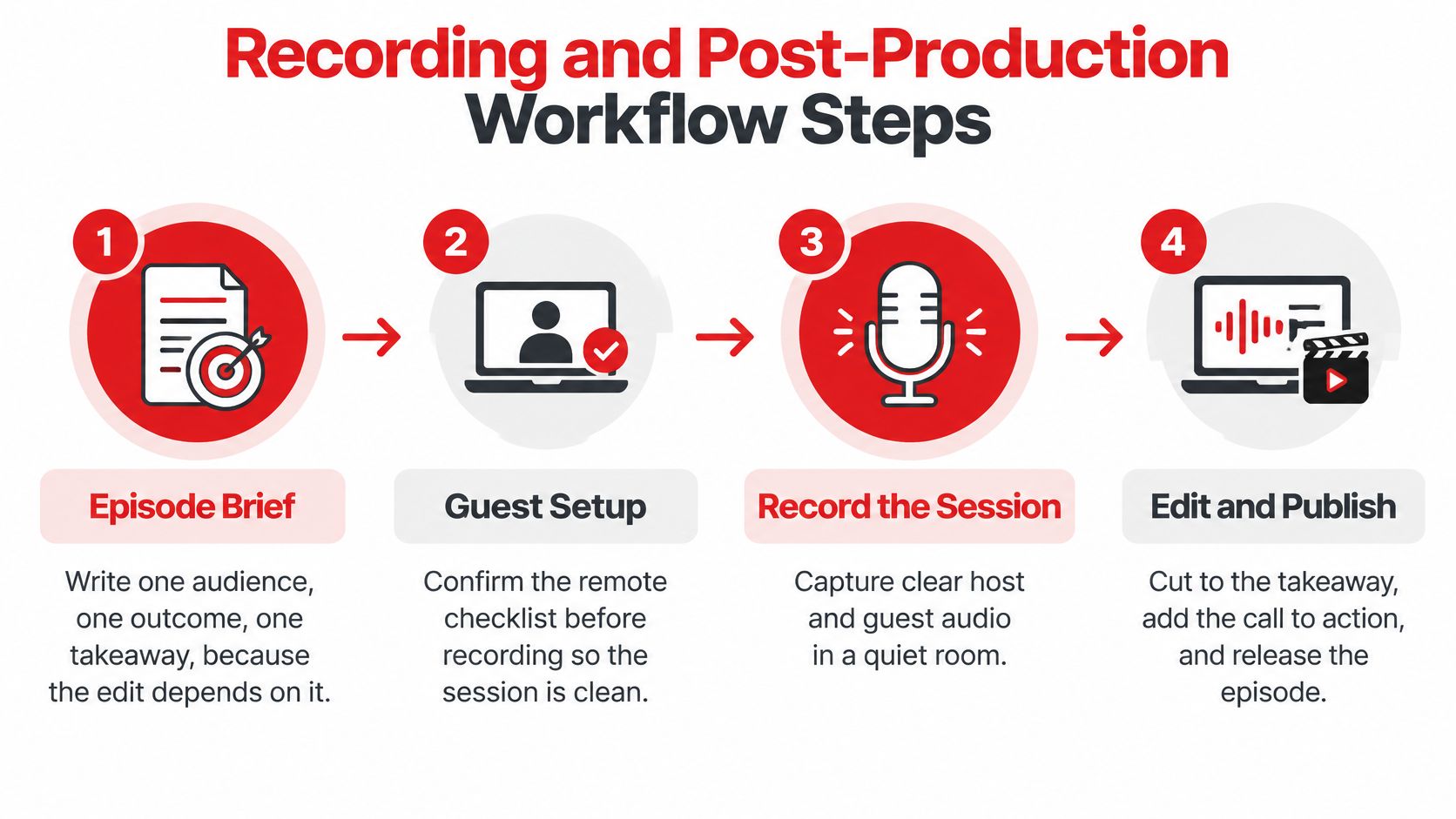
Write the brief before you book the room. One audience, one outcome, one takeaway tied to a measurable result such as a reservation link, a menu page or a supplier inquiry. Without a declared takeaway, every tangent looks equally important and the episode lands at 70 minutes with no spine.
Decide the video tier per episode, not per show. An interview with a chef plating a dish earns cameras. A phone-quality remote guest talking through staffing numbers earns audio only. Committing every episode to video inflates budget and post time on stories that never needed a frame.
Confirm the guest's test recording passed. If it has not, reschedule or shorten the episode. The common slip is trusting a guest who says their laptop mic is "pretty good," then spending the edit trying to rescue a voice that was never captured cleanly.
Record each speaker on a dedicated microphone, then grab 30 seconds of clean room tone. The tone sample is your noise reference for the whole session and the difference between controlled cleanup and guesswork.
Set levels before anyone talks and watch for clipping. Laughter and applause are the usual culprits. Clipped audio cannot be repaired, only re-recorded, so leave headroom rather than chasing a hotter signal.
Edit for intelligibility first. Cut tangents, tighten pauses, keep the story in order. Chase the takeaway, not a runtime target, and let the episode end when the outcome is delivered.
Remove HVAC, traffic and handling noise conservatively. If cleanup is new territory, these noise removal tips from iScribe Live Transcribe lay out an order of operations before any denoiser runs. Aggressive processing thins voices and leaves metallic artifacts that listeners hear instantly on earbuds.
Match loudness across speakers and episodes. Two speakers in one conversation rarely sit at the same level. Listeners should never reach for the volume dial between segments or between episodes.
Export a clean voice master, a mixed version, captions and two or three clips. The clean track serves accessibility, prevents clipping when an episode earns its video tier, and keeps future captions accurate.
One analysis found atmospheric sound in 90% of top-ranked podcasts versus 20% of bottom-ranked ones. That spread is the argument for keeping ambience deliberate rather than absent: kitchen texture and service cues earn their place under narration, and they get cut the moment they compete with a guest's answer.
Three checks close every episode: the brief named one outcome, levels hold steady across speakers, and the ambience sits audible without crowding the voice. If you would rather watch the sequence once before you build it, this walkthrough runs the same order from brief to export.
Publishing and Discovery on Spotify, Apple and YouTube
Publishing is where small mistakes cost the most reach, because the fixes are free and many skip them.
Ship One Master to Two Audio Platforms
Upload the same master to Spotify and Apple through a hosting provider, since both platforms pull from your RSS feed. Spend the effort on the listing instead:
Write titles that name the operator, topic or result. "How a 40-seat room cut ticket times by nine minutes" beats "Episode 12 with Dana" in every search result.
Write show notes with a two-sentence summary, timestamps, a guest bio and links to the menu, supplier or booking page the episode mentions.
Publish the full transcript on your own site. It gives search engines readable text for each episode page and gives guests something to link to.
Build a YouTube Version That Earns Search
Only for episodes that earned a visual tier. Chapter markers should match your show-note timestamps exactly, the thumbnail needs a clear face and two or three words, and the description repeats the title keyword once without stuffing it. Our own production splits interview-style video podcasts from narrated audio content for this reason, since the same story wants a different cut on YouTube than it does inside a podcast app.
Cut Clips With One Takeaway Each
Two or three vertical clips of 30 to 60 seconds, captions burned in, one takeaway per clip, hook inside the first two seconds, and a link back to the full episode. Then hold a fixed publishing day. Listeners learn the rhythm faster than any promotion schedule teaches them.
Promotion Channels and Paid Podcast Ads
Promotion splits into two phases, and the order matters more than the budget. Owned channels first, because they cost time rather than money and reach people who already trust you.
Guest sharing is the strongest free channel, and it only works when the guest has their own audience of operators or diners. Make it effortless: send them a ready-made clip, a caption and a unique tracked link, not a request to "share the episode." Promo swaps with another restaurant show work when the two shows serve different segments, so you're trading access rather than competing for the same listener. Newsletter and staff sharing is the most underrated of the three. Your team talks to customers daily, and a QR code at the host stand pointing to the episode outperforms most paid social tests.
Test before you scale: run paid spend behind the two channels that already produced redemptions organically, not the two that sound most exciting.
Paid placements make sense once a handful of episodes show steady listen-through and you have one clear call to action to point at. Host-read sponsorships carry the presenter's voice and suit trust-led shows, programmatic audio buys let you target geography and listener segments when the offer is location-specific, and paid social clips work best for video episodes with a strong opening ten seconds. A 2021 industry summary found that 69% of podcast listeners learn about new products or services from sponsored episodes, and Nielsen research cited there found podcast advertising generated 4.4 times better brand recall than other formats (Menufy).
Channel | Cost model | Best use | How to measure |
|---|---|---|---|
Guest sharing | Free, time cost | Reaching the guest's operator or diner audience | Unique tracked link per guest |
Promo swaps with other shows | Free, reciprocal | Reaching adjacent segments | Promo code per swap |
Newsletter and staff sharing | Free | Existing customers and team advocates | Link clicks per send |
Host-read sponsorship | Paid, flat fee or CPM-based | Trusted endorsement in a listener's trusted show | Promo code redemptions |
Programmatic audio ads | Paid, CPM-based | Geographic and segment targeting | Matched market comparison |
Paid social clips | Paid per impression or per click | Retargeting viewers of video episodes | Click-through to episode page |
Give every channel its own promo code or tracked link before the first promotion goes live. Without that separation, all six channels report the same number and you learn nothing about where to spend next month.
Measuring Results and Growing Listeners
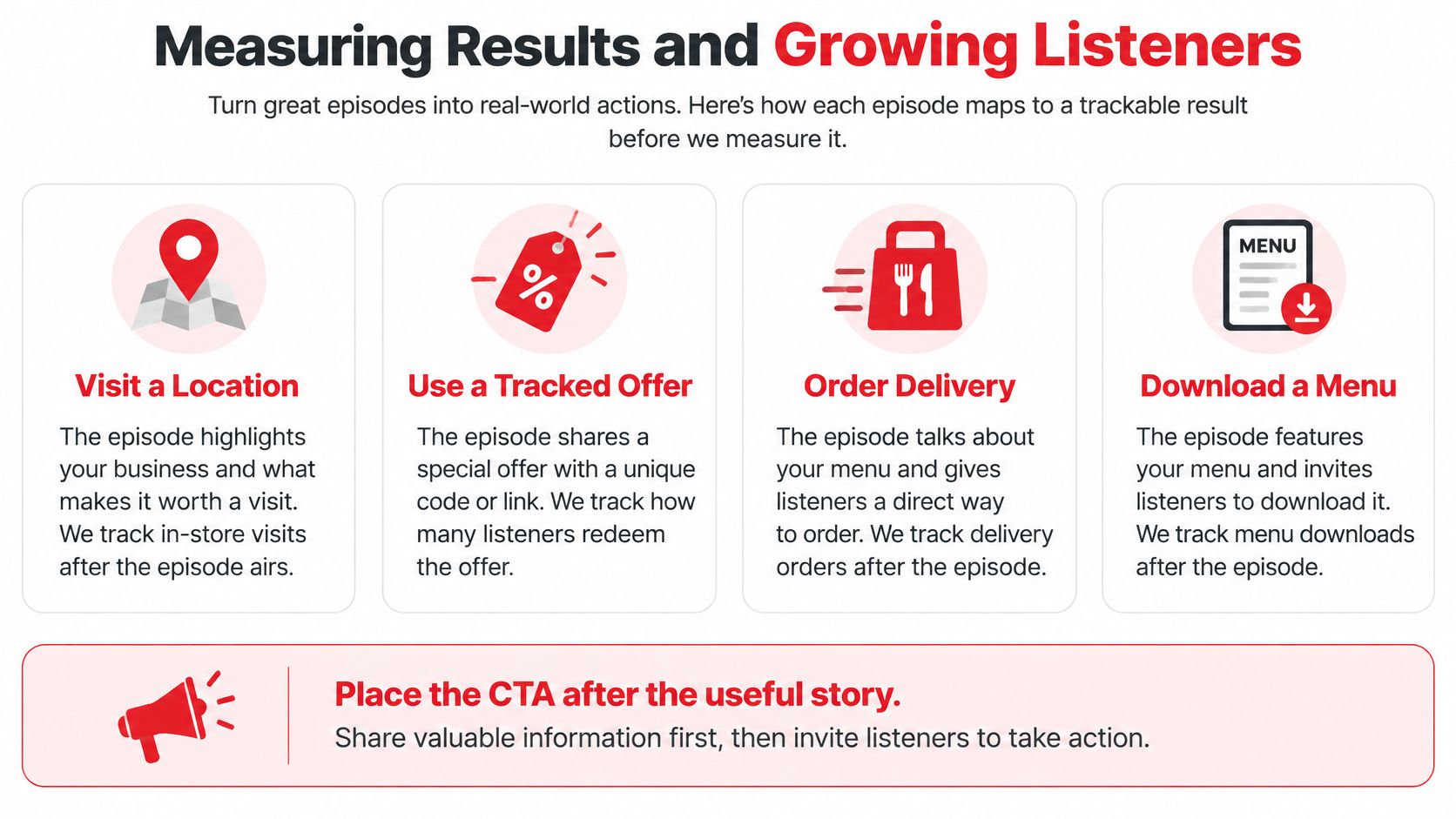
Map each episode to one action before you measure anything: visit a location, use a tracked offer, order delivery, or download a menu. One action, chosen at the brief stage. Then place the call to action after the useful story or the operational insight, because a listener who hasn't been given anything yet has no reason to act.
Quick-service audiences are already close to a purchase decision. Research on U.S. QSR customers indicates most podcast listeners in that segment had recently visited, ordered pickup, or ordered delivery, and a large share of that listening happens in the car on the way to a restaurant. Build around the commute. Episodes timed to a drive, carrying geographically specific offers, do more work than a general brand spot.
Set a baseline before launch, not after episode four. The table below is the working version I'd hand to whoever owns the numbers.
Metric | What it tells you | How to baseline it |
|---|---|---|
Downloads at day 30 per episode | Reach of each episode | Record day-30 downloads for each episode from launch |
Listen-through rate | Whether the story holds attention | Compare with your first five episodes |
Branded search volume | Whether listeners look you up | Track weekly search volume from before launch |
Promo-code redemptions | Direct response per episode | One code per episode and channel |
Location sales against matched control | Revenue effect in exposed markets | Compare exposed markets with comparable markets |
For video episodes, judge the same mapped action rather than view counts alone. A strong listen-through rate means nothing if redemptions and branded search stay flat.
Control markets carry the weight here. A sales lift in one city can come from seasonality, a competitor closing, or a local event, so compare exposed markets against comparable ones rather than against last year. Review the numbers monthly and cut any format that moves downloads without moving the action you mapped to it. If you want a structured way to grow the audience side while the commercial side matures, this guide to podcast audience growth covers the levers that compound.
Decide Whether to Hire a Production Partner
Keep three things in-house no matter who you hire: the brief, guest selection, and the host's voice. Those carry the show's point of view, and outsourcing them produces a technically clean program nobody recognizes as yours.
Everything else is logistics that eat a week you don't have: booking and confirming guests, running sessions, editing, noise cleanup, mixing, publishing, cutting clips, writing show notes, reporting.
What to Bring to the First Call
Write a one-page brief before you talk to anyone. It should cover episodes per month, the formats and capture tiers you've chosen, whether you want studio or remote capture, your deliverables (audio, video, captions, clips), and your turnaround expectation. Then ask three questions:
Is pricing per episode or a monthly retainer, and what does it include? Guest booking, promotion and ad placement swing the total more than the edit does.
Who handles the guest confirmations and the technical checklist? That's the task most likely to land back on your desk.
What reporting arrives, and how often? Name the numbers you'll judge the show on in the brief itself and agree the cadence before you sign.
Run a single pilot episode before committing to a season, then listen to it on earbuds and through a car speaker, which is where most of your audience will hear it. If one of those two playback contexts fails, the mix isn't finished.
The decision rule I'd use: if you can't hold a steady publishing schedule in-house, outsource editing first. Add recording support second. Move strategy out last, if ever.
At Podmuse we design, produce and manage audio or video podcasts for clients who host the show while we handle the rest, which keeps the conversation with you and the production calendar off your desk. Recording can happen in a studio network, remotely, or on location at your restaurant.
Podmuse handles restaurant podcast production end to end, from concept and episode briefs through studio, remote or on-location recording, editing, mixing, publishing and clip distribution, so your host stays on the microphone instead of chasing guest confirmations. If you're planning a show for 2026 and want the format mix, capture tiers and production load scoped before you commit to a season, visit Podmuse for a free consultation.
Comments