
Podcast Advertising Campaign Management Playbook for 2026

Your B2B launch has a date and an approved budget, but nobody has a podcast shortlist. Sales wants qualified demos, leadership wants recognizable shows, and the media team needs to know what it can measure before signing an insertion order.
That's where podcast advertising campaign management starts: turning an interesting channel into a defensible buying decision. Incrementality, audience duplication, and privacy-limited measurement belong in that decision before booking, not in the caveats attached to the final report.
Table of Contents
The Campaign Lifecycle From Brief to Wrap-Up - Podcast campaign workflow by phase - Keep the channel inside the media plan
Setting Goals and Measurable KPIs Before You Book - Match the KPI to the buying objective - Define the denominator and the owner
Splitting Budget Across Shows, Networks and Formats - Four-layer podcast buy portfolio - Buy context and account for uncertainty
Writing Host-Read Creative and Testing What Works - Give the host a usable brief - Make the comparison interpretable
Tracking Delivery and Proving Incremental Results - Establish the outcome and validate delivery - Instrument response and test causality - Measurement methods and what each proves
Fixing Underperforming Flights Mid-Campaign - Mid-flight symptoms, likely causes and first actions - Keep a record leadership can audit
Decide Whether This Quarter Is a Test or a Delay - Choose the operator by capacity
The Campaign Lifecycle From Brief to Wrap-Up
The work stalls when teams treat show selection as the starting point. A recognizable host isn't an objective, and available inventory isn't a strategy. First agree on the business outcome, then give each person a defined decision and a document to hand forward.
Podcast spending deserves the same controls as other paid media. The IAB and PwC revenue report puts U.S. podcast advertising revenue at approximately $2.43 billion in 2024, up 26.4% from 2023.
Podcast campaign workflow by phase
Phase | Key decision | Output to hand off |
|---|---|---|
Brief and objective | Which outcome the campaign must move | One-page brief with a primary KPI |
Audience and show shortlist | Which listeners and show categories fit the offer | Shortlist with audience notes and episode cadence |
Budget and buy route | How spend splits across host-read, programmatic and promotion | Media plan with buy-route split and frequency cap |
Creative and host briefs | What the host says and how the offer is tracked | Approved talking points, disclosure line and unique code |
Launch and delivery checks | Whether ads ran as booked | Delivery log reconciled against the invoice |
Mid-flight optimization | Which show, position or creative to cut or scale | Dated change log with the reason for each change |
Final attribution report | Whether results were incremental | Report comparing results to the original brief |
The handoff is the approval gate. The marketing lead owns the brief, the buyer owns inventory and terms, and the measurement lead confirms that the proposed outcome can be observed. Nobody books while those owners disagree about success.
Build backward from launch. Allow room for host availability, claims review, recording, revisions, and publisher trafficking. Host-read placements require more coordination than uploading an approved recorded spot; network and programmatic buying can offer a faster route, but targeting and reporting still need approval.
Keep the channel inside the media plan
Podcasts sit beside search and social, using the same business objective and stakeholder reporting cadence. Separate channel dashboards are useful; separate definitions of a qualified lead aren't.
At Podmuse, we manage strategy, execution, and optimization across leading ad networks, publishers, and marketplaces. That coordination matters because a publisher's delivery responsibility and the advertiser's measurement responsibility aren't automatically the same thing.
Readiness test: Name the mid-flight decision you expect to make and the metric threshold that will trigger it. If you can't, the brief isn't finished.
Setting Goals and Measurable KPIs Before You Book
A team presents an impressive podcast reach total. Leadership asks what it bought: downloads, people who heard an ad, or viewers who watched a video. Without a metric definition, the team can't answer.
The distinction matters because podcast consumption spans formats. Edison Research's Infinite Dial 2025 estimated that 70% of Americans aged 12 and older had ever listened to a podcast, while 51% had watched one. Those aren't mutually exclusive audiences, and neither measure describes exposure to your campaign.
Match the KPI to the buying objective
Use a ladder that distinguishes commercial intent rather than treating every available metric as equally important.
Awareness: Prioritize estimated unique reach, verified completion signals where available, and exposed-versus-control brand lift. A download alone doesn't establish a completed listen.
Consideration: Track tagged landing-page sessions, information requests, and branded-search changes. Treat search movement as supporting evidence unless the experiment can isolate the campaign's contribution.
Conversion: Use qualified leads, purchases, or applications, with cost per incremental action as the commercial efficiency measure.
Choose a primary KPI and a small supporting set. Give each a target range and a review date, rather than promising a precise outcome the buying and measurement systems can't support.
Use podcast advertising benchmarks to challenge assumptions, not substitute for a forecast. Your offer, audience, landing page, and sales cycle determine whether a comparison is useful.
Define the denominator and the owner
Write down what qualifies someone for the metric. For a demo campaign, specify whether success means a submitted form, an accepted sales meeting, or an attended meeting from a target account.
The CRM owner should approve that definition before launch. Otherwise, the agency may optimize toward form fills while sales rejects the resulting contacts.
Awareness and conversion also need different observation methods. A brand survey can answer an awareness question; it can't validate qualified pipeline. A conversion tag can record a purchase; it can't establish that the ad caused it.
Use this goal statement: Reach [audience] to generate [qualified action], targeting [numeric range] during [flight window], reviewed on [date] using [measurement method].
Splitting Budget Across Shows, Networks and Formats
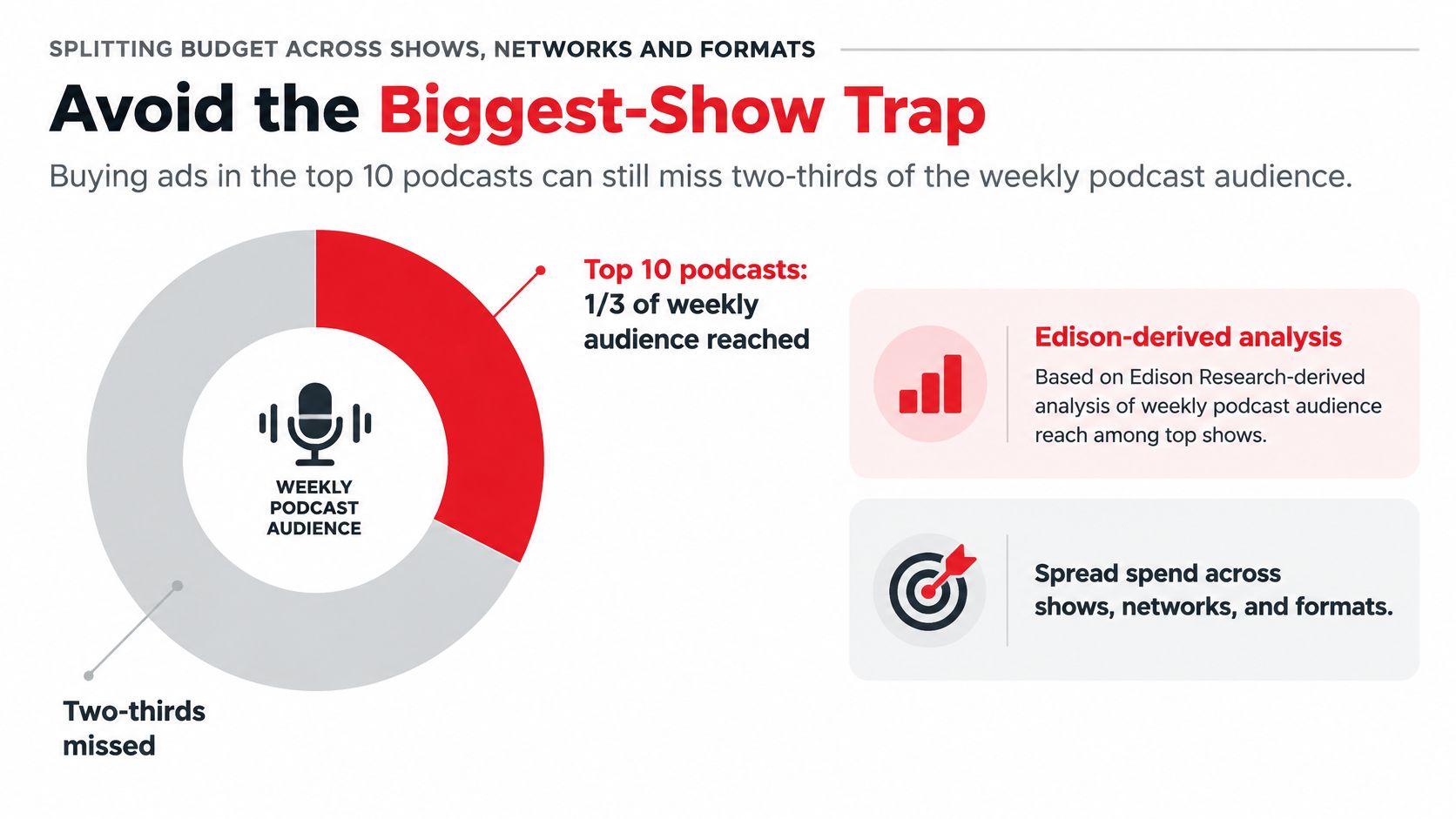
Buying the biggest shows feels defensible until you examine who the plan misses. Westwood One's Edison-derived reach analysis found that buying ads in the top 10 podcasts could still miss two-thirds of the weekly podcast audience.
That's a concentration warning, not an argument against popular shows. A premium placement can be valuable, but repeatedly buying similar listeners isn't the same as expanding reach.
Use the audience picture to challenge a fame-led shortlist.
Four-layer podcast buy portfolio
Layer | Job | How the buy works | Control |
|---|---|---|---|
Core host-read | Trust on proven shows matched to the offer | Reserve host availability ahead of launch; agree on baked-in, dynamic, or live execution, an approved brief, and unique code | Track show-level response and manage repeat exposure where controls permit |
Mid-tier shows | Incremental reach beyond famous shows | Select by episode topic and host credibility, not demographics alone | Check estimated audience overlap before approval |
Network or programmatic | Scale and frequency control when direct slots are full | Traffic approved creative across eligible publishers with documented delivery definitions | Require show or episode transparency and a bundle-level frequency cap where supported |
Video or YouTube promotion | Simulcast reach when a video version exists | Run alongside the audio flight and score completed views separately | Don't equate video views with unique audio listeners |
Start the allocation with the objective. Awareness buying needs additional relevant people; conversion buying needs a persuasive match between the offer, host, and audience. Don't force the same split onto both.
Reserve a fixed test allocation before committing the rest. Keep its comparison conditions stable so a promising placement can earn more budget through evidence rather than enthusiasm.
Buy context and account for uncertainty
Evaluate episode-level relevance alongside show-level suitability. A business podcast might cover hiring, investing, and software procurement, but only some episodes will fit your offer. Use transcripts, episode descriptions, and host editorial patterns to qualify the shortlist.
Before approval, request reach-and-frequency estimates, the included shows, substitution rights, and the scope of each cap. A network-level cap doesn't necessarily control exposure through another publisher or a separate video platform.
Where identifiers don't support reliable deduplication, label reach as estimated. Don't add publisher totals and present the sum as unique people.
Compare podcast advertising rates against inventory quality, targeting, reporting, and cancellation flexibility, not CPM alone. For commerce teams weighing podcasts against other channels, AI Optimization Services' guide to budget planning for stronger e-commerce returns provides an adjacent planning resource; keep podcast allocations accountable to the same commercial constraints.
A finished plan contains the share for each route, an expected reach band, known overlap limitations, and a stop rule. If a network won't disclose the inventory needed to assess suitability, price that uncertainty into the decision or buy elsewhere.
Writing Host-Read Creative and Testing What Works
Host-read creative deserves a test, not automatic preference. Nielsen's podcast advertising analysis, covering more than 260 surveys and 240 brands, found a 71% brand-recall rate for host-read ads. Recall is useful evidence of attention, but it isn't proof of incremental purchases.
The host needs room to sound like a person, with clear boundaries around what they can claim.

Give the host a usable brief
Include claims-approved talking points, mandatory disclosure wording, pronunciation notes, the offer, a unique tracking code, and the destination URL. Separate mandatory language from optional examples so the host knows what can change.
Use a talking-point framework rather than a dense script: listener problem, relevant benefit, credible support, and next action. Don't ask a host to imply personal product use unless it's true.
For example, a software advertiser can describe a workflow problem without having the host invent an endorsement. Pure Write's guidance on how to use logic and emotion effectively is useful when balancing an understandable benefit with a reason to believe it.
Review the recording for factual accuracy, claim boundaries, disclosure, pronunciation, and CTA clarity. Fix those issues without rewriting every transition into corporate language. Assign a final approver so publisher feedback doesn't become an open-ended committee exercise.
Make the comparison interpretable
Test a defined creative question. Compare host-read with announcer-read, placement position, shorter with longer execution, or alternative CTA structures. Keep the audience and budget conditions sufficiently stable to understand the difference.
A duration test should preserve the underlying promise and offer. If the longer read also introduces a discount and a different landing page, you won't know which change affected response.
Use this video as a separate creative-review resource.
Avoid over-scripting: Preserve the host's natural vocabulary while protecting approved claims.
Make the CTA memorable: Give listeners a clear action they can recall away from the player.
Don't change everything: Keep creative tests distinct from targeting and offer tests.
Wait for adequate exposure: Agree on the comparison window and evidence requirement before viewing early results.
A test ends when the variants have enough delivery and outcome evidence for the agreed comparison, not when someone prefers a recording. Rotate the winner into the next flight, and record whether it won on recall, response, or commercial impact.
Tracking Delivery and Proving Incremental Results
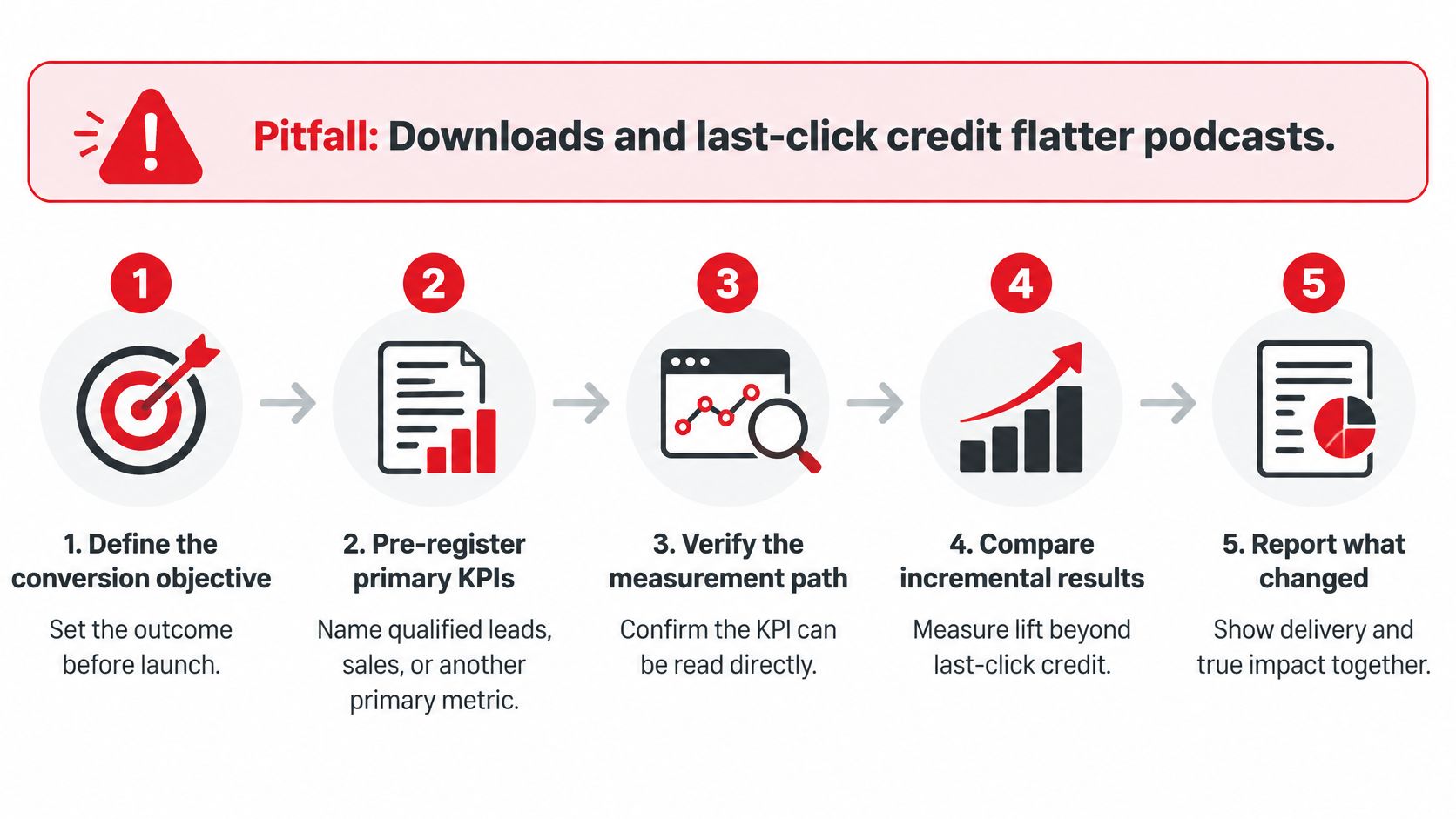
Downloads and last-click reports can make a campaign look healthier than it is. Downloads describe potential exposure; last-click attribution assigns credit according to a rule. Neither establishes how many customers you gained because the campaign ran.
Separate delivery, response, and causality. That separation lets leadership see both whether the media was supplied and whether it changed behavior.
Use this workflow to keep those questions distinct.
Establish the outcome and validate delivery
Define the conversion objective and pre-register the primary KPI before launch. Document qualification rules, exclusions, attribution windows, and the analysis date so nobody changes success after seeing results.
For delivery validation, the IAB Podcast Measurement Technical Guidelines describe a five-step server-log process: filter invalid traffic, apply file-threshold logic, identify and aggregate unique users, generate metrics, and audit through a feedback loop. For dynamically inserted advertising, the guidelines require the full ad content to be downloaded for the ad impression to count.
Have the buyer reconcile publisher reporting with the contracted definition. Flag partial transfers, unexplained delivery spikes, missing placements, and inconsistent reporting windows before approving invoice reconciliation.
Instrument response and test causality
Set up a memorable vanity URL or offer code, tagged landing pages, and pixel-based or identity-matched measurement where privacy rules and consent permit. Verify the complete journey before launch, including CRM capture and qualification status.
Then choose a causal design that fits the buying footprint. Geo holdouts need comparable markets and protection against contamination; audience splits need consistent assignment and exposure controls. Brand surveys need suitable exposed and control samples.
Measurement methods and what each proves
Method | What it proves | Blind spot |
|---|---|---|
Vanity URL or offer code | Direct response from people using the campaign destination or code | Misses listeners who search for the brand later; codes may circulate |
Tagged landing page | Visits and conversions recorded through a campaign URL | Misses journeys that bypass the tagged destination |
Pixel or identity match | Observable digital journeys associated with exposure | Coverage differs by platform, identity availability, and consent |
Exposed vs control brand survey | Estimated lift in awareness, consideration, or intent | Needs an adequate sample and comparable groups |
Geo holdout or audience split | Estimated incremental conversions against a control | Needs stable comparison conditions and enough time to read results |
For B2B, keep the observation period compatible with the sales cycle. Anonymous research, buying committees, and delayed opportunity creation mean immediate form submissions won't describe the entire contribution.
Use a podcast attribution model to organize observable touchpoints, but label modeled or attributed results separately from experimental lift. Report assisted pipeline and brand effects alongside direct response without adding them together as independent wins.
Commercial test: Compare incremental conversion rate and cost per incremental action. If estimated lift is indistinguishable from noise, report the uncertainty instead of manufacturing a precise return.
Fixing Underperforming Flights Mid-Campaign
Waiting through repeated underperformance spends money on the same unresolved problem. But reacting to every reporting fluctuation can be just as expensive: you replace interpretable tests with a sequence of unrelated changes.
Check delivery and response weekly. Judge creative after its agreed exposure window, and distinguish a broken measurement path from a weak placement before moving budget.
Mid-flight symptoms, likely causes and first actions
Symptom | Likely cause | First action |
|---|---|---|
Downloads high, site visits flat | Reach without response, or a weak CTA | Test a clearer CTA and memorable offer code |
Visits fine, conversions low | Landing page doesn't match the promise, or audience mismatch | Check page-message alignment, then review show audience |
Strong recall, no response | Brand effect without a clear response path | Add a memorable URL while retaining brand-lift measurement |
Delivery below plan | Inventory limits or bid settings | Reconcile logs and adjust the buy route or networks |
Same listeners hearing the ad repeatedly | Excess frequency across overlapping shows | Apply available caps and review duplication |
Results flat after repeated revisions | Too many variables changed at once | Freeze variables and rerun a clean comparison |
Treat these as diagnostic hypotheses, not automatic verdicts. If visits are flat, test the URL and analytics before blaming the host. If conversions fall, check form errors, stock availability, offer eligibility, and CRM routing before removing a show.
Cut a placement when delivery is valid but the primary outcome remains below the agreed floor throughout the test window. Scale when the objective-specific outcome and incremental efficiency justify it; brand lift can strengthen the case, but it shouldn't replace the commercial criterion for a conversion campaign.
Keep a record leadership can audit
Maintain a dated change log with the old setting, new setting, reason, owner, and expected effect. Don't rely on someone remembering why a placement disappeared from the next invoice.
For teams coordinating podcast and paid-social activity, NotFair's resource on how to review campaign diffs with MCP is relevant to documenting Meta-side changes. Keep those changes visible in the shared timeline without treating that tool as podcast measurement.
Leave the control cell untouched for the full agreed window. Moving budget into it, changing its offer, or exposing it through another route can undermine the comparison.
Use this compact monthly reporting format:
Primary KPI: Actual result against the approved target range and qualification definition.
Incremental efficiency: Estimated cost per incremental action against the maximum acceptable cost, including uncertainty.
Spend and delivery: Actual versus planned delivery across host-read, mid-tier, network or programmatic, and video promotion.
Changes made: Every dated adjustment, its reason, and the expected effect.
Measurement caveat: Vanity-code and last-click conversions aren't incremental conversions; summed publisher reach isn't deduplicated reach.
Keep the distinction between a response floor and a cost ceiling clear. You want more qualified outcomes than the minimum and less cost than the maximum, not a dashboard where every threshold points upward.
Change a defined variable, wait for the agreed window, then decide. A busy optimization log isn't evidence of better campaign management.
Decide Whether This Quarter Is a Test or a Delay
Approve a flight only when the brief names a primary KPI with a numeric range, the measurement specification can read that KPI, and the stop rule has a review date. If anything is missing, finish the document before booking.
Make the approval against the written plan, not a presentation summary.

Choose the operator by capacity
An in-house team fits when it can reconcile delivery, maintain the change log, and coordinate publishers alongside its other work. An outside buyer fits when insertion orders, trafficking, and delivery checks would otherwise compete for the same unavailable person.
Keep the first flight manageable: a focused show shortlist, a defined creative comparison, and a protected control. Scale placements only when they clear the primary outcome floor and remain below the acceptable cost per incremental action.
Stop or revise the brief when delivery is on plan but incremental response remains inadequate. Write those boundaries before the first invoice so the test ends with a decision rather than a debate.
At Podmuse, we offer customized podcast advertising plans covering host-read ads, programmatic placements, and in-app promotions. Our AI-Powered Podcast Media Plan delivers relevant podcasts and YouTube channels as a full media plan within 24 hours. Visit Podmuse and choose “advertise a product or service” on the contact form to discuss your audience, objective, and test requirements.
Comments