
Podcast YouTube Channel: A Brand's Guide to Growth in 2026
Your team already has a podcast. Episodes are shipping. Guests are strong. The audio feed is live on the usual platforms. Then the same question keeps coming up in meetings: do we really need a YouTube channel too?
That hesitation is reasonable. Video adds production work, editorial decisions, creative review, and another analytics surface to manage. If you treat YouTube as a place to dump full audio episodes with a static image, the skepticism is justified.
But that's the wrong frame.

A podcast YouTube channel isn't just another distribution endpoint. For brands, it's a discovery engine, a search surface, a browse surface, and a conversion layer. It can introduce your show to people who would never open a podcast app, and it can turn one episode into a system of long-form content, Shorts, clips, and topic-driven assets that support pipeline goals.
Table of Contents
Why Your Podcast Needs a YouTube Channel Now - Discovery happens differently on YouTube - The cost of waiting is creative debt
Laying the Foundation for a Brand-First Channel - Name the channel for clarity - Build visual consistency early - Write the channel page like a landing page - Structure the home page for intent
Designing Your Podcast Video Format Strategy - Choose formats by job, not by habit - What works better than static uploads - A simple format mix for most brands
Building a Scalable Production and Editing Workflow - Record for editability - Edit for retention, not for completeness - Standardize the handoff
Mastering YouTube SEO and Thumbnail Strategy - Packaging drives the first click - Descriptions and metadata still matter - Thumbnail rules for branded podcasts
A Growth Playbook for Distribution and Promotion - Build a layered discovery funnel - Promote with assets, not announcements - Use guests and partnerships strategically
Measuring Performance and Unlocking Monetization - Track behavior before vanity metrics - Connect channel performance to business outcomes - 90-day launch timeline
Why Your Podcast Needs a YouTube Channel Now
Most brands still evaluate YouTube as an added workload. The better question is whether your audience already expects to find podcast content there. At this point, the answer is yes.
A 2025 industry report says 33% of podcast consumption occurs on YouTube, ahead of Spotify at 24% and Apple at 12%, according to Sweet Fish Media's 2025 state of video podcasts report. The same report shows the platform shift clearly. YouTube ranked third for podcast destination in 2021, tied Spotify in 2022, and became the #1 preferred streaming platform in 2024.
That changes the strategic conversation. If your brand podcast only lives in audio apps, you're not just missing a video format. You're missing a major consumption environment.
Discovery happens differently on YouTube
Podcast apps mostly depend on existing intent. People search for a show they know, browse a category, or respond to a recommendation. YouTube adds another layer. People find content through search, suggested videos, homepage browse behavior, Shorts, guest-name queries, topic clusters, and adjacent viewing patterns.
That matters for demand generation teams. A buyer may never search for your brand, but they may search for the problem your guest discusses. A founder may never subscribe in Apple Podcasts, but they may click a thumbnail about a hiring challenge, pricing decision, or category trend.
Practical rule: Treat YouTube as the place where strangers meet your show, not the place where loyal listeners simply replay it.
The cost of waiting is creative debt
Teams often delay because they want a perfect studio setup first. That usually creates more friction, not less. While you're debating camera packages and motion graphics, competitors are publishing useful, well-packaged conversations that answer the same audience questions.
The shift here isn't "we need video because everyone says so." It's simpler. Your audience is already consuming podcast content on YouTube at scale, and the platform now plays a primary role in podcast preference. That makes a YouTube presence part of channel strategy, not an optional add-on.
For a brand, the strongest reason to launch isn't vanity reach. It's the ability to turn existing podcast IP into searchable, clickable, performance-oriented content built for discovery.
Laying the Foundation for a Brand-First Channel
A weak setup creates drag for months. Before you publish a single episode, make the channel look and behave like a durable brand asset.

YouTube's scale is the reason this groundwork matters. In early 2025, YouTube reached about 2.7 billion monthly active users, people watched more than 1 billion hours of content daily, and creators uploaded over 500 hours of video every minute. A separate report says there are more than 1 billion podcast users on YouTube, based on YouTube statistics compiled by Talks. On a platform that crowded, weak branding doesn't just look unpolished. It makes your show forgettable.
Name the channel for clarity
Most brands choose between three naming models:
Brand-led naming. Best when the company already has recognition and the podcast is part of a broader media strategy.
Show-led naming. Best when the podcast has a distinct identity that should stand on its own.
Hybrid naming. Useful when you need both search clarity and brand association, such as a show title paired with the company name.
Pick the option that reduces confusion in search and on the channel page. If viewers can't tell whether the channel is the company, the show, or a random side project, subscriber conversion drops.
Build visual consistency early
Your icon, banner, thumbnail system, and intro treatment should feel related, even if they aren't identical. That doesn't mean overdesigned. It means recognizable.
Use a simple thumbnail grid, two brand fonts at most, a limited color palette, and one recurring placement for the show mark or series label. If you need a fast starting point for intros without building custom motion graphics from scratch, Browse intro video templates can help your team test a cleaner opening style before you invest in a bespoke package.
A branded channel should look like a publication, not an archive folder.
Write the channel page like a landing page
There's a tendency to underwrite the description and overfocus on the banner. That's backwards. The description helps humans and the platform understand what the show covers.
Include:
Your audience. Name who the show is for in plain language.
Your themes. State the recurring topic areas, not just a slogan.
Your episode style. Interviews, solo breakdowns, panel discussions, customer stories, or executive conversations.
Your business connection. If the show supports thought leadership, category education, or product-adjacent problem solving, say so directly.
Structure the home page for intent
A branded podcast channel shouldn't present every upload as equal. Organize the page around how a new visitor thinks.
Use playlists for:
Start here episodes for newcomers.
Popular topic clusters such as AI, RevOps, fintech, leadership, or ecommerce.
Guest collections for notable operators or creators.
Shorts and clips separated from full-length episodes.
A strong channel trailer also helps. Keep it focused on who the show serves, what they'll learn, and why they should subscribe. Don't make it a generic brand sizzle reel.
If your internal team doesn't want to own all of this setup, agencies and production partners can handle it. Podmuse's podcast services include production, distribution, and channel management, which is useful when the marketing team wants YouTube to support pipeline without adding another operational burden.
Designing Your Podcast Video Format Strategy
The biggest mistake brands make is treating every episode format as interchangeable. They aren't. On YouTube, each format has a different job.

YouTube-focused podcast guidance recommends video-native episodes over untouched audio uploads, along with detailed descriptions, Shorts built from the strongest moments, and Premieres for scheduled launches. The practical benchmark isn't publishing everything. It's publishing the episodes that can become compelling video, then iterating based on retention and watch-time signals, as summarized in Captivate's guide to putting a podcast on YouTube.
Choose formats by job, not by habit
Think in three buckets.
Format | Primary job | When it fits | Main weakness |
|---|---|---|---|
Full-length video episode | Depth and authority | Strong guest, visual conversation, topic with sustained interest | Higher production and editing load |
Highlight clips | Discovery and topic entry points | Sharp opinions, memorable moments, tactical advice | Can feel contextless if clipped poorly |
Audiogram or enhanced audio video | Low-lift presence | Limited video resources, back-catalog testing | Usually weak for browse performance |
A lot of teams start with audiograms because they seem efficient. That's fine as a temporary bridge, but not as the long-term center of a podcast YouTube channel. Static image uploads rarely compete well when surrounded by active human faces, movement, and stronger packaging.
What works better than static uploads
For branded podcasts, the best-performing approach is usually selective video investment.
Record the episodes that justify video. That often means:
guest interviews with recognizable names
debates or point-of-view episodes
visually explainable topics
founder or executive conversations where face and delivery add credibility
Then build a second layer of derivative assets around those episodes. That might include short clips, chaptered highlights, quote-led excerpts, and vertical edits.
Teams exploring visual production choices can review this breakdown of visual podcast formats to decide how far they want to push the show toward a YouTube-native look.
If an episode isn't strong enough to earn a click on YouTube, uploading it anyway won't fix the problem.
A simple format mix for most brands
A sustainable mix often looks like this:
Anchor episodes Publish the strongest conversations as full-length videos. Give these the best title-thumbnails, tighter intros, and real editing attention.
Discovery clips Pull the sharpest moments into Shorts and short horizontal clips. These are top-of-funnel assets, not leftovers.
Selective back-catalog repackaging Don't migrate everything. Resurface older episodes only if the topic is still relevant and you can package them for current search or browse behavior.
Enhanced audio when needed If you need to maintain consistency during a resource crunch, use a cleaner audio-first visual with waveform, motion, subtitles, and chaptering. That's still better than a completely lifeless upload.
Premieres can also help when the episode has event energy, such as a notable guest or a timely category discussion. But don't use them on autopilot. A weak episode scheduled as an event still lands weakly.
The trade-off is straightforward. Full-length video creates authority. Clips create reach. Audiograms create coverage. Most brands need all three, but not in equal volume.
Building a Scalable Production and Editing Workflow
The teams that sustain a podcast YouTube channel don't rely on heroics. They use a repeatable workflow that reduces decisions, shortens handoffs, and makes editing easier before the recording even starts.

Record for editability
Most post-production problems start in the recording. If the host and guest are poorly framed, underlit, or recorded on unstable connections, the editor spends time repairing instead of improving.
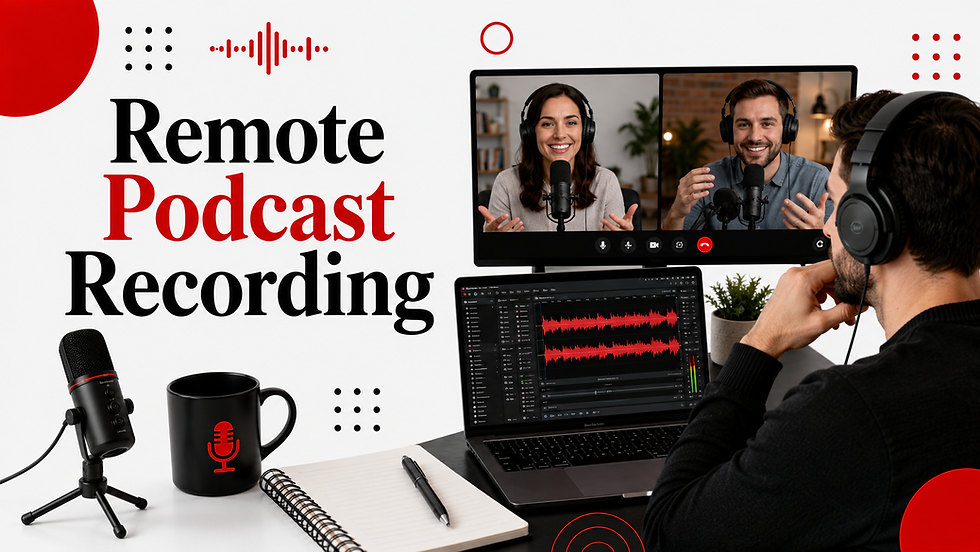
For remote recordings, standardize a few basics:
Camera framing with eyes near the upper third
Clean background with limited visual clutter
Separate audio tracks whenever the platform allows
Consistent mic choice for hosts across episodes
Pre-call checks for lighting, headphones, and browser permissions
For in-person recordings, don't overbuild if your show doesn't need it. A clean two-camera or three-camera setup is often enough. The point isn't cinematic complexity. The point is giving the editor enough visual variation to maintain pace.
If your team is still mapping how to operationalize this, discover repurposing strategies for agencies for ideas on building content workflows that turn one recording session into multiple usable assets.
Edit for retention, not for completeness
A podcast episode can work in audio and still drag on YouTube. Long pauses, throat-clearing intros, repetitive answers, and slow transitions all cost watch time.
Edit the first minute aggressively. That's where many branded shows lose momentum. The opening should tell viewers why this episode matters now, what tension or value they can expect, and why the guest is worth listening to.
A practical post-production stack often includes:
Cold open or strongest moment first
Short branded intro
Lower thirds for host and guest identification
Tighter silence and tangent trimming
Chapter markers added in the description and edit notes
On-screen callouts only when they support comprehension
For production teams comparing approaches, this guide to video podcast production gives a useful reference point for the moving parts involved.
A good editing reference is worth showing the team before you lock your style.
Keep the human rhythm. Cut the dead air. Viewers don't leave because a show is long. They leave because the pace feels expensive.
Standardize the handoff
Most branded channels break at the approval layer. Nobody knows which cut is final, who owns metadata, or when clips get exported.
Use a shared checklist for every episode:
Editorial owner signs off on the main cut and clip pull list.
Designer or video editor applies thumbnail and graphic package.
Channel manager handles title, description, chapters, cards, and upload settings.
Growth lead publishes promotional assets across email and social.
Sales or demand gen owner aligns the CTA with campaign goals when relevant.
Export specs don't need to become a debate every week. Keep the workflow simple. Render a standard 16:9 HD or higher file, use clean stereo audio, and verify captions before publish. Consistency beats tinkering.
Mastering YouTube SEO and Thumbnail Strategy
Publishing isn't the hard part. Earning the click is.
YouTube growth advice consistently points to packaging plus retention as the key driver of channel momentum. The core work is improving the title-thumbnail combination, the opening hook, and the edit pace before chasing advanced tactics. That's the central message in this YouTube creator education breakdown on growth fundamentals.
Packaging drives the first click
Most podcast teams title videos like RSS feeds. Episode number, guest name, vague topic. That format preserves internal order, but it doesn't create interest.
A YouTube title should do one of three things:
promise a clear outcome
frame a tension or strong opinion
attach the guest's authority to a specific problem
Compare these approaches:
Weak title | Stronger direction |
|---|---|
Episode 42 with Jane Doe | How B2B Teams Break Content Bottlenecks with Jane Doe |
Revenue Podcast Ep. 18 | Why Pipeline Stalls After Good Lead Volume |
Founder Interview Series | What Early-Stage Founders Get Wrong About Distribution |
The stronger version gives both viewers and YouTube more context. It says what the episode is about, who it's for, and why it's worth attention.
Descriptions and metadata still matter
Descriptions won't rescue weak creative, but they help the platform categorize the video and help viewers move through it.
Write them like short blog summaries, not boilerplate. Include the core themes, relevant terms your audience uses, guest context, and chapter timestamps. If the episode answers a real search question, say that plainly in the title and reinforce it in the description.
If your team wants a practical checklist for metadata and search-oriented packaging, boost video visibility on YouTube with a guide like this one and adapt the parts that fit your editorial standards.
Strong SEO on YouTube doesn't start with tags. It starts with knowing what your audience would actually type into the search bar.
Thumbnail rules for branded podcasts
For most branded podcast channels, the thumbnail carries more weight than the guest list.
Use these rules:
One idea per thumbnail. Don't cram in every topic discussed.
Faces help when expression supports the promise.
Text should be short and easy to read on mobile.
Contrast matters more than decorative detail.
Series consistency helps recognition, but sameness kills curiosity.
Many in-house teams overbrand thumbnails. They add full logos, taglines, gradients, and small text blocks until the image turns into a brochure. That's a mistake. The thumbnail's job is to earn a click, not to carry every brand asset.
A practical review process helps. Look at the thumbnail at small size. Ask what a cold viewer would understand in one second. If the answer is "not much," simplify it.
The same logic applies to the opening of the video. A great title and thumbnail get the click. A weak opening wastes it. Packaging and retention work as one system, not as separate tasks.
A Growth Playbook for Distribution and Promotion
A brand podcast channel doesn't grow because you posted the link on launch day. It grows when each episode feeds a broader discovery system.

A useful framing comes from treating YouTube as a podcast-discovery funnel. Edison Research reports that 31% of weekly podcast listeners use YouTube as their primary platform, and YouTube reported that Shorts exceeded 70 billion daily views globally in 2024, as highlighted in this discussion of YouTube as a podcast discovery channel. That combination tells you something important. Long-form episodes matter, but short-form packaging is often what creates first contact.
Build a layered discovery funnel
Think of the channel in layers:
Layer | Asset type | Job |
|---|---|---|
Top of funnel | Shorts, clips, excerpt graphics | Reach new viewers through browse and short-form behavior |
Mid funnel | Topic-led full episodes, chaptered replays | Convert interest into sustained watch time |
Bottom of funnel | CTAs, linked resources, newsletter prompts | Turn attention into owned audience or business action |
That structure changes how you promote. Instead of pushing one full episode everywhere, you distribute different assets based on where the viewer is in the journey.
A strong episode can produce:
A vertical Short built around one sharp claim
A horizontal clip for LinkedIn or X
A guest quote asset for newsletter placement
A chapter-based teaser that highlights sections viewers might care about
A full episode page with the clearest business CTA attached
For a deeper look at audience building systems around your show, this podcast audience growth guide is a useful operational reference.
Promote with assets, not announcements
Many creators promote by saying "new episode out now." That rarely works outside your existing audience.
Asset-based promotion works better:
Lead with a moment, not the upload
Match the creative to the platform
Give guests prebuilt clips they can share without editing
Use email to frame the episode around a problem your list already cares about
Your existing channels matter here. Newsletter, LinkedIn page, founder account, sales enablement Slack, community groups, customer marketing, and partner channels can all support distribution. But each one needs native packaging.
A clip with a strong opinion often outperforms a generic announcement because it gives the audience a reason to care before they click.
Use guests and partnerships strategically
Guests shouldn't just appear on the show. They should become distribution partners.
Give them:
a short clip with captions
a simple thumbnail or still
a suggested post angle tied to their audience
the main video link and the most relevant chapter link if needed
Partnerships can help too. Cross-promotions with adjacent newsletters, event brands, communities, or non-competing media properties often create more qualified traffic than broad social posting. The key is topical fit. A niche audience that already cares about the problem you're discussing is more valuable than a large audience with no context.
Growth on a podcast YouTube channel usually comes from repetition, not one launch spike. Build a system where every episode has a discoverability layer, a conversion layer, and a distribution plan attached before it goes live.
Measuring Performance and Unlocking Monetization
If your reporting starts and ends with views, you'll make bad decisions. A branded channel needs metrics that explain behavior and tie back to business value.
Track behavior before vanity metrics
The first metrics to watch are the ones that explain whether your packaging and content are working together.
Focus on:
Click-through rate to understand whether title and thumbnail are earning attention
Audience retention to see where viewers leave or stay engaged
Watch time to identify which topics and formats hold interest
Traffic sources to learn whether search, browse, suggested videos, or external channels are driving discovery
Subscriber movement as a signal of repeat-interest quality, not as the only success metric
This data tells you what to fix. Low click-through rate usually means packaging is weak or misaligned. Strong click-through but poor retention points to an opening problem, a pacing problem, or a mismatch between promise and delivery.
Connect channel performance to business outcomes
For brands, the next layer is conversion behavior.
That can include:
visits to a resource page linked in the description
demo or contact intent driven by an episode CTA
newsletter signups from recurring video traffic
brand lift in category visibility, measured qualitatively through inbound mentions, guest demand, and sales-call recognition
Monetization also deserves a broader definition. YouTube ads may eventually matter, but most branded podcasts generate value faster through owned offers. That might mean promoting a report, webinar, product workflow, community, event, or service line inside the video and description.
A strong podcast YouTube channel can also support sponsorship inventory if the show develops a real audience. But for most B2B teams, the more immediate win is turning YouTube into a lower-friction path from attention to consideration.
90-day launch timeline
Phase (Days) | Key Actions | Primary Role (Example) |
|---|---|---|
Days 1-15 | Define channel positioning, naming, visual system, publishing scope, success metrics | Marketing lead |
Days 16-30 | Build channel assets, upload structure, thumbnail templates, metadata process, recording SOPs | Creative lead and channel manager |
Days 31-45 | Record first batch, edit pilot episodes, cut Shorts, prepare descriptions and chaptering | Producer and editor |
Days 46-60 | Publish initial episodes, test titles and thumbnails, distribute guest assets, monitor early retention | Channel manager and growth marketer |
Days 61-75 | Review analytics, identify strongest topics, adjust intro format, refine clip selection process | Marketing lead and editor |
Days 76-90 | Expand proven formats, align CTAs to campaigns, formalize reporting cadence, plan next production cycle | Demand gen lead and content team |
A clean operating model helps. One person should own editorial quality. One should own publishing and metadata. One should own growth and distribution. If those roles blur, episodes get made but the channel doesn't improve.
The advantage of YouTube isn't that it hosts your podcast. It's that it reveals audience behavior in enough detail for you to improve packaging, topic selection, and conversion pathways over time.
If you want help building a podcast YouTube channel that supports brand awareness, audience growth, and measurable business outcomes, Podmuse can support strategy, production, distribution, and cross-platform promotion without forcing your internal team to build the workflow from scratch.


Comments