
Spotify Podcast Distribution: A Complete 2026 Guide

You're probably in one of two situations right now. Either the podcast launch is already approved and your team needs to get it live without creating a mess across Spotify, Apple Podcasts, and YouTube, or you're still in planning mode and someone keeps reducing distribution to a simple checkbox: “We'll just put it on Spotify.”
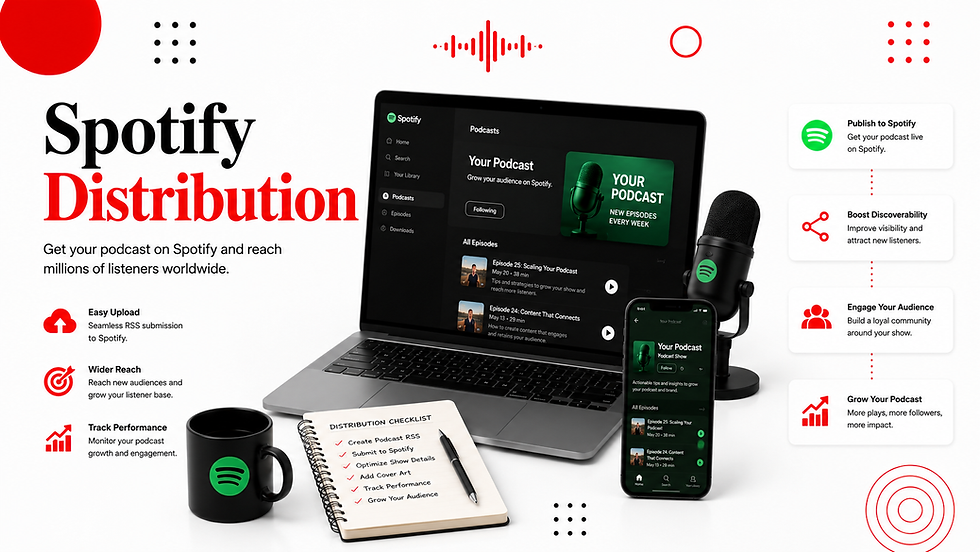
That's how brands end up with avoidable problems. The Spotify submission itself is straightforward. The hard part is building a distribution setup that won't break later, making your show discoverable once it's live, and connecting the channel to real marketing outcomes. Good Spotify podcast distribution isn't about getting a feed accepted. It's about setting up the show so it can grow, travel across platforms cleanly, and support the business case behind the podcast.
Table of Contents
Why Spotify Is a Non-Negotiable Channel for Your Podcast - Spotify combines reach with format flexibility - The platform matters because the audience composition matters - What works and what doesn't
Your Pre-Launch Distribution Checklist - Choose your host like infrastructure, not like software - Build the feed before you submit the feed
The Spotify for Podcasters Submission Process - What the actual submission flow looks like - The mistake that creates invisible distribution gaps
Activating Growth with Video and Metadata - Metadata is distribution, not admin - Why video changes the growth equation
Measuring Performance and Monetization Strategies - Which metrics matter to a brand team - How to think about monetization without distorting the show
Common Distribution Pitfalls and Best Practices - The errors that cause the most damage - The habits that keep distribution healthy
Why Spotify Is a Non-Negotiable Channel for Your Podcast
A brand manager usually asks one reasonable question before launch: which platforms matter enough to prioritize? The practical answer is that your show needs a multi-platform footprint, but Spotify sits in the center of that plan because of its scale, discovery environment, and listener behavior.
As of February 2026, Spotify hosts approximately 7 million podcast titles, including over 300,000 video podcasts, and reaches over half a billion fans globally, according to Backlinko's podcast statistics roundup. That matters for one simple reason. If you want a branded show to be available where modern audiences already consume audio and video, Spotify isn't optional.

Spotify combines reach with format flexibility
Spotify isn't just an audio endpoint anymore. It supports traditional audio shows, video podcasts, follower growth inside the app, and a listening environment where users already spend time moving between music, shows, and creator content. For brands, that creates a cleaner path from launch to ongoing audience development.
A lot of teams still treat podcast distribution as if directories are interchangeable. They're not. Some are mainly about access. Spotify is access plus discovery plus format expansion.
Practical rule: If your brand has any interest in video podcasting, audience growth inside an app ecosystem, or younger audience reach, Spotify needs to be in the first-wave launch plan.
The platform matters because the audience composition matters
In the United States, Spotify captured 37.5% of podcast listeners in January 2025, and among Gen Z listeners ages 15 to 29, Spotify is the second-most-preferred platform at 35%, based on industry stats compiled by The Podcast Host. That doesn't mean you ignore other platforms. It means Spotify gives you strong access to a large, active listener base and especially strong relevance if your brand needs younger audiences.
There's another operational advantage. Spotify's ecosystem now supports both audio-first and video-first execution without forcing a full rebuild of your show strategy. That's useful for teams that want to start with audio, validate the format, and later expand into video clips or full episode video.
What works and what doesn't
Here's what tends to work well on Spotify podcast distribution for brands:
Consistent publishing: Brands that release on a clear schedule give the platform better signals and give listeners a reason to follow.
Strong packaging: Clear show positioning, recognizable cover art, and episode titles built for scanning help more than clever branding language.
Cross-format thinking: Teams that plan for audio, video, clips, and social derivatives from the start usually avoid expensive rework later.
What doesn't work is treating Spotify as a passive archive. Uploading episodes and waiting for the algorithm to care rarely produces useful momentum. The platform rewards clean setup, strong metadata, and deliberate promotion.
Your Pre-Launch Distribution Checklist
Most Spotify podcast distribution problems start before the first submission. The issue usually isn't Spotify. It's weak infrastructure, rushed asset prep, or a feed that was built without any thought for how it will behave across platforms.
Choose your host like infrastructure, not like software
Your media host is the foundation of the show. It controls the RSS feed, stores your episodes, and becomes the system every major platform reads from. If you choose a host because the dashboard looks nice but ignore feed control, analytics quality, and migration support, you're making a branding decision where you should be making an infrastructure decision.
Before you commit to a host, check for these basics:
RSS control: You need direct access to your feed, not a setup that obscures or limits it.
Episode-level metadata controls: Titles, descriptions, categories, author fields, and artwork should be editable without workarounds.
Migration support: Sooner or later, some brands change hosts. Redirect support matters because your subscribers and listings depend on it.
Operational clarity: Your production team should know who owns publishing rights, login credentials, and feed-level settings.
If your internal team doesn't already use a launch checklist, build one before anything goes live. This podcast launch checklist is a useful reference for making sure the operational details don't get missed.
Build the feed before you submit the feed
A surprising number of brands try to submit an unfinished show. They have cover art in draft form, trailer audio that still needs edits, and episode descriptions written like internal notes. That creates unnecessary rejections, messy listings, and weak first impressions.
Your pre-launch package should include:
Asset | What to finalize before submission | Why it matters |
|---|---|---|
Show title | Clear, searchable, stable naming | Changing titles later can confuse listeners and platforms |
Show description | Concise positioning with audience and topic clarity | Helps conversion when someone lands on the show page |
Episode 0 or trailer | A short introduction to the show and what listeners should expect | Gives the feed a live item and helps the listing feel complete |
Cover art | Final branded artwork that remains readable at small size | Spotify surfaces shows in compact visual spaces |
Categories and language | Accurate classification | Mislabeling weakens discoverability and relevance |
Launch the feed only when the brand, editorial, and production sides all sign off on the same version. A technically live podcast with unfinished positioning is still a bad launch.
Audio quality also matters, but not because listeners obsess over technical specs. They notice clarity, consistency, and whether the show sounds intentionally produced. Use clean masters, keep leveling consistent across episodes, and make sure intros, ads, and interviews don't feel stitched together from different rooms and workflows.
One more operational point gets overlooked all the time. Decide in advance whether the show is a branded content asset, a founder-led thought leadership show, or a campaign-linked series. That decision affects your naming, art direction, guest strategy, and metadata language. If you blur all three, the feed often feels unfocused before it ever reaches Spotify.
The Spotify for Podcasters Submission Process
The actual Spotify submission is the easy part. If your host is set up correctly and your RSS feed is ready, the process is mostly administrative. The danger is assuming that because it feels simple, the wider distribution strategy is also handled.
What the actual submission flow looks like
The typical flow inside Spotify for Creators or Spotify for Podcasters looks like this:
Log in or create an account using the team-owned email that should control the show.
Paste in your RSS feed URL from your media host.
Verify ownership through the email associated with the feed.
Review show details such as category, language, and publisher information before submitting.
That's the core flow typically followed when listing a new show.

If you want a visual walkthrough of the interface, this short video is useful:
After submission, your team should manually verify the live listing in the app, check the artwork, confirm episode order, and review how titles appear on mobile.
The mistake that creates invisible distribution gaps
The biggest misconception in Spotify podcast distribution is believing that listing on Spotify automatically distributes the show everywhere else. It doesn't. Spotify's own support documentation explains that creators must submit their show's RSS feed to other services individually, including platforms like Apple Podcasts, via their own submission processes, as outlined in Spotify's guide to distributing your show to other platforms.
That sounds minor, but it creates a serious gap for brands. A team submits to Spotify, sees the show live, assumes the job is done, and only later discovers that Apple Podcasts, YouTube, or other listening environments were never properly activated.
Being on Spotify is not the same thing as being distributed well. One accepted feed does not equal a multi-platform launch.
This is where expert operations matter. Your team needs a distribution map, not a single submission task. At minimum, that means:
Track every destination separately: Spotify, Apple Podcasts, YouTube, and any other priority endpoint need their own status.
Assign ownership: One person should own credential storage, submission records, and verification checks.
Document the canonical feed: Everyone on the team should know which RSS feed is the source of truth.
Keep platform metadata aligned: Small inconsistencies across submissions create unnecessary confusion later.
What works is a controlled rollout where each listing is checked and logged. What doesn't work is treating RSS as magic and assuming the ecosystem will sort itself out.
Activating Growth with Video and Metadata
A live listing gives you existence. It doesn't give you discovery. Once the show is published, the job shifts from setup to signal quality. Spotify has to understand what your show is, who it's for, and where it belongs inside the platform.

Metadata is distribution, not admin
Most brand teams treat metadata as cleanup work done right before publishing. That's backwards. Metadata is one of the main ways you help Spotify classify your show and connect it to the right listeners.
Spotify's internal research found that underserved or less-streamed podcasts are highly likely to grow if their content and metadata are optimized for Spotify's Knowledge Graphs, which match shows with listeners who have similar tastes, according to Spotify Research on how less-streamed podcasts can reach their potential. That finding matters because it shifts the growth conversation. Smaller shows aren't locked out by default. They need cleaner signals.
For brand podcasts, the biggest metadata errors are predictable:
Vague show titles: Clever names with no topical context are hard to classify and harder to search.
Thin episode descriptions: If every description reads like generic promo copy, the platform gets less usable information.
Inconsistent episode naming: If one week is a keyword-led title and the next week is an inside joke, your packaging becomes noisy.
Missing guest and topic entities: Strong descriptions should name the person, company, theme, and problem being discussed when relevant.
If your team also publishes clips and derivative content, this social media metadata guide is useful because it reinforces the same core principle across channels: structured information improves discoverability and packaging.
Why video changes the growth equation
Spotify now hosts a substantial video podcast library, which changes how brands should think about format planning. Video isn't mandatory, but it creates more assets, more surfaces for engagement, and a clearer path into clip-based promotion. For many branded shows, video also improves internal adoption because sales, social, and leadership teams can reuse it more easily than audio alone.
If you're evaluating whether to add video, focus on operational questions first:
Decision area | Better approach | Risky approach |
|---|---|---|
Recording setup | Design a repeatable camera and lighting workflow | Treat video as an occasional add-on |
Episode format | Use formats that still work as audio-only | Depend on visuals that audio listeners can't follow |
Post-production | Plan clip extraction during edit | Finish the episode, then scramble for social cutdowns |
Brand usage | Reuse clips across paid and organic channels | Let full episodes sit unused after upload |
A detailed operational overview of video podcasts on Spotify can help if your team is deciding how to structure the workflow.
If you want discovery help from the platform, feed it clean titles, useful descriptions, coherent topics, and a format it can confidently recommend.
What usually works is boringly consistent. Clear titles. Detailed descriptions. Repeatable visual framing. Polls, Q&A, and in-app engagement features used with purpose instead of as filler. Growth often follows when the inputs stop being sloppy.
Measuring Performance and Monetization Strategies
A lot of brand podcasts get approved, published, and promoted, then stall at the first quarterly review. The problem usually is not distribution. It is weak reporting. If the team cannot show what Spotify is contributing, the show gets treated like a nice content experiment instead of a channel with a job to do.
Spotify performance should be measured in two layers at the same time. First, track what is happening inside the platform. Second, connect those signals to outcomes the business already funds, such as pipeline support, account penetration, executive visibility, customer education, or campaign efficiency. Getting on Spotify is easy. Proving that the Spotify presence is working, alongside Apple Podcasts and every other listening surface, is where brand teams either build support or lose it.

Which metrics matter to a brand team
Inside Spotify analytics, four categories matter more than the rest:
Reach signals: Unique listeners, episode starts, and follower growth show whether your distribution and promotion plan is bringing people in.
Consumption signals: Streams, completion patterns, and drop-off points show whether the topic, host structure, and runtime are holding attention.
Audience fit: Demographic trends, geography, and device behavior help verify whether the show is reaching the market you intended to reach.
Episode patterns: Compare high-performing episodes against weaker ones. Guest profile, topic framing, title clarity, publish day, and length often explain more than teams expect.
Reporting gets sharper when each metric answers a business question. If follower growth is up, ask whether branded search, direct traffic, or owned promotion caused it. If retention is poor, ask whether the episode opened too slowly or promised the wrong thing in the title. If one guest episode outperformed the rest, determine whether the guest brought audience, the topic had stronger demand, or the packaging was clearly better.
That is also why Spotify should not be treated as a stand-alone scorecard. A brand needs a cross-platform reporting view, because the same show is usually being consumed across multiple apps with separate submission systems, separate dashboards, and different strengths in discovery and engagement. A practical framework for building that view is this guide to podcast data analytics and reporting models.
One warning from practice. Do not let a dashboard turn into a vanity screen. Downloads, followers, and starts matter, but they are not enough on their own. The reporting model has to show whether the show is helping sales conversations, improving campaign efficiency, extending the life of executive IP, or attracting the right audience segments.
How to think about monetization without distorting the show
Monetization decisions fail when teams ask the wrong question too early. They ask, "How do we make money from this podcast?" before they have established audience fit, publishing consistency, and a clear role in the broader marketing mix.
For some publishers, monetization means ad revenue or subscriptions. For a brand, the first return is often indirect but more valuable. A strong show can support demand generation, improve nurture content, give sales teams better follow-up assets, and create reusable media across email, social, paid, and events. That is monetization in operational terms, even if no external advertiser is involved.
There are three common paths:
Platform-native monetization Spotify offers ad and subscription options in parts of its ecosystem. These only make sense if the audience is established and the listening experience can absorb them without hurting retention.
Owned-media return Many branded podcasts perform better as strategic media assets than as direct revenue products. If the show helps move prospects, retain customers, or strengthen category authority, that return often outweighs modest ad income.
Paid media feedback loop Show performance can inform broader podcast advertising decisions. If specific topics, hosts, or audience segments perform well on your owned show, use that insight to shape host-read partnerships or programmatic audio buys elsewhere.
The trade-off is simple. Early monetization can reduce listener trust if the show has not earned enough loyalty to carry ads, gated content, or aggressive sponsorship messages. I usually advise brands to get the format working first, then test monetization against audience behavior, not internal pressure.
Strong monetization starts with repeatable audience value and disciplined measurement. A weak show with rushed revenue tactics usually creates two problems at once. Listener experience gets worse, and the business still does not get the return it wanted.
Common Distribution Pitfalls and Best Practices
The brands that struggle with Spotify podcast distribution usually don't fail because they skipped one big step. They fail through a string of small operational mistakes that compound over time.
The errors that cause the most damage
One common problem is changing hosts or feeds without a proper redirect plan. That can break continuity across platforms and create confusion around which listing is current. Another is inconsistent metadata. Teams rename the show in one place, shorten titles in another, and update descriptions only on their host. The result is a fragmented footprint that weakens search, discovery, and reporting.
Promotion is another weak point. Many teams launch the feed and assume distribution itself will create attention. It won't. A show needs coordinated promotion through email, social, internal stakeholders, guests, and paid support where relevant. If you don't plan activation, the first episodes often underperform because nobody was sent to them.
The habits that keep distribution healthy
The best distribution systems are disciplined and unglamorous. They rely on repeatable publishing operations, centralized ownership of credentials, and a standard publishing checklist used every single time.
Keep these practices in place:
Protect the feed: Treat your RSS feed like core infrastructure. Limit access and document any changes before they happen.
Standardize metadata rules: Create clear internal rules for show titles, episode titles, descriptions, guest naming, and category usage.
Audit listings regularly: Check how the show appears across Spotify and other platforms after launches, rebrands, and seasonal changes.
Publish with promotion attached: Every episode should have a distribution plan, not just a publish date.
Review performance patterns: Adjust packaging and format based on listener behavior, not internal preference alone.
The winning mindset is simple. Launching the show is not the finish line. Maintaining a clean, discoverable, multi-platform presence is the job.
If your team wants help turning Spotify podcast distribution into a real growth channel, Podmuse can support the strategy, production, distribution, and promotion work needed to launch cleanly and scale with purpose.
Comments